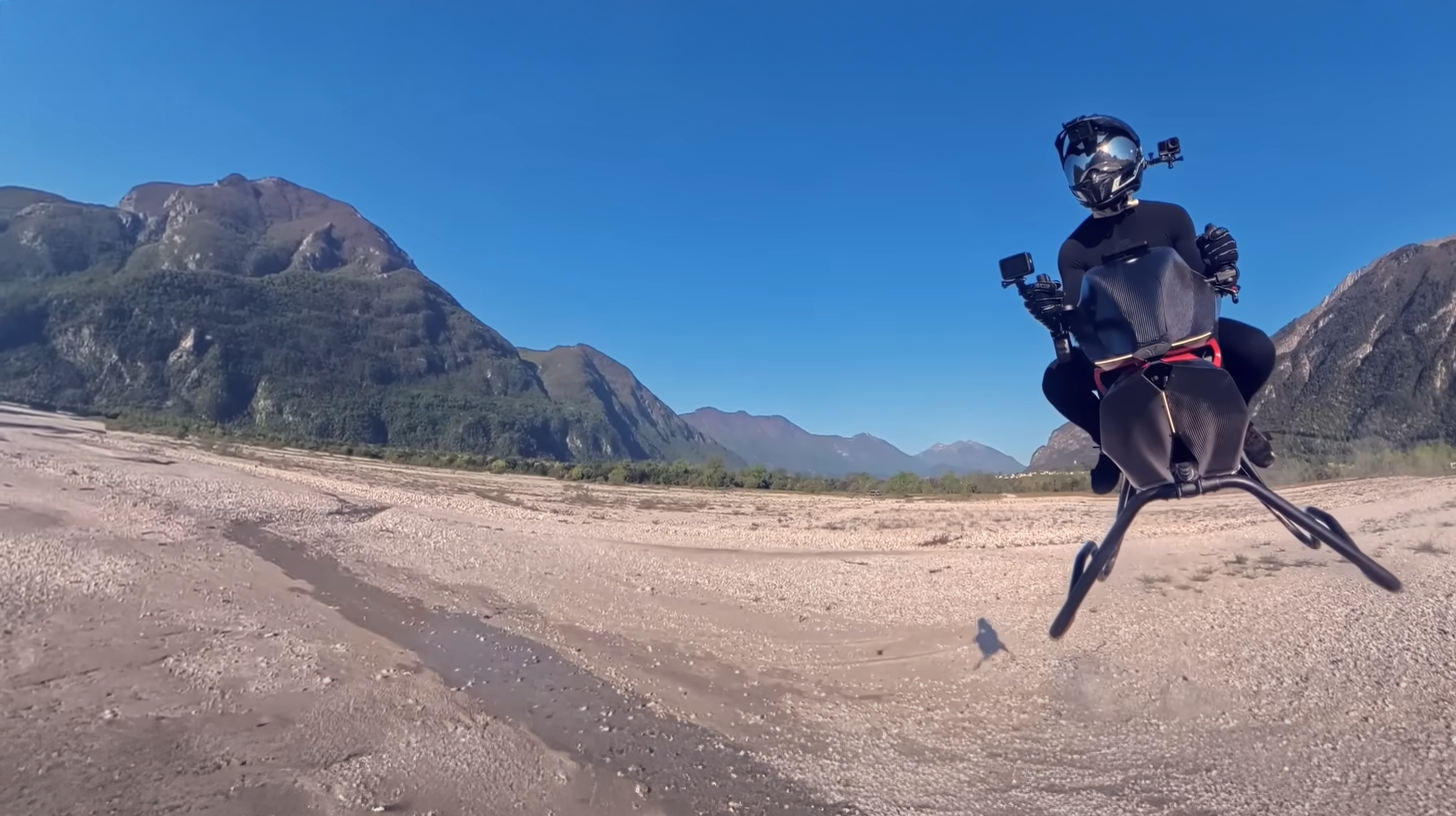
Flying motorcycles between vision and reality – The Airkbike from Volonaut and its competitors – Video image screenshot: Volonaut
Urban Air Mobility: How flying motorcycles could change traffic
Why are flying motorcycles being discussed right now?
Flying motorcycles are an extreme version of the urban air mobility concept that engineers and investors have been exploring for years. Lightweight structural materials, compact engine design, powerful flight computers, and simplified certification classes for ultralight aircraft are creating, for the first time, a technical and regulatory environment in which individuals could buy, fly, and insure such a device. At the same time, media attention is driving demand for spectacular prototypes.
What is the story of the developer of the Volonaut Airbike?
Tomasz Patan, an engineer from Poland, became known for the electrically powered eVTOL ultralight aircraft Jetson One, which has been in series production since 2025. Patan previously worked in the helicopter and drone sector and promotes his approach of simplifying aircraft so that "anyone can be a pilot.".
What makes the Airbike structurally different from classic eVTOL drones?
- Propulsion: A steerable mini gas turbine generates thrust, while most eVTOLs rely on distributed electric motors.
- Weight: According to the manufacturer, the frame, which is made entirely of 3D-printed carbon fiber, weighs only 30 kg.
- Aerodynamics: No wings, no freely rotating rotors; lift is generated solely by turbine thrust and software-controlled vector nozzles.
- Cockpit: Completely open; flight information is to be projected into the helmet.
- Control: A flight computer stabilizes attitude and yaw, similar to a camera drone.
How fast, how far and how high can the Airbike fly?
The prototype Airbike reaches a top speed of 190 km/h, while the planned production model is limited to 102 km/h to comply with ultralight aircraft regulations. Flight time is up to 10 minutes, depending on pilot weight, and remains unchanged in the production model. The maximum pilot weight is 95 kg. The Airbike uses VTOL (vertical takeoff and landing) for takeoff and landing; the prototype takes off until ground contact, and the production model will also use VTOL.
The range remains below 20 km and depends heavily on power demand and thrust reserve.
Does the pilot need to have a pilot's license?
In the US, according to the manufacturer, the Airbike falls under FAR Part 103 for ultralights; there, a briefing is sufficient. In Europe, at least a national sport pilot license for ultralight vertical takeoff and landing aircraft would be required. The German LTF-UL (Light Aircraft Training and Regulations for Ultralights) permits single-seaters with a maximum takeoff weight of 600 kg and a continuous power output of 120 kW. The Airbike easily meets the weight requirements, but the noise emission standards and the requirement for emergency safety equipment remain unclear.
Which fuels are suitable and what are their environmental impacts?
The turbine accepts Jet-A-1, kerosene, diesel, or biodiesel. While Sustainable Aviation Fuel can reduce emissions by up to 80%, the engine remains noisy and produces high emissions compared to electric eVTOLs. However, the short flight time also means relatively low overall emissions per flight, as long as the aircraft is not operated continuously.
What safety reserves exist in the event of engine or software failure?
- No autorotation or gliding flight mode: In the event of turbine failure, the Airbike descends unbraked.
- No emergency parachutes like the one Jetson One possesses are known to exist.
- Flight time buffer: Only a few minutes reserve in case of headwinds or a failed approach.
- Stress test data is not publicly available; no published patents exist.
Why is a price of US$880,000 being asked on the market despite the risks?
- Handcrafted carbon structures, 3D printed in small series.
- Airworthy mini-turbines from the model jet sector cost five- to six-figure sums each.
- Certification tests, insurance and manufacturer's liability increase the cost of each individual item.
What competing models are there and how do they compare?
There are several competing models that differ in concept, propulsion, speed, flight time, price, and stage of development. The Volonaut Airbike is a single-seater with a VTOL turbine and a jet engine, reaching a speed of 102 km/h, flying for up to 10 minutes, and costing $880,000; it is available for pre-order for 2026. The JetPack Aviation Speeder has four to eight jet turbines, reaches speeds of up to 240 km/h, and has a flight time of between 10 and 22 minutes at a price of $380,000; it is currently at the P2 prototype stage. The Aerwins XTurismo uses two propeller rotors and four stabilizers, is powered by a hybrid Kawasaki ICE engine and an electric motor, reaches speeds of 100 km/h, flies for up to 40 minutes, costs $777,000, and is being produced in small series in Japan. Aerofex's Aero-X has a double-jacketed rotor, is powered by a piston-driven internal combustion engine, flies at 72 km/h for up to 75 minutes, and costs $85,000; the model has been announced but not yet launched. The Jetson One has eight electric-driven propellers, reaches 102 km/h, has a flight time of 20 minutes, costs $98,000, and is scheduled for series production starting in 2024.
What technical hurdles caused previous projects to fail?
- Vibrations and uncontrolled resonances in mantle rotors (Aerofex).
- Noise levels exceeding 120 dB for jet turbines (speeders).
- Battery weight versus range in electric hoverbikes like the Lazareth LMV 496.
- Inadequate flight control software for stable hovering (military hoverbike programs).
- Lack of business models for maintenance, spare parts and pilot training.
How realistic is mass production by 2026?
Volonaut has not disclosed its suppliers or production capacity. Comparable eVTOL startups often require five to seven years from first flight to certification. The Jetson One line produces 300 units per year, but with significantly simpler technology. The following components are still lacking for a turbine-powered airbike:
- vibroacoustic approval according to ICAO Annex 16
- an approved rescue system
- detailed maintenance manuals
- transparent financing.
What legal obstacles might arise in European airspace?
- Airworthiness certificate: The German Federal Aviation Office requires component verification, noise and emission data.
- Emergency rescue system requirement: In Germany, single-seat ultralight aircraft must have a complete emergency rescue system unless an exception is granted.
- Flight restriction zones over cities: Many metropolitan areas are planning U-Space corridors for drones, where jet turbines might be undesirable due to noise.
- Insurance obligation: Liability coverage for turbine-powered devices is significantly higher than for powered paragliders; rates are still unclear.
How do potential buyers react to the niche product?
Initial reservation lists are targeting affluent enthusiasts in the US and the Middle East. The market is reminiscent of the early days of home helicopter kits, when just a few hundred units were enough to make a manufacturer profitable.
However, the combination of high price, short flight time, and noise pollution limits its use to show events, desert resorts, or private property.
Which use cases are frequently mentioned – and do they stand up to scrutiny?
Frequently cited use cases for drones are examined for their plausibility. Their use in urban commuter traffic is considered very low due to noise, a limited range of ten minutes, and a lack of suitable launching areas. For extreme sports and leisure activities, their plausibility is moderate, as the spectacle factor is high, but available weather windows are limited. Military supply drones are considered impractical because the payload is too small and the devices are unprotected. Their use for rapid deployment in emergency services is considered very low due to a lack of redundancy and the absence of certification for night-time IFR flights. For luxury off-road tourism, their plausibility is moderate, as their use is permitted on private property and sandy deserts reduce noise complaints.
What open questions remain from a regulatory perspective?
- How is the exhaust emission limit according to LTF-UL S 113 interpreted for turbine ultralights?
- Can the German Air Navigation Service safely integrate the device in airspace E and G at 102 km/h without a transponder?
- Is there a need for Europe-wide harmonization of new UL helicopter categories that cover VTOL jets?
- What training hours does the legislator require if an auto-hover mode exists, but manual throttle management is necessary in an emergency?
How do specialist portals and aviation magazines assess the chances of success?
They emphasize the engineering achievement but express doubts about patents, funding, and concrete test data. Experts point out that despite numerous PR videos, no independent observer has yet seen a complete flight, thrust, or noise log.
What do the Airbike projects mean for the broader urban air mobility debate?
Flying motorcycles are test laboratories for:
- Lightweight fiber composite structures for VTOL applications
- Turbine hybrid concepts, until energy storage becomes lighter
- Automated stabilization, which also benefits large air taxis
- At the same time, the devices illustrate that acoustics, crash consequences and proof of airworthiness remain unresolved UAM problems.
Will the personal jet bike really arrive in 2026?
Technically feasible, financially elitist, and regulatory complex: The Volonaut Airbike illustrates both the leap forward in mini-turbines and lightweight carbon construction and the gap between prototype and everyday mobility.
Without robust rescue systems, certification timelines, and cost reduction, the Airbike will remain a spectacular but fringe sports and showpiece. The future of urban air mobility therefore depends less on sensational one-offs than on quiet, efficient eVTOL fleets that reconcile public acceptance, infrastructure, and regulatory approval.
Your global marketing and business development partner
☑️ Our business language is English or German
☑️ NEW: Correspondence in your native language!

Konrad Wolfenstein
I and my team are happy to be available to you as your personal advisor.
You can contact me by filling out the contact form here wolfenstein@xpert.digital:or simply call me at +49 7348 4088 965. My email address is
I'm looking forward to our joint project.