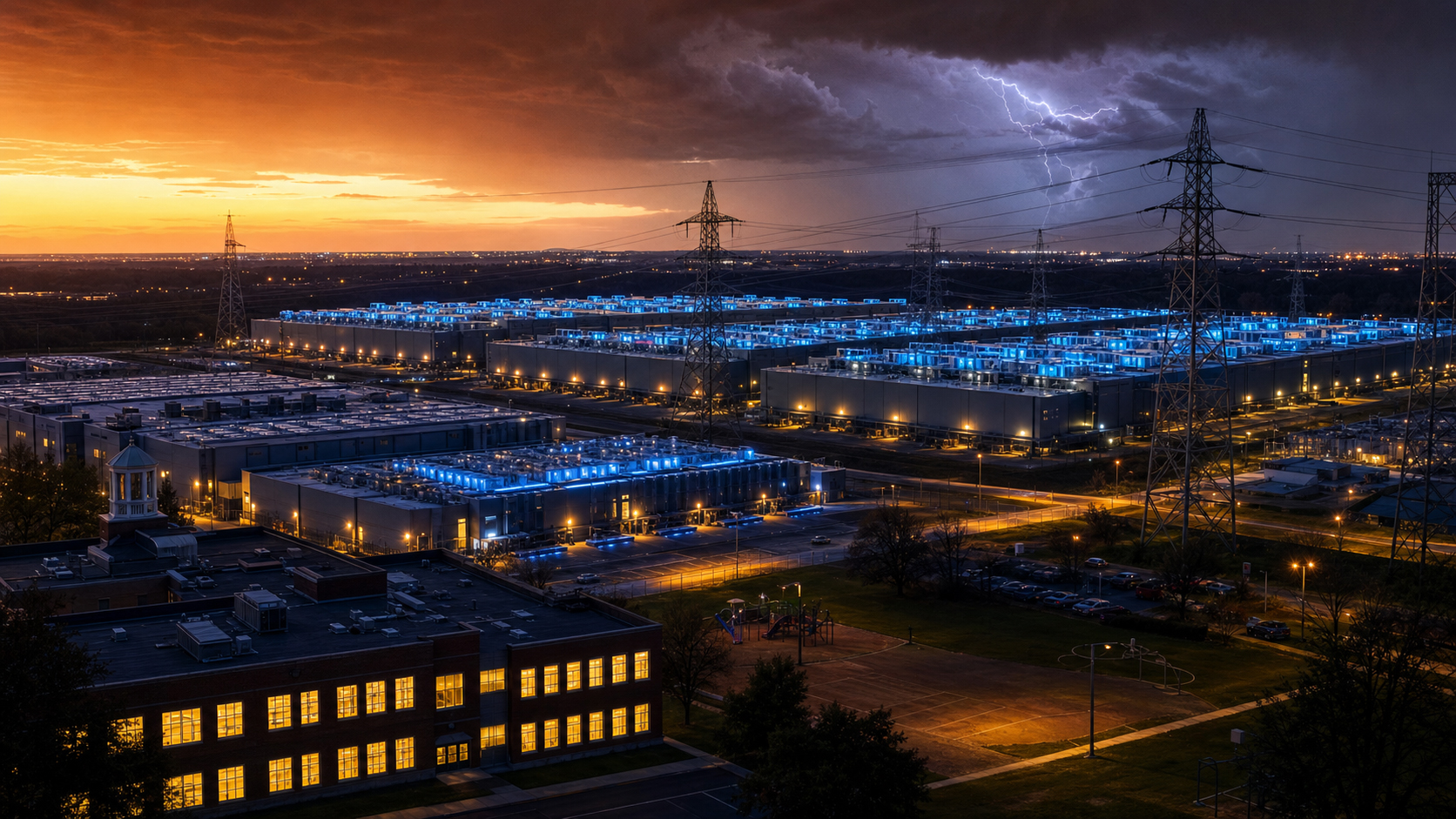
When digital hunger turns off the lights: How data centers are pushing Virginia's energy supply to the brink – Creative image: Xpert.Digital
Lights out for AI: Why schools need to save electricity so that servers from Meta and others can run
The price of the AI boom: How data centers are plunging an entire US region into an electricity crisis
Exploding electricity prices: What the data center mecca of Virginia tells us about the future of AI
Virginia is the undisputed global epicenter of the digital age—nowhere else are there so many data centers concentrated. But the unprecedented boom, massively fueled by the insatiable energy demands of artificial intelligence, is now taking a drastic toll. In Henrico County, a US county that once welcomed tech giants with tax breaks and open arms, schools and government offices are now forced to ration electricity. The reason: skyrocketing electricity prices. The case reveals a disturbing, systemic market failure. While the tech industry reaps enormous profits, the massive infrastructure costs for the necessary grid expansion are being passed on to the general public. From drastically rising wholesale prices and the threat of power outages to massive health risks for the local population, Virginia vividly demonstrates what happens when the physical limits of energy supply collide with the boundless expansion of the tech industry. A cautionary tale of a future that could also await the rest of the world.
Related to this:


The silent electricity theft – why the AI boom is draining public coffers before it has improved anyone's life
One district gives up: Schools are supposed to save money so that servers can run
It sounds like a parable from a dystopian novel: An American county, which for years proudly marketed itself as a pioneer of the digital economy, is sending its teachers and administrative staff an email asking them to turn off the lights in the evenings. Not because thrift is a virtue, but simply because electricity has become too expensive. Henrico County in the US state of Virginia has experienced a 24.9 percent increase in electricity prices since July 1, 2026, which is costing the public budget an additional five million US dollars per year. County Manager John Vithoulkas listed specific measures in his email of June 26: shut down computers, unplug chargers, adjust blinds, and refrain from using electric heaters. A single space heater costs the county up to 300 US dollars per year. The official interpretation of the circular is remarkable: it's not just about saving money, it reflects an "environmentally conscious pioneering spirit." The reality behind it is less romantic.
Henrico County is not a victim of its own backwardness. Quite the opposite: The county actively courted data centers, implemented expedited permitting processes, provided affordable land in the White Oak Technology Park, and offered tax incentives. Thirty-seven of these facilities are now operational, including a massive Meta campus spanning over 350 acres with 2.5 million square feet of usable space. At least 17 more projects are in the pipeline. Henrico did what economic development textbooks recommend—and is now paying a price no textbook predicted. The public infrastructure that paved the way for private investment is bearing the cost of its own success.
Virginia's special role: World capital of digital infrastructure
To understand Henrico County, one must understand Virginia. The state is the undisputed world leader in the concentration of data centers. Northern Virginia alone, the region around Fairfax and Loudoun Counties, is estimated to house over 500 data centers and, according to some sources, handles up to 70 percent of global internet traffic. Henrico County and the White Oak Technology Park are an emerging satellite of this ecosystem, attractive due to more affordable land prices, high-speed fiber optic connections with direct access to transatlantic submarine cables like MAREA, BRUSA, and Dunant, as well as two 230-kilovolt transmission lines from Dominion Energy. The result of this geography: Virginia is now not only a technological but also an energy policy laboratory for the entire United States.
The location's appeal has solid economic reasons. Virginia offers one of the most comprehensive tax exemption frameworks for data centers in the US: Operators who invest at least $150 million and create 50 jobs are exempt from the state sales and use tax on server hardware and software. This regulation cost Virginia an estimated $1.9 billion in lost revenue in the 2025 fiscal year, according to the Senate. Proponents counter that the industry has generated more than $2.1 billion in tax revenue over the past two fiscal years and created tens of thousands of well-paying jobs. According to a state study, Virginia grants the equivalent of $6.10 in labor income for every dollar of tax exemption – the second-best value of all state economic stimulus programs. This argument is at the heart of a fierce political dispute that nearly plunged Virginia into a budget crisis in the spring of 2026.
Structural pricing: How wholesale markets become unbalanced
The price increase Henrico County is experiencing is not a local phenomenon, but rather an expression of a fundamental market failure at the level of the largest electricity grid in the US. PJM Interconnection, the grid that supplies electricity to 13 states and Washington, D.C., serving approximately 67 million people, is experiencing a structural imbalance. Monitoring Analytics, PJM's independent market observer, reported that wholesale electricity prices in the first quarter of 2026 rose from $77.78 per megawatt-hour in the same period of the previous year to $136.53—an increase of 75.5 percent. The market observer was unusually direct: the growth of data centers is the primary driver of this development, and the price consequences are "significant and irreversible.".
Capacity markets, where power plant operators auction their willingness to supply electricity, have experienced even more dramatic fluctuations. The capacity price has increased tenfold in just two years, from $28.92 per megawatt-day in 2024/2025 to $329.17 for 2026/2027. At the same time, PJM has registered a system-wide supply gap for the first time in its history: Approximately 6,523 megawatts of secured capacity are lacking for the 2027/2028 delivery year. Monitoring Analytics quantified that the additional costs for consumers due to data center loads in the capacity market alone amounted to around $9.3 billion in 2025/2026. From June 2026 onward, this figure will increase by an additional $1.4 billion per year.
For Henrico County, this means that its electricity will be procured through the Virginia Energy Purchasing Governmental Association (VEPGA), which pools electricity for local governments, school districts, cities, and public institutions within Dominion Energy's service area. The new contract negotiated by VEPGA directly reflects wholesale price developments: an initial increase of 24.9 percent starting July 1, 2026, followed by a further increase of at least 12 percent in July 2027. The public sector, which has no way to shift or hedge its electricity demand, bears the full market risk.
Between January and May 2026: When statistics become budget problems
The figures from the VEPGA contract are reflected in the latest wholesale data. According to Monitoring Analytics, wholesale electricity prices in the data center network area rose by 62.7 percent year-over-year between January and May 2026. Over 74 percent of this increase was directly attributable to data center electricity demand. Specifically, this means that this demand alone drove up wholesale electricity prices by $11.26 per megawatt-hour in the first five months of 2026. Cumulatively, PJM's total network operating costs rose to $40 billion in the first five months of 2026 – an increase of 68 percent compared to $23.8 billion in the same period of the previous year. Of this, $3.8 billion was directly attributable to the additional costs caused by data centers.
For the fiscal policies of public bodies, these abstract market variables are of immediate relevance. School districts, municipalities, and state agencies cannot simply pass on their energy costs through price increases—they must either find other ways to save money or propose politically difficult-to-justify tax increases. In Henrico County, this initially means appealing to everyone's instincts: turn off the lights, shut down computers, and put away space heaters. Whether these measures will actually yield the projected savings of $150 to $300 per person is questionable—the goal is as symbolically significant as it is numerically important. It raises awareness within an administration that suddenly realizes its power grid is no longer a given.
In July 2026, a heat wave over the PJM area further exacerbated the situation, triggering another stress test. Reuters reported in early July that PJM had to activate additional fossil fuel reserve power plants to prevent outages while dealing with a heat dome. Wholesale electricity prices in Northern Virginia temporarily rose to over $2,000 per megawatt-hour during this period. The height of summer could thus once again push Henrico County into an unplanned additional burden, one not accounted for in the current budget.
The opposing view of industry: Scapegoat or structural problem?
It would be incomplete to conduct the analysis without considering the perspective of the data centers themselves. Nicole Riley, Virginia government relations director for the Data Center Coalition, has clearly stated the industry's position: The sector pays for every kilowatt consumed, and bipartisan studies consistently conclude that data centers do not drive up energy prices. The Lawrence Berkeley National Laboratory and JLARC share this assessment. In fact, the relationship between data center expansion and electricity prices is methodologically more complex than a simple statement of causality suggests.
Data centers do pay for the electricity they consume—that's correct. However, the problem isn't the energy consumption itself, but rather the infrastructure investment required for this usage. Dominion Energy has to invest significantly in developing new areas, building new substations, upgrading transmission lines, and acquiring reserve capacity. Under current Virginia regulations, the costs of this infrastructure are initially passed on to all customers until specific safeguards take effect. Dominion spokesperson Aisha Khan herself acknowledged that while future tariffs for large consumers will provide for a greater share of these costs, this will not retroactively offset the increases implemented in 2026.
References to studies that fail to demonstrate a price-driving effect primarily pertain to older analysis periods when data center growth rates were still moderate. What Monitoring Analytics documents for 2026 is a scale that simply overwhelms existing models. Capacity prices increasing tenfold, a supply gap in the first quarter, and the explicit assessment by an independent market observer that the situation is "irreversible"—this is not a political opinion, but market mechanics. The Data Center Coalition, for its part, argues that impact fees and new taxes will ultimately be passed on to businesses and consumers, thus increasing the overall costs of the digital economy.
🎯🎯🎯 Data-driven B2B industry hub as a quasi-in-house solution


The quasi-in-house solution: How Xpert.Digital closes operational gaps in B2B marketing and sales – Smart Content-Driven Business - Image: Xpert.Digital
Xpert.Digital is a data-driven B2B industry hub led by Konrad Wolfenstein . The company acts as an external, quasi-in-house solution for industrial partners, closing operational gaps in marketing, content, and sales – without requiring additional resources on the client side.
More information here:
From local annoyance to national problem: Virginia as a harbinger of the energy crisis
Scaling without limits: The global AI boom as an accelerator
The problem in Henrico County is not an isolated local issue, but an early symptom of a trend of global proportions. Goldman Sachs predicts that electricity consumption by data centers in the US will double from 31 gigawatts to 66 gigawatts by 2027. A Bloom Energy report from January 2026 even anticipates that the total combined energy demand of US data centers will rise from 80 to 150 gigawatts between 2025 and 2028—an increase roughly equivalent to the total energy consumption of Spain. The US Energy Information Administration (EIA) expects the commercial sector, where data centers are the driving force, to increase its electricity consumption by five percent in 2026—significantly above the historical trend of two percent annually.
The Department of Energy found in a report that data centers already consumed 4.4 percent of total US electricity in 2023—a figure that could rise to 12 percent by 2028. Internationally, the International Energy Agency (IEA) forecasts that global electricity consumption by data centers will grow from 415 terawatt-hours in 2024 to 945 terawatt-hours by 2030. This scale exceeds all previous assumptions about the capacity of power grids, which were designed for 20th-century industrial consumption patterns. Bloomberg Intelligence calculated that US demand from data centers alone could grow by 20 to 40 percent in 2025, with continued double-digit growth through 2030.
The technological cause of this escalation lies in the architecture of new AI workloads. While traditional cloud applications generate relatively consistent loads, AI training and inference tasks demand extremely high power density. Modern GPU server racks consume many times the energy of their predecessors. Data centers are not only becoming more numerous but also more power-hungry per square meter – a phenomenon that presents network planning with entirely new challenges.
Related to this:

What the regulatory framework can – and cannot – do
Virginia has responded to the pressure with regulatory tools that demonstrate both strengths and significant limitations. In November 2025, the State Corporation Commission (SCC) approved a tariff increase for Dominion Energy customers of $11.24 per month starting in 2026, but simultaneously rejected a further request from the utility and reduced the permitted return on equity from 10.4 percent to 9.8 percent. At the same time, a new tariff class, GS-5, was introduced for large consumers with a capacity of 25 megawatts or more, effective from January 2027, requiring them to take over at least 85 percent of their transmission and distribution capacity and 60 percent of their generation capacity. In its decision, the SCC explicitly acknowledged that the growth of data centers presents a challenge unlike anything seen "in decades, or ever.".
The problem is the timing asymmetry: The new protective regulations don't take effect until 2027, while the cost impact will be fully felt as early as 2026. For Henrico County and thousands of other municipalities in Dominion Energy's service area, this time lag is costly. The situation is even more complicated with the state budget. For months, the Virginia Senate and House of Representatives argued over whether the tax exemptions for data centers should expire in 2027 or 2035—a difference that would cost the state over $1.9 billion a year in lost revenue. In the end, the Senate agreed on a new impact-based approach: a tiered fee on data center diesel generators based on power and emissions, which is expected to generate around $850 million annually starting in January 2027. The data center lobby called it "a new name for the same bad approach.".
Health, noise and quality of life: The invisible bill
While the economic debate revolves around gigawatts and billions of dollars, there is a second, less quantifiable dimension to the problem: the quality of life of people living in the immediate vicinity of these facilities. A study published in February 2026 in the journal Frontiers in Climate by George Mason University analyzed the health impacts of data centers in Northern Virginia and identified air, noise, and water pollution as serious risk factors. According to the study, the long-term effects include increased risks of respiratory illnesses, cardiovascular disease, mental health problems, strokes, diabetes, and adverse pregnancy outcomes.
Air pollution is the most pressing problem: Virginia relies heavily on fossil fuels for its electricity generation. Added to this are the diesel generators that are activated in the event of power outages or peak demand and could emit their maximum permitted annual emissions within a few days. Shaolei Ren of the University of California, Riverside, estimates that the health costs of air pollution from US data centers could exceed $20 billion annually by 2028 and be associated with approximately 600,000 cases of asthma and 1,300 premature deaths each year. Elena Schlossberg, who leads a citizens' movement against uncontrolled data center expansion in Virginia, summed up the dilemma bluntly: either the lights go out or you breathe pollution—there is no middle ground. Donna Gallant of Bristow, Virginia, reports panic attacks caused by load tests from Google data centers that make her house vibrate. In Prince William County, a broad coalition of homeowners and citizen groups formed after a three-member panel of judges halted a 2,100-acre data center project near Manassas National Battlefield Park in March.
The structural problem: When infrastructure costs are socialized
The core of the conflict in Henrico County and Virginia can be precisely defined in economic policy terms: it is the classic problem of cost externalization. Data centers create private value by enabling digital services and AI applications, the profits from which accrue to tech companies. The infrastructure costs underlying this value creation—network expansion, capacity reserves, transformers, substations—are temporarily socialized through the general electricity tariff under the current regulatory framework. Schools, municipalities, and private households share the investment costs of an industry that provides them with hardly any direct benefits. In Washington, D.C., monthly electricity bills for private households increased by about $10 per month solely due to capacity market effects. In Henrico, taxpayers are paying millions of dollars through public funds for the very boom that the community itself welcomed.
The paradox is fundamental: the more successful a region is in attracting data-intensive industries, the greater the burden it places on its own community, at least until the regulatory framework fully corrects the cost allocation. Henrico County is a pioneer—of both success and dilemma. More than 40 data centers within the county, hundreds of millions of dollars in investment, thousands of jobs in construction and operation. And yet, the county manager tells his employees to please turn off the lights after work. This juxtaposition is not irony—it is a symptom of a regulatory gap that has failed to keep pace with the speed of technological expansion.
Not an isolated case: The national dimension of a local problem
Henrico County is neither the first nor the last community to find itself in this situation. The dynamic is replicable wherever the AI boom collides with older network infrastructures. In Loudoun County, the heart of Data Center Alley in Northern Virginia, citizen initiatives have already delayed or halted several projects through legal action, including ventures worth approximately $98 billion. In Nebraska, legislation is being considered that would require new data centers to be self-sufficient in terms of power generation, in order to relieve the burden on the public. The logic behind this approach is politically straightforward and increasingly technically feasible: those who generate extreme electricity demand should also provide the corresponding generation capacity.
Texas plans to build more than 40 gigawatts of data center capacity by 2028 – a 142 percent increase compared to today. ERCOT, the Texas grid operator, faces similar structural challenges to PJM. The demand from Amazon, Google, Meta, and OpenAI in the fall of 2025 to share their infrastructure costs proportionally is a response to political pressure – but not yet a binding tariff structure. It remains a commitment without immediate effect. The independent market observer Monitoring Analytics has explicitly recommended that data centers should be required to provide their own new generation capacity or be curtailed during grid stress – otherwise, wealth redistribution at the expense of the general public is imminent.
Related to this:



Between grid stability, climate policy and digital progress
The situation in Virginia and the PJM grid reveals a three-pronged tension that will intensify in the coming years. First, electricity demand is growing faster than new capacity can be built. The PJM grid already shows a structural supply gap for 2027/2028, and permitting processes for new power plants in the US typically take years. Second, climate policy is under pressure: If the power system is under greater strain, expensive fossil fuel peak-load power plants will remain in operation longer, despite the long-term trend toward decarbonization. The Data Center Coalition itself points out that operators like Meta in Henrico County are powered entirely by renewable energy from purpose-built solar power plants. However, this does not resolve the systemic problem of capacity markets, which respond to guaranteed capacity, not generation mix. Third, public support for the AI boom is at risk of eroding as the link between tech investments and rising living costs for ordinary households becomes more apparent.
The message in Vithoulkas' email to Henrico County staff is more succinct in its brevity than any political analysis: We have 37 data centers in the county and ask our teachers to turn off the lights after class. This isn't a failure. It's the honest picture of an economy in transition, celebrating the fruits of digitalization without having fully accounted for its infrastructure. As long as the cost accounting remains incomplete, school employees will continue to turn off screens while servers in climate-controlled halls work around the clock—funded by the same taxpayers who received their county manager's email.
Your global marketing and business development partner
☑️ Our business language is English or German
☑️ NEW: Correspondence in your native language!

Konrad Wolfenstein
I and my team are happy to be available to you as your personal advisor.
You can contact me by filling out the contact form here wolfenstein@xpert.digital:or simply call me at +49 7348 4088 965. My email address is
I'm looking forward to our joint project.
☑️ SME support in strategy, consulting, planning and implementation
☑️ Creation or realignment of the digital strategy and digitization
☑️ Expansion and optimization of international sales processes
☑️ Global & Digital B2B trading platforms
☑️ Pioneer Business Development / Marketing / PR / Trade Fairs
📈🚀 From visibility to trust 👀🤝 Your scalable path with Xpert.Digital

From visibility to trust: Your scalable path with Xpert.Digital - Image: Xpert.Digital
In industrial B2B, sustainable business relationships rarely emerge overnight. They develop step by step – through visibility, professional relevance, recurring touchpoints, and growing trust. Xpert.Digital's 4-stage model addresses precisely this: It offers a structured path that begins with a manageable entry point and can evolve into deeper collaboration in business development if needed.
Instead of relying on loud marketing promises, this model puts the relationship at the forefront. Companies start with clearly defined, easily calculable measures and then decide, based on their own experience, how far they want to expand the collaboration. A key factor for this undisturbed trust-building process: The platform completely avoids annoying advertising ads, so the editorial focus remains solely on the companies' expertise.
More information here: