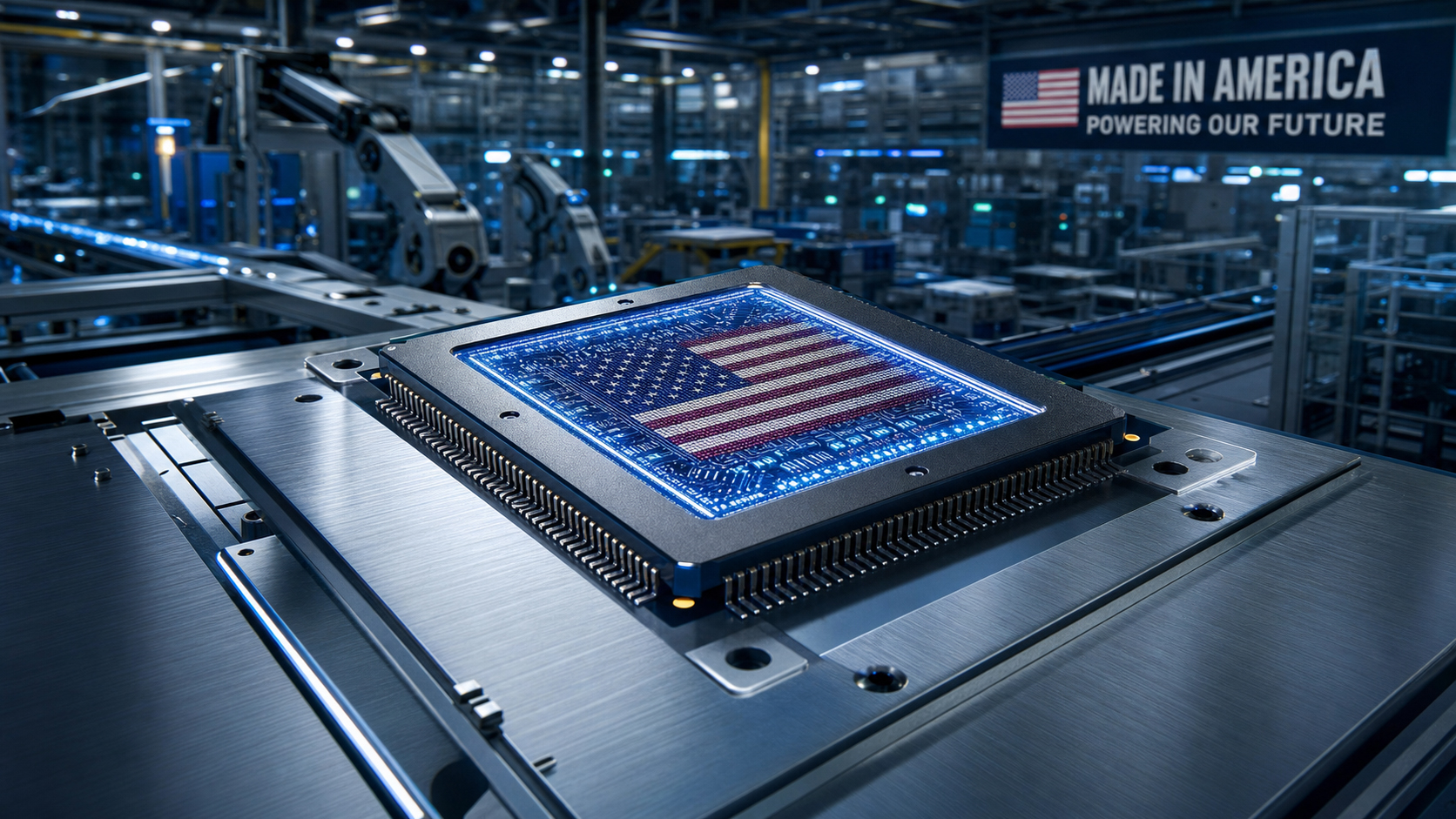
"Made in America" instead of Asia: Apple's 30-billion-dollar move – What's behind the new mega-deal with Broadcom – Image: Xpert.Digital
Expensive reshoring: Who will ultimately pay for Apple's radical $30 billion plan?
Geopolitics and silicon: Not just for the iPhone
July 8, 2026, marks a historic turning point in the strategy of the world's most valuable technology company: Apple and Broadcom have signed a chip supply agreement worth over $30 billion, shattering all previous records. But this mega-deal is about far more than just 5G components and custom silicon for the next iPhone generation. It's an unprecedented industrial policy statement. At least half of the production will take place on US soil – a radical step that will fundamentally reshape the architecture of global supply chains. At a time when trade policy is increasingly being used as an instrument of national security, Apple, under enormous political pressure, is making a massive shift toward "Made in America." What does this pact mean for the future of the global chip industry, who will ultimately bear the immense costs of this reshoring, and how will the market react to this geopolitical move? An in-depth analysis of a contract that will redefine the balance of power in the semiconductor world for the coming decade.
When trade policy becomes industrial strategy: Why the Broadcom deal is far more than a supply agreement
On July 8, 2026, Apple officially announced the signing of a chip supply contract with Broadcom worth more than $30 billion, extending until 2031. Under the terms of this agreement, Broadcom will develop and manufacture custom silicon components and advanced wireless connectivity technologies for Apple products. More than 15 billion of these chips are to be manufactured in the United States. In public statements from both companies, the deal is being hailed as a milestone in Apple's "American Manufacturing Program" (AMP). However, anyone familiar with the economic and geopolitical landscape of 2026 recognizes this agreement as far more than a mere procurement announcement: it is a symbolic and strategically significant document marking the beginning of a new era in American industrial policy.
From supplier to strategic partner: The story of the Apple-Broadcom relationship
The collaboration between Apple and Broadcom stretches back to the history of mobile technology. For many years, Broadcom supplied the radio frequency chips that form the core of wireless communication in iPhones—most notably the so-called FBAR (Thin Film Bulk Acoustic Resonator) filters, which are essential for 5G connectivity. These components are manufactured at Broadcom's plant in Fort Collins, Colorado. This facility will now receive a $1.5 billion investment as part of the new deal to modernize and expand its capabilities. Back in 2023, Apple and Broadcom signed a multi-year contract obligating Broadcom to develop and manufacture 5G radio frequency components for Apple in American facilities—a precursor to the now significantly larger and longer-term agreement. While the earlier agreement amounted to approximately $15 billion over three years, the current deal represents a substantial expansion of the commitment in terms of scope, technological breadth, and geopolitical significance.
Apple's industrial policy shift: The $600 billion promise
To properly understand the Broadcom deal, it must be viewed within the context of Apple's comprehensive commitment to American manufacturing. In February 2025, the company announced plans to invest more than $500 billion in the United States over the next four years, hire 20,000 new employees, and build a new server factory in Texas. In August 2025, this commitment was increased to $600 billion, coinciding with the official launch of the "American Manufacturing Program" (AMP), whose partner companies include Broadcom, Corning, Applied Materials, Texas Instruments, Samsung, and GlobalFoundries. Apple is thus operating against an industrial policy backdrop deliberately shaped by the Trump administration: tariffs on imports from Asia and China, pressure on global corporations to relocate manufacturing, and a realignment of trade relations make supply chain diversification not merely desirable, but a business imperative.
Geopolitics of Silicon: The CHIPS Act and the New Tectonics of the Semiconductor World
The Apple-Broadcom deal is part of a structural shift in the global semiconductor industry, the momentum of which was triggered by the U.S. Chips and Science Act. This legislation, which has provided more than $52 billion in government funding and loan guarantees, has mobilized an estimated $450 billion in private investment into the U.S. semiconductor ecosystem. The result is remarkable: While the U.S. accounted for roughly 12 percent of global advanced chip manufacturing capacity in 2020, the Semiconductor Industry Association estimates that this share will reach approximately 22 percent by the first quarter of 2026. TSMC's Fab 21 in Arizona is now producing 4-nanometer chips at scale, Samsung's plant in Taylor, Texas, has reached full operational capacity for 3-nanometer processes, and Intel's Ohio complex is shipping its first 18A-class wafers.
The role of Fort Collins: Where frequency meets national security
Within the Apple-Broadcom deal, the Fort Collins plant plays a special role. It is the center of FBAR filter production, the critical components that enable smartphones to communicate precisely in congested radio frequencies. The $1.5 billion investment planned for Fort Collins is motivated not only by economic factors but also by security considerations. Radio frequency components for 5G networks are considered critical infrastructure in Washington planning circles. Dependence on Asian supply chains in this area would pose a strategic risk from a national security perspective. The deal thus provides significant reassurance to the US Department of Defense and critical technology oversight: Apple—the company with the world's largest customer base and a market capitalization of over three trillion dollars—will henceforth produce its most sensitive connectivity components domestically.
Broadcom as the main beneficiary: Financial arithmetic of a mega-deal
For Broadcom, this contract secures its market position vis-à-vis Apple for a period of five years, establishing the company as its preferred supplier of custom chips and wireless connectivity components until at least 2031. In the second quarter of fiscal year 2026, Broadcom reported total revenue of $22.187 billion, a 48 percent increase over the same period of the previous year. Apple has traditionally been one of Broadcom's most important single customers, particularly in the area of consumer electronics semiconductors. Securing this customer relationship through a long-term contract provides Broadcom with planning certainty for capacity investments and enables a more aggressive expansion of its manufacturing infrastructure. In the past fiscal year 2025, Broadcom recorded a record adjusted EBITDA of $43 billion and free cash flow of $26.9 billion.
Our US expertise in business development, sales and marketing

Our US expertise in business development, sales and marketing - Image: Xpert.Digital
Industry focus areas: B2B, digitalization (from AI to XR), mechanical engineering, logistics, renewable energies and industry
More information here:
A thematic hub offering insights and expertise:
- Knowledge platform covering global and regional economies, innovation and industry-specific trends
- A collection of analyses, insights, and background information from our key areas of focus
- A place for expertise and information on current developments in business and technology
- A hub for companies seeking information on markets, digitalization, and industry innovations
Broadcom & Apple: Strategic protection rather than just a technology deal
The costs of home production: Structural challenges of reshoring
As attractive as the narrative of industrial return to America sounds, the economic reality is more complex. Studies estimate the additional costs of US semiconductor manufacturing compared to Asian production sites at 30 to 50 percent. This cost difference arises from a combination of higher energy prices, more expensive skilled personnel, more complex regulatory requirements, and the lack of an industrial ecosystem of upstream suppliers. Added to this is a severe labor shortage: The US semiconductor industry cannot meet its demand for engineers and technicians through the domestic education system. Apple is addressing this problem to some extent by establishing the Apple Manufacturing Academy in Detroit, which offers free workshops on AI integration and advanced manufacturing to small and medium-sized enterprises. Nevertheless, the question remains valid: Who ultimately bears the additional costs of reshoring? The answer is inevitable: the end consumer through higher product prices, or the company through lower margins.
Wage policy as a driving force: How political pressure becomes an investment calculation
It would be naive to believe that Apple's commitment to American manufacturing stems solely from patriotic convictions. The company operates under considerable political pressure. President Trump openly criticized Apple's Asian manufacturing strategy during both his first and second terms, threatening import tariffs that would significantly increase the price of iPhones. The $500 billion and then $600 billion pledges that Apple successively announced clearly serve as a political buffer—building goodwill in Washington, protecting against tariffs, and generating a narrative that lends itself well to White House press releases. Apple's investments in American manufacturing are therefore a prime example of what economists call "political risk mitigation": strategic spending primarily aimed at limiting regulatory or trade risks.
Global supply chain architecture: What stays in the USA and what doesn't
A critical look at Apple's reshoring strategy reveals the structural limitations of this movement. The Broadcom deal involves radio frequency and connectivity chips—important, but not the highest-volume components in Apple's supply chain. Mass production of iPhones, iPads, and MacBooks continues to take place predominantly in Asia. Apple's manufacturing partner Foxconn and other contract manufacturers produce in China, Vietnam, and India, and this is unlikely to fundamentally change in the foreseeable future. What is changing is the composition of component sourcing: silicon chips for Apple's own processors are increasingly being produced at TSMC's Arizona fab, radio frequency components come from Fort Collins, and servers for Apple Intelligence are assembled in Houston. It is a deliberate decoupling of highly sensitive, security-relevant, and politically exposed parts of the supply chain from the Asian ecosystem—while the more cost-effective mass production remains there.
The Broadcom model: Custom silicon as a core competency of the future
Behind the deal lies a technological logic that transcends geopolitics and trade policy. For years, Apple has pursued a strategy of complete vertical integration of its core components – from the M1 chip to the Apple C1 modem, the first cellular chip developed entirely in-house. Broadcom plays a role in this system as a supplier of specialized technology that Apple itself cannot adequately replace in the short to medium term. FBAR filter architectures and advanced 5G RF technologies require years of specialization and proprietary know-how, accumulated at Broadcom in Fort Collins through a decades-long industrialization process. Apple's decision to secure this expertise contractually therefore demonstrates not only pragmatism but also an acknowledgment of the limits of its own development capabilities.
Competitive implications: What does the deal mean for Qualcomm, Intel, and others?
The Apple-Broadcom deal has immediate competitive implications for other semiconductor manufacturers. Qualcomm, long a major Apple supplier of modem chips, is losing ground after Apple built its own capabilities with the C1 modem. The consolidation of the Broadcom partnership reduces the scope for competitors to penetrate the RF component market. For the overall market, deals of this magnitude also send a signal to potential investors: securing a long-term supply relationship with Apple provides a kind of quality seal and planning certainty, which facilitates raising debt capital on attractive terms. Broadcom's share price reacted positively, as expected – the market rewards such revenue visibility over several years, which is extremely rare in the semiconductor industry.
Technological future agenda: 6G, AI chips and the next decade
The agreement runs until 2031 – and during this time, the semiconductor world will undergo a fundamental metamorphosis. The standardization of 6G networks, the rapid proliferation of edge AI processing, and the decentralization of data center capacity will place entirely new demands on chip architectures. With this deal, Apple and Broadcom secure the foundation to jointly shape these developments. In particular, the development of custom silicon – tailor-made chips optimized for specific Apple products and workflows – is likely to become an even more important competitive advantage in the coming years. The phrase "cutting-edge wireless connectivity technologies" in the agreement leaves room for a wide range of future innovations that are currently only just being developed in laboratories.
Geopolitics, technology and capital combined in a mega-deal
The $30 billion deal between Apple and Broadcom, in its full significance, is a historic document of our time. It reflects the new reality that global technology companies can no longer base their supply chain decisions solely on economic optimum criteria, but must operate under the ongoing influence of trade policy, national security policy, and geopolitical risk management. Apple's transformation from a primarily Asia-oriented procurer to a player actively investing in American semiconductor infrastructure is structural. It is not merely the result of isolated political pressure, but rather the outcome of a fundamental reassessment of which supply chains remain resilient in a world of increasing geopolitical fragmentation. The Broadcom deal is thus both a powerful industrial policy signal and a sober business calculation—both credibly combined in this $30 billion contract.
Your global marketing and business development partner
☑️ Our business language is English or German
☑️ NEW: Correspondence in your native language!

Konrad Wolfenstein
I and my team are happy to be available to you as your personal advisor.
You can contact me by filling out the contact form here wolfenstein@xpert.digital:or simply call me at +49 7348 4088 965. My email address is
I'm looking forward to our joint project.
☑️ SME support in strategy, consulting, planning and implementation
☑️ Creation or realignment of the digital strategy and digitization
☑️ Expansion and optimization of international sales processes
☑️ Global & Digital B2B trading platforms
☑️ Pioneer Business Development / Marketing / PR / Trade Fairs
🎯🎯🎯 Data-driven B2B industry hub as a quasi-in-house solution


The quasi-in-house solution: How Xpert.Digital closes operational gaps in B2B marketing and sales – Smart Content-Driven Business - Image: Xpert.Digital
Xpert.Digital is a data-driven B2B industry hub led by Konrad Wolfenstein . The company acts as an external, quasi-in-house solution for industrial partners, closing operational gaps in marketing, content, and sales – without requiring additional resources on the client side.
More information here: