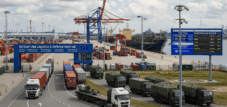
Europe's unfinished infrastructure – Is TEN-T the missing piece for the final EU single market and global competition? – Image: Xpert.Digital
Europe's trillion-dollar bet: How a gigantic mega-network is set to attack the global market
A trillion euro loss: Why the EU single market is suffering from a lack of rails
Six mega-corridors through Germany: Are we the biggest bottleneck in Europe?
Europe is facing a historic turning point. To compete in the global economic battle with giants like the USA and China, a single market on paper is no longer enough – it needs a physical backbone. This is precisely where the Trans-European Transport Network (TEN-T) comes in: a mega-project costing hundreds of billions of euros, intended to seamlessly connect the continent via rail, road, and waterways. But while geopolitical ambitions are growing and the new network now extends as far as Kyiv, the European Union is grappling with dramatic cost overruns, national egoism, and decades of construction delays. Is the TEN-T network the long-awaited missing piece to unleash Europe's true economic potential – or is the project in danger of being stifled by the bureaucratic patchwork of member states? An in-depth analysis of Europe's most ambitious transport project, caught between grand vision and harsh reality.
Europe's network: The nine pan-European transport corridors: The European dream on rails, roads and waterways
Europe is a continent of borders—geographical, historical, linguistic, and regulatory. For three decades, however, the European Union has pursued an ambitious project that aims to physically overcome all these dividing lines: the Trans-European Transport Network, or TEN-T. What appears on paper to be a technical infrastructure program is in reality one of the most significant economic policy experiments of the 21st century—an attempt to forge a unified, efficient, and multimodal network from 27 national transport systems, enabling the free movement of goods and passengers without interruptions, bottlenecks, or missing connections.
The idea behind it is as simple as it is revolutionary: A single market without physical infrastructure remains a legal fiction. Trade barriers can be reduced through regulations, tariffs eliminated through agreements—but as long as goods wait for hours at borders because track gauges are incompatible, as long as freight trains have to change locomotives between two EU member states, as long as high-speed trains stop at national signaling systems, the common market will remain limited in its efficiency. The TEN-T network is the physical answer to this structural weakness.
From ten corridors to nine: The new architecture of the European transport network
The historical pan-European corridors and their transformation
The term "pan-European transport corridors" originally referred to the ten infrastructure axes defined at the Pan-European Transport Conferences in Crete (1994) and Helsinki (1997) in the 1990s—connecting routes that at that time still included the post-Soviet space and envisioned links from Helsinki to Nizhny Novgorod, from Berlin to Moscow, and from Dresden via Kyiv to Istanbul. These ten Helsinki corridors formed the geopolitical foundation of a time when Europe was still pursuing rapprochement with Russia.
With Russia's invasion of Ukraine and the geopolitical rupture that followed in 2022, this network became politically obsolete. The European Commission reacted decisively: In the revised TEN-T Regulation, which entered into force in June 2024 as Regulation (EU) 2024/1679, Russia and Belarus were removed from the network maps, while Ukraine and Moldova were integrated into four of the nine core corridors. The old ten Helsinki corridors were replaced by nine newly defined European Transport Corridors, consistently focused on the EU and its immediate partners.
An overview of the nine European transport corridors
The nine corridors of today's TEN-T network structure the continent along its main economic axes:
- Baltic-Adriatic Corridor: From Gdynia and Gdańsk via Warsaw, Katowice, Ostrava, Vienna, Graz and Ljubljana to Trieste, Koper and Bologna — a north-south axis connecting Poland, Czechia, Slovakia, Austria, Slovenia and Italy.
- North Sea-Baltic Corridor: From Helsinki via Tallinn, Riga, Kaunas and Warsaw to Berlin, Hamburg, Bremen and Rotterdam — an east-west connection that links the Baltic states with the North German seaports and the Benelux region.
- Mediterranean Corridor: From Algeciras via Madrid, Barcelona, the southern French coast, Milan, Trieste, Ljubljana and Budapest to Kyiv — one of the longest and most economically important east-west axes in Europe.
- Orient/East-Med Corridor: From Hamburg via Dresden, Prague, Vienna and Budapest to Thessaloniki, Athens, Nicosia and Beirut — a connection that links Central Europe with the southeastern Mediterranean region.
- Scandinavian-Mediterranean Corridor: From Helsinki via Stockholm, Copenhagen, Hamburg, Frankfurt, Munich, the Brenner Pass and Verona to Palermo — the central north-south axis of Europe.
- Rhine-Alpine Corridor: From Rotterdam and Antwerp via Cologne, Frankfurt, Basel, Milan to Genoa — the busiest freight corridor in Europe.
- Atlantic Corridor: From the Irish ports via Porto, Lisbon, Madrid to Paris and Strasbourg — the western Atlantic axis.
- North Sea-Mediterranean Corridor: From Ireland via the English Channel, Paris, Lyon and Marseille to the Mediterranean Sea — an east-west connection in western Europe.
- Rhine-Danube Corridor: From Strasbourg via Stuttgart, Munich, Vienna, Budapest and Bucharest to the Black Sea — an east-west axis connecting Central Europe with the Danube region.
In addition, there are two so-called horizontal priorities: the European Rail Traffic Management System (ERTMS) and the European Maritime Area — both span all nine corridors and create the technological basis for the interoperability of the network.
The three-level model: core network, extended core network, and overall network
The hierarchy of expansion
The TEN-T Regulation of 2024 defines the network in a three-tiered hierarchy, which structures the gradual expansion until 2050:
The core network comprises the most important European connections and hubs. It must be completed by 2030 and forms the backbone of the European transport system. The requirements here are the most stringent: full electrification of the rail network, a minimum speed of 160 km/h for passenger trains and 100 km/h for freight trains, compliance with ERTMS standards, and seamless multimodal connections to ports and airports.
The extended core network represents the second phase of development and must be completed by 2040. It adds those routes that are crucial for the completeness of the pan-European system but do not fall into the first priority category—in particular, cross-border routes in less developed regions and connections to smaller cities with more than 100,000 inhabitants.
The overall network will connect all regions of the EU to the core network and must be completed by 2050. It comprises a rail network of up to 138,072 kilometers and also connects peripheral and rural regions to the European transport system.
The economic engine behind the kilometers of track
Infrastructure as the invisible foundation of the internal market
To understand the economic significance of the TEN-T network, one must begin with a fundamental question: What holds the single market together? The answer is not simply laws, regulations, and common standards. The real foundation is the ability to physically transport goods from point A to point B—quickly, reliably, and at competitive costs. Without efficient infrastructure, any regulatory integration remains incomplete.
The single market, which according to the European Union generates almost €18 trillion in gross domestic product, is projected by the International Monetary Fund to be the world's second-largest economic area in 2025, with a GDP of $20.29 trillion, behind the US with $30.34 trillion and ahead of China with $19.53 trillion. However, these figures mask a crucial weakness: the European single market does not function nearly as smoothly as its American counterpart. The Federation of German Industries (BDI) estimates that this results in the EU missing out on over €1 trillion – almost nine percent of EU GDP – in additional economic output.
A significant part of this gap is physical in nature. According to IMF calculations, non-tariff trade barriers between EU member states still amount to around 44 percent of a conventional tariff for goods and as much as 110 percent for services. Transport costs and logistical friction play a central role here: Every hour's delay at a border, every locomotive change due to incompatible train control systems, every detour due to a lack of direct connections increases transaction costs and undermines the competitiveness of European companies.
Growth impulses through network effects
A study by the University of Münster, published in the journal Transportation Research Part A, analyzed the growth impact of the TEN-T corridors in 241 NUTS 3 regions of Eastern Europe and reached a clear conclusion: The corridors not only lead to increased growth in those regions where new corridor sections are built, but also generate stronger growth in directly adjacent regions and in regions along the same corridor section. This multiplier effect is economically crucial: Infrastructure unfolds its benefits not only locally, but systemically.
The logical chain is well understood. When transportation costs fall, companies expand their sales market. A larger sales market enables higher production volumes, which in turn unlock economies of scale. Economies of scale lower unit costs, increase profitability, and strengthen investment in research and development—which, in the long term, drives productivity growth. This is precisely the mechanism that the US, with its integrated domestic market, has been using so successfully for decades, and which Europe has not yet fully exploited.
Europe's financing architecture: Ambition meets reality
The Connecting Europe Facility as a core financing instrument
The most important financing instrument for TEN-T is the Connecting Europe Facility (CEF). For the period 2021 to 2027, the CEF has a total budget of €33.7 billion, of which €25.8 billion is reserved for the transport sector. An additional €11.3 billion from the Cohesion Fund is specifically earmarked for the less developed member states.
Since its launch in 2014, the CEF has invested a total of €47.34 billion in the transport sector, supporting 1,861 projects. In July 2025 alone, 94 transport projects received funding totaling almost €2.8 billion – 77 percent of which went to rail. For the next programming period, 2028 to 2034, the European Commission is planning a massive increase: the CEF's total budget is set to rise to €81.4 billion – more than double the amount in the current period.
The funding gap: The central structural problem
Despite these impressive figures, a massive funding gap remains. The actual investment required for the TEN-T expansion by 2030 is estimated at around €500 billion for rail infrastructure alone. The European Court of Auditors and various experts have previously estimated the total investment requirement by 2030 at around €700 billion. This contrasts sharply with a CEF transport budget of €25.8 billion – a funding gap of enormous proportions.
This discrepancy makes it clear: TEN-T is not a purely EU project financed from Brussels, but a joint undertaking where national investments and private capital must shoulder the lion's share. The EU's cohesion funds are investing an additional €32.5 billion in completing the network, but even this cannot close the gap. The discussion about new financing models—such as public-private partnerships, specific infrastructure bonds, or a European infrastructure fund—has therefore gained considerable momentum in recent years.
Megaprojects in delay: Between ambition and feasibility
A structural implementation deficit
The European Court of Auditors delivers the most scathing assessment of TEN-T progress. In its special report 02/2026, it examined eight major TEN-T infrastructure projects and reached a damning conclusion: Completion of the core network by 2030 is undoubtedly unattainable. The five megaprojects for which reliable data is available are now, on average, 17 years behind schedule—compared to the average delay of 11 years that the same Court of Auditors had already identified in 2020. The situation has therefore deteriorated further.
The cost development is equally alarming. Compared to the original cost estimates, the eight projects examined have seen actual cost increases averaging 47 percent. Specifically, there is an enormous range of costs:
The Lyon-Turin rail link has seen a real cost increase of 127 percent compared to the original estimates and is now scheduled to open in 2033 instead of the originally planned 2015. Rail Baltica, which is intended to run from Tallinn via Riga and Kaunas to Warsaw, has experienced a cost increase of approximately 291 percent. The Brenner Base Tunnel is 40 percent more expensive than originally planned and is now expected to be completed no earlier than 2032 instead of 2016, although the crucial breakthrough in the exploratory tunnel was achieved in September 2025, establishing the first direct connection between the Austrian and Italian sides. The Fehmarn Belt Tunnel has become 52 percent more expensive and its opening has now been delayed until 2031.
Causes of failure
The reasons for these delays are structural in nature and cannot be attributed to individual errors. Firstly, the complexity of cross-border megaprojects regularly exceeds the planning capacities of the authorities involved. Projects such as the Brenner Base Tunnel require coordinated permitting, financing, and construction management in several countries with different legal systems, environmental standards, and administrative cultures.
Secondly, permitting processes, environmental impact assessments, and political resistance in neighboring regions lead to delays of several years, even in the planning phase. Thirdly, rising construction costs—particularly for steel, cement, and energy—have massively inflated budgets without corresponding additional funding being automatically available. Fourthly, despite EU coordinators, there is a lack of binding enforcement mechanisms that would truly hold member states accountable in the event of delays.
Our EU and German expertise in business development, sales and marketing


Our EU and German expertise in business development, sales and marketing - Image: Xpert.Digital
Industry focus areas: B2B, digitalization (from AI to XR), mechanical engineering, logistics, renewable energies and industry
More information here:
A thematic hub offering insights and expertise:
- Knowledge platform covering global and regional economies, innovation and industry-specific trends
- A collection of analyses, insights, and background information from our key areas of focus
- A place for expertise and information on current developments in business and technology
- A hub for companies seeking information on markets, digitalization, and industry innovations
How TEN-T is reconnecting Europe — and why digitalization is the key
Interoperability and digitalization: Overcoming the invisible boundaries
ERTMS as a technological key
Besides the physical expansion of the infrastructure, technological standardization is the second major challenge of TEN-T. The European Rail Traffic Management System (ERTMS) is intended to replace the currently existing 20 to 30 different national signaling systems as a unified train control system, thereby enabling genuine cross-border interoperability on the railways. A train traveling from Hamburg to Budapest today has to change locomotives several times, depending on the route, because the national systems are not compatible—an absurdity in the 21st century that causes considerable costs and time losses.
The 2024 regulation mandates the use of ERTMS across the entire TEN-T network. The core network must be fully equipped with ERTMS by 2030, and the entire network by 2050. The CEF program alone has earmarked around €7 billion for ERTMS and smart mobility to implement this. The economic benefits are substantial: interoperable signaling systems reduce border waiting times, increase network capacity, and lower operating costs for railway companies operating across borders.
Multimodality as a strategic principle
The current TEN-T architecture takes a consistently multimodal approach to mobility. It's not about pitting rail against road or waterway, but about deploying each mode of transport where it is most efficient: seaports as gateways for intercontinental trade, inland waterways for heavy goods over long distances, rail for goods and passengers over medium to long distances, and road for the last mile. The hubs—ports, airports, marshalling yards, and combined transport terminals—are the crucial switching points in this process.
This multimodal paradigm also serves climate goals. The TEN-T Regulation of 2024 obliges the EU to reduce greenhouse gas emissions in the transport sector by 90 percent by 2050. Expanding the rail infrastructure on the TEN corridors creates the conditions to shift the modal split in favor of lower-emission modes of transport. Studies show that switching to night trains compared to flying saves around 375 grams of CO2 equivalent per passenger kilometer—a significant climate protection potential that can only be realized through the expansion of rail connections.
TEN-T and the geopolitical dimension: Eastern opening as a strategic project
Ukraine, Moldova and the new eastern flank
The extension of the TEN-T network by four corridors into Ukraine and Moldova is not merely an infrastructure project, but a geopolitical act of strategic importance. The integration of the Ukrainian ports of Mariupol and Odessa into the European transport network sets a course that will determine the future of Ukraine's economic connectivity to Europe. The four corridors extended into Ukraine and Moldova—including the Baltic-Black Sea-Aegean Sea Corridor (BBA)—create the physical foundation for closer economic integration of these countries into the EU single market, even before formal EU membership is achieved.
The Western Balkans-Eastern Mediterranean Corridor fulfills a similar function for the Balkan states: it gradually connects Serbia, North Macedonia, Albania and the other Western Balkan states to the European transport infrastructure, thereby creating economic facts that flank and accelerate the EU enlargement process.
The big comparison: EU single market vs. US single market
Where Europe lags structurally behind
The question of whether Europe can catch up with or even surpass the US domestic market through completed infrastructure is economically complex. Simple comparisons fall short. The strength of the American domestic market is not based solely on physical infrastructure, but on a combination of factors: a common language, a largely uniform legal system (common law with federal overlay), an integrated capital market, high labor mobility, and—crucially—a common currency that minimizes transaction costs.
The US GDP was projected to reach $30.34 trillion in 2025, according to IMF estimates, while the EU's was projected at $20.29 trillion. GDP per capita in the EU, measured at purchasing power parity, is only about 72 percent of the US level, as the IMF noted in a 2024 study. According to the IMF, the reason lies less in infrastructure deficits than in the lower productivity of the European economy—though even this is closely linked to the fragmentation problem.
The Draghi report of September 2024, prepared at the invitation of Commission President von der Leyen, offers a precise diagnosis: While the EU possesses the basic structure of a competitive economic area, with approximately 440 million consumers and 23 million businesses, a lack of single market integration, regulatory fragmentation, and a lag in innovation severely hamper its potential. The report recommends the full implementation of the single market as an essential prerequisite for any competitiveness strategy.
Enrico Letta, in his report presented in April 2024, called for a deepening of the single market from 27 to 1—that is, consistent integration that also applies to services, capital, and digital goods. He identified finance, energy, communications, and transport as the four key sectors. In this analysis, a coherent TEN-T network is one of four essential building blocks—necessary, but not sufficient.
Where Europe is structurally stronger
A more nuanced view, however, reveals a surprising strength of the European single market: in certain areas, it is more deeply integrated than its American counterpart. An analysis by the Friedrich Naumann Foundation, based on research by Matthijs and Parsons, concludes that the European single market is more effective than the American market in enforcing non-tariff trade barriers. Europe also now performs better than the US in competition policy.
This assessment is supported by the finding that, according to the European Central Bank, the single market has contributed around 8.5 percent of EU GDP and between 12 and 22 percent of GDP per capita since 1993. A completed TEN-T network would further enhance this effect by reducing supply chain costs, stimulating trade, and unlocking agglomeration benefits.
The real challenge: Not infrastructure alone
A direct comparison with the US domestic market shows that infrastructure alone is no guarantee of economic superiority. The US benefits massively from economies of scale in its integrated market, as an analysis by Xpert.Digital demonstrates—consumer spending drives the economy with a record share of 68.8 percent of GDP, compared to only 49.9 percent in Germany. An integrated, high-performance transportation network is a necessary, but not sufficient, condition for this kind of domestic market strength.
The real reserves that Europe needs to mobilize lie in completing the digital single market, integrating capital markets, and harmonizing services markets. In goods trade alone, the EU loses around €228 billion annually due to non-tariff barriers; in services, the figure is even higher at around €279 billion. Approximately €150 billion is lost annually in capital markets because national regulations and tax systems diverge. These figures make it clear: the TEN-T network is not the missing piece—it is one of at least four crucial components, and its completion would have a multiplicative effect on other integration efforts.
The fragmentation of non-infrastructure: What TEN-T doesn't solve
Digital and regulatory boundaries remain
Even a fully developed TEN-T network would not completely solve the fundamental fragmentation problem of the European single market. Despite all the progress, the digital single market remains highly fragmented due to stricter national regulations. Companies wishing to offer digital services across Europe must meet specific requirements in each member state as soon as personal data is involved. This regulatory fragmentation is structurally more difficult to overcome than physical infrastructure gaps because there is no single technical solution.
According to the European Commission, the services market remains less integrated than the goods market, and many of the barriers hindering cross-border trade in services have remained unchanged for more than 20 years. The EU's 2025 Single Market Strategy, operating under the motto "One Europe, One Market," aims for a fully integrated single market by the end of 2027—an ambitious goal that requires regulatory convergence in addition to infrastructure.
The German Council of Economic Experts diagnoses similar shortcomings in its 2025/26 annual report: Non-tariff trade barriers act like conventional tariffs, dampening GDP growth and productivity and preventing companies from sufficiently benefiting from economies of scale in production. A completed TEN-T eliminates one important category of these barriers—namely physical transport costs and time losses—but leaves regulatory, digital, and capital market-related barriers in place.
Six corridors through Germany: their significance for the European economy
Germany as the linchpin
No country in the TEN-T network is as significant as Germany. Six of the nine European transport corridors run through German territory, reflecting the country's central geographical location and economic importance. Germany is the EU's largest freight market, the most important transit corridor for East-West trade, and, via Rotterdam and Hamburg, directly connected to Europe's busiest freight route through the Rhine-Alpine Corridor.
The bottlenecks in the German section of the TEN-T network are particularly evident. The Nuremberg Chamber of Industry and Commerce and the Stuttgart Chamber of Industry and Commerce have repeatedly drawn attention to the serious bottlenecks in the Rhine-Danube corridor between Strasbourg, Stuttgart, Munich, and Wels/Linz, and have called for the urgent elimination of these bottlenecks with EU funding. For Germany's export-oriented industry, transport connections to supra-regional and international markets are not just important—they are essential. Freight traffic in Germany is growing faster than the gross domestic product, which further increases the pressure on the existing infrastructure.
Political pressure for reform: CEF 2028-2034 and the new financing logic
The quantum leap of the next generation
The proposed Common Economic Forum (CEF) for the period 2028 to 2034 marks a fundamental shift in European infrastructure financing. With a total budget of €81.4 billion—€29.9 billion for energy, €17.6 billion for military mobility, and a significantly strengthened transport budget—the new program is more than double its predecessor. The inclusion of military mobility as an explicit funding category reflects the changed geopolitical context: the TEN-T network is intended to enable the rapid movement of not only trade goods and tourists, but also, if necessary, heavy military equipment across Europe.
The fact that 60 percent of CEF funds are dedicated to climate goals permanently links infrastructure financing to the European Green Deal. Investments in rail infrastructure, inland waterways, and intermodal terminals are therefore simultaneously climate protection measures—a strategic dual function that strengthens the political justification for the program.
An indispensable but incomplete building block
What the TEN-T can and cannot do
From an analytical perspective, the TEN-T network is one of the most ambitious infrastructure projects in human history. Nine corridors, three expansion phases by 2050, investment requirements of several hundred billion euros, and a vision that will allow Europe to grow together physically and economically—this is a project of historic proportions.
Is it the missing piece for the final EU single market and the leap via the US? The honest answer is: It is an essential, but not sufficient, piece. A fully developed TEN-T network would significantly stimulate trade, reduce logistics costs, unlock economies of scale, and strengthen the continent's economic cohesion—these are real, significant gains. The growth effects in Eastern European regions already demonstrate how transformative corridor connections can be.
But the gap with the US single market has deeper structural roots: fragmented capital markets, a split services market, an incomplete digital single market, diverging legal systems, and a lack of labor market flexibility. The Letta Report, the Draghi Report, and the EU Single Market Strategy 2025 show that Europe's political leadership understands these connections—the real question is whether the political will to implement them is strong enough to overcome the structural resistance of the member states.
The TEN-T is not the missing puzzle piece that will complete the EU single market overnight. It is the physical lifeline without which all other integration measures would lose efficiency. A single market in which laws, capital, and data flow freely, but goods and people are hampered by capacity bottlenecks, technical incompatibilities, and a lack of connections, remains limited in its effectiveness. In this sense, the TEN-T is a conditio sine qua non—an indispensable prerequisite, but not the sole solution.
The real provocation lies elsewhere: Europe has the tools. It has the funds—albeit with significant gaps. It has the legal architecture and the political vision. What it still has to prove is the ability to implement them quickly and in a coordinated manner—in the face of decades of overruns, cost increases, and planning failures. If the Brenner Base Tunnel was originally planned for completion in 2016 and will now be finished no earlier than 2032, and if Rail Baltica ends up costing 291 percent more than expected, then this is not just a financing problem—it is a governance problem. And this is a problem that no CEF program, no regulation, and no corridor coordinator can solve on their own.
Europe needs to speed up. Not just on its new railway lines.
Consulting - Planning - Implementation

Konrad Wolfenstein
I would be happy to serve as your personal advisor.
You can contact me at wolfenstein∂xpert.digital or
Just call me on +49 7348 4088 965 .
Your container high-bay warehouse and container terminal experts

Container high-bay warehouses and container terminals: The logistical interplay – expert advice and solutions - Creative image: Xpert.Digital
This innovative technology promises to fundamentally change container logistics. Instead of stacking containers horizontally as before, they will be stored vertically in multi-story steel racking structures. This not only allows for a drastic increase in storage capacity within the same area, but also revolutionizes all processes at the container terminal.
More information here: