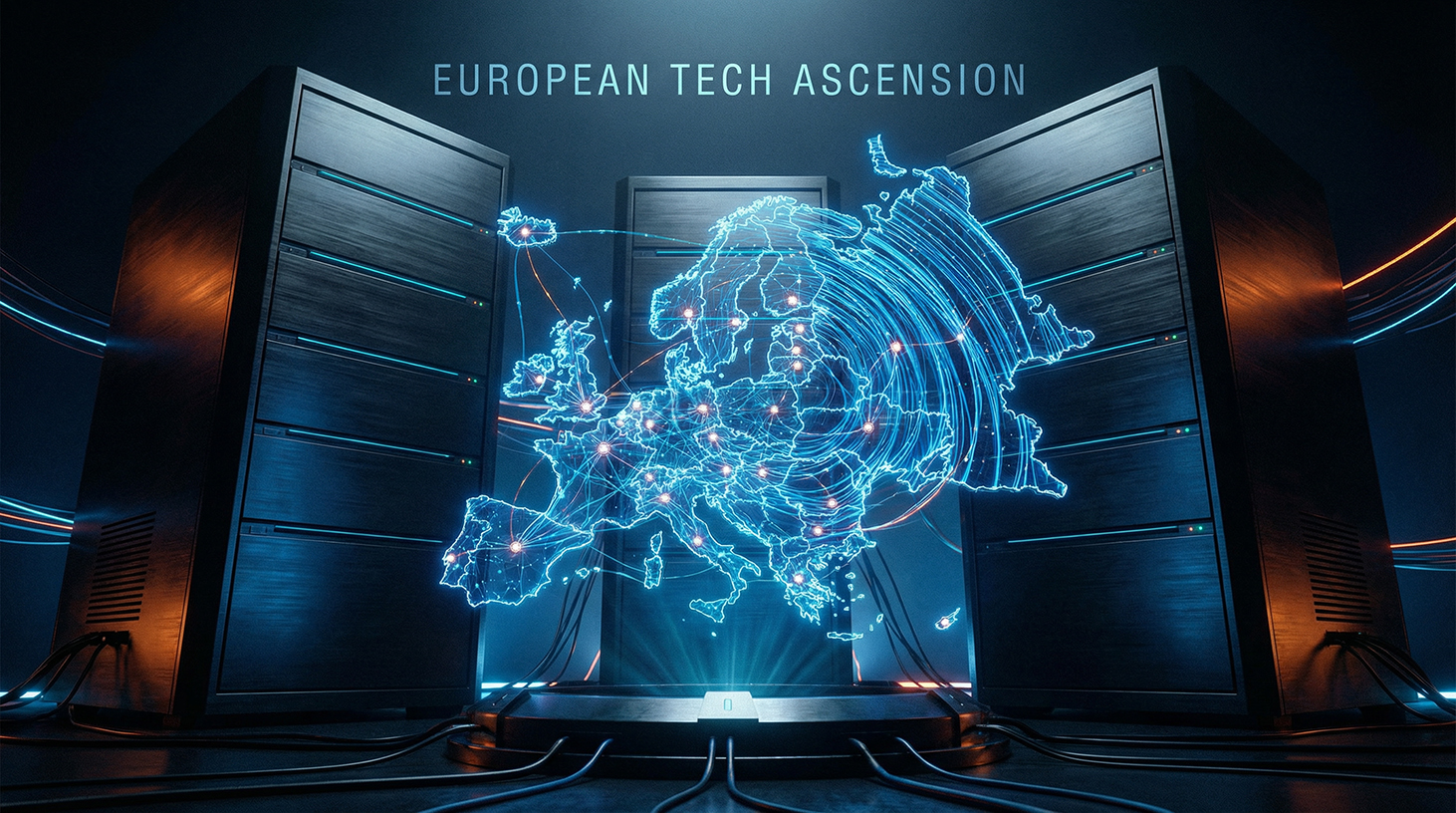
The billion-dollar excuse: Why Europe's tech industry is far more powerful than anyone thinks – 2,000 companies against Amazon & Google – Image: Xpert.Digital
David versus Hyperscalers: The secret revolution of European software providers
End of US dependence? Why the “European Tech Map” is currently skyrocketing
Europe's digital dependence on US giants like Amazon, Microsoft, and Google was long considered an insurmountable fate. The standard argument from politicians, government agencies, and businesses was always the same: "There are simply no high-performing European alternatives." But since spring 2026, this excuse has been collapsing under the weight of hard facts. The *European Tech Map*, a directory that has gone online, impressively demonstrates that Europe doesn't have an innovation problem, but rather a massive visibility problem. With almost 2,000 listed companies from 37 countries, the platform shows that sovereign, data protection-compliant, and high-performance solutions already exist – from cloud infrastructures to AI tools. The path to digital independence isn't failing due to a lack of offerings, but rather due to convenience, established procurement processes, and the market power of the hyperscalers. A look at the true strength of the European tech landscape and the rocky but indispensable road to digital sovereignty.
Related to this:


The visibility problem – Why Europe can't find its own technology and how 2,000 companies want to change that
The biggest excuse of European digital policy collapses under the weight of the facts
Anyone in European companies, government agencies, or political bodies who raises the question of whether there shouldn't be a greater focus on European technology solutions is almost guaranteed to hear the same answer that has served as a trump card for years: there are no European alternatives. This claim has always been dubious. Since February 2026, it has been demonstrably false. The European Tech Map, a freely accessible directory of European technology companies, now lists almost 2,000 companies from 37 countries in 81 categories. What began as a side project of a single consultant has, within just a few weeks, developed into a movement that is fundamentally changing the narrative of the European tech debate.
Related to this:
From hobby project to ecosystem tool
On February 17, 2026, the European Tech Map went online as a so-called soft launch. At that time, the platform comprised 651 European tech companies from 44 countries across 75 categories. In the first week after its launch, the site recorded around 40,000 visitors. The response was so overwhelming that hundreds more companies applied for inclusion within a very short time. By the end of February, there were already over 1,000 companies with 55 categories from 32 countries, and by the beginning of March 2026, the platform was approaching the 2,000 listed companies mark.
The spectrum is broad: cloud infrastructure, collaboration tools, DevOps platforms, AI providers, cybersecurity solutions, email services, e-commerce platforms, and dozens of other categories. Many of the listed companies offer EU data residency, open-source options, or self-hosting capabilities. Each listed company must meet criteria such as strategic autonomy, economic security, adherence to values, collective resilience, and European innovation.
The founder, Dante Emilio Grassi, a Sweden-based consultant with a background in finance, AI, and machine learning, discovered while analyzing incoming data that categories many considered US-dominated actually have ten or more European alternatives. Founders from countries like Estonia, Bulgaria, and Portugal are building world-class tools. The problem, therefore, is not the existence of European solutions, but their visibility.
The Anatomy of Digital Addiction
The figures that form the backdrop to this debate are sobering. US hyperscalers—Amazon Web Services, Microsoft Azure, and Google Cloud—control an estimated 70 percent of European cloud computing infrastructure. Looking at the bigger picture, it becomes even more drastic: US providers hold around 72 percent of the European cloud market, while European providers have shrunk to a mere 13 percent market share—a decline of 27 percent since 2017. Around 92 percent of European data resides on cloud servers controlled by US companies. Annually, €264 billion in European cloud and software spending flows to US hyperscalers, equivalent to roughly 1.5 percent of the EU's GDP.
The European Union attracts only seven percent of global investments in artificial intelligence, a significant lag compared to the US and China. This dependency extends even to the hardware level: European cloud providers like OVHcloud, Hetzner, and Scaleway predominantly use Intel Xeon and AMD EPYC processors. The few ARM-based options use Ampere Altra processors, also a US design. This technological dependency of 85 to 90 percent across all infrastructure levels persists, even when European cloud providers are chosen.
Why visibility is key
The real obstacle to using European alternatives is not a lack of quality or availability. It lies in procurement logic, lobbying, market power, and ingrained habits. Search queries for European alternatives have increased by 660 percent year-on-year, and the European Alternatives website recorded a 1,100 percent increase in visitors in 2025. There is therefore an enormous, as yet unmet, need.
Companies and public authorities reflexively resort to the same old US platforms. This isn't because alternatives don't exist, but because they lack awareness of their existence, because procurement processes are geared towards established providers, and because the switching costs are perceived as prohibitive. In the public sector, several German states have already taken this step, replacing their Microsoft cloud services with sovereign alternatives based on STACKIT and the Open Telekom Cloud. Such projects demonstrate that the transition is possible, even if it requires careful planning.
Our EU and German expertise in business development, sales and marketing


Our EU and German expertise in business development, sales and marketing - Image: Xpert.Digital
Industry focus areas: B2B, digitalization (from AI to XR), mechanical engineering, logistics, renewable energies and industry
More information here:
A thematic hub offering insights and expertise:
- Knowledge platform covering global and regional economies, innovation and industry-specific trends
- A collection of analyses, insights, and background information from our key areas of focus
- A place for expertise and information on current developments in business and technology
- A hub for companies seeking information on markets, digitalization, and industry innovations
Hidden Champions: These European providers can compete with the US giants
An overview of the European supplier landscape
The European cloud market now offers a wide range of providers. OVHcloud from France operates 46 data centers worldwide and offers S3-compatible storage. IONOS Cloud from Germany advertises its GDPR-native architecture and competitive pricing. The Open Telekom Cloud, operated by Deutsche Telekom, is ISO 27001 and BSI compliant. STACKIT, a product of the Schwarz Group, follows a GDPR-first approach. Scaleway from France offers managed Kubernetes and GPU instances. Exoscale from Switzerland stands out with its neutral jurisdiction and open-source philosophy.
An analysis by independent experts found that European providers can typically match the computing power of hyperscalers for standard workloads. The gap primarily lies in proprietary PaaS integrations and AI services, not in core infrastructure. Price advantages of 45 to 63 percent compared to hyperscalers are not uncommon for European providers. The often-lacking global footprint of European providers can be compensated for by hybrid architectures that combine European providers for sovereignty-critical workloads with hyperscalers for global edge delivery.
Related to this:


The regulatory tailwind
EU legislation is increasingly providing the regulatory framework for strengthening digital sovereignty. The General Data Protection Regulation (GDPR) has formed the basis for this for years. The Digital Services Act and the Digital Markets Act obligate technology providers to greater data protection, transparency, and fair competition. The Digital Operational Resilience Act imposes strict requirements on cloud providers and third-party service providers in the financial sector. The EU Cloud and AI Development Act, whose implementation was delayed until the first quarter of 2026 due to discussions about the definition of effective European control, aims to establish European control criteria for cloud providers.
The urgency of these regulatory measures became particularly evident in the fall of 2025, when outages at major hosting providers like Amazon Web Services and Cloudflare affected millions of websites worldwide. Such incidents underscored the critical dependence on a few, mostly US-based, infrastructure providers. Several EU member states, including Austria, Germany, and France, subsequently committed to concrete measures in a declaration on digital sovereignty.
The structural hurdles of the transition
Despite the growing availability of European alternatives, the challenges of a complete transition remain considerable. The investment gap is enormous: estimates put the amount required for significant digital independence at between 500 and 700 billion euros. The fragmentation of the European market, with national champions and regional solutions instead of continental platforms, works against the economies of scale that make modern cloud computing economically viable.
The AI and machine learning gap compared to hyperscalers is real. AWS, Azure, and Google Cloud offer extensive managed AI services that European providers cannot directly replicate. However, Scaleway offers managed AI infrastructure, and European providers support bring-your-own-AI frameworks via Kubernetes and GPU instances.
Another problem is the so-called CLOUD Act risk: Even if US hyperscalers operate sovereign cloud offerings with data centers in Europe, the US parent company does not completely eliminate CLOUD Act exposure. European providers under EU jurisdiction offer stronger legal guarantees in this regard.
An ecosystem that is just emerging
The European Tech Map is not the only sign of a growing European tech consciousness. The platform has evolved from a simple company directory into an ecosystem tool that now maps over 15 non-software-related industry verticals, including defense and aerospace, FinTech, HealthTech, CleanTech, DeepTech, and SpaceTech. In addition, the platform encompasses eight resource categories, including venture capitalists, accelerators, professional services, events, talent pools, media, public funding, and co-working hubs.
Market dynamics demonstrate that this issue is more than just a political buzzword. Since the beginning of 2025, customers have been actively seeking out cloud providers that are genuinely European companies. This demand is driving growth. At the same time, US cloud service providers are also investing billions in building sovereign European clouds with data centers located in Europe to meet data sovereignty requirements and secure their market position. The pressure from Europe is clearly having an effect.
The European Tech Map proves that Europe doesn't have a quality problem, but a visibility problem. Those who can't find European solutions can't implement them. Dante Emilio Grassi's project closes this gap, providing a foundation on which companies, government agencies, and policymakers can make informed decisions. The biggest excuse in the European tech debate has thus been eliminated. What now matters is the will to actually use the available options.
Your global marketing and business development partner
☑️ Our business language is English or German
☑️ NEW: Correspondence in your native language!

Konrad Wolfenstein
I and my team are happy to be available to you as your personal advisor.
You can contact me by filling out the contact form here wolfenstein@xpert.digital:or simply call me at +49 7348 4088 965. My email address is
I'm looking forward to our joint project.
☑️ SME support in strategy, consulting, planning and implementation
☑️ Creation or realignment of the digital strategy and digitization
☑️ Expansion and optimization of international sales processes
☑️ Global & Digital B2B trading platforms
☑️ Pioneer Business Development / Marketing / PR / Trade Fairs
🎯🎯🎯 Benefit from Xpert.Digital's extensive, five-fold expertise in one comprehensive service package | BD, R&D, XR, PR & Digital Visibility Optimization

Benefit from Xpert.Digital's extensive, five-fold expertise in a comprehensive service package | R&D, XR, PR & Digital Visibility Optimization - Image: Xpert.Digital
Xpert.Digital possesses in-depth knowledge across various industries. This allows us to develop tailored strategies precisely aligned with the requirements and challenges of your specific market segment. By continuously analyzing market trends and monitoring industry developments, we can act proactively and offer innovative solutions. The combination of experience and expertise generates added value and provides our clients with a decisive competitive advantage.
More information here: