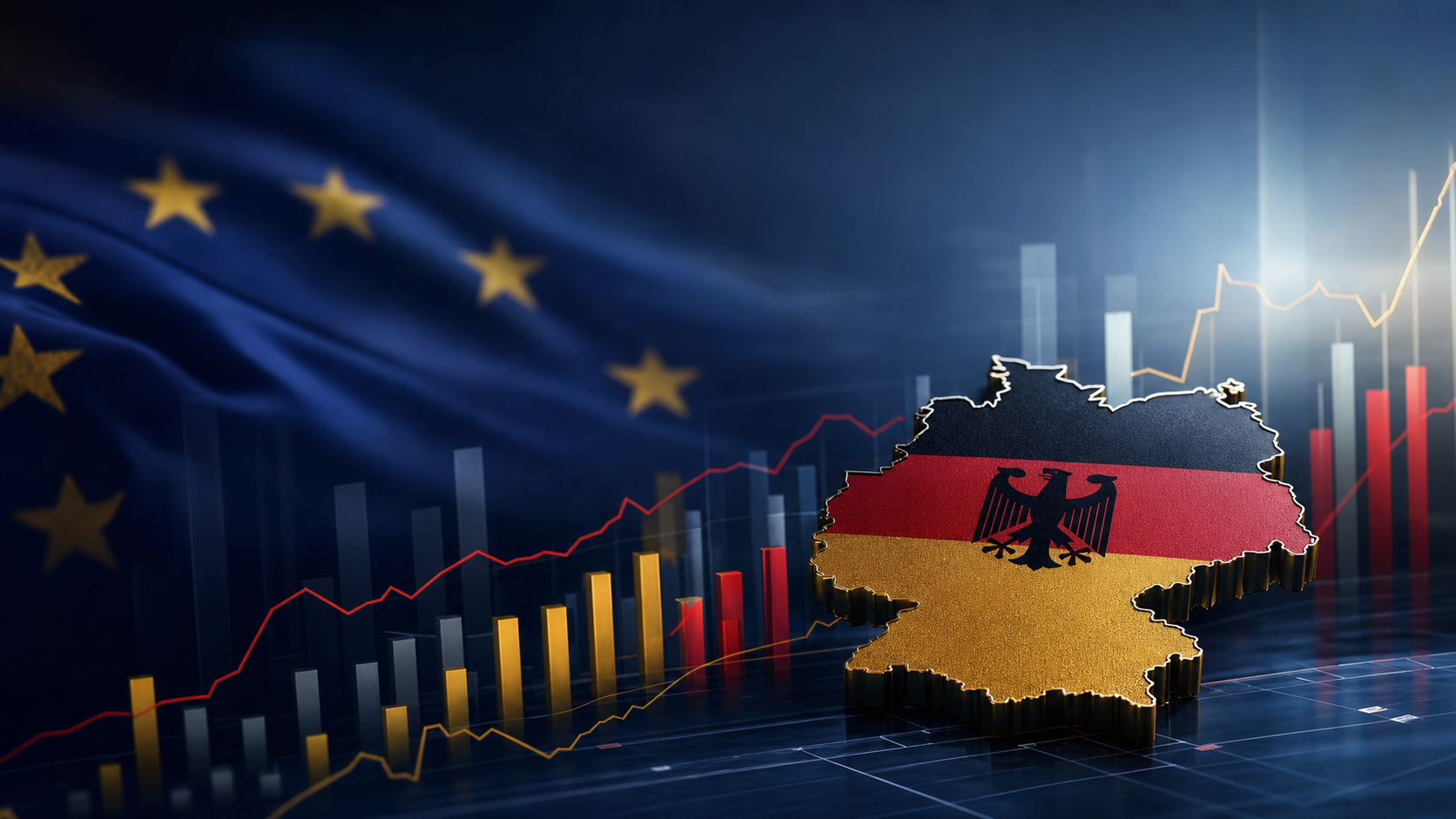
Europe's model student in crisis: Why the German economy is better than its reputation – and yet stagnating – Image: Xpert.Digital
The paradox of the German economy in 2026: Low debt, no growth: The bitter truth about Germany as a business location
Dilapidated bridges, but top employment: The divided picture of our economy
Germany in 2026: An economic hub under constant stress. While dire news about stagnant growth, crumbling infrastructure, and sluggish digitalization dominates the headlines, a closer look at the raw figures reveals a surprisingly different picture. In direct comparison with the 27 EU member states, Germany shines in key areas such as national debt, inflation control, and the employment rate. How does this solid macroeconomic foundation reconcile with the noticeable economic slowdown?
Germany's economy in comparison to other EU countries: Solid foundation, shaky future?
Stability despite stagnation: A contradiction that becomes the program
The German economy has been mired in a growth slump for years, which many commentators rightly describe as a structural crisis. After two consecutive years of recession and a minimal increase of just 0.2 percent in 2025, research institutes and the German government are forecasting growth rates for 2026 that, depending on the source, range between 0.5 and 1.3 percent. This discrepancy between the forecasts already demonstrates how fragile the economic situation actually is. And yet, on closer inspection, it becomes apparent that Germany fares better than the average of the 27 European member states in a number of key macroeconomic indicators. This apparent contradiction—weak growth coupled with solid fundamentals—is the crux of the current German economic situation and deserves a more nuanced examination.
The four key indicators listed in the current Statista graphic based on Eurostat data paint a remarkably consistent picture. Germany consistently performs better than the EU average in terms of gross government debt, inflation rate, employment rate, and unemployment rate. This raises the question of why this solid foundation is not automatically translated into stronger growth and where the real obstacles to growth in the German economy lie.
The debt advantage: Fiscal discipline as a double-edged sword
With a gross national debt of 63.5 percent of gross domestic product in the fourth quarter of 2025, Germany not only significantly undercuts the EU average of 81.7 percent, but also remains well below the Maastricht reference value of 60 percent, which is considered the upper limit for sound fiscal management in the eurozone. This comparatively low level of debt is the result of decades of fiscal restraint, characterized primarily by the debt brake enshrined in the Basic Law (Germany's constitution). While many European partner countries, especially France, Italy, and Greece, have accumulated considerable debt since the financial and euro crisis, Germany has largely preserved its fiscal leeway.
This leeway is now proving to be a crucial strategic advantage, as the German government is increasingly using it to counteract economic downturns with debt-financed special funds for infrastructure, climate neutrality, and defense. More than €108 billion is earmarked for defense alone in 2026, and economists from Goldman Sachs and other firms estimate the positive growth effect of this additional spending at around 0.5 percentage points of gross domestic product. The German government itself anticipates that economic and fiscal policy measures will contribute roughly two-thirds of a percentage point to the expected GDP growth in 2026. Thus, low debt is not only a testament to past fiscal soundness but also the foundation for future fiscal flexibility in a time of multiple crises.
However, this restraint also has its downside. Critics have long pointed out that Germany's decades of fiscal austerity have come at the expense of necessary investments in infrastructure, education, and digitalization. The low level of debt was partly achieved through a wait-and-see approach to public investment, the consequences of which are now evident in dilapidated bridges, overcrowded school buildings, and a digitally backward administration. The question of whether a stricter fiscal policy is more advantageous in the long run than somewhat higher, but investment-oriented, debt remains one of the country's central economic policy debates.
Price stability as a location factor: Why lower inflation is more than just a number
The inflation rate in Germany was 2.4 percent in June 2026, below the EU average of 2.9 percent. This difference may seem small at first glance, but it has far-reaching consequences for purchasing power, wage negotiations, and the real competitiveness of companies. More moderate inflation means that the European Central Bank (ECB) feels less pressure to implement drastic interest rate cuts, which in turn facilitates investment decisions by companies. Various institutions, such as the German Institute for Economic Research (DIW Berlin), anticipate that no further significant interest rate hikes by the ECB are expected in the near future, thus stabilizing financing conditions for the economy as a whole.
Germany's comparatively lower inflation can be attributed, among other things, to its strongly export-oriented industrial structure, which partially dampens domestic price pressures, and to a wage-setting process through collective bargaining agreements that remains relatively disciplined by international standards. At the same time, forecasts for the coming years show a degree of convergence, with several institutes predicting inflation rates between 2.2 and 3.1 percent for Germany in 2026 and 2027, depending on the impact of geopolitical risk factors such as the Middle East conflict on energy prices. This range of forecasts illustrates how strongly external shocks can continue to influence price developments, even in an economy with a structurally moderate tendency toward inflation.
The labor market as a German success story with cracks
The German economy's strength is perhaps most evident in a European comparison when looking at its labor market. With an employment rate of 81.5 percent in the first quarter of 2026, Germany is significantly above the EU average of 76.3 percent, and the unemployment rate of 3.8 percent in May 2026 is also considerably lower than the EU average of 5.9 percent. These figures confirm a pattern that has characterized the German economy since the Agenda 2010 reforms and especially since the financial crisis of 2008/2009: a remarkable ability to maintain employment even during challenging economic periods.
A key structural factor in this is the dual vocational training system, which combines theoretical vocational school education with practical on-the-job training and is repeatedly cited internationally as a model for a smooth transition between school and working life. Nine out of ten companies providing training still consider this system an indispensable instrument for securing their own skilled workforce, and the retention rate for trainees was around 79 percent in 2024. This model makes a significant contribution to ensuring that qualifications are closely aligned with the actual needs of companies and that youth unemployment remains low by international standards.
But this very model of success is increasingly showing signs of fatigue. The number of newly concluded dual vocational training contracts fell by 2.8 percent in 2025 compared to the previous year, to 461,800, while at the same time almost 40,000 young people remained completely without a training position – the highest number since 2009. Only 18.7 percent of companies offer any training at all, a historic low that particularly affects smaller companies, which are increasingly withdrawing from training. At the same time, 57 percent of companies with staffing problems report that they specifically lack skilled workers with dual vocational training. The shortage of skilled workers thus remains a structural problem despite the economic downturn, one that could negatively impact the future growth potential of the economy if no countermeasures, such as an expansion of the apprenticeship guarantee or improved career guidance, are implemented.
Our EU and German expertise in business development, sales and marketing

Our EU and German expertise in business development, sales and marketing - Image: Xpert.Digital
Industry focus areas: B2B, digitalization (from AI to XR), mechanical engineering, logistics, renewable energies and industry
More information here:
A thematic hub offering insights and expertise:
- Knowledge platform covering global and regional economies, innovation and industry-specific trends
- A collection of analyses, insights, and background information from our key areas of focus
- A place for expertise and information on current developments in business and technology
- A hub for companies seeking information on markets, digitalization, and industry innovations
Germany's economy under scrutiny: Between industrial strength and the need for structural reform
Where Germany shines: Industry, exports and labor force participation
Beyond the four core indicators, the traditional strength of the German economy is particularly evident in industrial value creation and export performance. The manufacturing sector continues to form the backbone of the German economy and structurally distinguishes Germany from many other European economies that are more service-oriented. This industrial base, supported by a broad foundation of medium-sized enterprises, ensures a more stable demand for skilled labor compared to purely service-based economies and contributes to the robust employment situation.
Germany is also showing surprising strength in the digital transformation of companies: In the current Bitkom DESI Index 2026, Germany ranks 11th among the 27 EU member states in this sub-area and even 1st among the five most populous EU countries, partly due to a slightly positive trend in the number of unicorn startups. The quality of its digital infrastructure also scores above average, ranking 11th, driven by 5G network coverage of 99.5 percent of households, which is above the EU average of 96.8 percent. These partial successes put the often sweeping portrayal of a digitally backward German economy into perspective and show that reality is more nuanced than some public discourse suggests.
Where the need to catch up begins: Growth, investment and administration
Despite the strengths described, weak growth remains the central problem of the German economy. Following declines in gross domestic product in 2023 and 2024 and stagnation in 2025, forecasts for 2026 show considerable variation: While the German government, in its latest spring projection, anticipates growth of only 0.5 percent, primarily due to the strain caused by the Middle East conflict, other institutions such as KfW (0.7 percent) and the ifo Institute (0.8 percent) are somewhat more optimistic. These repeated downward revisions of growth forecasts throughout the year demonstrate a structural vulnerability to external shocks, be they from US tariff policies, geopolitical tensions in the Middle East, or an overall only moderately growing global economy.
A second key weakness lies in investment, particularly in the public sector. Since 2000, Germany has consistently invested less in its public infrastructure than the EU average. While across Europe, an average of around 3.7 percent of gross domestic product was spent annually on roads, schools, and other public infrastructure, Germany, at an average of only 2.1 percent, lagged significantly behind. Remarkably, this gap cannot be fully explained in academic studies by economic, fiscal, demographic, or institutional factors – nor solely by the debt brake. Rather, lengthy planning processes, a shortage of skilled workers in construction administrations, and chronic underfunding at the municipal level appear to be the underlying causes. This weakness in investment is becoming an increasingly pressing problem in light of the growing shortage of skilled workers and materials, because without functioning infrastructure, Germany's attractiveness as a business location for new companies and expansion investments diminishes.
Germany lags far behind in the digitalization of its public administration compared to other European countries. In the Bitkom DESI Index 2026, Germany ranks only 22nd out of 27 EU countries, one place lower than the previous year. Pre-filled government forms in Germany score just 52 points, while the EU average is 75.9 points, and only 69.6 percent of internet users utilize digital administrative services at all, compared to 76.0 percent EU-wide. Furthermore, in the overall digitalization ranking, Germany has fallen from 14th place last year to 17th, despite a slight improvement in its absolute score. This exemplifies a fundamental problem in German economic policy: progress in absolute terms is insufficient when other countries are advancing faster and the relative gap to the European leaders widens.
Structural reform is needed instead of short-term economic policy
A summary of Germany's economic situation reveals a country caught between proven stability and an urgent need for reform. Low public debt, moderate inflation, and a robust labor market form a solid foundation that makes Germany more resilient to external shocks than many other EU member states. This resilience is particularly evident when compared to highly indebted southern European economies, which would be significantly more vulnerable to similar external pressures.
At the same time, this fundamental stability should not obscure the fact that Germany is in a structural growth crisis that cannot be resolved through fiscal discipline alone. Weak investment in public infrastructure, lagging behind in the digitalization of public administration, and increasing problems in the dual vocational training system are homegrown structural deficits that have accumulated over decades and cannot be remedied in the short term. The currently increased government spending on infrastructure, defense, and climate neutrality—made possible by past fiscal leeway—offers a historic opportunity to address these deficits. Whether this opportunity is seized or squandered by bureaucratic hurdles and planning delays will be a decisive factor in determining whether Germany can maintain its relative strength in comparison to other EU countries in the long term, or whether the weak growth becomes entrenched as a permanent structural disadvantage. The next two to three years are therefore likely to be crucial for the country's future economic viability.
📈🚀 From visibility to trust 👀🤝 Your scalable path with Xpert.Digital


From visibility to trust: Your scalable path with Xpert.Digital - Image: Xpert.Digital
In industrial B2B, sustainable business relationships rarely emerge overnight. They develop step by step – through visibility, professional relevance, recurring touchpoints, and growing trust. Xpert.Digital's 4-stage model addresses precisely this: It offers a structured path that begins with a manageable entry point and can evolve into deeper collaboration in business development if needed.
Instead of relying on loud marketing promises, this model puts the relationship at the forefront. Companies start with clearly defined, easily calculable measures and then decide, based on their own experience, how far they want to expand the collaboration. A key factor for this undisturbed trust-building process: The platform completely avoids annoying advertising ads, so the editorial focus remains solely on the companies' expertise.
More information here:
Your global marketing and business development partner
☑️ Our business language is English or German
☑️ NEW: Correspondence in your native language!

Konrad Wolfenstein
I and my team are happy to be available to you as your personal advisor.
You can contact me by filling out the contact form here wolfenstein@xpert.digital:or simply call me at +49 7348 4088 965. My email address is
I'm looking forward to our joint project.