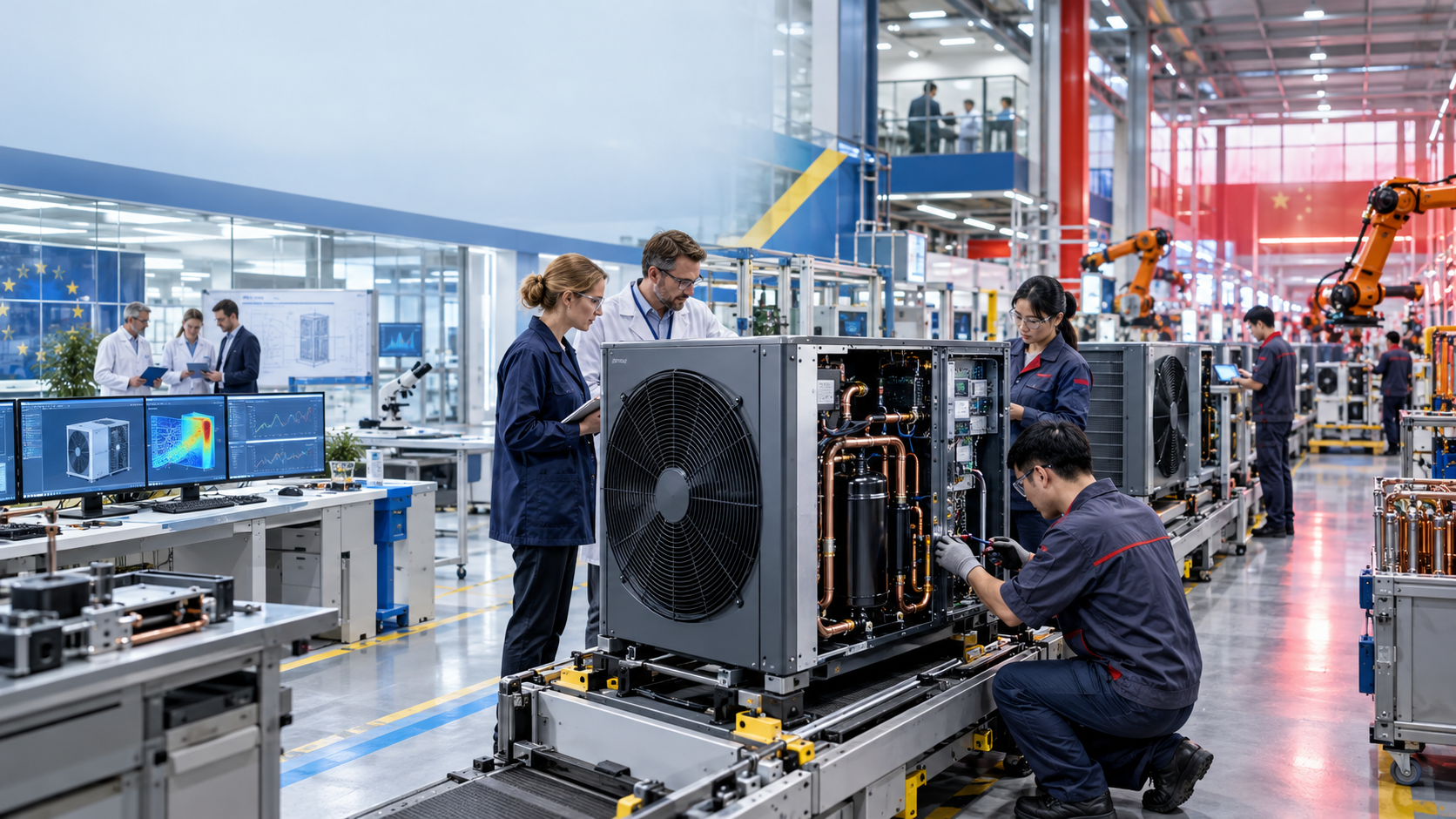
China's influence on Europe's heat pump industry: A new era of control? – Creative image on the topic, created with AI: Xpert.Digital
Heat pumps and geopolitical power games: Who controls the European market?
Chinese takeovers in Europe: threat or opportunity for industry?
The battle for heat pumps: How China is conquering Europe's markets
The heat pump industry in Europe is on the verge of a profound transformation with not only economic but also geopolitical dimensions. Chinese manufacturers are showing increasing interest in acquiring or investing in European companies and production facilities. This development is further fueled by the European Union's efforts to link public funding to European value creation and sustainability. While European industry attempts to protect itself against full-scale exports from China, a paradoxical situation could arise: the stricter the regulations on heat pump imports, the more attractive it becomes for Chinese companies to operate local production facilities in the EU.
Against this backdrop, the heat pump is becoming a key product that extends far beyond its function as a heating appliance. It is at the heart of energy policy, climate protection, and technological development in Europe. Whoever gains control over production, technology, and data in this sector will not only influence heat supply but also the future industrial sovereignty of the continent. The transformation of the heat pump industry is therefore not just a question of technology but also of geopolitical power dynamics in an increasingly interconnected world.
Europe's heat pump industry under Chinese control
Europe's heat pump market is becoming the stage for an industrial policy power struggle. Several Chinese manufacturers are considering acquiring production capacity in the European Union, taking stakes in European companies, or converting existing factories for heat pump production. The trigger is not solely the prospect of a growing sales market in the long term. Crucially, it is the European Union's attempt to more closely link public funding to European value creation, security of supply, and sustainable production. What is intended to protect domestic industry could, in fact, unleash a new wave of Chinese direct investment and acquisitions.
This creates a paradoxical situation. The more Europe restricts the import of heat pumps manufactured entirely in China, the more attractive it becomes for Chinese companies to produce within the EU. Regulation, therefore, does not necessarily close the European market to Chinese suppliers. Rather, it changes the mode of entry: from exporter to local producer, from supplier to shareholder, and potentially from competitor to owner of established European brands. This is not inherently negative from an economic perspective, but it does raise questions about control, technology, supply chains, employment, and the long-term distribution of industrial value creation.
Heat pumps are therefore far more than just another heating appliance. They intertwine building policy, the electricity market, climate protection, energy supply, mechanical engineering, refrigeration technology, semiconductors, power electronics, and digital control. Whoever controls production volume, key components, data access, and distribution channels in this market significantly influences Europe's future heat supply. The upcoming decisions thus affect not only individual manufacturers, but also the question of whether Europe shapes the transition to electrified heat with its own competitive industry or ultimately provides primarily a sales market for foreign-controlled corporations.
From heating appliance to key industry
The strategic value of heat pumps stems from their role in the energy system. Buildings are among the largest energy consumers in Europe, and a significant portion of gas demand is for space heating and hot water. Heat pumps can reduce this consumption because they utilize ambient heat from the air, ground, or water, generating multiple units of heat from a single unit of electricity. Their widespread adoption thus fundamentally reduces dependence on fossil fuel imports, but simultaneously increases the importance of electricity grids, flexible tariffs, storage, and digital load management.
From an industrial perspective, this is a complex system product. A manufacturer must integrate compressors, heat exchangers, valves, pumps, sensors, refrigerant circuits, power electronics, control software, and housing into a reliable unit. Additional requirements include noise levels, efficiency, frost resistance, high flow temperatures, cybersecurity, and integration into building energy management systems. The technical challenge is particularly demanding in existing European buildings, as many are poorly insulated, have varying heating surfaces, and require high flow temperatures at low outside temperatures.
This traditionally gives European manufacturers an advantage in the high-end segment. They have experience with water-based heating systems, demanding climates, local standards, installation practices, and a dense network of skilled tradespeople, wholesalers, and customer service. Chinese suppliers, on the other hand, bring enormous economies of scale from air conditioning and refrigeration technology, a tightly integrated supplier base, and high levels of expertise in automated manufacturing. It is precisely this combination that makes the competition so intense: Europe is strong in system integration and application, while China excels in industrial scaling, components, and costs.
The market is growing, but not in a straight line
The long-term demand outlook is strong, but the European heat pump market has recently demonstrated its strong dependence on political and economic conditions. Following the boom triggered by the energy crisis, sales declined significantly in 2023 and especially in 2024. Changes in subsidies, high financing costs, weak new construction activity, uncertain consumers, falling gas prices, and controversial debates about building regulations all dampened sales. Many companies had previously built up additional capacity and subsequently faced underutilization, excess inventory, and cost pressures.
A recovery began in 2025. In 21 surveyed European countries, approximately 2.9 million heat pumps were sold, about 13 percent more than in the previous year. The total number of units in operation rose to roughly 29.3 million. Germany recorded particularly strong growth; with approximately 299,000 units sold, the heat pump became the best-selling heating system there for the first time, accounting for nearly half of all new heat generator sales. France remained the largest market by unit sales, with more than half a million units sold, followed by Italy.
This recovery, however, should not be mistaken for a guaranteed growth path. Enormous differences exist between countries. Scandinavian markets have high installation rates, while countries like Poland or the United Kingdom still possess significant untapped potential relative to the number of households. Sales are sensitive to subsidy conditions, the ratio of electricity to gas prices, and the availability of qualified installers. A factory investment decision with a 20-year lifespan thus enters a market where demand can fluctuate considerably in the short term due to political announcements or budgetary decisions.
This very volatility increases the pressure to consolidate. Underutilized plants, weaker balance sheets, and postponed investments create acquisition opportunities. For well-capitalized Chinese corporations, a European investment can therefore be more advantageous than the lengthy process of building a completely new site. They acquire production facilities, experienced employees, certifications, brands, distribution networks, and relationships with skilled tradespeople all in one package. For European owners, the involvement of a strategic investor can simultaneously provide a solution to their capital requirements and a lack of scalability.
Brussels' rules of origin are changing competition
European industrial policy is gradually shifting from a largely technology-neutral approach to promoting demand towards one that places greater emphasis on origin, resilience, and sustainability. The Net-Zero Industry Act introduces qualitative criteria for certain public procurement and funding measures. These include environmental sustainability, supply capability, cybersecurity, and the diversification of sourcing. The proposed Industrial Accelerator Act goes further, aiming to more specifically favor European value creation in strategic technologies.
For water-based heat pumps, the current proposal stipulates that, after a transitional period, they must originate in the European Union to benefit from certain public support instruments. The decisive factor is not the brand logo on the casing, but rather the product's economic origin and the value-added share. Details may still change during the legislative process. Nevertheless, the current political direction already provides strong investment incentives, as manufacturers must plan their location strategy years before binding rules come into effect.
Member states are also tightening their subsidy policies. France, for example, now only supports products in certain programs that meet defined European origin and environmental requirements. Germany plans to further differentiate its subsidies from 2027 onwards: the eligible subsidy for heat pumps manufactured outside the EU will be significantly lower than for European products. For a private household, this difference could amount to several thousand euros. This transforms origin from an abstract industrial policy criterion into a tangible competitive factor in sales negotiations.
Economically, such rules act as an investment filter. They don't necessarily increase the cost of every import through a traditional tariff, but they do change the effective final price of subsidized products. A Chinese manufacturer can react to this in three ways: It can accept a smaller eligible customer base, build its own factory in Europe, or acquire or invest in a European producer. The third option is often the fastest because, in addition to manufacturing, it also unlocks technical expertise, market knowledge, and service capabilities.
Chinese capital follows the promotion
Industry reports indicate that at least three Chinese companies are seeking access to heat pump factories in the EU. Discussions are underway regarding complete takeovers, majority or minority stakes, collaborations with European manufacturers, and the purchase of existing plants from other industries. This interest is understandable: companies that establish a European production base before stricter rules of origin come into full effect can adapt their supply chains and products in a timely manner.
This isn't just about circumventing funding obstacles. Local manufacturing shortens delivery times, reduces storage and transport costs, facilitates adaptation to national regulations, and increases credibility with installers. Unlike standardized consumer electronics, heat pumps are rarely sold solely on the basis of the lowest price. Planning, sizing, hydraulic integration, commissioning, maintenance, and spare parts supply determine economic success. A European production site can therefore possess strategic value that extends far beyond mere assembly.
Midea provides a compelling example. In 2016, the Chinese conglomerate acquired a majority stake in the Italian climate control and heat pump specialist Clivet and transformed its Feltre site into a European production and development center. In September 2026, Clivet commissioned a new factory there, covering approximately 14,000 square meters. This €24 million investment doubled the capacity of certain commercial product lines; at full capacity, the plant is expected to produce around 8,800 units per year. This model demonstrates that Chinese ownership and European production are not mutually exclusive.
Furthermore, Haier and Midea attempted to acquire the Italian heating technology provider Riello from the US corporation Carrier. The Italian government blocked a sale to Chinese buyers using its special intervention rights for strategic companies. Ultimately, Riello was sold to the Italian manufacturer Ariston. This case illustrates that freedom of investment and security interests will increasingly clash in the future. Not every transaction will be politically acceptable, even if it appears economically sound.
Europe's strength ends at the factory gate
At first glance, Europe is in a comfortable position. Around 70 percent of the heat pumps installed in Europe are also assembled in Europe. The industry has approximately 300 manufacturing sites for units and components and, according to estimates, secures around 433,000 direct and indirect jobs. European companies are among the technological leaders in sophisticated water-based systems, large industrial heat pumps, and integration into district heating networks.
These figures, however, mask a deeper dependency. Final assembly is not the same as industrial sovereignty. Depending on their design, components account for roughly 60 to 85 percent of production costs. Compressors, which compress the refrigerant in a closed loop and thus form the technical heart of the system, are particularly critical. China possesses approximately 90 percent of the world's capacity for certain rotary compressors and also holds strong positions in four-way valves, refrigerants, power electronics, and rare earth elements.
Global heat pump manufacturing capacity was approximately 145 gigawatts per year in 2024. China accounted for around 35 percent of this, the United States about 25 percent, and the European Union roughly 20 percent. While production of finished units is more regionally distributed than that of solar modules or battery cells, the dependency runs deeper in the supply chain. A European system may have been formally assembled in the EU but still contain key components from China.
This creates a dilemma for rules of origin. If they are defined too superficially, limited final assembly in Europe suffices, while research, component production, intellectual property, and a large portion of the profit margin remain outside the EU. If they are defined too strictly, costs and supply bottlenecks will increase in the short term because European alternatives are not available in sufficient quantities for some components. A credible industrial policy must therefore distinguish between mere screwdriver assembly and unrealistic demands for self-sufficiency.
The price advantage is structural
Chinese manufacturers benefit from more than just lower wages. Their advantage lies in large production volumes, high automation, closely integrated supply networks, favorable financing, and industrial proximity to global air conditioning production. Many components of an air-to-water heat pump are derived from related technologies that are already manufactured in enormous quantities in China. This reduces purchase prices, development times, and investment costs per unit.
The final assembly of a heat pump in Europe is estimated to cost roughly twice as much as in China. For air-to-water systems, the overall manufacturing cost disadvantage in Europe compared to China can reach approximately 60 percent. Such differences cannot be offset by subsidies alone. They reflect the structure of entire industrial ecosystems: toolmaking, electronics, motors, compressors, heat exchangers, logistics, and financing are all interconnected.
European manufacturers must therefore avoid being forced into a purely price-driven competition with standardized devices. Their advantage lies in high efficiency at low outdoor temperatures, quiet systems, durable construction, natural refrigerant, high flow temperatures, intelligent controls, and reliable service. However, this differentiation only works if customers recognize the added value and installers can communicate it effectively. As soon as public subsidies reward almost exclusively the purchase price, they unintentionally strengthen suppliers with the lowest manufacturing costs.
At the same time, Europe's cost disadvantage should not be romanticized. Expensive production is not a sign of quality. Chinese manufacturers are rapidly improving their technology, investing heavily in research, and using artificial intelligence for development, production control, and maintenance. Those in Europe who rely on regulation without improving productivity, standardization, and scalability are merely buying time. Permanently protecting inefficient structures would burden consumers and slow down the energy transition.
New: Patent from the USA – install solar parks up to 30% cheaper and 40% faster and easier – with explanatory videos!

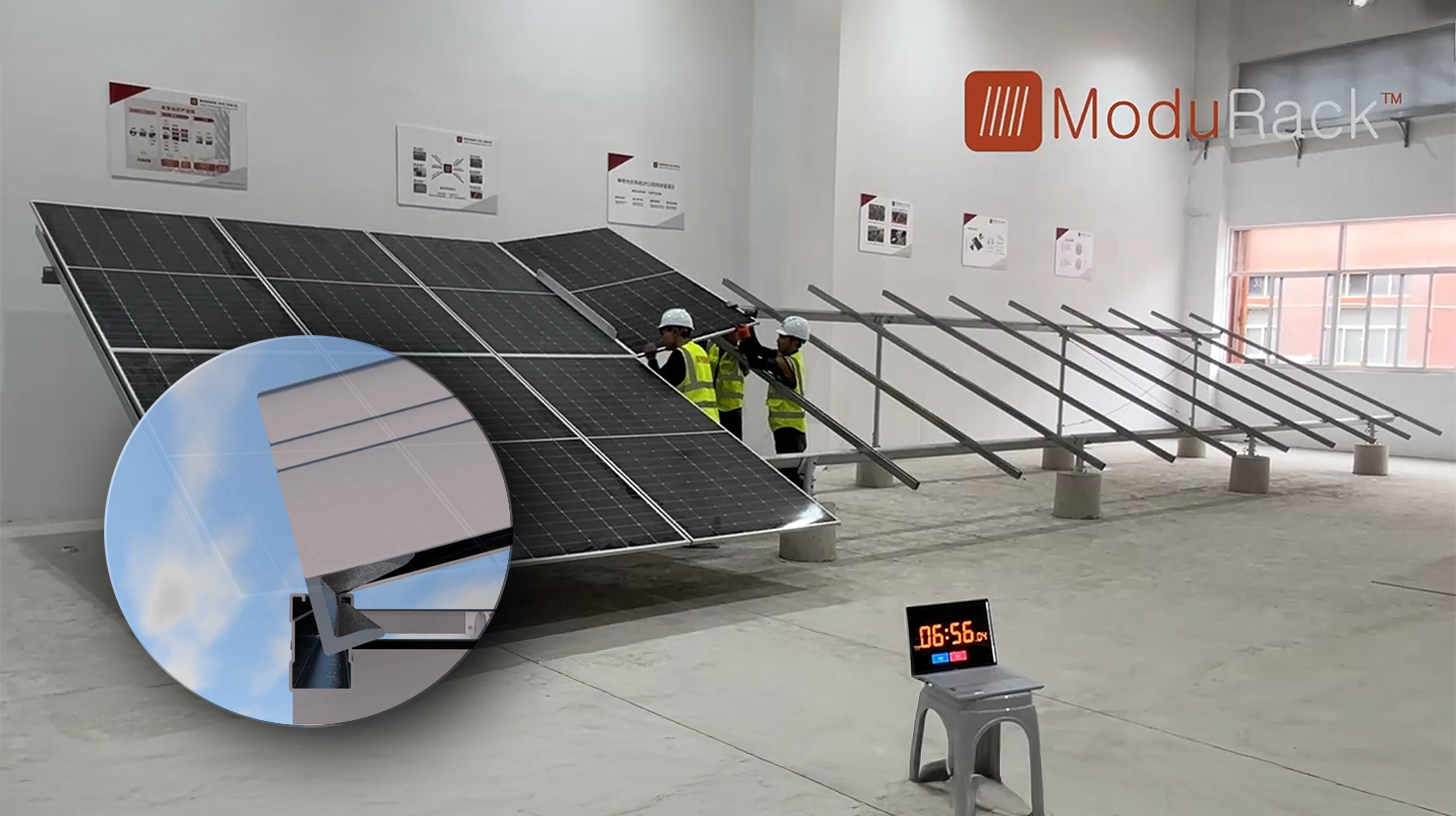
New: Patent from the USA – Install solar parks up to 30% cheaper and 40% faster and easier – with explanatory videos! - Image: Xpert.Digital
The core of this technological advancement is the deliberate departure from conventional clamp mounting, which has been the standard for decades. The new, more time- and cost-effective mounting system addresses this with a fundamentally different, more intelligent concept. Instead of clamping the modules at specific points, they are inserted into a continuous, specially shaped support rail and held securely in place. This design ensures that all forces – whether static loads from snow or dynamic loads from wind – are distributed evenly across the entire length of the module frame.
More information here:
Chinese investments in Europe's heat pump market: opportunities and risks
Acquisitions can strengthen Europe's industry
Foreign direct investment can bring significant advantages. A Chinese investor can provide capital for new production lines, reduce purchasing costs, open up international sales markets, and integrate a European site into a global production network. Existing jobs can be secured, additional positions created, and research projects accelerated. Particularly for medium-sized European manufacturers suffering from high financing costs and fluctuating demand, a financially strong partner can enable the necessary scaling.
Local production also generates spillover effects. Suppliers receive orders, employees acquire new skills, regional universities cooperate with development centers, and logistics become more firmly rooted in Europe. When a company develops and produces for the European market, it must address local standards, buildings, and customer needs. This can lead to genuine technology transfer in both directions.
The Clivet example shows how an acquisition can lead to investment and site expansion. A blanket rejection of Chinese capital would therefore be economically short-sighted. Europe needs investment to achieve its climate goals, and not every foreign involvement leads to a loss of control or relocation. Japanese and South Korean companies have long been producing in Europe and are an accepted part of the industrial base.
The conditions are crucial. A positive contribution arises when research, product responsibility, skilled employment, and key supplier relationships grow in Europe. A model that retains a European brand name but reduces the factory to minimal assembly of imported components is less convincing. Therefore, the economic evaluation must not be limited to the number of assembled devices. It must consider where patents, software, purchasing power, data, management decisions, and profits are located.
Loss of control is not an abstract risk
Acquisitions can become problematic if they permanently remove critical knowledge, market channels, and strategic decisions from European control. Companies with their own compressor technology, power electronics, control software, or a strong network of installers are particularly vulnerable. If such a supplier is integrated into a non-European corporation, the new parent company can align research priorities, procurement, and investments with its global interests.
Access to operational data is also gaining importance. Modern heat pumps are networked devices. They record temperatures, consumption, operating times, and sometimes information about buildings and user behavior. In smart grids, millions of systems can be controlled as flexible loads. This increases the importance of cybersecurity, data storage, software updates, and clear accountability for security vulnerabilities. In this context, the origin of the metal casing is less important than control over the cloud platform, firmware, and interfaces.
Another risk factor is the possibility of cross-subsidization. A global corporation can temporarily offer very low prices in Europe to gain market share and distribution channels. If this puts local competitors under pressure, the market structure can narrow in the long term. If the number of independent European manufacturers decreases, Europe loses not only production capacity but also bargaining power and technological diversity.
However, this does not mean that every Chinese acquisition should be prohibited. A blanket ban could discourage investment, provoke countermeasures, and cut European companies off from important supply chains. A more sensible approach is a differentiated assessment based on clear criteria: technological criticality, data access, market position, potential state influence, impact on competition, location commitments, and the company's replaceability within Europe.
Subsidies can be very expensive for consumers
Industrial policy origin criteria come at a price. If cheaper products receive less funding, households either have to contribute more themselves or the government has to provide more money. This can slow the adoption of heat pumps, especially among lower-income homeowners and in unrenovated buildings with high conversion costs. Excessive protection for manufacturers would then contradict the climate policy goal of replacing fossil fuel heating systems as quickly as possible.
The total cost of a heat pump is not just the unit itself. Planning, installation, hydraulic balancing, electrical work, and potentially new radiators and grid connection make up a significant portion of the investment. In many markets, the bottleneck is more often skilled tradespeople than manufacturers. Therefore, a subsidy program that focuses too heavily on the purchase of the unit may miss the real cost issue.
At the same time, the lowest purchase price is not necessarily the best option for the economy as a whole. A device with poor spare parts availability, a short lifespan, or insufficient efficiency will ultimately lead to higher costs. If European funding links quality, repairability, efficiency, and safety criteria with origin requirements, it can steer the market toward more durable systems. For this to happen, the criteria must be measurable, transparent, and technology-neutral.
The key challenge is to avoid pitting climate policy against industrial policy. Subsidies should stabilize sales without financing long-term dependencies. A gradual model would be more suitable than an abrupt exclusion: The required European value-added share could increase step by step, while particularly efficient, repairable, and grid-connected devices would receive additional benefits. Manufacturers would gain planning certainty, and consumers would not be suddenly confronted with sharply rising prices.
Ownership and origin are two different issues
A device manufactured in Europe may belong to a Chinese corporation. Conversely, a European brand may source a large portion of its components from China. Therefore, simply distinguishing between European and Chinese heat pumps is insufficient. A meaningful assessment requires considering at least four factors: the location of final assembly, the origin of key components, control over technology and data, and the location of the beneficial owner.
These levels may require different policy responses. For employment and regional value creation, the production location is important. For security of supply, the origin of critical components matters. Innovation capacity depends on research, patents, and qualified development teams. For strategic control, ownership, voting rights, and data access are relevant. A single origin label cannot fully reflect these differences.
The EU should therefore avoid equating formal origin with industrial sovereignty. If a corporation merely assembles imported modules in Europe, it may meet a minimum requirement without significantly reducing its dependency. Conversely, a foreign-controlled company with European research, local component manufacturing, and long-term site commitments can make a greater contribution than a European brand owner with largely outsourced production.
A modern industrial policy must therefore be value-added based. It should precisely record what proportion of materials, components, software, research, and manufacturing originates in Europe. While this increases the administrative burden, it prevents symbolic localization. Digital product passports and auditable supply chain data could help to more reliably demonstrate origin and sustainability.
The real bottleneck is in the engine room
The political debate often focuses on finished heat pumps and visible brands. However, some seemingly insignificant components are strategically more important. The compressor significantly determines efficiency, noise level, lifespan, and operating range. Power electronics regulate the speed and enable flexible adjustment to the heating demand. Valves control the refrigerant flow, sensors provide operating data, and the software optimizes the overall system.
Europe should therefore not invest its limited funding exclusively in additional final assembly. Considerable capacity already exists in this sector, which was partially underutilized during the market downturn. A further subsidy race for assembly plants could create overcapacity, while maintaining dependence on compressors and electronics. A more effective industrial policy approach would be the targeted development of critical component production, combined with research into natural refrigerants, quiet systems, and high supply temperatures.
This requires scaling. A small European compressor factory can hardly compete on price with large-scale Asian production. Purchase guarantees, common standards, long-term procurement contracts, and European production alliances could pool the necessary demand. At the same time, Europe should expand partnerships with Japan, South Korea, and other technologically strong countries to avoid simply shifting its dependence on China to a single new supplier.
Recycling and the circular economy are also part of resilience. Heat pumps require copper, aluminum, electronics, and sometimes rare earth elements. European recovery of these materials reduces import dependencies and can stabilize costs in the long term. Repairable designs, standardized interfaces, and the remanufacturing of components would additionally create an industrial service sector.
The installer determines market share
Even the best factory strategy will fail without qualified specialists. Heat pumps must be correctly sized, installed, and adjusted. Errors in planning or hydraulics lead to high energy consumption, noise, and dissatisfied customers. Manufacturers with a high-performing network of installers therefore possess a competitive advantage that cannot be easily copied.
For Chinese corporations, European acquisitions are attractive for this reason as well. They are not only buying machinery and buildings, but also relationships with wholesalers, planners, energy suppliers, and tradespeople. A well-known local brand also reduces the perceived risk for the customer. In a market requiring extensive consultation, this advantage of trust can be more important than a moderate price difference.
European manufacturers, for their part, should expand service and digital support as a strategic bulwark. Automated design, remote commissioning, predictive maintenance, and rapid spare parts logistics can reduce installation costs and increase customer satisfaction. Making skilled tradespeople more productive will defend market share more effectively than political appeals.
For policymakers, this means not treating training and retraining programs as a secondary issue. The industry anticipates a very high additional demand for engineers, technicians, and installers in the coming years. Without these resources, demand will remain limited despite subsidies, factories will remain underutilized, and expansion will fail to achieve its intended energy policy impact.
Europe needs open gates with security checkpoints
A viable strategy must combine openness and control. Europe should not categorically reject Chinese investments, but neither should it automatically celebrate every local assembly project as a success. Investments that create additional capacity for critical components, anchor research in Europe, create jobs, and meet verifiable safety standards are desirable.
In the case of acquisitions of strategically important companies, authorities should be able to demand binding commitments. These include minimum investments, the preservation of research facilities, the protection of sensitive data, long-term supply obligations, and clear rules for future relocation. Such conditions must be verifiable and linked to sanctions. Non-binding promises are insufficient when it comes to industrial capabilities that are difficult to rebuild after a closure.
At the same time, Europe needs faster permitting processes, competitive energy prices, and better financing options for its own manufacturers. Origin requirements alone do not eliminate structural disadvantages. If a factory in Europe faces permanently higher electricity, construction, capital, and regulatory costs, its production will only be competitive to a limited extent, even with subsidies. Industrial policy must therefore consider the entire cost base.
Competition policy remains important. Mergers must not lead to a market structure in which a few global corporations control prices, data platforms, and spare parts supply. Open technical interfaces, data portability, and access to repair information can limit dependence on individual manufacturers. This will not only make the market safer but also more conducive to innovation.
Three possible development paths
In the first scenario, productive localization succeeds. Chinese companies invest in European factories, research, and suppliers. European manufacturers simultaneously increase productivity and specialization. Subsidies stabilize demand, while clear rules of origin encourage the development of local component production. Consumers benefit from increased competition, shorter supply chains, and technologically adapted products. This scenario combines climate protection with industrial renewal.
In the second scenario, a superficial Europeanization occurs. Many manufacturers only relocate final assembly to the EU, while compressors, electronics, software, and essential components continue to come from China. Formal funding criteria are met, but the strategic dependency remains. European brands gradually lose their independence, and a growing share of profits flows to non-European corporate headquarters. Policymakers could then pay high subsidies without gaining any real sovereignty.
In the third scenario, protectionism escalates. Europe abruptly tightens rules of origin, and China responds with trade restrictions or makes access to components and raw materials more difficult. Appliance prices rise, investments are postponed, and the expansion of heat pump production slows down. European manufacturers gain short-term protection but suffer from more expensive intermediate products and may lose access to the Chinese market. This scenario would be equally detrimental to the climate, consumers, and industry.
A combination of the first two paths is most likely. Chinese companies will establish real production capacities in Europe, while simultaneously leveraging their global cost advantages through imported components. Europe's political task is to gradually increase the local share without disrupting supply chains. Success cannot be measured by a single factory opening, but rather by whether an independent innovation and supply ecosystem develops over the years.
The energy transition is becoming a question of ownership
The search by Chinese manufacturers for European acquisition targets is not a surprising side effect, but a logical reaction to the new funding architecture. When public money is more strongly tied to European origin, international capital moves to where that origin can be produced. The EU has thus created a powerful lever, but must precisely define the desired outcome.
If the goal is simply to assemble more devices within Europe, Chinese investments can quickly achieve this objective. However, if technological sovereignty is the objective, this is insufficient. Compressors, power electronics, software, research, and data control must then be given greater consideration. The location of an assembly line is visible, but strategic power often lies in the less visible parts of the value chain.
Europe's best response is neither isolationism nor naivety. The continent should welcome Chinese capital where it creates additional industrial substance and set limits where critical technologies, data, or market structures are at risk. At the same time, European companies must become more productive, achieve larger production runs, and consistently expand their advantages in quality, systems integration, and service.
The heat pump alone will not determine Europe's climate future. However, it will serve as a test case for whether the EU has learned from its experiences with the solar industry, batteries, and digital platforms. If a smart combination of open competition, local value creation, and strategic control is achieved, Chinese involvement can complement Europe's industrial base. If, however, only formal origin labels and short-term subsidies are implemented, the next key technology risks being manufactured in European factories but no longer under European control.
Your partner for business development in the fields of photovoltaics and construction
From industrial rooftop PV to solar parks and larger solar parking lots
☑️ Our business language is English or German
☑️ NEW: Correspondence in your native language!

Konrad Wolfenstein
I and my team are happy to be available to you as your personal advisor.
You can contact me by filling out the contact form here wolfenstein@xpert.digital:or simply call me at +49 7348 4088 965. My email address is
I'm looking forward to our joint project.