
Deutsche Telekom invests 100 million euros in Mistral: Europe's AI bet begins in the factory – creative image on the topic, with AI: Xpert.Digital
Europe's AI should reach companies: What the partnership between Telekom and Mistral aims to achieve
AI from Europe for factories and government agencies: Telekom expands partnership with Mistral
More than data centers: How Telekom and Mistral want to turn industrial AI into a business
Deutsche Telekom is investing €100 million in Mistral AI, thereby forging a closer link between European AI technology, computing infrastructure, and industrial applications. The funds will be channeled through the T.Capital Tech Fund into the French company's Series D financing round. At the same time, both partners aim to develop a joint business with German companies and public institutions. Telekom will contribute its infrastructure, customer relationships, and integration expertise, while Mistral will provide AI models and enterprise software. The focus will be on industrial companies, government agencies, and regulated sectors. However, the collaboration is currently a strategic approach – the established joint business model still needs to prove itself.
Powerful AI models alone don't transform production processes, and data centers alone don't create productive applications. Economic value only arises when technology is integrated into concrete work processes, functions reliably, and delivers more benefits than it costs. This is precisely where the opportunity of the partnership lies – and simultaneously its greatest challenge: Significant investments in models and infrastructure must be recouped through paid applications, recurring revenue, and measurable productivity gains.
Deutsche Telekom's investment is part of a three-billion-euro financing round that values Mistral at more than 21 billion euros. In addition, Deutsche Telekom is investing nearly 250 million euros in expanding its Industrial AI Cloud in Munich, after the first phase reached full capacity after seven months. Together, these projects demonstrate the partners' commitment to developing an industrial AI offering. However, they do not yet prove that the investments will generate an adequate return or make companies permanently more efficient.
The crucial question, therefore, is not simply whether Europe can finance more AI companies or build additional computing power. The crucial question is whether this will lead to applications that reliably solve industrial problems, are economically viable, and simultaneously give customers sufficient control over their data and systems. Ultimately, whether the partnership results in a sustainable competitive advantage will not be determined by the amount of funding, but by whether companies can use the solutions more productively and generate viable revenue.
Telekom and Mistral: Europe's AI bet will be decided not in the data center, but in the factory
Deutsche Telekom is investing €100 million in Mistral AI, thereby pursuing two strategic goals: acquiring a stake in a European developer of high-performance AI models and laying the foundation for a joint business with German companies and public institutions. The capital is being channeled through the T.Capital Tech Fund into the French company's Series D financing round. The plan envisions a division of labor, with Telekom contributing computing infrastructure, customer relationships, and integration expertise, while Mistral provides AI models and enterprise software. The focus will be on industrial companies, government agencies, and regulated sectors. This investment is currently the starting point for a planned strategic partnership, not yet proof of an already established joint business model.
Therefore, what is economically interesting is not so much the participation itself, but rather the connection of different value chain stages. High-performance models alone do not change production processes. Data centers alone do not generate productive applications. And a large customer base does not guarantee that companies are willing to link their data, processes, and decisions with new AI systems. Only when these elements come together does an offering emerge that can be more than just another technical platform.
The central question, therefore, is not whether Europe can finance another AI company or install additional graphics processors. The crucial question is whether this will result in economically viable applications whose benefits outweigh the total costs. The merger of Telekom and Mistral has a comprehensible industrial logic in this regard. At the same time, it exposes the fundamental difficulties of the European AI business: high upfront investments, uncertain revenue models, demanding integration, and a promise of sovereignty that must prove itself in practical operation.
A small share with significantly greater strategic leverage
Deutsche Telekom's €100 million investment is a limited but significant amount within the Mistral financing round. The Series D round, announced in September, totals €3 billion and values the company, founded in 2023, at more than €21 billion after the funding. Investors include Samsung Electronics, Nvidia, and ASML. Samsung led the financing round along with other investors.
The Telekom investment corresponds to approximately 3.3 percent of the total financing volume. Based on a company valuation of exactly 21 billion euros, this would result in a calculated share of just under 0.48 percent. Since the valuation is above this threshold, the corresponding percentage would be slightly lower under simplified conditions. However, this does not allow for an exact equity stake to be derived: For that, information on share classes, special rights, and the specific capital structure would be required.
This scale nevertheless clarifies the nature of the investment. Telekom is not acquiring control of Mistral. Rather, it is securing a financial stake and improving the starting point for operational cooperation. The strategic benefit can therefore be considerably greater than the significance of the stake within the overall ownership structure.
To evaluate the investment, two potential sources of return must be considered separately. First, the value of the Mistral shares could increase. Second, Deutsche Telekom could generate additional revenue from computing power, software operations, integration, and support. These two developments are not identical. A stake can lose value even if individual joint customer projects are profitable. Conversely, Mistral's valuation can increase without resulting in a profitable AI business for Deutsche Telekom.
This commitment is therefore best understood as a combination of financial investment and strategic option. Deutsche Telekom gains access to a technology partnership without having to bear the full cost of developing its own fundamental AI models. Whether this option justifies its price will depend on its subsequent implementation.
Why Deutsche Telekom wants to sell more than just computing power
The planned division of labor addresses a problem that is often underestimated in the public AI debate: There is a considerable organizational and technical effort required between an impressive model and a reliably functioning business application.
An industrial corporation doesn't simply need a chatbot. It needs a system that can locate technical documents, respect access rights, integrate with existing software, and deliver verifiable results. A government agency needs not only linguistically convincing answers but also transparent processes, clear responsibilities, and controlled information handling. Regulated companies face additional requirements regarding documentation, security, and operational stability.
This is precisely where Telekom's economic function lies within the planned partnership. Its role is not limited to providing servers. Infrastructure, customer relationships, and integration expertise will jointly enable the transition from available technology to usable application. Mistral complements this with models, enterprise software, and technical deployment options.
This could lead to a business model with multiple revenue streams. Customers initially pay for design and implementation. Subsequently, recurring fees apply for computing capacity, software, monitoring, maintenance, and further development. Industry-specific customizations may also be included.
However, these revenue streams differ in their scalability. A largely standardized software service can be expanded to additional customers relatively efficiently. In contrast, a complex integration project requires additional personnel, coordination, and individual customization. The economic challenge lies in developing reusable solutions from the initial projects.
If every customer project remains custom-made, a solid service business may emerge, but not a highly scalable platform business. However, if interfaces, security concepts, and application components are standardized, the cost per additional customer can decrease. A significant portion of long-term profitability hinges on this transition.
The Munich expansion shows demand, but no return on investment yet
The infrastructure forms the material foundation of the strategy. The first expansion phase of the Industrial AI Cloud in Munich reached capacity after seven months. Therefore, Telekom is investing an additional 250 million euros in the site; this will more than double the computing power. The facility went into operation in February 2026.
Such rapid occupancy suggests that a market for high-performance AI infrastructure exists. It initially reduces the risk of building computing capacity without discernible demand. However, it would be premature to equate utilization with economic success.
For profitability, it's not just about whether capacity is allocated. Crucial factors are the prices at which this occurs, the services included, and the operator's costs. A fully booked facility can achieve a poor return on investment if high acquisition, energy, and operating costs coincide with low usage fees. Conversely, a specialized infrastructure with sophisticated services can be economically attractive even if its technical utilization isn't always at maximum.
The meaning of the term "utilization" must also remain precise. Contractually booked capacity is not the same as hardware that is continuously used intensively. Therefore, for an economic evaluation, information on contract durations, guaranteed purchase quantities, actual revenues generated, and ongoing costs would be necessary.
The expansion of nearly €250 million primarily demonstrates that Deutsche Telekom is translating its anticipated demand into additional capital commitment. This increases the potential revenue, but also the risk. Data centers must be operated economically over extended periods, while AI hardware and software can evolve rapidly.
A currently efficient system remains technically usable, but its economic viability can be threatened if newer systems deliver significantly better results per euro invested. Therefore, expansion is not only a bet on increased AI demand, but also on the ability to utilize infrastructure efficiently, operate it effectively, and develop it further.
Two investments, two different risk profiles
Taken together, the €100 million for Mistral and the nearly €250 million for the Munich expansion represent an additional commitment of approximately €350 million. However, this sum does not encompass Telekom's total AI expenditures to date, nor does it represent a single, unified investment project. It combines two economically distinct decisions.
The investment in Mistral is an equity investment. Its value depends on the company's performance, future financing, potential dividends, and later sale opportunities. In contrast, the infrastructure investment creates operational assets that must be refinanced through ongoing revenues and, where applicable, complementary services.
This distinction is important because the risks can reinforce each other. If demand for Mistral applications grows, the telecommunications infrastructure can also benefit. Conversely, if the joint offering develops more weakly than expected, the strategic importance of the investment and the utilization of certain capacities could simultaneously fall short of expectations.
On the other hand, a sufficiently open infrastructure can limit the risk. If data centers support different models, providers, and industrial applications, their profitability does not depend solely on the success of a single partner.
The partnership should therefore enable technological collaboration without creating unnecessary economic one-sidedness. For Deutsche Telekom, an exclusive agreement would only make sense if its benefits outweigh the resulting loss of flexibility. The same logic applies to customers: they need reliable services, but shouldn't have to replace their entire technical architecture for every subsequent change in their business model strategy.
Mistral needs Germany not only as a sales market
Mistral is simultaneously expanding its operational presence in Germany. Since the end of September, the company has maintained a branch in Munich. There, research teams will work on AI models for industrial applications and develop concrete use cases together with companies.
Economically, this location decision is more than just a sales measure. Industrial AI often doesn't arise from simply adopting a general model without modification. It requires expertise in production processes, technical interrelationships, documentation systems, and the economic consequences of errors.
Proximity to industrial users can therefore be a development advantage. A model provider learns earlier which tasks are truly valuable, what data is available, and where existing solutions fail. Such feedback helps to align research and product development with profitable demand.
For Mistral, the partnership with Telekom also opens up access to customers who don't buy solely based on technical performance data. Large companies and public institutions also value operational reliability, contact persons, contract terms, and the ability to provide long-term support.
Conversely, a German location can facilitate practical collaboration. Joint development teams need to understand requirements, oversee pilot projects, and translate results into existing processes. Geographical proximity doesn't replace technological quality, but it can reduce friction between development and application.
The crucial question remains whether individual collaborations will result in reusable products. An industrial application that only works under very limited conditions will not create a large market. A solution that can be transferred to many companies with manageable adjustments, on the other hand, has considerably greater economic potential.
Industrial AI earns its money by solving problems
The term industrial AI can encompass very different applications. Therefore, it is important not to equate voice-based assistance systems, data-driven forecasts, visual quality control, and the direct control of technical processes.
For the planned integration of models, enterprise software, and infrastructure, tasks involving the retrieval, summarization, structuring, or preparation of information initially appear plausible. This could include technical documentation, maintenance records, internal knowledge bases, or support in processing complex procedures. These are potential areas of application, not yet proven results of the partnership.
The economic benefit arises not from the linguistic quality of an answer, but from an improvement in the entire workflow. Can a service technician find relevant information faster? Is a fault narrowed down sooner? Is the effort required to create technical documentation reduced? Can specialists handle more tasks without increasing the error rate?
In applications with a direct impact on machinery, safety, or production quality, the requirements increase significantly. A convincingly formulated proposal is not a sufficient basis for decision-making in such cases. It must be reviewed, placed within the technical context, and, if necessary, reinforced by additional systems.
This leads to a sober prioritization: The most spectacular applications are not automatically the most economically attractive. Often, clearly defined tasks with frequent occurrences, measurable time expenditure, and manageable error risk provide a better starting point.
Starting with such processes can also be organizationally beneficial. Companies gain experience with data access, monitoring, and responsibilities before integrating AI into particularly critical processes. A phased rollout can increase learning gains while simultaneously limiting the risk of costly mistakes.
🎯🎯🎯 Data-driven B2B industry hub as a quasi-in-house solution

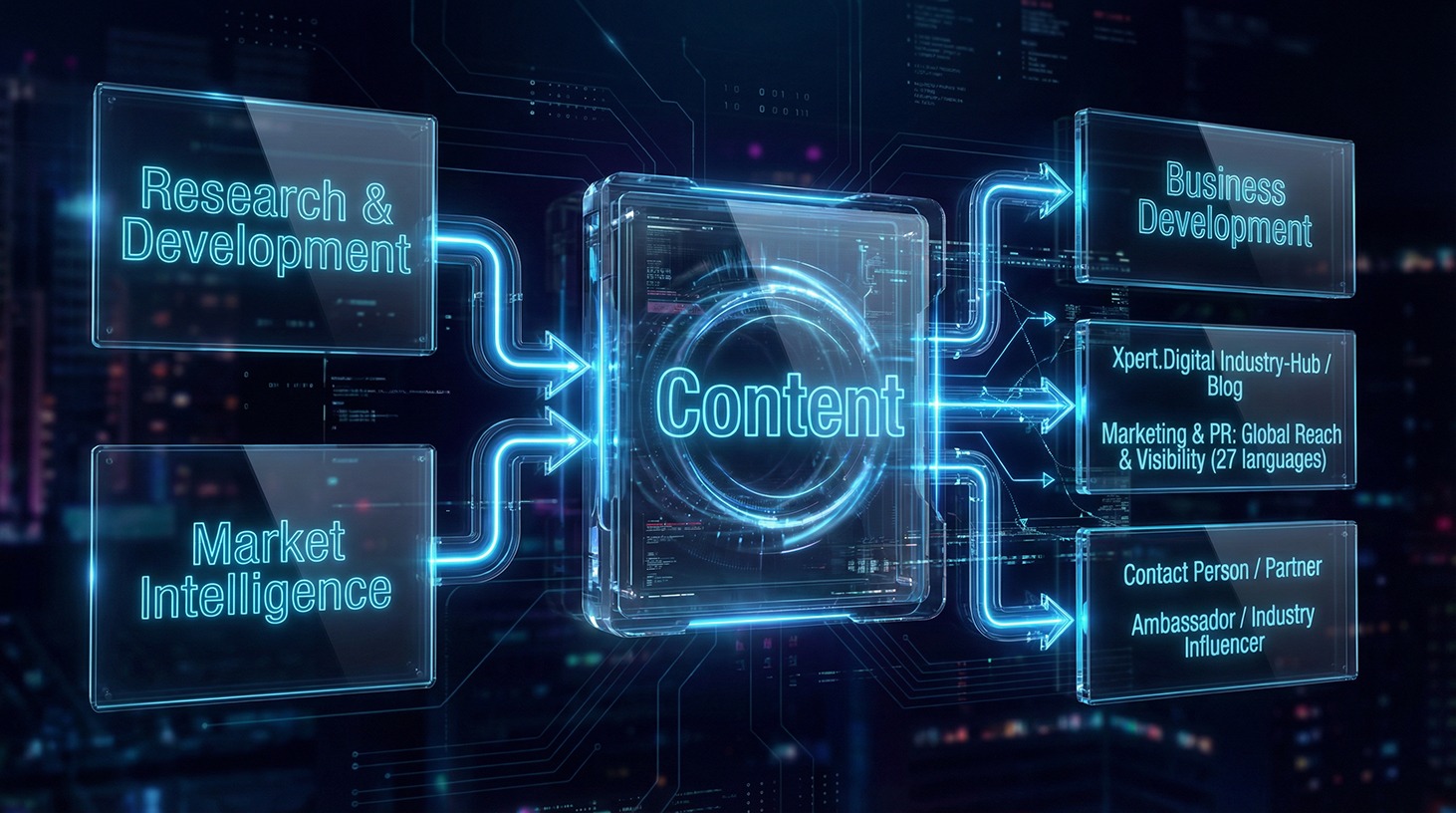
The quasi-in-house solution: How Xpert.Digital closes operational gaps in B2B marketing and sales – Smart Content-Driven Business - Image: Xpert.Digital
Xpert.Digital is a data-driven B2B industry hub led by Konrad Wolfenstein . The company acts as an external, quasi-in-house solution for industrial partners, closing operational gaps in marketing, content, and sales – without requiring additional resources on the client side.
More information here:
Mistral and Telekom: The future of industrial AI in Germany
From saved minutes to actual realized productivity
A data-driven AI strategy must differentiate between technical performance, time savings, and economic return. These factors are related but not identical.
A simplified calculation illustrates the difference. A company employs 1,000 people in jobs where an AI application would save an average of 15 minutes per workday. Assuming 220 workdays per year, this equates to 55,000 hours annually. If these hours are valued at an internal total cost of €50, this corresponds to a calculated capacity value of €2.75 million.
This is explicitly a model calculation and not a forecast for Telekom or Mistral customers. It initially only shows the order of magnitude that could result from relatively small daily improvements.
Whether this translates into an actual financial benefit depends on how the time saved is used. If employees can serve additional clients, complete projects faster, or eliminate bottlenecks, then there is an economic benefit. However, if the time saved remains unused organizationally, expenses will not automatically decrease.
At the same time, the full costs must be taken into account. These include not only model usage and computing power, but also implementation, data preparation, training, security testing, ongoing support, and the control of erroneous results.
Assuming total annual costs of one million euros and an additional 500,000 euros for implementation and conversion, the project initially appears attractive. However, if only one-third of the calculated time savings can be used productively, the corresponding capacity value decreases to approximately 917,000 euros. This significantly alters the valuation.
That's precisely why companies shouldn't evaluate AI projects solely based on demonstrations or subjective satisfaction. Crucial are verifiable key performance indicators (KPIs) before and after implementation: processing time, error rate, rework effort, throughput time, and actually usable additional capacity.
The underestimated bottleneck lies in the company data
Increased computing power and improved models can only partially compensate for incomplete, contradictory, or poorly accessible underlying information. Therefore, data organization is likely to be at least as important as model selection for the practical implementation of the partnership.
In a typical application scenario, an AI must be able to distinguish between current and outdated documents. It must recognize which information is relevant for a specific task and which person is authorized to access it. If incorrect documents are used, even a linguistically flawless answer may be factually unsuitable.
This shifts part of the value creation to tasks that receive less attention than new model generations: organizing data sets, clarifying responsibilities, creating interfaces and consistently implementing access rights.
This could create a new business opportunity for Deutsche Telekom. At the same time, the effort required per customer increases. The more fundamental data problems an implementation has to solve first, the longer it takes to reach productive use.
For customers, it is therefore important to distinguish between AI costs and necessary modernization. If a project becomes expensive because documents first need to be consolidated and outdated systems connected, not the entire expense can be attributed solely to AI. Nevertheless, it remains part of the economic decision if no benefit can be derived without this preliminary work.
A successful partnership would need to make this connection transparent. Exaggerated promises of short implementation times might facilitate sales in the short term, but damage trust and profitability in the long run.
Digital sovereignty is a question of control
Deutsche Telekom and Mistral explicitly position their collaboration within the context of sovereign European AI. This refers to the combination of infrastructure, models, and applications, enabling companies to use powerful technology while retaining control over their data and systems.
This concept only becomes economically meaningful when translated into verifiable characteristics. The location of a data center is one such characteristic, but not the only one. Equally important are access rights, technical dependencies, contractual terms, data portability, and the ability to modify or replace the models used.
A company can store its data in Germany and still be heavily dependent on a single provider. This would be the case, for example, if applications only function via proprietary interfaces and switching providers would require extensive new development.
Conversely, international technology can be deployed under certain conditions in such a way that a customer retains significant operational control. Sovereignty is therefore not a simple distinction between European and non-European. It describes the scope of action within a specific technical and contractual architecture.
This also includes the question of what happens in the event of a disruption or a change in the terms and conditions. Can data be exported? Is there an alternative operating environment? Will applications remain functional without a persistent connection to a specific service? Who can investigate security issues?
For regulated customers, this control can have economic value. A higher price may then be justified if it reduces relevant risks or makes deployment possible in the first place. However, the promise of sovereignty must not become a blanket justification for arbitrary price increases. It must deliver a demonstrable added value.
Open model weights create options, but not automatic independence
Mistral combines its strategy with models whose weights are accessible and with controllable deployment methods. The funding round is intended to strengthen research, computing capacity, infrastructure, and international marketing, among other things.
Openly available model weights can be an important option for companies because they create additional possibilities for independent operation and customization. However, this does not automatically mean that all components of a system are freely available or can be used without restrictions.
A reliable evaluation requires consideration of licensing terms, technical requirements, and the availability of complementary components. A model alone does not constitute a complete enterprise solution. Tools for data connectivity, monitoring, security, updates, and ongoing operation are also necessary.
The ability to switch providers also depends on more than just available weights. Applications can be tightly bound to a specific system due to their data structure, special interfaces, or individual customizations.
The potential advantage therefore lies not in blanket independence, but in additional options for action. Companies could shape operations and further development more independently or involve different service providers. Whether they can actually utilize these options, in turn, depends on their own expertise and a suitably structured architecture.
This creates a challenging competitive advantage for Telekom and Mistral: they would have to enable control while simultaneously simplifying operations to such an extent that customers do not have to become specialized AI infrastructure operators themselves.
Europe's AI needs international partners and its own negotiating power
The involvement of international technology companies in Mistral underscores that European AI is not emerging outside of global value chains. Samsung Electronics, Nvidia, and ASML represent different segments of the technology and industrial landscape. Their investment broadens the company's financial and strategic foundation.
In addition, there is the collaboration with Microsoft. The two companies have expanded their strategic alliance; this also involves additional European computing capacity, some of which Microsoft intends to use.
This does not automatically contradict the demand for greater European autonomy. A company can need international partners and still contribute to expanding the choices available to European customers.
The crucial factor is the distribution of control and economic benefits. Will additional European development and operational expertise emerge? Will customers be able to choose between multiple offerings? Or will only new interfaces be created while critical dependencies remain unchanged?
A realistic European strategy would therefore not have to aim for complete technological isolation. It would have to reduce particularly problematic dependencies while simultaneously maintaining access to international technology.
The partnership between Telekom and Mistral can thus be understood as an attempt to more closely link several European-based stages of the value chain. Its success would not be measured by whether every component is of European origin. More important would be whether European companies gain more choice, better control, and stronger negotiating power.
Mistral's valuation anticipates much of its future success
A company valuation of more than €21 billion says nothing about profits already generated. It primarily reflects expectations regarding future market position, growth, and profitability. The €3 billion financing increases Mistral's financial resources but does not replace proof of a sustainably profitable business.
Especially in the case of AI companies, several levels must be distinguished. Technological capabilities can generate customer interest. Customer interest can lead to contracts. Contracts can generate revenue. However, whether this translates into substantial profits depends on pricing, computing costs, personnel expenses, and long-term customer loyalty.
The publicly confirmed information regarding the Telekom stake does not provide a sufficient basis for deriving Mistral's profitability or a fair valuation. A sound analysis must not attempt to fill this gap with supposedly precise return expectations.
For Deutsche Telekom, this represents a classic investment risk. Further financing rounds could require additional capital or dilute existing shares. A weaker market phase could negatively impact the balance sheet or realizable value of the investment.
However, it would also be too narrow a view to consider the investment solely as an isolated financial asset. If it enables profitable customer relationships and infrastructure revenues, the overall strategic benefit can extend beyond the share price performance.
That is precisely why Telekom needs a dual system of performance monitoring: the development of the investment on the one hand and the demonstrable economic contribution of the operational cooperation on the other.
The competition will be decided on total costs and reliability
A European offering cannot permanently rely solely on its origin. Customers will evaluate the combination of performance, cost, control, and operational stability.
The price of a single model request is only one part of the equation. A seemingly inexpensive solution can become costly if results need to be frequently checked, errors corrected, or processes repeated. Conversely, a more expensive solution can be more economical if it operates more reliably and integrates better into existing workflows.
This presents a clear positioning opportunity for the partnership: not the cheapest computing power, but a favorable ratio between total costs and usable result could become the decisive selling point.
However, this presupposes that integration and operational services are efficiently organized. If high project costs are permanently masked by the sovereignty argument, competitiveness will remain limited.
It is equally insufficient to use a particularly large model for every task. For simple, frequently recurring tasks, a leaner solution can be more economical. More complex models should be used where their additional performance offers a measurable advantage.
The ability to appropriately combine different technical means could therefore become more important than exclusively adhering to a single model size or product generation. A successful offering would be one that reduces complexity for customers without imposing unnecessarily expensive architectural decisions on them.
Small and medium-sized enterprises need ready-made solutions, not new complexity
For medium-sized businesses, the planned connection is particularly relevant if it simplifies access to AI. While many potential applications require expertise, they do not justify extensive, individual technology development.
A medium-sized company may need support with technical documentation, preparing proposals, or internal knowledge retrieval. It doesn't necessarily need its own research department or permanently reserved high-performance computers for this.
The economic potential therefore lies in standardized offerings with manageable implementation effort, transparent costs, and clearly defined functions. A comprehensive but difficult-to-calculate transformation project may be less attractive to smaller customers than a limited application that reliably solves a specific problem.
For Telekom and Mistral, this target group would also serve as a test of their scalability. If solutions developed once can be reused with minor adjustments, a broader market emerges. If data, interfaces, and processes have to be completely rebuilt each time, costs quickly escalate.
Realistic expectations are also crucial. A standardized product cannot cover every unique aspect of a business. Conversely, the necessary customization must not turn a seemingly simple offering into a difficult-to-manage consulting project.
Access to the SME sector is therefore likely to depend less on spectacular model capabilities than on product design, implementation expertise, and economic predictability.
Authorities need demonstrable added value
For public institutions, too, the economic evaluation must be based on specific tasks. The proposed partnership is explicitly aimed at the public sector, without any specific applications or efficiency gains being derived from it at this stage.
Potential starting points lie in supporting information retrieval, document processing, and internal knowledge processes. The crucial question is whether this reduces processing times and relieves the burden on employees without compromising quality or traceability.
These boundaries are particularly important where individual rights, legally relevant assessments, or confidential information are affected. A linguistically plausible statement should not be confused with a sound decision.
Economically problematic would be isolated solutions that are introduced in parallel but are hardly compatible with each other. If each institution develops similar basic functions separately, a significant portion of the potential economies of scale can be lost.
A viable offering would therefore need to combine common technical foundations with adaptable specialist functions. At the same time, public sector clients should not unnecessarily tie their data and essential processes to a single provider.
For this partnership, a credible control and operating model could become a key differentiator. However, this would need to be demonstrated practically: through verifiable security concepts, clearly defined responsibilities, and results that justify the additional effort.
Three development paths will determine the economic future
Three basic scenarios can be distinguished for further developments. They are not predictions, but help to systematically classify opportunities and risks.
In a successful scenario, Telekom and Mistral will develop standardized and reliably operable applications from initial projects. Customers will achieve measurable improvements, the demand for computing power will grow, and recurring revenues will become more important. The investment will then strengthen an operational collaboration that remains economically viable even independently of rising company valuations.
In the medium scenario, a technically compelling but labor-intensive project-based business emerges. Individual customers benefit, but each implementation requires extensive customization. The partnership generates revenue and expertise, but fails to achieve the anticipated economies of scale. For Deutsche Telekom, this wouldn't necessarily be a failure, but it could fall short of expectations for a rapidly growing AI business.
In the worst-case scenario, infrastructure development and actual willingness to pay diverge. Pilot projects are not rolled out widely, revenues per unit of use come under pressure, and implementation costs remain high. At the same time, weaker performance from Mistral could negatively impact the value of the investment.
Individual announcements don't reveal which development is more likely. More telling are the conversion of pilot projects into permanent use, contract renewals, recurring revenues, and the effort required to support additional customers.
The key figures lie beyond the financing round
A reliable measure of success would need to combine several levels. On the customer side, economically viable time savings, reduced error costs, and improved process performance are crucial. On the supplier side, recurring revenues, contribution margins, and customer acquisition costs are relevant.
For infrastructure, actual revenues per capacity unit, energy and operating costs, and the quality of utilization must be considered. Long-term contracts can provide predictability, but are only valuable if their terms allow for a reasonable return.
For the software and integration business, the speed at which new customers become productive is crucial. If the implementation effort decreases with increasing experience, this suggests reusability. If it remains consistently high, a project-based model is dominant.
Technical interchangeability is also an important economic indicator, even if it doesn't directly appear in a profit and loss statement. If customers can switch models or transfer data without rebuilding their entire application, their long-term customer retention risk decreases. This can facilitate the purchasing decision.
A transparent presentation of such metrics would be more meaningful than simply the number of installed processors or the size of subsequent funding rounds. Capital and hardware are prerequisites. They don't guarantee success.
Europe's opportunity lies in combining AI and industrial implementation
Deutsche Telekom's investment in Mistral is neither a breakthrough to complete digital independence nor a purely symbolic financial transaction. It unites a European model developer with an infrastructure and integration provider that can support access to German business and government customers. The additional presence of both companies in Munich reinforces this industrial focus.
The most compelling perspective lies in not treating AI as an isolated technology. Its economic value only arises in conjunction with data, expertise, processes, and a reliable operating environment. This very combination could be more important for Germany and Europe than attempting to dominate each technological sub-sector independently.
The risks remain significant. High valuations presuppose growth. Additional infrastructure must be used profitably. Integration costs must not permanently consume any scalability. And digital sovereignty must be expressed in actual control, not just in European corporate addresses.
Nevertheless, the strategy has a sound economic basis. It addresses the specific needs of industrial customers: the transition from generally available AI to robust applications within their own operations.
Whether the €100 million in equity capital and the expansion of Munich's infrastructure will translate into a lasting competitive advantage will therefore not be decided by the next funding record. It will depend on whether companies can work more reliably, develop faster, and use their scarce resources more productively with the joint solutions. Only then will European AI funding translate into European value creation.
📈🚀 From visibility to trust 👀🤝 Your scalable path with Xpert.Digital

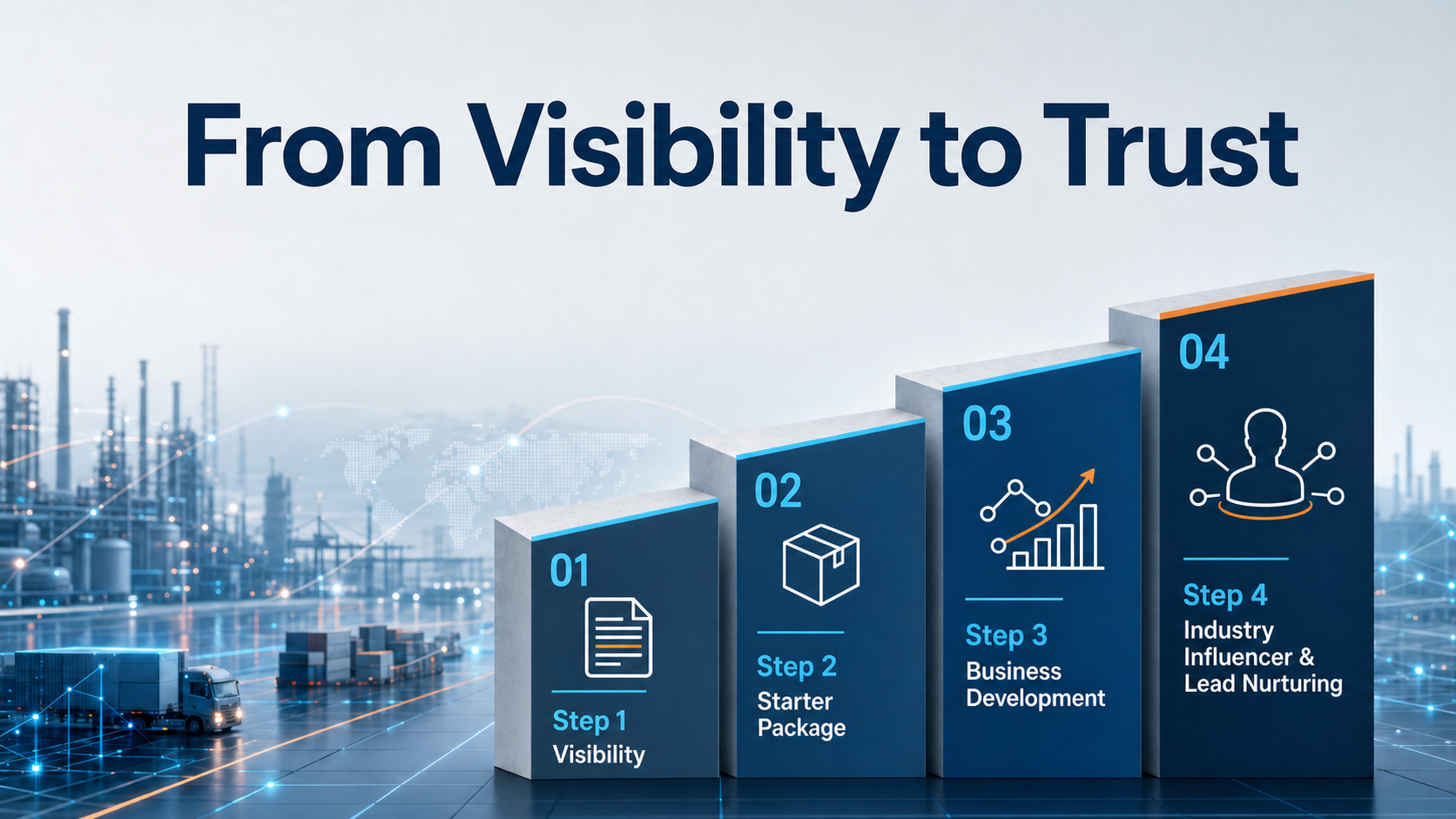
From visibility to trust: Your scalable path with Xpert.Digital - Image: Xpert.Digital
In industrial B2B, sustainable business relationships rarely emerge overnight. They develop step by step – through visibility, professional relevance, recurring touchpoints, and growing trust. Xpert.Digital's 4-stage model addresses precisely this: It offers a structured path that begins with a manageable entry point and can evolve into deeper collaboration in business development if needed.
Instead of relying on loud marketing promises, this model puts the relationship at the forefront. Companies start with clearly defined, easily calculable measures and then decide, based on their own experience, how far they want to expand the collaboration. A key factor for this undisturbed trust-building process: The platform completely avoids annoying advertising ads, so the editorial focus remains solely on the companies' expertise.
More information here:
Your global marketing and business development partner
☑️ Our business language is English or German
☑️ NEW: Correspondence in your native language!

Konrad Wolfenstein
I and my team are happy to be available to you as your personal advisor.
You can contact me by filling out the contact form here wolfenstein@xpert.digital:or simply call me at +49 7348 4088 965. My email address is
I'm looking forward to our joint project.