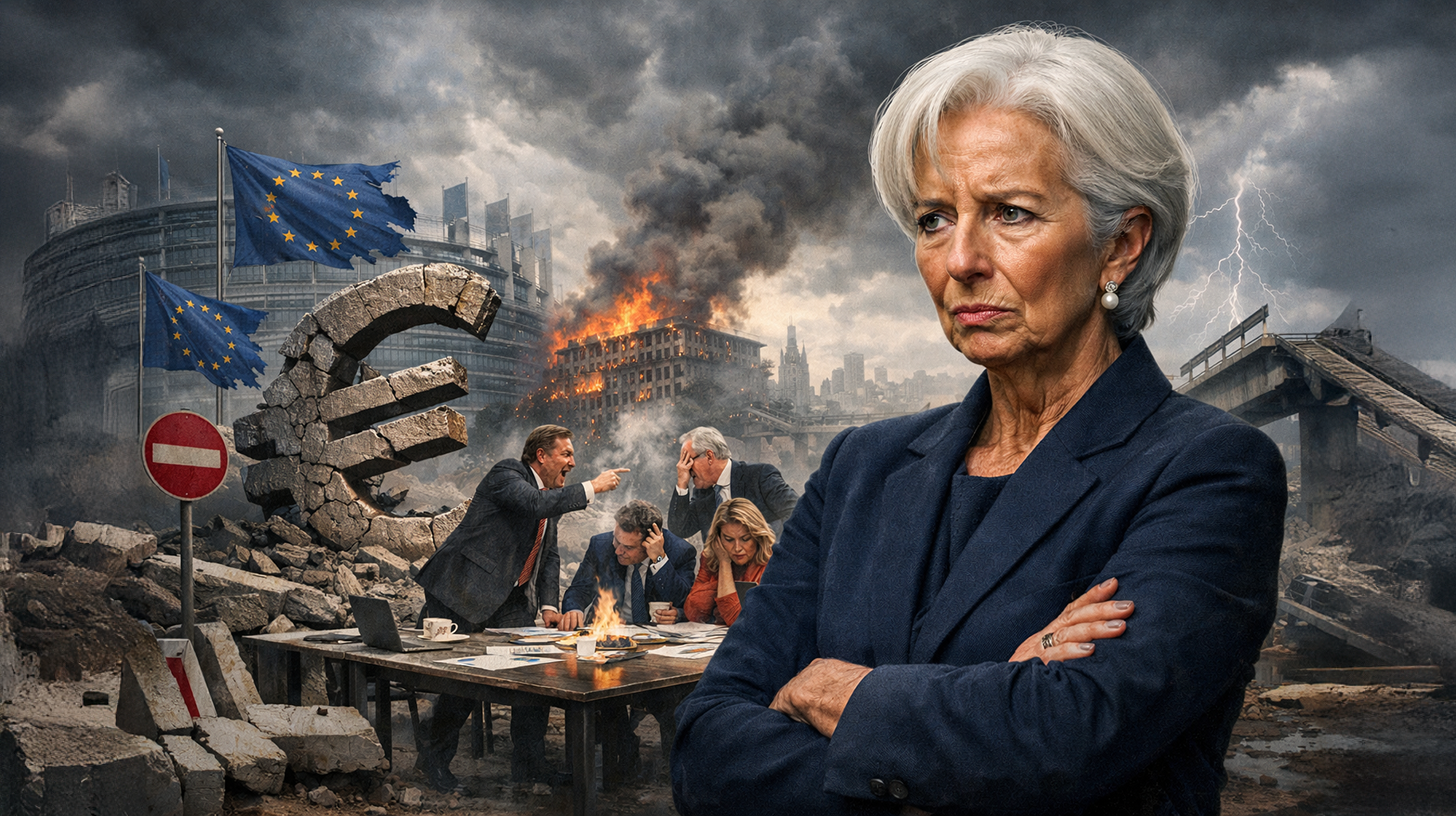
Europe's resistance to reform | Why defiance is no substitute for crisis management. The Lagarde episode as a symptom: Resentment instead of action – Creative image: Xpert.Digital
The relentless balance sheet of failures – or: Why know-it-alls cannot survive in a changing world
Lagarde's Davos debacle: Why her departure reveals Europe's deepest problem
- The reckoning from Davos: What Lagarde's reaction reveals about Europe's inability to reform
- Offended instead of able to act: How Europe's moral arrogance is jeopardizing our prosperity
- Taxes, bureaucracy, stagnation: Why Europe urgently needs a new strategy
- The US is pulling ahead, Europe is sulking: The bitter truth behind the criticism of the ECB
The Davos episode revealed more than just a fleeting emotional reaction. It symbolizes a fundamental structural problem that the European leadership has carried with it for decades: the inability to accept uncomfortable truths and draw actionable conclusions from them. Christine Lagarde's "smug and offended departure from the room" (more on this below) was not merely inappropriate, but rather symptomatic of a political culture that interprets criticism as a personal insult instead of a necessary opportunity for self-correction.
The core problem is not the tone of the criticism. The core problem is Europe's systematic refusal to take stock, a task any rational strategist should have undertaken by now. In a world where the United States is increasing its productivity, China is consolidating its technological power, and emerging economies are catching up, Europe has spent a generation cementing institutional structures that stifle rather than foster innovation. This assessment was not written by hostile outsiders—it is the result of European policymaking.
Looking at the facts, disillusionment is inevitable. Germany, long the economic engine of Europe, has fallen from ninth to eleventh place in the Global Innovation Index 2025, thus dropping out of the top ten innovation powerhouses worldwide. The innovation indicator of the Federation of German Industries (BDI) now ranks Germany only twelfth out of 35 industrialized and emerging economies, despite rising private and public investment in innovation. These statistics read like a diagnosis of advanced paralysis: despite the investment, the return on investment is steadily declining.
The source of the failure becomes particularly clear when one examines the weaknesses. Germany continues to present a strong image in traditional technological products and scientific research. However, precisely where future value creation occurs—in digitalization, the development of a software culture, and the promotion of startups—its positions are fragmented and underdeveloped. With a ranking of 48th in the "Mobile App Creation" indicator and 41st in entrepreneurial culture, Germany lags behind in exactly the areas that define technological societies of the 21st century. This is no coincidence. This is policy.
The vicious cycle of corporate stress: capital withdrawal instead of capital accumulation
Germany's economic model – and even more so the EU's as a whole – relies on systematic redistribution through the fiscal system. Germany taxes corporate profits with an effective tax rate of almost 30 percent, while the total tax burden (taxes plus social security contributions) reaches 38.1 percent of gross domestic product. This places Germany firmly in the top quarter of OECD countries, surpassed only by countries like France, Belgium, and the Scandinavian nations.
This statement seems abstract until one understands its implications for capital allocation. It means that a company growing profitably in Germany has to pay significantly higher taxes than a competing company in Ireland (12.5 percent), Bulgaria (10 percent), or Switzerland. The marginal investment incentive for a global player is not in Germany itself. The incentive lies in directing capital to locations where the after-tax return is substantially higher. Through this tax architecture, Europe has created a systematic disadvantage compared to the US market, where the average corporate tax burden is lower than in Germany and where the capital market infrastructure encourages investment rather than making it more expensive.
The result is measurable and clear: US private equity funds raised approximately $460 billion in 2024, while European funds mobilized just $150 billion – a discrepancy of 3:1. The structure of the capital supply differs fundamentally. In the US, pension funds, insurance companies, and large foundations are systematically channeled into risky assets. In Europe, strict liquidity and solvency requirements prevent them from investing in innovative companies and instead push them into safe assets – government bonds and listed stocks.
The same mechanism by which Europe rejects capital also attracts it. A company that thrives in Germany—if it exists—will eventually earn enough to consider an exit strategy. And then, often enough, that company is acquired by an American or Chinese buyer, or the management team relocates to pursue its growth in a less regulated environment. Germany has failed to produce equivalents to Google, Microsoft, Amazon, or Meta—not because it lacks talent, but because its institutional structures favor foreign capital and penalize domestic entrepreneurship.
Regulation as a brake on growth: The promise without the fulfillment
Bureaucracy is a contentious issue in German debate, yet the scale of the problem is routinely underestimated. The regulatory burden in Germany is estimated at 65 billion euros per year. This isn't just a minor inconvenience; it's a major impediment to growth.
Germany's reform efforts – such as the Fourth Bureaucracy Relief Act – are so disappointing because they don't even begin to address the depth of the problem. According to analyses by CDU/CSU parliamentary groups, the laws will only generate savings of around 300 million euros, which amounts to a mere half a percent of the total bureaucratic burden. While the federal government celebrates these microscopically reduced savings, it is simultaneously introducing new regulations – such as those concerning sustainability reporting – that will impose new costs of 1.4 billion euros per year on companies. This is not reducing bureaucracy. This is simply shifting it elsewhere.
The mutually reinforcing effect of high taxes and high regulatory burdens is particularly problematic. Companies not only have to pay higher taxes, but they also have to devote substantial resources to compliance, reporting, certifications, and approval processes. This ties up management capacity that could otherwise be used for product development, customer service, or expansion. In surveys, medium-sized family businesses, the backbone of the German economy, identify the growing regulatory and bureaucratic burden as a pressing problem and an obstacle to their growth – especially with regard to complex laws such as the Supply Chain Act, as well as approval processes and tax legislation.
Digitalization, touted as a panacea in political rhetoric, is making no progress under these conditions. Germany invests less in IT infrastructure internationally than its leading competitors. Only 17 percent of German companies currently use artificial intelligence – a figure that, while having risen from 13 percent in 2024, clearly demonstrates that widespread adoption is still years away. This isn't due to a lack of technology. It's because decision-making in many companies is driven not by visions of digitalization, but by considerations of compliance with overlapping regulations.
Monetary policy as a coercive mechanism: dependence instead of sovereignty
The idea of ECB independence is formally one of the strongest legal principles in the EU, enshrined in treaties and legal safeguards. Practical reality, however, is more nuanced and less self-assured. The European Central Bank, under the leadership of Christine Lagarde, effectively operates within the gravitational pull of the American central bank. It "follows" the Federal Reserve with a delay of at most one to two days on significant measures. This is not accidental. It is structurally determined by the architecture of the financial markets.
The Fed aggressively cut its key interest rates in 2024 – from 5.25 percent to 4.5 percent by the end of the year, with further cuts planned for 2025. The ECB followed suit: an interest rate cut in June 2024, then in September, October, and December 2024, as well as January, March, April, and June 2025. This dynamic is not the result of coordinated monetary policy. It is the result of an asymmetry in market power. Should the ECB maintain higher interest rates while the Fed cuts, the euro would appreciate. A euro appreciation would further weaken the competitiveness of European exporters. Therefore, the ECB cuts interest rates to avoid destabilizing relative currency parity.
This is not monetary sovereignty. This is monetary dependence cloaked in a veneer of formal independence. Christine Lagarde regularly emphasizes that the ECB makes data-driven decisions – which is technically true. However, the results of these data-driven decisions systematically align with the imperatives of American monetary policy. The euro is on the same path to becoming a weak currency as the dollar. Inflation has not been sustainably resolved, but rather temporarily masked. Should the US, under pressure from expansive fiscal policy, once again struggle with inflationary tendencies, the ECB will face the same choice: either lower interest rates and thus shift the risk to wealth onto savers, or resist the dollar and inflation and burden the export sector with an expensive currency.
Defense: The necessary but poorly planned leap
There is one dimension in which Europe has actually reacted: defense. Following Russia's war of aggression against Ukraine in 2022, EU member states dramatically increased their military spending. In 2024, the defense budgets of all 27 EU countries reached €343 billion – a 19 percent increase over the previous year and the highest figure since modern records began. A further increase to €381 billion is expected for 2025, which would exceed the NATO two percent target for the first time. This is not to be underestimated. It represents a complete turnaround in a policy issue that has been criminally neglected for decades.
But this budget growth also reveals Europe's structural problems. While EU member states now invest 31 percent of their defense spending in equipment, research, and development—well above the NATO target of 20 percent—these investments are fragmented. Different countries buy different systems from different suppliers. There is no genuine European arms industry in the sense of an integrated supply chain. This means that European countries cannot purchase with the efficiency that a consolidated market would allow. A united Europe could leverage its billions far more effectively than 27 states with fragmented strategies.
Our EU and German expertise in business development, sales and marketing

Our EU and German expertise in business development, sales and marketing - Image: Xpert.Digital
Industry focus areas: B2B, digitalization (from AI to XR), mechanical engineering, logistics, renewable energies and industry
More information here:
A thematic hub offering insights and expertise:
- Knowledge platform covering global and regional economies, innovation and industry-specific trends
- A collection of analyses, insights, and background information from our key areas of focus
- A place for expertise and information on current developments in business and technology
- A hub for companies seeking information on markets, digitalization, and industry innovations
Developed in Europe, made rich in the USA: The fatal fate of our best ideas
The European startup paradox: growth without a sustainable structure
There is a sign of hope: The European startup sector is reviving. German startups raised a record €8.4 billion in venture capital in 2025 and founded almost 3,600 new companies – an increase of 30 percent compared to the previous year. This is the third-largest fundraising volume ever in Germany. European founders – whether in London (Nscale), Amsterdam (Framer), or Cambridge (CuspAI) – continue to attract substantial amounts of capital.
The problem: This startup renaissance is still fragmented and subject to the gravitational pull of larger markets. Large European startups, if they succeed, are often headed for the US or under the control of US investors. Top unicorns in Germany – Celonis, N26, Personio – are still a rarity. Europe's ecosystem produces founders and early innovative approaches. But it doesn't consistently produce tech giants that compete with American or Chinese conglomerates.
This isn't due to a lack of talent. It's due to a lack of capital flow and a lack of cultural risk appetite. In the US, pension funds and insurance companies accept a level of private equity that would be unthinkable in Europe. The regulatory framework steers European savings rates into supposedly safe assets – which, over long periods, guarantees that they will continue to deliver moderate returns.
The moral arrogance trap: Why Europe's moral compass has lost its bearings
Europe's political elites—Lagarde included—have maneuvered themselves into a mindset that could be described as "moral arrogance." This arrogance manifests itself in Europe's perception of the United States as one of critical superiority: the US is unregulated, unequal, too capitalist, too militaristic, too loud. Europe, on the other hand, is the embodiment of sustainable, responsible, and civilized economic activity. From this position, criticism from outsiders—especially from someone like Howard Lutnick, who represents the US and its economic philosophy—is intolerable. It is perceived as an affront to their self-image.
The problem with this stance is that it ignores reality. It's commendable to strive for sustainability and combat inequality. But the United States—with all its shortcomings—still produces more technological innovation, more world-changing ventures, and more economic mobility than Europe. This isn't morally superior. It's simply the economic outcome.
Europe has spent decades reducing inequality through redistribution – and this has created stability. But in parallel, Europe has spent that same time stifling dynamism through regulation and tax systems that penalize growth and entrepreneurship. The result is a society that is leveled but also stagnant. It produces middle-class stability, but not the energy a 21st-century society needs.
A lack of transformation: Reform without genuine catharsis
It is remarkable how Europe has found all the right words in recent years. The Draghi Commission 2024, the EU Commission's Competitiveness Compass 2025, the Letta Report – all these documents diagnose Europe's weaknesses with impressive precision. They identify innovation, digitalization, bureaucracy, and the capital market as key vulnerabilities. They call for deregulation, simplification, more courage, and less regulation. On paper, the analysis is coherent, and the recommendations are sound.
But there's a gap between diagnosis and action. The EU Commission aims to reduce bureaucracy by 25 percent – 35 percent for small and medium-sized enterprises – by 2029. That's an ambitious figure. But compared to the status quo, it's still just a band-aid on a gaping hole. And even this reduction in bureaucracy is counteracted by regulatory additions that create new compliance burdens. Governments are promising investments – Germany, for example, has announced €500 billion in investment programs – but much of that is flowing into transport infrastructure and social programs, not into the truly disruptive transformations that would drive technology forward.
The fundamental question is this: Does Europe have the capacity for genuine transformation, or does it simply keep resetting itself with the same old patterns? A country like Germany could reduce corporate profit taxes to 20 percent—making it internationally competitive and business-friendly. It could reduce bureaucracy not by 25 percent, but by 50 percent or more. It could radically simplify regulations. It could implement capital market reforms that rival those of the US.
But this requires a transformation of political culture. Society would have to collectively decide that past stability is less important than future growth. A coalition would have to form that doesn't ask how to maximize redistribution, but rather how to enlarge the pie so that there is more to distribute. The SPD, for example, has shaped German social policy for decades with the philosophy that high achievers are not conducive to the common good and that it is morally right to curtail capital in order to channel it into social programs and international engagement. This stance is responsible for domestic stability, but it stifles the courage for the dynamism that the global economy demands from the outside.
The Lagarde episode as a symptom: taking offense instead of taking action
The Davos episode was so precisely symptomatic because it reflected this cultural attitude in miniature. Howard Lutnick was rude, no doubt. His rhetoric was confrontational. But his point was not wrong: Europe was asleep at the wheel. Europe underestimated the neoliberal wave and the digital revolution and reacted too late. Europe avoided investment—in defense, in innovation, in entrepreneurship. And now Europe finds itself in a position where it is no longer a technological leader, but a midfielder with stable institutions.
A perceptive leader would have accepted this uncomfortable truth and seized the opportunity to outline a concrete transformation. They could have said, “You’re right. We’ve been asleep at the wheel. And here’s what we’re going to change. We’re going to cut corporate taxes. We’re not going to cut red tape, we’re going to transform it. We’re going to fund innovation in technology instead of regulating it. And in five years, you’ll see the results.”
Instead, Lagarde left the room. She responded to criticism with insults. She retreated into self-righteousness instead of taking the initiative for transformation. This is precisely what an institution does that doesn't believe change is necessary, or that cannot implement change because political resistance is too great. It is the gesture of a person and an institution that wants to say: "You others are the problem, not us."
The unspoken dilemma: Reform requires economic growth, but reform requires contraction of existing structures
Europe's deepest contradiction is this: the countries that need reforms most have the fewest resources to implement them. Germany and France need to reform their capitalist models, but these reforms would create short-term instability. Welfare state reforms lead to political resistance. Tax cuts reduce tax revenues before growth can offset them. Deregulation creates anxiety among citizens who see regulation as protection, not a trap.
Trump didn't solve these dilemmas in America, but he named them. "I was five billion dollars in debt and now I'm one of the most successful men in the world," Trump says in his books. That's not the moral code of a European. But it is the mentality of a man who believes that something new can emerge by restructuring existing structures—not by preserving them.
Europe could confront Trump with the same story, but in reverse: “We were a devastated continent after two world wars and transformed ourselves into a welfare power through reconstruction, cooperation, and regulation. Now we must leave this reconstruction phase and enter a renewal phase. And that is what we will do.” This would be a coherent, historically grounded counter-narrative. It wouldn't avoid capitalism, but rather redefine it.
Instead, Europe remains mired in moral self-righteousness. It criticizes the US as being too aggressive, too unequal, too power-hungry. And while it criticizes, it loses ground.
The inconvenient truth and the necessary break
The episode with Lagarde in Davos wasn't the result of Trump's unpleasant tone. It was the result of Europe's inability to face an uncomfortable truth. The truth that a generation of European leaders has spent years congratulating themselves on their civility while the world around them has transformed. The truth that great companies didn't emerge in Germany—not because the German people are less talented, but because the institutions that breed companies have withered under the weight of high taxes, excessive regulation, and a cultural skepticism toward high profits and high risks. The truth that Europe's monetary policy is, in effect, a follower policy, not a leader policy. The truth that while Europe has succeeded in reducing poverty, it has also stifled dynamism.
These truths are not destructive. They are the foundation for genuine reform. If you understand where the obstacles come from, you can address them. If you acknowledge the failure of innovation policy, you can outline new strategies. If you understand that taxes and regulation are a competitive disadvantage, you can recalibrate policy.
What Europe needs is no more Davos. It's no more talk. It's humility in the face of facts, followed by the courage to transform. A continental leader – whether Lagarde or someone else – could stand up and say: “We made mistakes. We transformed too slowly. We over-regulated. We approached entrepreneurship in the wrong way. But we understand now. And in the next five years, you will see the results.”
That would be the story Trump could understand. That would also be the story the world could respect. Because it's not based on defiance, but on insight.
Instead, Europe's leaders run from the room when confronted with uncomfortable questions. And that is precisely the behavior of a continent that is not yet aware of its own pace.
Global Innovation Index 2025; German Patent and Trade Mark Office Innovation Indicator 2025; BDI/Roland Berger/Fraunhofer ISI/ZEW Global Innovation Index 2025 Detailed Study: Taxes in International Comparison 2024-2025; Federal Ministry of Finance Tax burden and rates OECD comparison Corporate tax comparison Ireland and Bulgaria Private equity USA vs. Europe Capital raising Regulatory hurdles European capital markets Compliance costs Regulation Germany Analysis BEG IV Savings effect CDU/CSU Sustainability reporting Compliance costs Bureaucratic burden German family businesses Digitalization investments Germany International AI adoption German companies 2024-2025 ECB independence Legal anchoring Fed interest rate policy 2024-2025 ECB key interest rate trend 2024-2025 Lagarde monetary policy statements Euro currency policy Soft currency trend EU defense spending 2024 EU defense forecast 2025 Investment rate Defense budgets German startup figures 2025 European funding rounds 2025 German unicorns Capital market structure USA vs. Europe Pension funds Draghi report Competitiveness compass Letta report EU Commission's goals for reducing bureaucracy; German investment program; EU goals for reducing bureaucracy.
Your global marketing and business development partner
☑️ Our business language is English or German
☑️ NEW: Correspondence in your native language!

Konrad Wolfenstein
I and my team are happy to be available to you as your personal advisor.
You can contact me by filling out the contact form here wolfenstein@xpert.digital:or simply call me at +49 7348 4088 965. My email address is
I'm looking forward to our joint project.
☑️ SME support in strategy, consulting, planning and implementation
☑️ Creation or realignment of the digital strategy and digitization
☑️ Expansion and optimization of international sales processes
☑️ Global & Digital B2B trading platforms
☑️ Pioneer Business Development / Marketing / PR / Trade Fairs
🎯🎯🎯 Benefit from Xpert.Digital's extensive, five-fold expertise in one comprehensive service package | BD, R&D, XR, PR & Digital Visibility Optimization

Benefit from Xpert.Digital's extensive, five-fold expertise in a comprehensive service package | R&D, XR, PR & Digital Visibility Optimization - Image: Xpert.Digital
Xpert.Digital possesses in-depth knowledge across various industries. This allows us to develop tailored strategies precisely aligned with the requirements and challenges of your specific market segment. By continuously analyzing market trends and monitoring industry developments, we can act proactively and offer innovative solutions. The combination of experience and expertise generates added value and provides our clients with a decisive competitive advantage.
More information here: