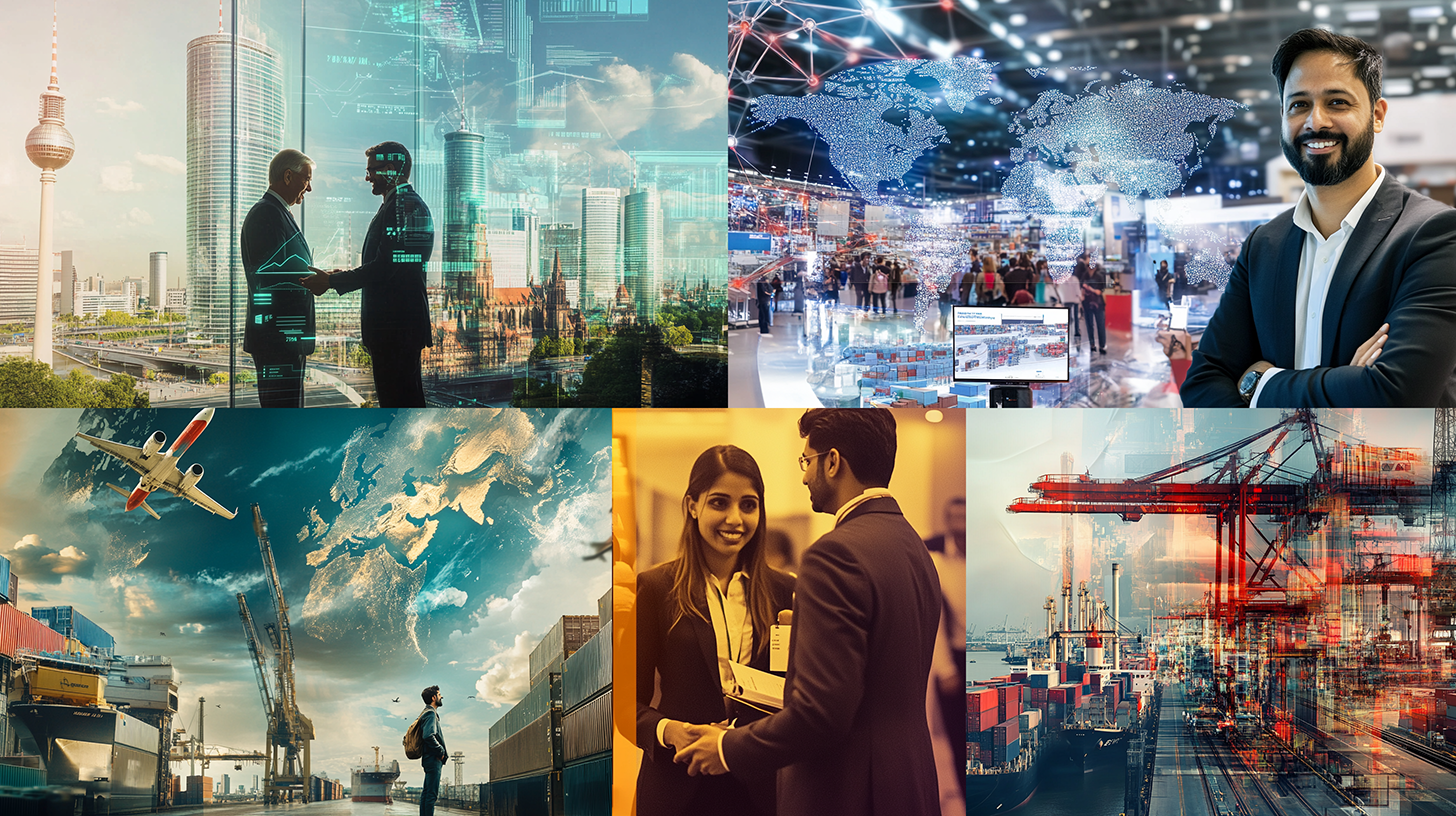
EU-India Free Trade Agreement – Opportunities and advantages for German companies – Ambitious agreement planned for 2025 – Image: Xpert.Digital
EU-India Free Trade Agreement: A Path to Economic Resilience?
Free trade agreement between the EU and India: Ambitious agreement planned for 2025
The European Union and India reaffirmed their intention at the end of February 2025 to conclude a comprehensive free trade agreement this year. During a high-level visit by European Commission President Ursula von der Leyen to New Delhi, concrete timelines for concluding the negotiations were established. This agreement, which von der Leyen described as "the largest of its kind in the world," is gaining particular significance against the backdrop of increasing global trade tensions and the search for reliable partnerships. Bilateral trade between the EU and India has tripled in the last ten years, reaching a value of €120 billion last year. With this initiative, both sides are responding to the protectionist policies of the US under Donald Trump and aiming to strengthen their economic resilience.
Related to this:

Historical context and new dynamics
The history of free trade negotiations between the EU and India is marked by numerous interruptions. Initial talks began as early as 2007, but were frozen for almost a decade between 2013 and 2022. Only about three years ago did the negotiations regain momentum, when both sides expressed renewed interest in closer economic cooperation in light of changing geopolitical realities. This long period of stagnation makes the current ambitious timetable all the more remarkable, as it aims to achieve within a single year what has eluded progress in almost two decades.
The new momentum in the negotiations is being driven by the highest political levels. During her visit to New Delhi at the end of February 2025, European Commission President Ursula von der Leyen emphasized the strategic importance of the partnership: “I am aware that it will not be easy, but I also know that timing and determination matter and that this partnership comes at the right time for both of us.” This assessment was shared by Indian Prime Minister Narendra Modi, who stated: “We have created a blueprint for cooperation,” adding that the teams on both sides have a mandate to conclude a mutually beneficial free trade agreement by the end of the year.
The revival of negotiations is taking place in a completely changed international environment. Increasing protectionist tendencies in the global economy, particularly the tariffs threatened by US President Trump against both the EU and India, have brought the two trading partners closer together. This external threat is acting as a catalyst for accelerating negotiations, which had previously progressed only sluggishly for years.
Economic significance of the agreement
The economic significance of the proposed free trade agreement can hardly be overstated. The EU is already India's largest trading partner, with a bilateral trade volume of €120 billion last year. This sum represents a tripling within a decade and demonstrates the enormous growth potential of trade relations. A successful agreement would further reinforce this trend and open up new markets for companies on both sides.
For European businesses, the Indian market, with its approximately 1.4 billion inhabitants, offers enormous sales opportunities. German business representatives like Andre Eckholt of the Hettich Group hope for concrete benefits from an agreement: easier market access for goods and services in India, lower tariffs, and greater mobility for Indian skilled workers. The Federation of German Wholesale, Foreign Trade and Services (BGA) considers the initiative "the right signal at the right time" and emphasizes that trade agreements remain one of the most important elements for strengthening resilience and competitiveness, "especially in these times.".
For its part, India sees great opportunities to expand its export possibilities into the European market. In recent years, India has already concluded trade agreements with Australia and the member states of the European Free Trade Association (Iceland, Liechtenstein, Norway, and Switzerland). This demonstrates India's increasing willingness to integrate into the global economy and diversify its trade policy.
Geopolitical dimensions of the free trade agreement
The efforts to reach a free trade agreement between the EU and India are situated within a broader geopolitical context. They are part of a strategic realignment by both partners in an increasingly uncertain world order. The EU is actively seeking new trading partners in response to the escalating trade conflict with the US. Donald Trump's threat to impose new tariffs on European goods has heightened the urgency in Brussels to strengthen alternative trade relationships.
At the same time, dependence on China also plays a key role in strategic considerations. The proposed agreement is seen as a building block in "de-risking China's supply chain," as Andre Eckholt puts it. At a time when dependence on individual suppliers and markets is viewed as an increasing risk, India is gaining further importance as a location "against the geopolitical backdrop." This diversification strategy is advantageous for both the EU and India, as both partners strive for stable and reliable economic relations.
The strategic partnership, however, extends far beyond trade. As became clear during von der Leyen's visit to New Delhi, both sides also intend to cooperate more closely in the areas of security and defense. Indian Prime Minister Modi emphasized: "Our growing cooperation on defense and security issues is a symbol of our mutual trust. We will advance our cooperation in the areas of cybersecurity, maritime security, and counterterrorism." This comprehensive rapprochement underscores the strategic nature of the partnership at a time of geopolitical upheaval.
Related to this:

Key points of contention and mutual demands
Despite the political will to reach an agreement, significant obstacles remain that must be overcome in the coming months. The EU primarily wants India to reduce import duties on cars, wine, and spirits. These products are of particular importance to European exporters but face comparatively high trade barriers in India.
In return, India is demanding better access to the EU market for its pharmaceuticals, textiles, and chemicals. The Indian pharmaceutical market has developed into a global player in recent decades and is now seeking simplified access to European consumers. Similar concessions are being sought for textiles, a traditionally strong export sector for India.
Agriculture is considered a particularly difficult issue in the negotiations. EU farmers fear unfair competition from non-European importers. At the same time, the issue is also sensitive for India, as agricultural production there is mainly based on small farms. Striking a balance between protecting domestic agriculture and opening up markets presents a key challenge.
Another potential point of contention is European environmental regulations, particularly the European Carbon Border Adjustment Mechanism (CBAM), which applies to imports into the EU. While the EU considers these measures "fair" and "WTO-compliant," India may perceive them as protectionist. A senior EU official stated, "These are unfounded concerns which we are prepared to address." Reconciling environmental protection with trade liberalization will be a key aspect of the negotiations.
Current developments and political framework
Political support for the agreement is currently strong on both sides. Ursula von der Leyen's visit to India at the end of February 2025, accompanied by most of her Brussels Commissioners, underscores the importance the EU attaches to this partnership. This was her third trip to India, which is interpreted as "a clear sign of the growing strategic importance of EU-India relations.".
Prime Minister Modi also expressed his conviction at the meeting regarding the need for closer cooperation: “The strategic partnership between India and the EU is natural and organic. Its core is based on trust, a shared belief in democratic values, and a mutual commitment to prosperity and progress.” This emphasis on shared values and interests forms a solid basis for the upcoming negotiations.
The President of the European Commission spoke of a "readiness on the Indian side to cooperate more with us." She elaborated: "In a world that has become more uncertain and fragmented, India is also looking for reliable partners – and these are found in Europe." This mutual perception of each other as trustworthy partners in difficult times could help to overcome even complicated negotiating issues.
The President of the German Association of Wholesale, Foreign Trade and Services (BGA), Dr. Dirk Jandura, urges the European Commission to consistently pursue this path and names not only India but also Indonesia, Thailand, and Australia as important potential trading partners for the EU. At the same time, he cautions that the agreement should not be overloaded with unrealistic sustainability demands in order to facilitate rapid implementation.
Political will and trade tensions are driving the EU-India agreement forward
Despite remaining challenges, the prospects for a successful conclusion of the EU-India free trade agreement in 2025 are quite positive. The political will at the highest level and the external pressure from trade tensions with the US provide strong incentives for both sides to find compromises and conclude the negotiations swiftly.
The economic benefits of such an agreement would be substantial for both partners. For the EU, it would improve access to one of the world's fastest-growing markets, while India could deepen its integration into the global economy and expand its export opportunities. However, the strategic dimension extends far beyond purely economic aspects and also includes closer cooperation in areas such as security, defense, and technology.
Ultimately, the proposed agreement could also send a strong signal for international trade policy. At a time of increasing protectionist tendencies, it would represent a clear commitment to open markets and multilateral cooperation. As von der Leyen put it, alluding to a particular planetary alignment in the sky: "The planets are aligned – and so are Europe and India." This metaphorical statement underscores the conviction that the moment has arrived for a deeper partnership between the EU and India.
Our recommendation: 🌍 Limitless reach 🔗 Connected 🌐 Multilingual 💪 Sales power: 💡 Authentic with strategy 🚀 Innovation meets 🧠 Intuition


From local to global: SMEs conquer the world market with a clever strategy - Image: Xpert.Digital
In an era where a company's digital presence determines its success, the challenge lies in creating an authentic, personalized, and far-reaching presence. Xpert.Digital offers an innovative solution that positions itself as the intersection of an industry hub, a blog, and a brand ambassador. It combines the advantages of communication and sales channels in a single platform and enables publication in 18 different languages. Cooperation with partner portals and the ability to publish articles on Google News and a press distribution list with approximately 8,000 journalists and readers maximize the reach and visibility of the content. This represents a crucial factor in external sales and marketing (SMarketing).
More information here:
Economic opportunities for German companies through the EU-India free trade agreement
Strategic opportunities: The EU-India free trade agreement in focus
The free trade agreement between the European Union and India, which has been under negotiation for years, promises significant economic benefits for German companies. After lengthy negotiations and several interruptions since 2007, both sides are once again engaged in intensive talks to overcome the remaining obstacles. Such an agreement could significantly strengthen German-Indian economic relations, which is of particular strategic importance given geopolitical developments and the need to diversify supply chains.
Economic growth potential and GDP effects
A successful free trade agreement between the EU and India would provide significant growth impetus to the German economy. According to a study by the Ifo Institute commissioned by the Bertelsmann Foundation, Germany could expect an annual increase in its gross domestic product of €4.6 billion. This figure demonstrates the enormous economic potential of such an agreement and underscores the importance of India as a trading partner for Germany.
These positive effects are particularly noteworthy in the context of current global economic challenges. The study ranks Germany second in the EU in terms of expected economic benefits, just behind Great Britain, which maintains special relations with India due to its colonial history. The projected growth effects would not only provide short-term economic stimulus but could also contribute to strengthening Germany's economic power in the longer term.
Related to this:


Sector-specific benefits for German industry
Not all economic sectors would benefit equally from a free trade agreement. The effects would be particularly positive for German manufacturers of motor vehicles, machinery, and equipment. These sectors, traditionally among the strengths of the German export economy, could increase their added value by up to €1.5 billion per year. Easier access to the Indian market would enable German companies to expand their export activities and gain new market share.
This is of particular importance to the automotive industry, as the Indian market is currently shielded by high tariffs. Those importing fully assembled passenger cars into India face tariffs of up to 100 percent, depending on the vehicle's size. A reduction or gradual elimination of these tariffs would significantly improve the competitive position of German car manufacturers and could lead to substantial increases in sales.
However, it should also be noted that not all sectors would benefit. In particular, the German service sector and the textile and clothing industry would have to expect losses of several hundred million euros each. This is primarily due to the competitive advantage that India has in these sectors because of lower labor costs.
Reduction of trade barriers and improved market conditions
A key advantage of a free trade agreement would be the reduction of existing trade barriers that currently hinder market access for German companies. According to the German Chamber of Commerce Abroad in India, companies are primarily calling for a comprehensive reduction in tariffs (59%), flexible rules of origin (46%), transparent and predictable customs procedures (45%), and the elimination of non-tariff barriers to trade (33%). These improvements would significantly reduce trade costs and strengthen the competitiveness of German products in the Indian market.
The EU currently lists 31 official trade barriers in India that burden European companies. For the German economy, these include, in particular, the sometimes very high import tariffs, import and export restrictions, localization requirements, and closed procurement and service sectors. A free trade agreement would systematically dismantle these barriers and thus significantly facilitate market access for German companies.
Furthermore, an agreement would improve the mutual recognition of standards and certifications. International standards used within the EU, such as the CE marking, some ISO and IEC standards, and EU motor vehicle directives, are often not fully adopted and accepted in India. The agreement could remedy this through regulatory cooperation and thus reduce the regulatory burden for exporting companies.
Diversification of supply chains and strategic advantages
In a time of increasing geopolitical uncertainty, the diversification of supply chains is becoming ever more important. A free trade agreement with India would help German companies reduce their dependence on other markets, particularly China. For Germany, India is seen as key to reducing its industry's heavy reliance on China. This diversification strategy aligns with the concept of "de-risking," which is gaining increasing importance in German and European economic policy.
Given the size and dynamism of India's economy and population, close institutional relations between the EU and India are in the strategic interest of German businesses. India is described as Asia's "new growth story," with projected economic growth rates of over 6 percent for 2023 and 2024, significantly higher than China's. This economic dynamism makes India an attractive future market for German companies.
Geopolitical shifts and increasing protectionist tendencies in the global economy underscore the importance of reliable trading partnerships. An agreement with India would send a strong signal in favor of open markets, rules-based trade, and against protectionism and isolationism. This is particularly important at a time when over half of the EU's external trade is governed solely by WTO rules, including, until now, trade with India.
Legal certainty and investment protection
A key advantage of a comprehensive trade agreement would be improved legal certainty for German companies operating in or planning to invest in India. Given the erosion of the WTO dispute settlement system, a bilateral agreement with enforceable provisions would offer crucial planning security for German businesses. This is particularly relevant considering that 53% of companies cite bureaucracy as a major burden in India, and 47% point to corruption as an obstacle.
To protect the investments of German companies, stringent safeguards should be agreed upon in the investment protection agreement, guaranteeing companies planning and legal certainty. This would strengthen the confidence of German investors in the Indian market and could lead to an increase in direct investment.
A comprehensive agreement would also improve intellectual property protection. The EU should advocate for stronger intellectual property protection in India, including the protection of geographical indications. This is particularly important for innovative German companies that rely on the protection of their patents and trademarks.
Skilled worker mobility and workforce potential
Another important aspect of a free trade agreement would be the facilitated mobility of skilled workers between Germany and India. Temporary entry for professional purposes should be made easier for skilled workers and business travelers. Agreements that simplify the mobility of skilled workers make a significant contribution to the internationalization of German companies, particularly in the service sector.
This mobility is also significant given the skilled labor shortage in Germany. A survey conducted by the German-Indian Chamber of Commerce (AHK India) identified the availability of labor (56%) and labor costs (45%) as the most important positive factors for doing business in India. German companies could benefit from the large pool of qualified workers in India, particularly in technical and IT-related professions.
Existing economic relationships and future potential
Economic relations between Germany and India are already substantial and provide a solid foundation for further deepening. More than 2,000 German companies are already present in India, employing a total of over 500,000 people. German-Indian trade volume amounted to €29.9 billion in 2022, representing an increase of 28% compared to the previous year.
The EU is India's third-largest trading partner and second-largest export market, as well as the largest investor in India. Approximately 6,000 European companies directly and indirectly create around five million jobs in the country. These figures illustrate the economic interdependence between the EU, Germany, and India, which would be further strengthened by a free trade agreement.
Related to this:
Challenges and open negotiation points
Despite the promising prospects of a free trade agreement, significant challenges and open points of negotiation remain. The automotive and pharmaceutical sectors are considered major obstacles to an agreement. While the EU wants to reduce the high Indian tariffs on imported vehicles, India sees this as a threat to domestic production.
Difficulties also exist in the agricultural sector, as a significantly larger proportion of the population in India works in this field than in Germany. Agriculture is considered a particularly difficult issue in the negotiations, as EU farmers fear unfair competition from non-European importers.
Conflicts could also arise in the areas of sustainability and environmental protection. BGA President Dr. Dirk Jandura cautions that the agreement should not be "overburdened with unrealistic sustainability demands" in order to facilitate rapid implementation.
EU-India trade agreement: Strategic advantages for German companies
A free trade agreement between the EU and India would offer numerous advantages to the German economy, from increased GDP and improved market access to diversified supply chains and greater legal certainty. Key German industries such as automotive and mechanical engineering could particularly benefit from such an agreement.
Despite the existing challenges in the negotiations, both economic and geopolitical factors support a successful conclusion of the agreement. Political support exists on both sides, as demonstrated by statements from Chancellor Scholz, who advocates for "rapid progress and quick results" and emphasizes that it could happen "in months rather than years.".
India's strategic importance for Germany and the EU will continue to grow in the future, particularly given India's projected economic development. As an emerging economic power with a young, growing population, India offers enormous long-term opportunities for German companies. A free trade agreement would significantly expand these opportunities and could make a vital contribution to securing the future of the German economy.
We are here for you - Consulting - Planning - Implementation - Project Management
☑️ SME support in strategy, consulting, planning and implementation
☑️ Creation or realignment of the digital strategy and digitization
☑️ Expansion and optimization of international sales processes
☑️ Global & Digital B2B trading platforms
☑️ Pioneer Business Development

Konrad Wolfenstein
I would be happy to serve as your personal advisor.
You can contact me by filling out the contact form below or simply call me on +49 7348 4088 965 .
I'm looking forward to our joint project.
Write to me


Xpert.Digital - Konrad Wolfenstein
Xpert.Digital is a hub for industry focusing on digitalization, mechanical engineering, logistics/intralogistics and photovoltaics.
With our 360° Business Development solution, we support renowned companies from new business to after-sales.
Market intelligence, smarketing, marketing automation, content development, PR, mail campaigns, personalized social media and lead nurturing are part of our digital tools.
You can find more information at: www.xpert.digital - www.xpert.solar - www.xpert.plus
Keep in touch