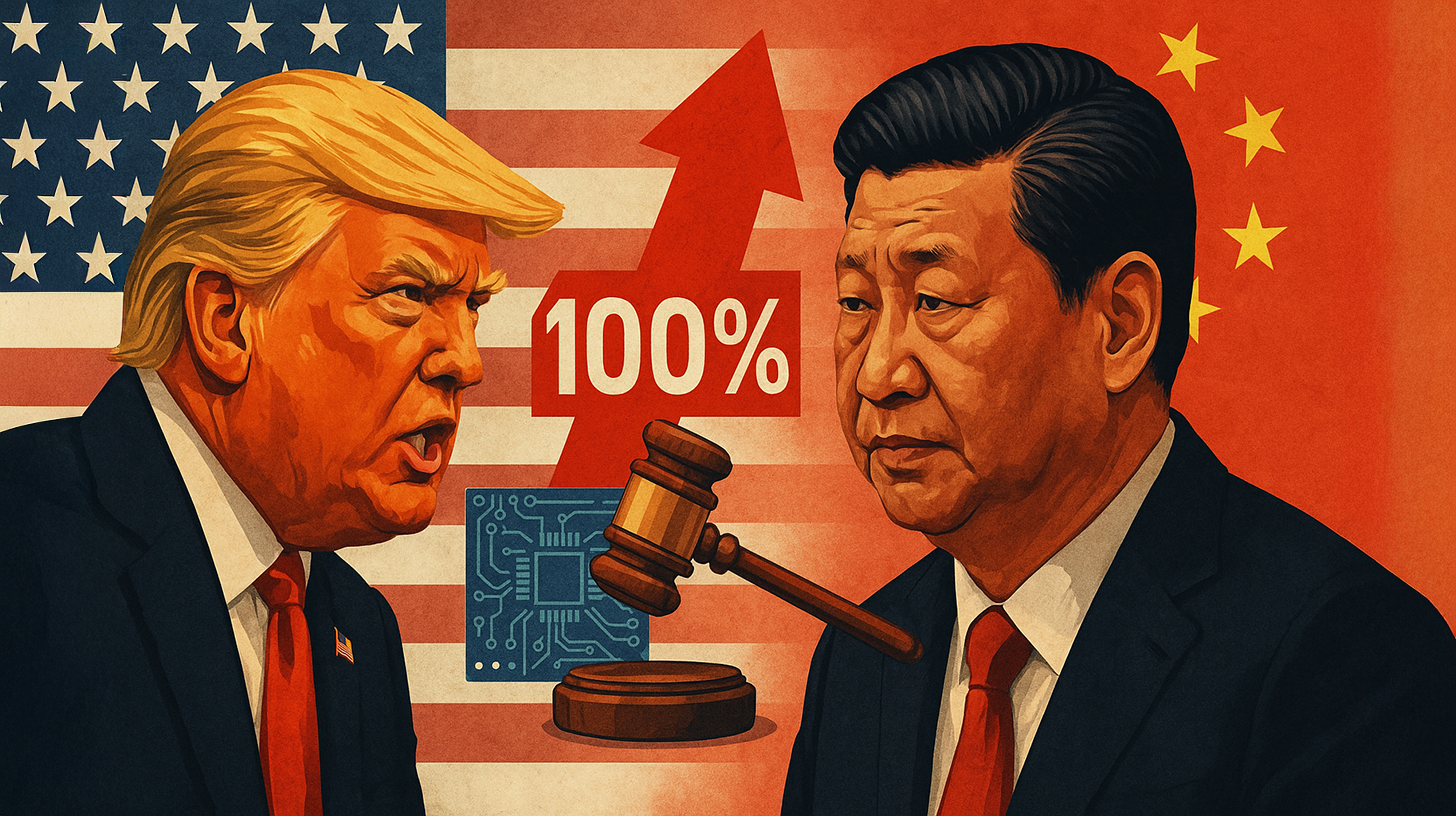
Escalation in the US-China trade conflict: 100 percent tariffs, export controls for software, and the shaky Trump-Xi meeting in South Korea – Image: Xpert.Digital
Tariffs, raw materials, summit poker: The conflict between the US and China is escalating – the most important facts
100% tariffs & software blockade: The trade war with China enters a new, dangerous phase
The US government has announced additional 100 percent tariffs on all imports from China and is considering export controls on "critical" software. This move comes in response to Beijing's tightened export controls on rare earth elements. At the same time, the US president is questioning a planned meeting with Xi Jinping at the APEC summit in South Korea, though he leaves the door open for a possible reconciliation. The decision increases risks to global supply chains, technology flows, and industrial prices—particularly in industries dependent on rare earth elements, from semiconductors and automotive to defense.
Related to this:

What exactly did the US government announce?
The announcement comprises two key elements: first, additional tariffs of 100 percent on all imports from China, to take effect no later than November 1; second, new export controls on "all important" or "critical" software, which could also take effect from the same date. Statements left open whether the 100 percent tariffs would be in addition to existing tariffs or replace them entirely. The president justified this by claiming that China was acting "extraordinarily aggressively" and tightening export controls in the strategic area of rare earths and related technologies.
What triggered this escalation?
The reason for this is a significant tightening of Chinese export controls on rare earths and related technologies. Beijing is imposing licensing requirements for the export of machinery, technologies, and processes for mining, processing, assembly, maintenance, and upgrading of corresponding production lines. Furthermore, it is reported that China is expanding controls, meaning that transactions involving rare earths or products with Chinese components could be subject to restrictive treatment. Beijing cites national security as the reason, given that rare earths also have military applications.
Why are “rare earth elements” so central to the debate?
Rare earth elements are indispensable for high-tech products, the energy industry, and the defense sector: from permanent magnets in electric motors and wind turbines to semiconductor processes, sensors, smartphones, and weapons systems. China holds a near-monopoly along the supply chain: roughly 60–70 percent of mining and around 90 percent of processing take place there. This dominance makes Beijing's export policy a powerful lever on global supply chains and prices.
Related to this:

Has the US government cancelled the meeting with Xi Jinping?
The meeting at the APEC summit in South Korea was briefly called into question; the US president stated that there seemed to be "no reason" for it. Shortly afterward, however, he clarified that the meeting had not been canceled; he would be present and assumed it would take place. This communication signals an increase in pressure while simultaneously maintaining tactical openness for de-escalation or room for negotiation.
Where and when should the meeting take place?
The APEC Leaders' Meeting will take place in South Korea from late October to November 1, 2025. The main Leaders' Week and the CEO Summit are scheduled for Gyeongju; accompanying ministerial meetings and forums will be held in cities including Incheon, Busan, Jeju, and Seoul. The CEO Summit is scheduled for October 28–31; Leaders' Week will culminate on October 31 and November 1 in Gyeongju.
What is the context of the customs announcement regarding the recent "customs pause"?
In the spring, both sides significantly increased tariffs on each other, then paused negotiations temporarily during the summer or held rounds of talks. Now the conflict is escalating again. It remains unclear whether the 100 percent tariffs apply in addition to previously imposed surcharges. This lack of clarity in communication increases the uncertainty, especially since export controls for software are being announced simultaneously, the specific scope of which is still unclear.
What is meant by "export controls for critical software"?
The government is considering export restrictions for "important" or "critical" software. Open questions remain regarding the precise scope. Software for chip development (EDA), firmware/OS components, industrial control software, and safety-critical tools along strategic supply chains could be under discussion. The technology sector is assessing this in the context of the ongoing US approach to limiting strategic technology transfers to China. Stricter licensing requirements for EDA and related tools have already been announced to prevent circumvention through subsidiaries.
How did the financial markets react?
The announcements put pressure on major stock indices in the US and Europe; risk assets declined, while safe-haven assets (e.g., the price of gold) gained ground. Observers spoke of a return of trade war fears and a more defensive risk positioning in the markets immediately after the statements.
Related to this:

What immediate economic effects can be expected?
Higher import prices in the US are expected in the short term, especially if the 100% tariffs are also in place. This affects both finished and intermediate goods, complicates cost structures for US industry and trade, and could fuel inflation. Model-based simulations indicate significant price increases and burdened exports in the US under strict tariff regimes, while China experiences relatively smaller effects, but global growth and trade suffer. European effects are mixed: on the one hand, relief through redirected trade flows with potential price reductions for imports; on the other hand, competitive pressure from Chinese overcapacities and burdens in China-exposed industries.
Are European supply chains directly threatened?
Yes, especially where rare earth elements are used in components and semi-finished products. The European automotive, mechanical engineering, electronics, and defense industries are heavily affected, as magnets, motors, and sensors frequently utilize rare earth elements. Industry associations are warning of supply bottlenecks and production cutbacks. Suppliers have already reported initial shutdowns and decreasing planning certainty since spring. Stricter Chinese export controls increase the risk of further delays and price increases.
How strong is the West's dependence on China's rare earth supply chain?
It is substantial: roughly 60–70 percent of mining and about 90 percent of smelting/processing take place in China; Germany imports a significant share from China. In addition, China possesses patents and process know-how that hinder the rapid development of alternative capacities. The EU classifies rare earths as critical raw materials and is working on diversification, recycling, and domestic capacity – however, with long lead times and environmental regulations.
What role does the APEC summit in Gyeongju play?
The APEC summit serves as a platform for economic policy coordination in the Asia-Pacific region. Gyeongju will host the Leaders' Meetings and the CEO Summit in 2025. Before the recent tensions, a bilateral meeting between Trump and Xi and a framework for further talks (including on technology, trade, and TikTok) were anticipated. The escalation makes agreements more difficult but also leaves open the option of a last-minute political deal, as both sides had signaled their willingness to negotiate.
What distinguishes the current escalation from previous rounds?
What's new is the stringency of Chinese export controls on rare earth processing technology. This goes beyond mere raw material exports and has extraterritorial effects when components with Chinese components are involved. On the US side, the combination of blanket 100 percent tariffs and generic (still undefined) software export controls sends a strong signal, going beyond product- or sector-specific measures and deliberately using uncertainty as leverage.
How realistic is a rapid de-escalation?
Politically, de-escalation is possible through tactical communication, particularly around the summit date. The US president left room to make tariffs dependent on China's response; conversely, Beijing can modulate its export control practices. However, both sides have taken measures that can be institutionally enshrined (licensing requirements, sanctions lists, export controls), which reinforces the structural decoupling trend. A short-term, symbolic easing of tensions seems possible, but a sustainable, structural de-escalation is less likely.
Which sectors are most exposed?
Particularly exposed are:
- Semiconductors and electronics, including EDA software and manufacturing chemicals, are affected, as both US export controls and Chinese materials are involved.
- The automotive industry, especially e-mobility and suppliers, due to its dependence on magnets and sensors containing rare earth elements.
- Renewable energies/infrastructure, in particular wind turbines (permanent magnet generators) and power electronics.
- Defense and aerospace due to special alloys, sensors, drives and electronics.
Is there already evidence of supply problems in Europe?
Reports and industry statements have indicated since April that suppliers have experienced initial shutdowns and that production lines in Germany have been scaled back due to difficulties in procuring rare earth elements and magnetic products. Companies are reporting that approval processes, licensing, and logistics lead times are extending lead times and causing inventory to be depleted faster than anticipated.
Are renewed price waves looming for rare earths?
Yes. News of stricter export controls already led to noticeable price increases in the summer. Another round of restrictive measures or retaliatory tariffs increases the risk of another price surge, especially for heavy rare earth elements (e.g., dysprosium, terbium), which are needed for high-temperature magnets and where Chinese dominance is particularly strong.
Could China interpret export controls extraterritorially?
Evidence suggests that Beijing could also apply restrictions to products from foreign locations that contain components or materials with Chinese rare earth elements. Enforcement and verification mechanisms are unclear, but the signal this sends increases compliance risks for globally operating companies that have a presence in China or remain intertwined with Chinese supply chains.
Our global industry and economic expertise in business development, sales and marketing

Our global industry and economic expertise in business development, sales and marketing - Image: Xpert.Digital
Industry focus areas: B2B, digitalization (from AI to XR), mechanical engineering, logistics, renewable energies and industry
More information here:
A thematic hub offering insights and expertise:
- Knowledge platform covering global and regional economies, innovation and industry-specific trends
- A collection of analyses, insights, and background information from our key areas of focus
- A place for expertise and information on current developments in business and technology
- A hub for companies seeking information on markets, digitalization, and industry innovations
Price shock or opportunities? Consumers and industry caught in a tariff dilemma
What possible countermeasures is the US side considering besides tariffs?
In addition to tariffs, expansions and tightening of export controls are under consideration, particularly for semiconductors, manufacturing equipment, and related software (EDA, firmware). Furthermore, investment and procurement priorities may be adjusted in favor of domestic buyers to mitigate bottlenecks in critical sectors. The prioritization of American demand for advanced AI chips has already been debated. The range of options extends from sector-specific rules to broad lists of critical software.
Related to this:

Can Europe benefit – or will it be more of a burden?
Both scenarios are possible. Potentially lower import prices for certain consumer goods due to the redirection of Chinese exports, as well as increased access to intermediate goods if US demand is dampened by tariffs, would have a positive impact. Negative aspects include competitive pressure from Chinese overcapacity in Europe (e.g., steel, consumer goods), the strain on China-exposed industries, and vulnerability to rare earth shortages. Ultimately, key industries face a net burden, while consumers in selected segments could benefit from price competition.
What role do political narratives and timing play?
Linking the tariffs to the summit timing and using dramatic rhetoric (hostage-taking, hostile practices) serves as a negotiating tactic. On the Chinese side, references to national security and military use underscore the legitimacy of export controls. Both narratives provide domestic political justifications and increase external pressure without blocking options for a face-saving arrangement.
What paths to de-escalation are conceivable?
- Extending the time frame or applying the 100% tariffs in a differentiated manner (exceptions, lists, transitional periods).
- Clarification and limitation of the software term to defined, security-relevant categories (e.g. EDA) instead of general formulations.
- Chinese licensing practices, while formally strict, alleviate operational bottlenecks through more generous approvals.
- Technical working groups within the APEC framework harmonize standards and compliance issues related to export controls in order to reduce extraterritorial friction.
What is the probability of a "hard" decoupling?
For years, the trend has pointed towards structural decoupling in sensitive technologies. A hard, broad decoupling is economically expensive and politically risky, but remains likely in defined segments (AI chips, EDA, lithography, rare earth technologies). Recent steps by both sides cement instruments that can be politically modulated in the short term but continue to be used in the long term.
What lessons can be learned for industrial companies?
- Diversification of sources for rare earth magnets and oxides; testing of alternative alloys and magnet-free designs where technically feasible.
- Stockpiling and longer-term call-off contracts for critical components; closer integration of engineering and purchasing for substitution.
- Strengthen export compliance: risk screening for software, firmware, and development tools; legal assessment of extraterritorial rules.
- Scenario planning along the lines of “customs + export controls” vs. “licensing relaxations”; price adjustment clauses and dual supply chain models.
What does this situation mean for consumer prices in the USA?
In the event of broad-based additional tariffs, consumer prices tend to rise, particularly for goods with a high Chinese component. Model analyses show that inexpensive intermediate and finished products will be scarce, creating inflationary pressure. At the same time, some exports could be sold domestically, which would depress export figures. Overall, this will negatively impact purchasing power and exports in the short term.
How is China reacting to the US tariffs?
Immediately following the US announcements, there was no detailed official Chinese response to the US tariffs. Political and media signals are focused on China's own export control agenda, which is justified as a legitimate security measure. Observers also interpret Beijing's actions as a deliberate bargaining chip ahead of the summit.
Is the escalation linked to geopolitical tensions beyond trade?
Yes. Tech competition (AI, semiconductors, telecommunications), security issues, and alliances in the Asia-Pacific region are closely intertwined. Export controls and tariffs act as levers in a larger strategic rivalry. APEC provides a multilateral framework but cannot resolve fundamental strategic differences in the short term.
What signal does the 100 percent inch figure send?
The large, round number symbolically represents the maximum and generates pressure and attention. However, its effect depends on the precise implementation: scope of application, exceptions, transitional rules, and administrative enforcement. The more vague the announcement, the stronger the uncertainty effect in supply chains and markets – part of the intended pressure tactic.
What might exceptions or licenses look like?
On the US side, carve-outs for medical goods, security-relevant components, or consumer price-sensitive categories are conceivable, provided they are politically expedient. For software export controls, license pathways could be established for non-security-relevant tools. On the Chinese side, licenses could be granted to selected customers/projects that are politically unproblematic or promise reciprocal trade.
What role do third countries and circumvention routes play?
During previous rounds, production chains were shifted to ASEAN countries. Expanding US tariffs to include goods from third countries or tightening the rules of origin could curb such circumvention. China, for its part, is addressing circumvention by extending controls to technology transfers and collaborations with international partners. This increases the complexity for companies with network manufacturing.
Can Europe reduce its dependence on rare earth elements in the short term?
In the short term, hardly any options exist. In the medium term, options include: rebuilding domestic processing, recycling, diversification (e.g., Australia, USA, Africa), material substitution, and design changes. High environmental and permitting standards extend the time horizons but reduce external costs. Policy initiatives at the EU level aim to promote raw material security and processing capacities, but scaling up takes years.
Which lines of communication are visible from the US side?
- Toughness against “hostile” trade practices; protection from being “held hostage” by China’s raw material dominance.
- Announcement of maximum tariffs and parallel tech controls, coupled with the option to make the timing or scope dependent on China's behavior.
- An open door for meetings and negotiations, to signal flexibility and to maintain pressure as a negotiating tool.
How does this fit into the history of the US-China trade conflict?
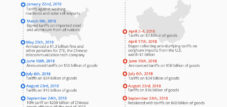
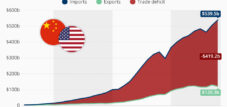
Since 2018, the conflict has escalated in waves: tariff increases, countermeasures, temporary pauses, partial solutions ("Phase One"), accompanied by export controls and tech sanctions. The current cycle shifts the focus more towards access to raw materials and technology and operates with extraterritorial effects from both sides. The fundamental points of contention (trade balance, intellectual property protection, technology transfer, security) remain unresolved.
What are the next relevant milestones?
- Specific US regulations regarding the 100 percent tariffs: scope, exceptions, timetable.
- Clarification of "critical software" and licensing procedures.
- Chinese implementation guidelines on export controls: licensing practices, audit criteria, extraterritorial validity.
- Political communication before and during the APEC summit; status of the bilateral meeting and possible “mini-deals”.
What should decision-makers in companies do now?
- Immediate inventory and exposure analysis for rare earth materials, magnets, and critical software dependencies.
- Qualify alternative suppliers; review and prioritize safety stocks.
- Update contract clauses regarding force majeure, export controls and customs changes.
- Strengthen compliance teams and legal advice for export control and customs issues; increase traceability.
- Keep communication lines with customers transparent, anticipate price adjustments and delivery times.
Related to this:

What is the most likely development in the coming weeks?
A period of high-level rhetoric alongside ongoing technical discussions is likely. Regulatory texts will clarify the scope and exemptions. Short-term market volatility and precautionary measures in affected industries are probable. Whether there will be a symbolic signal of easing surrounding APEC depends on the available room for maneuver on both sides. Structurally, everything points to continued risk premiums in rare-earth and technology-dependent sectors—and to sustained pressure to diversify supply chains.
Which points of information do BILD and SPIEGEL confirm in this context?
Both reports consistently cover the announcement of additional 100 percent tariffs, the planned software export controls, the justification based on Chinese export controls on rare earths, and the initially questioned, but later reconsidered, meeting with Xi at the APEC summit in South Korea. Both note that an official, detailed Chinese response was initially pending.
What open questions remain unanswered from today's perspective?
- Will the 100 percent tariffs be added to existing tariffs or will they replace them?
- How narrowly or broadly is "critical software" defined, and what licensing processes apply?
- How strictly and extraterritorially does China enforce export controls in practice?
- Will the APEC summit result in a bilateral arrangement that staggers tariffs/export controls over time or specifically excludes them?
- How will affected industries react in the medium term with regard to substitution and technology pathways?.
Recommendations for policy and business
Politically, Europe should strategically address its dependencies on raw materials and technology: swift but standards-compliant approval processes for domestic processing, targeted partnerships for raw materials, and the promotion of recycling and substitution research. Economically, a "just-in-case" approach to complement the "just-in-time" logic is advisable: redundant supplier networks, increased transparency in bills of materials (BOMs) down to the raw material source, and modular product designs that allow for material changes. These measures reduce exposure to escalating tariffs and export controls and increase resilience.
Your global marketing and business development partner
☑️ Our business language is English or German
☑️ NEW: Correspondence in your native language!

Konrad Wolfenstein
I and my team are happy to be available to you as your personal advisor.
You can contact me by filling out the contact form here wolfenstein@xpert.digital:or simply call me at +49 7348 4088 965. My email address is
I'm looking forward to our joint project.
☑️ SME support in strategy, consulting, planning and implementation
☑️ Creation or realignment of the digital strategy and digitization
☑️ Expansion and optimization of international sales processes
☑️ Global & Digital B2B trading platforms
☑️ Pioneer Business Development / Marketing / PR / Trade Fairs
B2B support and SaaS for SEO and GEO (AI search) combined: The all-in-one solution for B2B companies

B2B support and SaaS for SEO and GEO (AI search) combined: The all-in-one solution for B2B companies - Image: Xpert.Digital
AI search changes everything: How this SaaS solution will revolutionize your B2B ranking forever.
The digital landscape for B2B companies is undergoing rapid change. Driven by artificial intelligence, the rules of online visibility are being rewritten. For companies, it has always been a challenge not only to be visible in the digital mass, but also to be relevant to the right decision-makers. Traditional SEO strategies and managing local presence (geo-marketing) are complex, time-consuming, and often a battle against constantly changing algorithms and intense competition.
But what if there were a solution that not only simplified this process but also made it smarter, more predictive, and far more effective? This is where the combination of specialized B2B support with a powerful SaaS (Software as a Service) platform comes into play, specifically designed for the demands of SEO and GEO in the age of AI search.
This new generation of tools no longer relies solely on manual keyword analysis and backlink strategies. Instead, it leverages artificial intelligence to more accurately understand search intent, automatically optimize local ranking factors, and conduct real-time competitive analysis. The result is a proactive, data-driven strategy that gives B2B companies a decisive advantage: they are not only found, but perceived as the leading authority in their niche and location.
Here's the symbiosis of B2B support and AI-powered SaaS technology that transforms SEO and GEO marketing, and how your company can benefit from it to grow sustainably in the digital space.
More information here: