Maintaining the cap would have deterred many investors and photovoltaic enthusiasts from realizing such a system due to cost considerations.
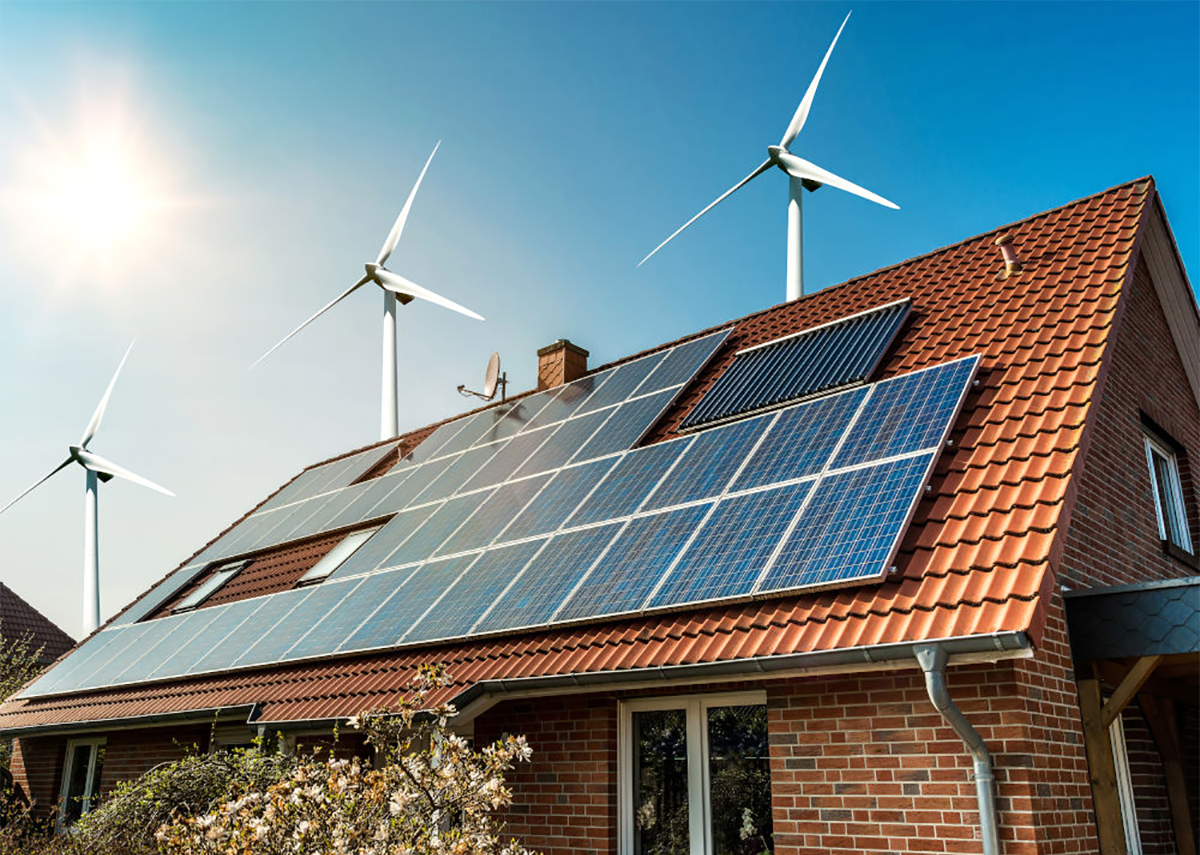
Solar panels on the roofs of houses and wind turbines – concept of sustainable resources – Image: @shutterstock|Diyana Dimitrova
Countless solar installers and building owners across the country have likely breathed a sigh of relief in recent days. This is due to the planned elimination of the 52-gigawatt cap on subsidies for photovoltaic systems up to 750 kilowatts. Since this cap was nearly exhausted, the industry was experiencing considerable uncertainty, as feed-in tariffs are a crucial factor in financing and ensuring the profitability of such projects.
The cap scared off solar installers and investors
Maintaining the cap would have deterred many investors and those interested in photovoltaics from building such systems due to cost concerns – with unforeseeable consequences for manufacturers, service providers, and installers. The cap on subsidizing solar capacity of no more than 52 gigawatts was enacted by parliament in 2012, not least for cost reasons. However, since then, both the political and economic landscape has changed considerably.
To achieve the targeted goal of a 65 percent share of renewable electricity by 2030, favorable conditions for alternative energies must continue to be created. Furthermore, the costs of solar power generation have fallen significantly in the meantime, making the originally planned cap seem anachronistic to many. Not least for this reason, work has been underway for some time to abolish this unpopular provision – though not without complications.
The lack of agreement on wind turbines delayed the solution
The trigger for the unnecessary delay was the linking of negotiations on ending feed-in tariffs with the dispute over minimum distances between wind turbines and residential areas. While the politicians of the coalition parties had already agreed in the spring that the cap on solar subsidies had to be lifted, they neglected to reach an agreement on the contentious minimum distances for wind turbines. But without this agreement, the CDU/CSU insisted, there would be no approval for ending the 52-gigawatt limit.
Finally, a compromise was reached. This compromise stipulates that the states will have some flexibility in setting the minimum distance of 1,000 meters between wind turbines and residential buildings. The compromise solution seems to have come just in time, as time is of the essence, since the capacity of subsidized wind farms has now exceeded 50 gigawatts. Given the current strong investment in photovoltaic systems, the 52-gigawatt mark could be reached in just a few weeks. For future homeowners, this could mean being left without subsidies, even though the government has committed in principle to continued support.
The uncertainty has thankfully ended since the Bundestag's vote on the Building Energy Act (GEG) on May 18th. However, before the regulation becomes legally binding, the Bundesrat must still give its approval. This is expected to happen at its next session – the last before the summer recess – on July 3rd, and thus probably just in time before the crucial 52-gigawatt threshold is reached.
Other project opportunities for solar installers?
At the same time, there is more good news for solar installers. The coalition partners decided in the Building Energy Act (GEG) that incentives for the construction of solar power systems should be further increased in the future. The focus is particularly on apartment buildings and larger buildings, which, according to politicians, have not been sufficiently developed so far. The solar energy audit requirement is intended to ensure that the federal government, states, and municipalities will have to examine more closely in new construction and renovation projects whether solar energy systems can be productively integrated into the projects.
The agreement means that investors and building owners considering installing a new photovoltaic system can continue to count on government support. With this restored planning certainty, solar installers and developers should be able to sleep more soundly again.
Related to this:
Keep in touch