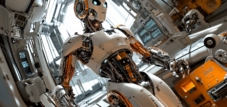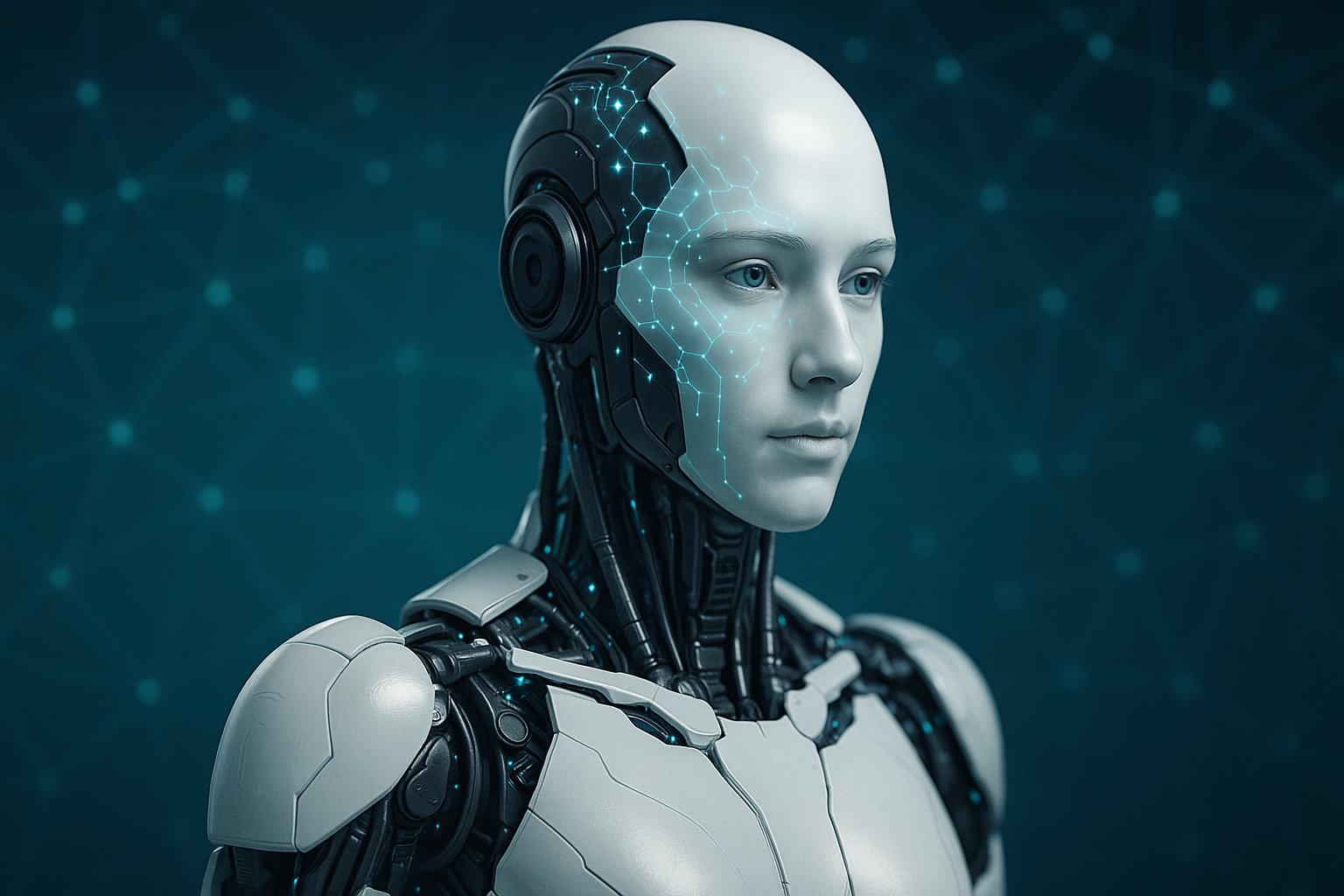
Embodied Artificial Intelligence (AI) – Image: Xpert.Digital
Embodied AI in focus: The future of human-technology interaction
New dimensions of AI: From abstract models to real-world applications
Embodied artificial intelligence, also known as embodied AI, represents an innovative approach in AI research where intelligence does not exist in isolation in the digital realm, but rather emerges through integration into physical systems and active interaction with the real world. Unlike traditional AI systems that operate in abstract, virtual environments, embodied AI systems are able to perceive, understand, and interact with their surroundings. This report provides a comprehensive overview of the principles, applications, and future prospects of embodied AI.
Related to this:

Basic concept of embodied AI
Embodied artificial intelligence refers to AI systems that are embedded in physical objects, such as robots, and can interact with their environment in meaningful ways. Unlike purely digital AI, which primarily produces digital artifacts or decision recommendations, embodied AI is designed to control the behavior of physical systems.
The concept of embodied AI encompasses all aspects of interaction and learning within an environment: from perception and understanding to thinking, planning, and execution. This holistic approach differs fundamentally from classical computationalism, which views mental processes as mere calculations and considers the brain a computer.
An embodied AI uses sensors to perceive its environment, is capable of learning and adaptation, and translates perceptual processes into action processes using its motor or reactive abilities. It possesses contextual understanding and can execute complex interactions even in dynamic environments.
Theoretical foundations and philosophical background
The theoretical foundations of embodied AI are deeply rooted in philosophy and cognitive science. The embodiment hypothesis, introduced by Linda Smith in 2005, states that thinking and learning are influenced by constant interactions between the body and the environment. This idea traces back to earlier philosophical concepts of the philosopher Maurice Merleau-Ponty, who emphasized the central role of perception and the body in understanding.
Embodied cognition represents a group of theories that investigate how cognition is shaped by the organism's physical state and abilities. These embodied factors include the motor system, the perceptual system, physical interactions with the environment, and beliefs about the world, which shape the functional structure of the organism's brain and body. The embodied cognition thesis challenges other theories such as cognitivism, computationalism, and Cartesian dualism.
Embodied AI builds on these concepts and proposes that true artificial general intelligence (AGI) can be achieved by controlling physical embodiments and interacting with simulated and physical environments.
Technological components and functionality
The development of embodied AI systems requires the integration of various technological components and methodologies:
Perception and sensory perception
Embodied AI systems use various sensors to perceive their environment, similar to the five classic senses in humans. These sensors can include cameras (for visual understanding), microphones (for audio capture), tactile sensors (for touch and pressure), as well as accelerometers and orientation sensors.
Cognitive processing
The cognitive architecture of an embodied AI comprises four essential components: perception, action, memory, and learning. These components work together to enable the agent to understand its environment and respond appropriately. Modern developments in this field include multimodal large-scale models (MLLMs), which offer advanced perception, interaction, and planning capabilities.
Actuators and physical interaction
Unlike passive observation, embodied AI agents interact with their environment and learn from the response. This requires actuators – components that can perform physical actions, such as robotic arms, wheels, or other mechanical systems.
Learning and adaptation mechanisms
Embodied AI systems learn through direct interaction with their environment, much like humans and animals learn through exploration and interaction. This encompasses various learning methodologies such as reinforcement learning, where the agent learns through trial and error, as well as supervised and unsupervised learning.
Related to this:

Application areas and examples
Embodied AI is used in numerous areas:
Robotics and autonomous systems
From autonomous vehicles to drones and industrial robots, embodied AI enables these systems to perceive, navigate, and interact with their environment. A simple example is the Roomba robotic vacuum cleaner, which uses sensors to navigate its physical surroundings, detect obstacles, and learn the room layout.
Manufacturing automation
In manufacturing, Embodied AI can control robotic cells that perform complex tasks such as grinding parts to the desired surface finish. The AI monitors the cell's condition using sensors and generates instructions for the robot.
Healthcare and nursing
In the healthcare sector, embodied AI promises revolutionary change by offering solutions that improve precision, efficiency, and personalization. Applications range from clinical procedures and daily care and support to post-interventional rehabilitation.
agriculture
In agriculture, intelligent robots are being developed that can manage the entire cultivation process. For example, a research team at Fudan University has developed a multifunctional robot that handles the entire tomato cultivation process, including pollination, leaf cleaning, fruit thinning, and harvesting. This "thinking" machine can simulate human perception, decision-making, and task execution.
Current research and developments
Multimodal Large Language Models (MLLMs)
A promising development in embodied AI research is the integration of multimodal large language models (MLLMs). These models process and integrate data from multiple sources such as text, images, and audio, enabling comprehensive decision-making. They demonstrate remarkable versatility, agility, and generalizability in complex environments compared to traditional reinforcement learning approaches.
Benchmarks and evaluation platforms
Several benchmarks have been developed to assess the performance of embodied AI. EmbodiedBench, for example, is a comprehensive benchmark designed to evaluate MLLMs as embodied agents. It provides a detailed evaluation of MLLM-based agents at both high- and low-level tasks, as well as across six critical agent capabilities.
Another example is EmbodiedEval, a comprehensive and interactive evaluation benchmark for MLLMs with embodied tasks. It includes 328 different tasks within 125 different 3D scenes, which were carefully selected and annotated.
Sim-to-Real transfer
A key challenge in embodied AI research is transferring skills acquired in simulations to real-world environments. This sim-to-real transfer is an active research area that aims to bridge the gap between simulated and real-world environments.
The future of embodied intelligence: Innovation and responsibility
Technical and practical hurdles
Although the development of embodied AI has made great strides, significant challenges remain. These include hardware limitations, model generalization, physical world understanding, and multimodal integration. Formulating a novel AI learning theory and innovating advanced hardware are critical for developing robust and reliable embodied intelligence systems.
Ethical considerations
The development of embodied AI also raises ethical questions, particularly regarding security, privacy, and potential social impacts. It is crucial to develop and deploy these technologies responsibly to minimize potential negative consequences.
Future research directions
Several directions are outlined for the future of embodied AI research. These include the development of large perception-cognition-behavior (PCB) models, physical intelligence, and morphological intelligence. Central to these perspectives is the general agent framework known as Bcent, which integrates perception, cognition, and behavioral dynamics.
Why AI represents the next stage of intelligent systems
Embodied AI represents a paradigm shift in AI research, emphasizing the importance of physical embodiment and interaction for the development of truly intelligent systems. By integrating AI into physical systems and enabling direct interaction with the environment, embodied AI opens new horizons for applications in fields such as robotics, healthcare, manufacturing, and agriculture.
Current AI research is highly data-driven, and the revolutionary breakthrough of deep learning has occurred in application areas where data is readily available or can be generated. In Europe, and particularly in Germany, where societal success is heavily reliant on technology and robotics, focusing on AI applications for machines is becoming increasingly important.
Research in the field of embodied AI requires a paradigm shift towards a holistic understanding of intelligence that does not exist in isolation but manifests itself through diverse, multimodal interaction with the environment. This vision of embodied intelligence could be the key to developing AI systems that are truly adaptable and can thrive in dynamic environments.
Related to this:
Your global marketing and business development partner
☑️ Our business language is English or German
☑️ NEW: Correspondence in your native language!

Konrad Wolfenstein
I and my team are happy to be available to you as your personal advisor.
You can contact me by filling out the contact form here wolfenstein@xpert.digital:or simply call me at +49 7348 4088 965. My email address is
I'm looking forward to our joint project.