Testing of electromobility – Image: Rido|Shutterstock.com
Reliably and securely testing future technologies – Shaping the future safely
The path to an industrial society committed to sustainability and aware of its responsibility towards future generations leads to a future without nuclear energy. A key element is the expansion of renewable energies. New technologies for energy generation and production, as well as for emission-free transportation, are becoming increasingly important. The promotion of these technologies is progressing steadily. Virtual power plants are already connecting a wide variety of energy producers and consumers.
To guarantee the necessary safety of all systems and users, comprehensive testing, especially of electrical safety, is essential. GOSSEN METRAWATT , as one of the world's leading testing technology providers, has developed into a solutions provider in this area, including for new technologies.
Testing of electromobility
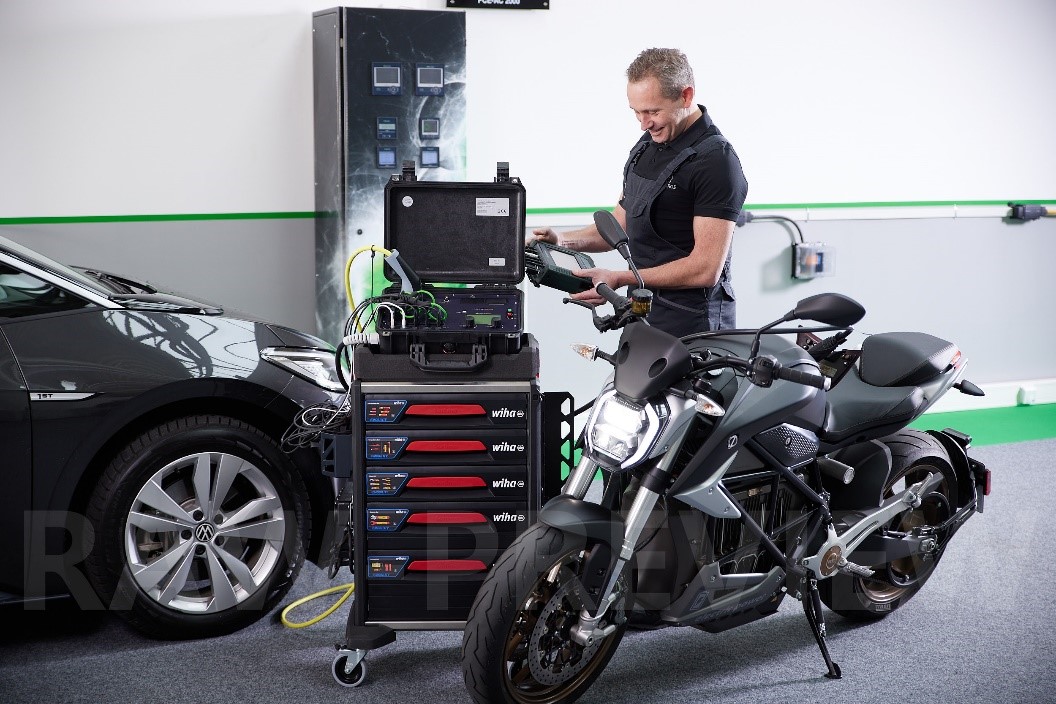
Testing electric vehicles with PROFITEST – Image: Gossen Metrawatt GmbH
Electromobility is key to climate-friendly mobility worldwide. Operating electric vehicles, especially when powered by renewable energy, produces significantly less CO2.
The charging infrastructure has a significant impact on the reliable charging of an electric vehicle. By observing a few key safety aspects, electromobility simple and trouble-free for all users. Electric vehicles draw a very high electrical power throughout the entire charging process – which can last several hours. Consequently, the charging infrastructure must be designed and tested accordingly.
Currently, 36,894 standard charging points and 6,099 fast charging points are installed in Germany (Federal Network Agency, as of May 1, 2021). The combined CCS charging system ensures both charging at standard charging stations with alternating current (AC charging stations) and fast charging with direct current (DC charging stations).
In addition to testing the charging infrastructure's protective measures and electrical safety, the charging station's functionality must also be tested. For this purpose, the vehicle connected to the station and the charging cable coding are simulated using adapters (in accordance with DIN EN 61851 / VDE 0122 / DIN SPEC 70121-1 and ISO 15118-1).
All components of the AC (normal) and DC (fast charging) charging infrastructure can be comprehensively and compliantly tested with the test equipment from Gossen Metrawatt
- Simulation of all charging states using ProType test adapters
- Testing charging infrastructure with PROFITEST MXTRA/PRIME and test adapter
- Diagnosis of malfunctions in the PROFITEST H+E BASE/XTRA charging infrastructure
- Test charging cables with SECUTEST ST and PROFITEST MXTRA
- Analyze malfunctions in the charging process with MAVOWATT PQ
- Testing high-voltage technology in electric vehicles with METRAHIT IM-XTRA/E-DRIVE
Testing of photovoltaic systems
In 2020, renewable energies (RE) together accounted for more than 50% of net electricity generation in Germany for the first time. Photovoltaics, based on consumption figures from the previous year [BDEW3], generated approximately 10.5% of net electricity, amounting to 51.42 TWh (according to the Fraunhofer Institute for Solar Energy Systems ISE).

PV SUN 1500 test case for measuring PV modules – Image: Gossen Metrawatt GmbH
The sun is an inexhaustible energy source available everywhere and is one of the Earth's natural energy sources. This energy is constantly regenerated by the power of the sun.
Thanks to a patented process, the PROFITEST PV can test the installed PV modules directly at the installation site with just one measurement and without specifying the module data:
- Peak power
- Series internal resistance
- Parallel internal resistance
- isolation
- polarity
- Ground fault
- protective conductor
The PROFITEST PVSUN and PROFITEST PVSUN MEMO enable all required electrical safety tests on photovoltaic systems to be carried out easily, safely, and in accordance with DIN EN 62446, and allow for the recording of module characteristic curves. These test instruments are suitable for testing PV modules and strings up to a maximum of 1,500 V / 20 A.
This goes well with:
Inspection of wind turbines
Humans have always harnessed the power of the wind. Whether in windmills or sailing ships, this energy has been used for centuries. With the latest technological advancements, it is becoming increasingly possible to better utilize this enormous potential.
Wind power was once again the most important energy source in 2020, accounting for 27 percent of electricity generation. However, the German offshore wind energy market was at a standstill in the second half of 2020. Compared to the previous year, the output of newly commissioned offshore wind turbines fell by approximately 80 percent in 2020.
Nevertheless, the operational safety of wind turbines is of paramount importance. Professional testing technology must ensure that the high investments in the expansion of this technology pay off and that the reliability required by insurers is maintained throughout the entire service life.
The PROFITEST PRIME, a testing device for protective measures in AC networks up to 690V and DC networks up to 800V, is used as an approved testing device according to DIN EN 61557/VDE 0413 for testing wind turbines for:
- Network and fault loop impedance
- Low resistance
- RCD test
- isolation
- Leakage and differential currents
- Dielectric strength
- protective conductor
Testing battery storage systems
Battery storage systems are not only used as UPS (Uninterruptible Power Supply) systems in data centers, hospitals, or other critical installations.
The anticipated increase in electric vehicles on the road will lead to peak loads for all electricity customers, depending on the time of day. Battery-powered energy storage systems can reduce these peaks and potentially eliminate them almost entirely. Combined with photovoltaics, battery storage will enable the private installation of wallboxes for charging electric vehicles. By integrating a suitable home storage system, the proportion of self-generated PV electricity can be significantly increased.
METRACELL BT PRO is used for testing:
- Internal resistance of battery storage systems
- Measurement of electrical resistance (Rel)
- Measurement of electrochemical (charge-transfer) resistance (Rct)
- Measurement of block voltages
- Measurement of total voltages up to 600 V
- Measurement of charging and discharging currents
- Measurement of block temperatures
- Measurement of acid densities
In all areas, the protection of the user from damage caused by electric current is paramount. Furthermore, the function and performance of the components used are tested. All tests performed must be documented and repeated at regular intervals. These intervals are determined by legal requirements, standards, or manufacturer specifications.
The tester must possess the necessary expertise and specialist knowledge to carry out the measurements and tests. This expertise can be acquired through initial or continuing training and should be regularly updated.
Related to this:
Via Gossen Metrawatt
Metrawatt International GmbH is the parent company of the Gossen-Metrawatt Group, a globally operating supplier of electronic capital goods based in Nuremberg, Germany. Its subsidiaries include Gossen Metrawatt GmbH, Nuremberg, a world market leader in measuring and testing equipment; Camille Bauer Metrawatt AG, Wohlen, Switzerland, specializing in industrial measurement and control technology; and Global Power Technology Inc., with its operating companies Dranetz, Daytronic, and Electrotek Concepts in the USA, which focuses on power quality and analysis. The group also includes Gossen Photo- und Lichtmesstechnik GmbH, a manufacturer of industrial light measurement technology. In 2014, the British Seaward Group, a manufacturer of electrical measuring and testing equipment for safety-related equipment testing, medical device testing, and renewable energy testing, was acquired, followed in 2016 by Kurth Elektronik GmbH, a measurement technology specialist in telecommunications, data technology, and electrical installations.
Production takes place in Nuremberg, Wohlen, and, since the acquisition of Dranetz, also in the USA. In addition, the company has its own sales subsidiaries in Italy, the Netherlands, the Czech Republic, Switzerland, Austria, France, and Spain.
Why Xpert.Solar? – Electromobility: How safe is it to drive electric cars? How is the safety of electric cars tested?
Xpert.Solar is a project of Xpert.Digital. We have many years of experience in supporting and consulting on warehouse solutions and logistics optimization, which we combine under the Xpert.Plus umbrella in a large network. With Xpert.Solar, we combine the same expertise in the field of photovoltaics and renewable energies.

Konrad Wolfenstein
I would be happy to serve as your personal advisor.
You can contact me by filling out the contact form below or simply call me on +49 7348 4088 965 .
I'm looking forward to our joint project.
Write to me


Xpert.Digital – Konrad Wolfenstein
Xpert.Digital is a hub for industry focusing on digitalization, mechanical engineering, logistics/intralogistics and photovoltaics.
With our 360° Business Development solution, we support renowned companies from new business to after-sales.
Market intelligence, smarketing, marketing automation, content development, PR, mail campaigns, personalized social media and lead nurturing are part of our digital tools.
You can find more information at: www.xpert.digital – www.xpert.solar – www.xpert.plus
Keep in touch