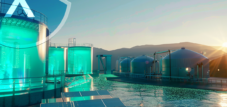
e-SAF from Nordic Electrofuel: Hydrogen fuel for aircraft – Oman uses its solar energy for green aviation – Image: Xpert.Digital
e-SAF and green hydrogen: A look at Oman's renewable revolution
Nordic Electrofuel plans e-SAF project in Oman: An analysis of the sustainable aviation fuel industry in the Sultanate
The Norwegian company Nordic Electrofuel recently announced its plans to build an electro-Sustainable Aviation Fuel (e-SAF) plant in the Sultanate of Oman. This development aligns with Oman's growing ambitions to establish itself as a hub for the production of renewable energy and sustainable aviation fuels. The planned plant will utilize renewable energy and green hydrogen to produce low-carbon aviation fuel with a significantly reduced carbon footprint compared to conventional kerosene. While the exact capacity of the plant in Oman is yet to be determined, this announcement demonstrates the growing international interest in harnessing Oman's abundant solar and wind resources for the production of sustainable fuels.
e-SAF (electrically generated sustainable aviation fuel) is not a pure hydrogen fuel for aircraft, but a synthetic fuel produced using hydrogen
The technology behind e-SAF and its significance for the aviation industry
Electro-Sustainable Aviation Fuel (e-SAF) represents a promising solution for decarbonizing air transport, a sector considered particularly difficult to decarbonize. The e-SAF production process begins with the use of renewable electricity for the electrolysis of water, separating hydrogen and oxygen. The resulting hydrogen is then combined with carbon dioxide, sourced either from the atmosphere or from industrial sources. Through chemical synthesis, a fuel similar to conventional kerosene is produced, but with a significantly smaller carbon footprint.
The advantages of e-SAF over conventional fossil aviation fuels are significant. It burns cleaner and can be used in existing aircraft engines without modifications, enabling an immediate reduction in greenhouse gas emissions. For airlines increasingly under pressure to reduce their environmental impact, e-SAF offers a viable solution for emissions reduction without requiring major changes to the fleet or infrastructure.
However, the production of e-SAF is energy-intensive and requires significant amounts of renewable electricity as well as access to CO₂ sources. Therefore, the choice of location for e-SAF plants is crucial to achieving economically viable production costs. The Sultanate of Oman, with its excellent conditions for solar and wind energy, positions itself as an ideal location for such plants.
The e-SAF production process includes the following steps
- Production of green hydrogen through electrolysis using renewable energy
- Combination of hydrogen with CO₂ (often from air capture or industrial processes)
- Conversion of these raw materials into a synthetic crude oil equivalent
- Further processing into a kerosene-like fuel
The end product is a liquid fuel that can be used in conventional aircraft engines without modifications. e-SAF can be used as a "drop-in" fuel, meaning it can be mixed with or completely replace conventional kerosene.
The main advantage of e-SAF lies in its potential CO₂ neutrality, as combustion releases only as much CO₂ as was absorbed during production. Furthermore, the use of e-SAF can lead to a reduction in soot and ice particle concentrations compared to conventional kerosene, which has a positive impact on contrail formation.
Related to this:


Nordic Electrofuels' global and regional e-SAF strategy
Nordic Electrofuel, a privately held Norwegian company, is pursuing an ambitious strategy to develop multiple e-SAF production plants in Europe and other regions. The company plans to reach a total capacity of approximately 1 billion liters of low-carbon aviation fuel per year by 2033. Its technology is based on the power-to-liquid (PtL) process, which uses green hydrogen and CO₂ to produce sustainable aviation fuel.
As part of its development strategy, Nordic Electrofuel is currently building a pilot plant in the Porgrunn district of Norway. This plant is scheduled to go into operation in 2027 and will have an annual capacity of 10 million liters of synthetic fuels. This pilot plant will serve as a technology demonstrator and provide valuable experience for larger commercial projects.
Nordic Electrofuel has already made significant progress in the Middle East. The company has received approval to build an e-SAF plant with a capacity of 350 million liters per year in Jubail, Saudi Arabia. According to Nordic Electrofuel CEO Gunnar Holen, this plant could be operational as early as 2029 if the project is accelerated. In Saudi Arabia, the company plans to produce the renewable hydrogen itself, while the solar power plants will be developed by partners.
The expansion into the Middle East, particularly Saudi Arabia and Oman, underscores Nordic Electrofuel's strategy of utilizing regions with optimal conditions for renewable energy. In both countries, the company anticipates benefiting from low renewable energy costs, made possible by the extremely favorable conditions for solar and wind power generation.
Nordic Electrofuel's planned Oman project
Nordic Electrofuel's announcement of plans to build an e-SAF plant in the Sultanate of Oman was made by the company's CEO, Gunnar Holen, in an interview with Argus Media, a London-based media organization and energy industry think tank. While the planned capacity of the plant in Oman has not yet been determined, Holen indicated that the raw material for the project could come from the large-scale green hydrogen developments expected to emerge in Oman in the coming years.
A key advantage for Nordic Electrofuel's planned investment in Oman is the availability of cost-effective renewable energy sources, thanks to the country's abundant high-quality solar and wind resources. According to Holen, electricity costs could be around USD 20/MWh, made possible by the extremely favorable conditions for solar and wind power generation.
Unlike its project in Saudi Arabia, where Nordic Electrofuel plans to produce the renewable hydrogen itself, the company may consider purchasing hydrogen from other projects in Oman. Oman has attracted strong interest from potential hydrogen project developers, and the state-owned Hydrom recently announced a third tender for land, having already allocated eight.
The partnership between Nordic Electrofuel and Oman could be beneficial for both sides. For Nordic Electrofuel, Oman offers ideal conditions for the cost-efficient production of e-SAF, while Oman could benefit from the company's technology and expertise to advance its ambitions in renewable energy and sustainable aviation fuels.
Oman's renewable energy and green hydrogen landscape
Oman is actively positioning itself as a leading producer and exporter of renewable hydrogen and hydrogen-based fuels. The country possesses excellent renewable resources, particularly solar PV and onshore wind, as well as a favorable geographic location for accessing key import markets such as Europe and Japan. Furthermore, Oman has large areas of land available for large-scale project development and existing fossil fuel infrastructure that can be used directly or converted to produce low-carbon fuels.
According to a report by the International Energy Agency (IEA) and the Ministry of Energy and Minerals, Oman could produce green hydrogen at a globally competitive cost of USD 1.6/kg by 2030. This forecast is based on the availability of cheap renewable electricity, made possible by abundant solar and wind resources and virtually unlimited land available for development.
Oman aims to produce approximately 1 million tons of renewable hydrogen per year by 2030, which will require about 50 terawatt-hours (TWh) of domestically generated renewable electricity. The investment needed to develop this capacity is estimated at around USD 33 billion by 2030, of which USD 20 billion is for renewable energy and USD 13 billion for electrolysis and ammonia conversion.
Currently, there are various estimates of hydrogen production costs in Oman. One study using the US National Renewable Energy Laboratory's H2A-Lite tool estimates the levelized cost of green hydrogen (LCOH) at approximately USD 5.63/kg. Another study indicates that hydrogen production costs for selected sites in Oman range between USD 6.31 and USD 7.32/kg. With advancing technology and economies of scale, these costs are expected to decrease significantly in the coming years.
The first green hydrogen project in Oman, for which a final investment decision is expected between 2026 and 2027, is likely to be the Hyport Duqm project, with an initial production capacity of 60,000 tons per year. The project is backed by OQ Alternative Energy (25.5%), BP (49%), and the Belgian company Deme (25.5%).
Related to this:

Other e-SAF initiatives in Oman
In addition to Nordic Electrofuel's plans, several other significant initiatives are underway to promote e-SAF production in Oman. The country's Civil Aviation Authority (CAA) is playing a leading role in attracting local and international investment to a national e-SAF production hub. Since hosting a landmark forum on sustainable and low-carbon aviation fuels in October 2023, several ambitious initiatives to support e-SAF production in the country have been announced.
Particularly noteworthy is the initiative of the OSCAR (Oman Sustainable Cars and Aviation Refuelling) consortium, which is investigating the potential for the production of e-gasoline and e-SAF. The consortium consists of OQ Alternative Energy (OQAE), Dutco, Sumitomo Corporation Middle East FZE, Automobili Lamborghini SpA, and Airbus. The concept study will examine the production of e-fuels (e-SAF and e-gasoline) in Oman on a pilot scale, with the possibility of later scaling it up to a commercial project by identifying the most suitable production pathway from qualifying hydrogen and CO₂ sources.
Furthermore, OQ Alternative Energy and Tree Energy Solutions (TES) have entered into a joint study agreement to evaluate the development of an electric natural gas (e-NG) plant in Oman. This agreement underscores Oman's commitment to diversifying its renewable energy sources and promoting the production of various types of clean fuels.
Another key player in Oman's sustainable fuel landscape is the startup WAKUD, which has announced plans to build two large biorefineries for the production of sustainable aviation fuel (SAF), representing a total investment of approximately USD 630 million. These plants are planned for the ports of Sohar and Salalah and are expected to become operational in 2026 and 2027, respectively. The Sohar plant is projected to have an annual capacity of 250 million liters of SAF and 125 million liters of e-SAF, while the Salalah plant is expected to produce 200 million liters of SAF and 100 million liters of e-SAF annually.
Economic considerations and potential challenges
The development of e-SAF production facilities in Oman offers significant economic opportunities but also presents challenges. Economic benefits include diversifying the economy away from fossil fuels, creating jobs, and developing new industries. Furthermore, Oman could benefit from the growing global demand for sustainable aviation fuels as an exporter of e-SAF, particularly in regions with stringent emissions regulations, such as Europe.
One of the main challenges, however, is ensuring a sufficient supply of renewable electricity at competitive costs. Although Oman has excellent solar and wind resources, developing the necessary infrastructure requires significant investment. Electricity costs are a crucial factor in the economic viability of e-SAF projects, as electrolysis for hydrogen production is energy-intensive.
Another challenge is ensuring a reliable CO₂ source for the e-SAF production process. Nordic Electrofuel plans to initially use CO₂ from industrial plants for its sites in the Middle East. In the long term, Direct Air Capture (DAC) technologies could provide an additional CO₂ source, although this depends on the further development of this technology.
The competitiveness of e-SAF compared to conventional kerosene is also a challenge, as e-SAF is currently produced at a higher cost. Support through favorable policy frameworks, incentives, and mandates may be necessary to promote the adoption of e-SAF and improve its competitiveness.
Soaring to new heights with renewable resources: Oman's plans for green aviation
Nordic Electrofuel's plans to build an e-SAF facility in Oman represent a significant step in the development of a sustainable aviation fuel industry in the Sultanate. This initiative aligns well with Oman's broader ambitions to establish itself as a leading producer and exporter of renewable hydrogen and hydrogen-based fuels. With its abundant renewable resources, strategic geographic location, and supportive policy framework, Oman is well-positioned to capitalize on the growing global demand for sustainable aviation fuels.
The successful implementation of this and other e-SAF projects in Oman could offer significant economic benefits, including economic diversification, job creation, and the development of new industries. Furthermore, it would help Oman achieve its environmental goals and contribute to the global effort to reduce greenhouse gas emissions from aviation.
While challenges remain regarding the scaling of renewable energy production, ensuring a reliable CO₂ supply, and improving the competitiveness of e-SAF, current developments point to a promising future for the sustainable aviation fuel industry in Oman. With the continued commitment of companies like Nordic Electrofuel and government support, Oman is well on its way to becoming a major player in the global sustainable aviation fuel market.
🎯🎯🎯 Benefit from Xpert.Digital's extensive, five-fold expertise in one comprehensive service package | BD, R&D, XR, PR & Digital Visibility Optimization


Benefit from Xpert.Digital's extensive, five-fold expertise in a comprehensive service package | R&D, XR, PR & Digital Visibility Optimization - Image: Xpert.Digital
Xpert.Digital possesses in-depth knowledge across various industries. This allows us to develop tailored strategies precisely aligned with the requirements and challenges of your specific market segment. By continuously analyzing market trends and monitoring industry developments, we can act proactively and offer innovative solutions. The combination of experience and expertise generates added value and provides our clients with a decisive competitive advantage.
More information here:
We are here for you - Consulting - Planning - Implementation - Project Management
☑️ SME support in strategy, consulting, planning and implementation
☑️ Creation or realignment of the digital strategy and digitization
☑️ Expansion and optimization of international sales processes
☑️ Global & Digital B2B trading platforms
☑️ Pioneer Business Development

Konrad Wolfenstein
I would be happy to serve as your personal advisor.
You can contact me by filling out the contact form below or simply call me on +49 7348 4088 965 .
I'm looking forward to our joint project.
Write to me


Xpert.Digital - Konrad Wolfenstein
Xpert.Digital is a hub for industry focusing on digitalization, mechanical engineering, logistics/intralogistics and photovoltaics.
With our 360° Business Development solution, we support renowned companies from new business to after-sales.
Market intelligence, smarketing, marketing automation, content development, PR, mail campaigns, personalized social media and lead nurturing are part of our digital tools.
You can find more information at: www.xpert.digital - www.xpert.solar - www.xpert.plus
Keep in touch