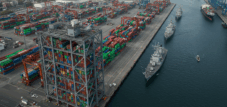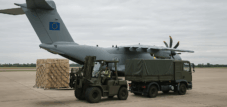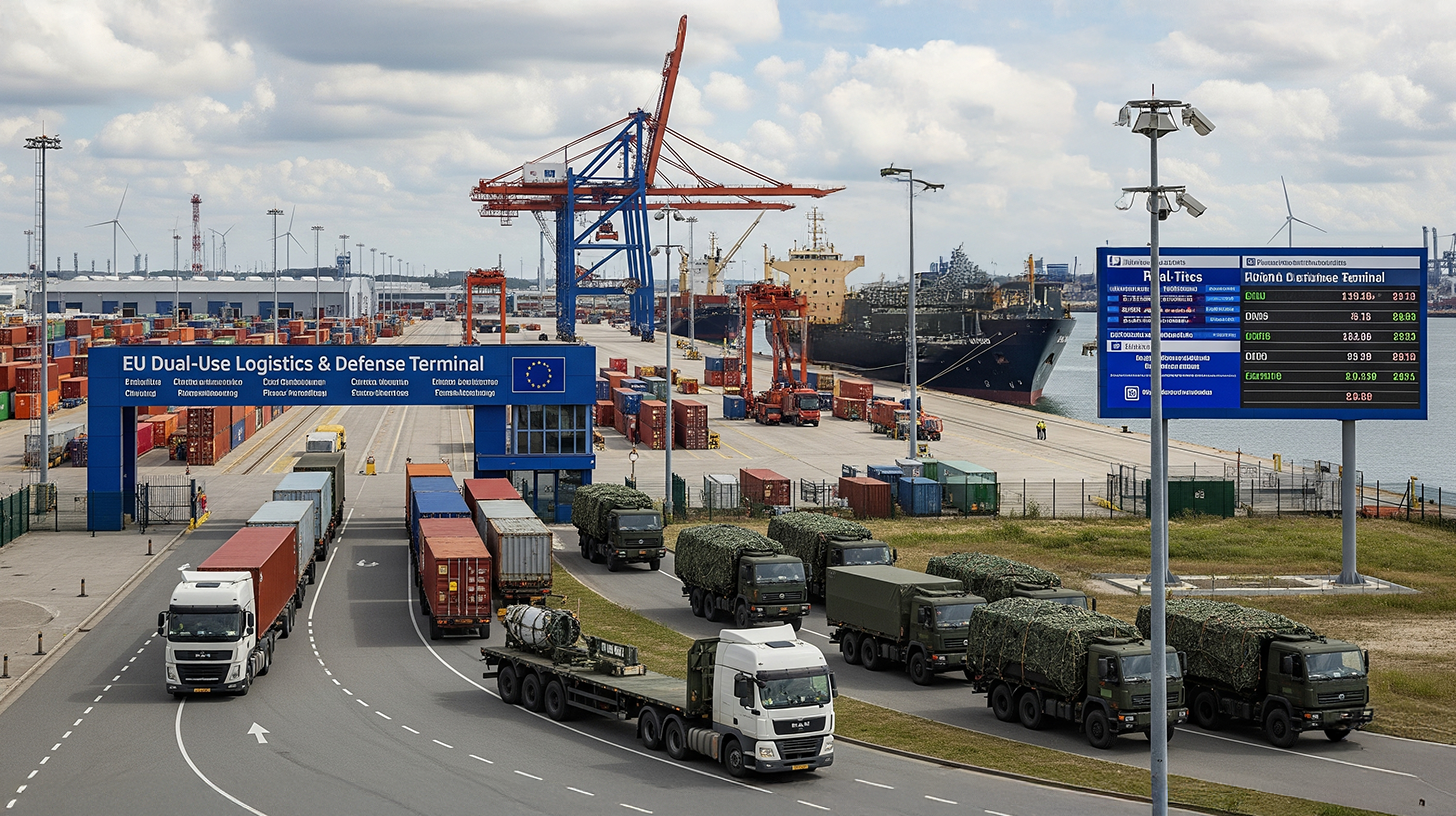
Dual-use heavy-lift container terminals – For the EU internal market and European military defense security – Creative image: Xpert.Digital
The integration of advanced terminal systems into a dual-use framework for military heavy-lift logistics
A comprehensive analysis of the integration of advanced commercial container and heavy-lift terminal systems into a dual-use logistics concept to support NATO's collective defense capability
It examines the technological capabilities of modern ports, the doctrinal framework of civil-military cooperation, and the practical challenges of interoperability. Key findings show that while commercial automation offers unprecedented efficiency, its application in military logistics requires significant investment in hybrid infrastructures, standardized digital interfaces, and robust contractual frameworks. The report concludes with strategic recommendations for policymakers, military planners, and port authorities to create a resilient, responsive, and technologically advanced logistics network capable of meeting the deterrence and defense demands of the 21st century.
The new geopolitical landscape: “Turning point” and the imperative for military mobility
The strategic environment has changed dramatically, shaped by Germany's "turning point" and a renewed, alliance-wide focus on credible deterrence and defense. This "enormous impetus" necessitates the rapid deployment of large units and heavy equipment across Europe. The ability to project and sustain combat power is now a primary measure of credible deterrence. This reality elevates logistics from a support function to a central strategic enabler, making the efficiency and resilience of transport infrastructure a matter of national and alliance security. The "Rearm Europe" concept is inextricably linked to the modernization of military logistics, with a focus on automation, speed, and the seamless use of civilian infrastructure.
The fundamentals of modern heavy haul and terminal logistics
The domain of heavy-load logistics
Definition of the scope
Heavy haul logistics is a highly specialized field focused on the project-based transport of goods that are non-standard in their dimensions, weight, or both. This includes industrial machinery, power plant components such as turbines and generators, wind turbine parts, and entire prefabricated buildings. It is a complex undertaking requiring meticulous planning, coordination with authorities to obtain permits, route surveys, and the combination of different modes of transport (road, rail, water).
The scale of the challenge
The crucial distinction lies in the scale of the loads. While a standard industrial pallet weighs approximately 1.5 tons, a 40-foot ISO container can weigh up to 40 tons, and specialized project cargo can be considerably heavier. Military heavy loads, such as main battle tanks (MBTs), can reach weights of up to 80 tons. This massive scaling necessitates a fundamental redesign of all supporting infrastructure and handling equipment.
Infrastructural requirements
Terminals handling heavy-lift and project cargo require specialized infrastructure: heavy-duty access roads, reinforced storage and assembly areas, and cranes with high lifting capacities. For example, the Niederrhein Heavy-Lift Terminal uses gantry cranes with a lifting capacity of up to 320 tons and has extensive, heated indoor and outdoor storage areas. This infrastructure is a direct analogue to the requirements for handling heavy military equipment.
The technological lineage from industrial to port automation
The technological innovations driving the automation of modern container terminals, particularly high-bay storage (HBS), did not originate in traditional port logistics. Rather, they are a direct evolution of heavy-duty intralogistics systems perfected over decades in industries such as steel, paper, and automotive. Technologies for handling extreme loads of 10,000 kg (10 tons) and more, developed in the steel and precast concrete industries, formed the technological reservoir and the foundation of trust for the leap into container port automation. This means that the key engineering challenges in developing robust, reliable, and precise automated systems for massive weights were first addressed in the factory environment before being adapted to the port setting. Comparing a 1.5-ton pallet with a 40-ton container highlights the necessary leap in development: the principles of automated high-bay pallet storage had to be massively scaled up and made more robust. This lineage is crucial for dual-use logistics. When considering the transport of an 80-ton tank, the most relevant commercial expertise may not lie with a standard container terminal operator, but rather with a logistics service provider or engineering firm specializing in the transport of industrial project cargo or the design of automated heavy-lift systems for factories. This suggests that military planners should consider a broader ecosystem of heavy-lift specialists beyond traditional port partners.
The technological evolution of port terminals
Vertical vs. Horizontal: The Paradigm Shift in Automation
Conventional terminals using straddle carriers (RTGs/RMGs) and straddle carriers face a fundamental conflict between storage density and operational efficiency. While stacking containers high saves space, it leads to unproductive shuffle moves to access containers at lower levels. Effective utilization is often limited to 70-80%; exceeding this threshold results in an exponential drop in performance.
Inspired by heavy-duty industrial intralogistics, HBS (High-Bay Storage) systems like BOXBAY store each container in an individual, directly accessible shelf compartment. This disruptive innovation completely eliminates restacking and enables 100% direct access. This vertical approach can triple or even quadruple storage capacity on the same footprint, enables automated 24/7 operation, drastically reduces truck handling times (to under 30 minutes), and increases safety by separating people from machines. The modular design allows for phased implementation, making the technology accessible even to smaller ports.
The workhorses: A comparative analysis of terminal equipment
The technological landscape of modern terminals is diverse and highly specialized. Each piece of equipment fulfills a specific function within the complex logistics chain.
Ship-to-Shore (STS) cranes: These are the primary devices for loading and unloading ships. Modern STS cranes are massive structures with lifting capacities of up to 120 tons and represent a key component for the throughput of a terminal.
Portal cranes: RTG vs. RMG:
Rubber-tired gantry cranes (RTGs): These cranes move on large rubber tires, offering the flexibility to change storage blocks or be repositioned within the terminal. They are powered by diesel, hybrid, or increasingly by batteries or cable reels. Their flexibility makes them adaptable; however, the interface between the rubber tires and the ground can be less precise for full automation.
Rail-mounted gantry cranes (RMGs): These cranes run on fixed rails and offer higher speed, precision, and energy efficiency, making them ideal for high-density, automated operations (ARMG systems). Their inflexibility is the trade-off for higher performance in a structured environment.
Horizontal Transport: Straddle Carriers vs. AGVs:
Straddle carriers: These can lift, transport, and stack containers (up to four high), making them a highly flexible, all-in-one solution. They can decouple the operation of quayside cranes from stacking in the warehouse and are effective in irregularly shaped terminal areas. However, they require more maintenance and have a higher center of gravity.
Automated Guided Vehicles (AGVs): These are driverless vehicles that transport containers between the quay and the storage area. They are highly efficient, have lower maintenance costs, and can be fully electric (emission-free). Standard AGVs require a crane at both ends of their journey (coupled operation), which can lead to bottlenecks. Lift AGVs (L-AGVs) can autonomously place containers onto racks, decoupling the process and improving efficiency.
Specialized heavy-lift equipment: For non-containerized cargo, terminals rely on other tools, including high-capacity mobile port cranes (up to 100 t), floating cranes (200-600 t) and self-propelled modular transporters (SPMTs) that can move loads of 300 t or more per trailer.
Comparative analysis of terminal handling systems
Straddle Carrier
- Main operating mode: Lifting, transporting & stacking (all-in-one).
- Flexibility/Adaptability: High: Ideal for irregular surfaces, can directly serve trucks.
- Throughput/Speed: Medium-High: Decouples the quay crane from the storage area.
- Space requirement/density: Medium: Stacks up to 4 high.
- Cost profile (CAPEX/OPEX): Medium CAPEX / High OPEX: High maintenance costs.
- Dual-use/military suitability (advantages & disadvantages): Pros: High flexibility for various, non-standard military vehicles. Cons: High ground pressure, maintenance-intensive.
AGV (Standard)
- Main operating mode: Horizontal transport (quay <-> warehouse).
- Flexibility/Adaptability: Low: Fixed routes, requires a crane at both ends.
- Throughput/Speed: High: Efficient in continuous flow.
- Space requirement/density: High (in the system): Enables dense block storage.
- Cost profile (CAPEX/OPEX): Low CAPEX / Low OPEX: Low maintenance, electrical.
- Dual-use/military suitability (advantages & disadvantages): Pros: High, predictable throughput for standardized supplies (ISO containers). Cons: Coupled operation can create bottlenecks.
Lift AGV
- Main operating mode: Horizontal transport with autonomous unloading.
- Flexibility/Adaptability: Medium: Decoups the transfer process to the storage crane.
- Throughput/Speed: Very High: Reduces waiting times of AGVs and cranes.
- Space requirement/density: High (in the system): Requires drop-off racks.
- Cost profile (CAPEX/OPEX): Medium CAPEX / Low OPEX: More expensive than a standard AGV.
- Dual-use/military suitability (advantages & disadvantages): Pros: Combines high throughput with increased flexibility, reduces bottlenecks. Cons: Additional infrastructure (racks) required.
RTG crane
- Main operating mode: Stacking in block storage, truck loading.
- Flexibility/Adaptability: High: Can switch blocks, flexible in layout.
- Throughput/Speed: Medium: Slower than RMG, manual operation.
- Space requirement/density: Medium: Requires tramlines for tires.
- Cost profile (CAPEX/OPEX): Medium CAPEX / Medium OPEX: Diesel/hybrid operation.
- Dual-use/military suitability (advantages & disadvantages): Pros: Flexible deployment on temporary or less developed sites. Cons: Lower degree of automation.
RMG crane
- Main operating mode: Stacking in block storage, truck/rail loading.
- Flexibility/Adaptability: Low: Bound to rails.
- Throughput/Speed: Very High: High speed and precision.
- Space requirement/density: Very high: Dense stacking possible.
- Cost profile (CAPEX/OPEX): High CAPEX / Low OPEX: Highly efficient, electrically powered.
- Dual-use/military suitability (advantages & disadvantages): Pros: Ideal for rapid mass transshipment at strategic hubs. Cons: Inflexible, requires massive fixed infrastructure.
HBS / AHRS
- Main operating mode: Fully automated single-location storage.
- Flexibility/Adaptability: Medium (in design): Modularly expandable.
- Throughput/Speed: Extremely High: No restacking, 24/7 operation.
- Land requirement/density: Extremely high: Maximum land use.
- Cost profile (CAPEX/OPEX): Very High CAPEX / Very Low OPEX: Low operating costs.
- Dual-use/military suitability (advantages & disadvantages): Pros: Unrivaled speed and capacity for strategic material stockpiling. Cons: High initial investment, inflexibility for oversized goods.
The digital brain: Terminal Operating Systems and the Smart Port
The "brain" of the terminal is the Terminal Operating System (TOS), a sophisticated software platform that manages and optimizes all complex processes. Core functions of the TOS include ship planning, storage management (optimizing container locations), equipment control (scheduling cranes and vehicles), gate operations, and real-time resource allocation. It integrates technologies such as RFID, GPS, and artificial intelligence (AI) to provide a complete operational overview.
A further development of this concept is the "digital twin," a highly accurate virtual replica of the physical port, including its facilities, processes, and systems. It uses real-time data from IoT sensors, cameras, and the TOS (Traffic Operations System) to reflect the port's condition. A digital twin enables the simulation of complex scenarios (e.g., planning a large-scale military deployment without disrupting commercial traffic), predictive maintenance, traffic flow optimization, and improved security and emergency planning. It transforms complex data into understandable, actionable information for decision-makers. The future trend is toward increased use of AI and machine learning to move from reactive management to predictive and optimized control. AI can optimize ship handling, predict cargo volumes, and manage autonomous vehicle fleets, significantly increasing efficiency and reducing emissions.
The TOS as a critical point of civil-military friction and vulnerability
Although the Terminal Operating System (TOS) is key to commercial efficiency, it also represents the most critical and complex interface for dual-use operations. Its proprietary, closed nature poses a significant obstacle to seamless integration with military command and control (C2) systems. The TOS is described as the "brain" that controls every physical asset in an automated terminal. However, military operations require dedicated C2 and logistics information systems to track troops, manage supplies, and ensure security, such as during the movement of classified information. Current research provides no evidence of a standardized interface between commercial TOS (such as NAVIS N4 or CyberLogitec OPUS) and military logistics systems. A military deployment would require the TOS to prioritize military movements, securely handle sensitive cargo data, and potentially operate in a noisy or contested electromagnetic environment—functions for which it was not designed. Furthermore, the concentration of control within the TOS and its associated IT/OT systems makes it a high-value target for adversaries. A successful cyberattack on the TOS (Telecommunications Operations System) of a major port like Bremerhaven or Rotterdam could halt a large NATO deployment before it even begins. Realizing true dual-use capability therefore depends not only on physical access to cranes and quays. It requires the development of a secure, standardized, and resilient "digital handshake" between commercial TOS and military C2 systems. This is a major political, technological, and cybersecurity challenge that is currently underdeveloped. Without it, military operations in an automated port would be slow, inefficient, and highly vulnerable.
Your container high-bay warehouse and container terminal experts

Container terminal systems for road, rail and sea transport in the dual-use logistics concept of heavy-lift logistics - Creative image: Xpert.Digital
In a world marked by geopolitical upheavals, fragile supply chains, and a new awareness of the vulnerability of critical infrastructure, the concept of national security is undergoing a fundamental reassessment. A state's ability to guarantee its economic prosperity, the provision of essential goods and services to its population, and its military capability increasingly depends on the resilience of its logistical networks. In this context, the concept of "dual-use" is evolving from a niche category of export control to a broader strategic doctrine. This shift is not merely a technical adjustment but a necessary response to the "paradigm shift" that demands a profound integration of civilian and military capabilities.
Related to this:
Civil-military logistics reimagined: Germany's key role in the NATO network
The dual-use mission: Civil-military cooperation in practice
The framework of civil-military logistics (CMZ)
Host Nation Support (HNS) and the “Germany Hub”
Host Nation Support (HNS) is the civilian and military assistance that a host nation provides to allied forces on its territory. It is a fundamental principle of collective defense, formalized in NATO doctrine (AJP-4.5(B)) and national agreements. It is not a voluntary contribution but a core obligation.
Due to its geostrategic location, Germany is the central logistics hub for NATO and serves as the primary transit country for forces being deployed to the eastern flank. This role encompasses the coordination of movements, the provision of supplies, route security, and support for the reception, staging, and onward movement (RSOM) of troops and equipment. In practice, HNS covers a broad range of services, from processing permits for heavy transport and providing escorts to organizing accommodation, refueling, maintenance, and medical support. The German Armed Forces process approximately 1,000 HNS requests annually, operating on the principle: "Whoever requests the service, pays for it.".
The coordination of the HNS in Germany is carried out by the Bundeswehr's Operational Command, which collaborates with regional commands and civilian authorities. In a crisis, NATO's Joint Support and Enabling Command (JSEC) in Ulm coordinates large-scale deployments within the SACEUR area of responsibility, while mobile Joint Logistics Support Groups (JLSG) manage logistics in the actual area of operations.
The civil-military interface: Synergies and points of friction
A key point of friction arises from the conflicting operating models of the commercial transport sector and the military. The commercial sector is driven by efficiency, tight margins, and just-in-time principles, which require high utilization of resources. The military needs guaranteed capacity, flexibility, and robustness for crisis situations, often at short notice, which conflicts with long-term commercial contracts.
The military's use of "robust contracts" is often perceived by industry as an attempt to shift risks. Civilian providers have the right to refuse performance, which poses a significant risk to military planning. Key challenges include liability in a conflict zone, insurance coverage for war-like scenarios, and the status of civilian personnel (e.g., drivers from non-NATO countries).
To bridge this gap, deeper integration is required. This includes creating long-term contracts with guaranteed charter shares, establishing a "reserve" status for key civilian personnel to ensure their availability and protection, developing joint training and exercises, and the state assuming the role of a self-insurer to cover extraordinary risks. This goes beyond simple procurement and aims to create a truly integrated civil-military logistics network.
Interoperability as a cornerstone of alliance logistics
The role of NATO standardization (STANAGs)
Interoperability is the ability of multinational armed forces to cooperate synergistically. It has three dimensions: technical (compatible equipment), procedural (common doctrines), and human (shared understanding and trust). Standardization, primarily through standardization agreements (STANAGs), is the key tool for achieving this. STANAGs exist for critical areas such as fuel types and connections, ammunition calibers, and medical evacuation procedures, which are essential for multinational logistics.
Despite the existence of STANAGs, significant interoperability gaps persist. Recent operations have demonstrated the continued existence of differing national traditions, resource gaps, and technological disparities. The implementation of STANAGs is a national responsibility and is not uniform across the Alliance. Existing STANAGs are often insufficient for seamless interoperability at the tactical level (brigade and below).
Overcoming practical interoperability gaps in a dual-use terminal
Even with STANAGs, physical incompatibilities can bring operations to a standstill. One example is a mismatch in fuel filler necks between US and Czech equipment. In a port, this could manifest as incompatible tie-down points on military vehicles, different data connectors for diagnostics, or varying power requirements. The military must provide civilian partners with clear technical specifications and "loading plans" for its equipment.
Communication and information systems pose a significant challenge. Civilian logistics companies utilize commercial GPS and data systems, which are prone to interference. Military forces rely on hardened, encrypted communications. Integrating civilian trucks into military convoys is one proposed solution for command and control. The lack of a shared operational situational awareness picture between a port's TOS (Tactical Operations System) and the military's C2 (Command and Control System) is a critical gap. Overcoming these procedural and human gaps requires intensive joint training and the deployment of liaison officers (LNOs) to bridge differing doctrines and languages. The principle that "only practice leads to success in the field" is of paramount importance.
Civil-military logistics integration: requirements and challenges
Planning horizon
- Commercial imperative: Long-term, predictable, just-in-time.
- Military requirement: Short-term, reactive, just-in-case.
- Resulting point of friction: Commercial capacities are tied up and not flexibly available for crises.
Contract model
- Commercial imperative: efficiency- and cost-based, fixed performance specifications.
- Military requirement: Capability-based, flexible deployment, guaranteed availability.
- Resulting point of friction: Standard contracts do not cover military risks (e.g., war clauses).
Risk management
- Commercial imperative: risk avoidance, insurable risks.
- Military requirement: Risk acceptance as part of the operation.
- Resulting point of friction: Civilian companies shy away from incalculable risks; liability and insurance issues remain unresolved.
staff
- Commercial imperative: Efficient deployment, cost minimization, diverse nationalities.
- Military requirement: Guaranteed availability, security clearance, protection status.
- Resulting point of friction: the status of civilian drivers (especially from third countries) in crisis situations; lack of "reservist" concepts.
Equipment philosophy
- Commercial imperative: Standardized (ISO), high utilization, cost-efficient.
- Military requirement: Robust, all-terrain capable, often non-standardized, redundant systems.
- Resulting point of friction: Incompatibility of civilian infrastructure (e.g. loading areas) with military equipment (e.g. tanks).
IT/Communication
- Commercial imperative: Public (GPS, mobile communications), unencrypted, efficiency-oriented.
- Military requirement: Hardened, encrypted, redundant, security-oriented.
- Resulting point of friction: Lack of interoperability between TOS and C2 systems; vulnerability of civilian systems to disruptions/attacks.
Your container high-bay warehouse and container terminal experts

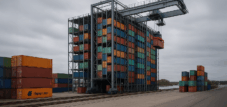
Container high-bay warehouses and container terminals: The logistical interplay – expert advice and solutions - Creative image: Xpert.Digital
This innovative technology promises to fundamentally change container logistics. Instead of stacking containers horizontally as before, they will be stored vertically in multi-story steel racking structures. This not only allows for a drastic increase in storage capacity within the same area, but also revolutionizes all processes at the container terminal.
More information here:
Hybrid terminals and smart networks: The new backbone of dual-use logistics
Case studies on dual-use capability
German Gateways: Hamburg and Bremerhaven
HHLA Hamburg: The high-tech/heavy-lift hybrid
The Port of Hamburg is an all-purpose port with terminals for every type of cargo. The Container Terminal Altenwerder (CTA) is a highly automated facility representing the latest technology in container handling, featuring automated stacking cranes and AGVs. Its high, predictable throughput makes it theoretically ideal for the rapid handling of large quantities of standardized military cargo in ISO containers. However, the rigid automation could pose challenges for non-standardized, oversized military vehicles. Meanwhile, the O'Swaldkai is a universal, multi-purpose terminal specializing in RoRo, project cargo, and special cargo.
A crucial capability for heavy-lift handling is HHLA's fleet of floating cranes (HHLA III – 100 t, HHLA IV – 200 t). They offer immense flexibility and can lift extreme loads, such as ship propellers or wind farm components, directly from barges onto ships in areas inaccessible to quayside cranes. Their capacity is perfectly suited for handling the heaviest military goods, such as tanks or bridge sections, which cannot be handled by standard container equipment. The recent successful handling of railway wagons demonstrates the port's expertise in project logistics.
BLG Bremerhaven: The proven military mobility hub
The RoRo terminal in Bremerhaven is one of the largest in Europe and a proven hub for military deployments, having played a crucial role in exercises such as DEFENDER-Europe. It handles a massive volume of self-propelled units (trucks, construction equipment) and general cargo. The port is also a key hub for the offshore wind industry, handling massive components such as nacelles and towers. This provides a direct commercial analogy to military project logistics and requires heavy-lift cranes, SPMTs, large reinforced staging areas, and sophisticated project management – all capabilities and facilities that are directly transferable to military needs.
The terminal has a 100-tonne mobile crane, access to 500-tonne truck cranes and a 600-tonne floating crane, 300-tonne capacity SPMTs, and extensive storage areas. BLG and EUROGATE are combining their wind energy expertise under the "Eco Power Port" brand, further concentrating these critical heavy-lift capabilities.
The ARA hub: Rotterdam and Antwerp-Bruges
As the two largest ports in Europe, Rotterdam and Antwerp-Bruges form the backbone of continental trade and have immense capacities in the general cargo and heavy cargo sectors.
The Port of Rotterdam is positioning itself as a key driver of the energy transition, which is fueling demand for project cargo and heavy lift (e.g., for offshore wind and hydrogen infrastructure). This focus on complex, high-value cargo has given it a resilient general cargo profile. The Port Authority has explicitly stated its ambition to support defense logistics as a necessary component of its role as a European hub. It has specialized facilities such as the Heavy Lift Centre, which can handle loads of up to 700 tons indoors.
The Port of Antwerp-Bruges has a strong tradition in general cargo handling, but faces challenges due to economic downturns affecting core steel volumes. The decommissioning of the 800-tonne floating crane "Brabo" has raised concerns about its competitive position in the heaviest cargo segment compared to Rotterdam. However, private terminals are investing in project cargo ecosystems and heavy-lift quayside cranes to compensate for this.
Both ports are deeply embedded in Europe's strategic ambitions for energy, security, and competitiveness. Their infrastructure, expertise in handling project cargo, and hinterland connections make them indispensable dual-use facilities.
Dual-use capability matrix of major European ports
Hamburg (HHLA)
- Key infrastructure for dual-use: Automated Container Terminals (CTA), multi-purpose terminals (O'Swaldkai), floating cranes (100-200 t).
- Specialized skills: Project logistics, heavy goods, RoRo, handling of oversized goods.
- Documented military/dual-use role: Handling of project cargo (e.g. trains), HHLA Project Logistics established.
- Strategic assessment: Flexible hybrid model: Combines highly efficient handling for standardized goods with highly flexible capacities for the heaviest, non-standardized equipment.
Bremerhaven (BLG)
- Key infrastructure for dual-use: Large RoRo terminal, high & heavy areas, heavy-duty cranes, SPMTs, floating crane access (600 t).
- Specialized skills: Wind energy logistics, RoRo, breakbulk, vehicle handling.
- Documented military/dual-use role: Central hub for NATO exercises (e.g., DEFENDER-Europe).
- Strategic Assessment: Proven RoRo Mobility Hub: Specialized and experienced in the rapid handling of large quantities of rolling stock and military project cargo.
Rotterdam
- Key infrastructure for dual-use: extensive breakbulk terminals, heavy lift centre (700 t indoor), strong hinterland connections.
- Specialized skills: Energy transition projects (offshore wind, hydrogen), project cargo, steel.
- Documented military/dual-use role: Explicit policy to support defense logistics.
- Strategic Assessment: Strategic Energy & Defense Hub: Leader in complex project cargo required for energy and security infrastructure; clear strategic alignment.
Antwerp-Bruges
- Key infrastructure for dual-use: multi-purpose terminals, quay cranes (up to 400 t), Project Cargo Ecosystems.
- Specialized skills: Breakbulk (especially steel), project cargo, RoRo.
- Documented military/dual-use role: Important NATO logistics hub (historical and current).
- Strategic assessment: Competitive breakbulk specialist: Strong industrial base, but needs to compensate for the loss of heavy lifting capacity (floating crane) to remain competitive in the top segment.
Critical enablers and future-oriented challenges
Securing the digital backbone: The cybersecurity challenge
Modern ports are a complex mix of information technology (IT) systems (business networks, planning) and operational technology (OT) systems (cranes, AGVs, sensors). The increasing interconnectedness of these two areas creates a massive, vulnerable attack surface. Key risks include ransomware, insider threats, and sophisticated, state-sponsored advanced persistent threats (APTs). OT systems often use older, less secure technologies and cannot be easily patched or protected with conventional IT security tools without disrupting operations. Reliance on third-party software and remote maintenance creates vulnerabilities in the supply chain.
For a dual-use terminal, the stakes are even higher. Adversaries know that compromising this critical civilian infrastructure can impair a nation's ability to deploy and supply military forces. The massive volume of cyberattacks on major ports like Los Angeles (40 million per month) underscores the constant threat.
A multi-layered approach to mitigation is required:
- Governance: Development of a comprehensive cybersecurity plan, appointment of a cybersecurity officer, and conducting regular risk assessments.
- Technical controls: Implementation of strong access controls (least privilege, segregation of duties), network segmentation to isolate OT and IT, encryption and robust patch management for all systems, including third-party software.
- Resilience: Development and testing of emergency plans. Crucial here is the ability to revert to manual or restricted operating modes – a capability that is often questionable and untested in highly automated environments.
- Cooperation: Promoting public-private partnerships between port operators, government agencies and military cyber defense units to exchange threat information and coordinate responses.
The green transition as a driver of modernization
The push for sustainability is accelerating the adoption of electrically powered equipment such as e-RTGs and battery-powered AGVs. This aligns with military goals of reducing reliance on fossil fuels and can lead to quieter, more efficient, and more reliable equipment.
For the heaviest, most energy-intensive equipment (e.g., reach stackers, straddle carriers), hydrogen fuel cells are emerging as a viable zero-emission alternative to diesel. Ports worldwide, including those in Japan, Los Angeles, and Valencia, are actively testing and implementing hydrogen-powered equipment, particularly RTG cranes. While battery-electric technology is currently more mature, hydrogen is considered competitive for certain heavy-duty cycles.
Developing a hydrogen infrastructure (production, storage, refueling) in ports for commercial purposes creates a valuable dual-use facility. It offers a potential source of clean energy for deployed armed forces, increases energy resilience, and reduces the logistical burden of transporting fossil fuels. Investing in "Eco Power Ports" is therefore also an investment in strategic resilience.
Strategic Recommendations
A design for a resilient dual-use logistics network
The synthesis of the findings in this report paints a picture of an ideal dual-use heavy-lift logistics network. It is not a single terminal, but an ecosystem.
Hybrid physical infrastructure: It combines the high-throughput automation of RMG/HBS systems for standardized cargo (containerized resupply) with flexible, robust RoRo and multi-purpose terminals equipped with high-capacity mobile and floating cranes for non-standardized heavy equipment (tanks, artillery, vehicles).
Integrated digital layer: A secure "Smart Logistics Backbone" connects the commercial TOS of multiple ports with military C2 systems via a standardized, secure API. This network is overlaid by a digital twin for collaborative planning, simulation, and real-time visibility for civilian and military authorities.
Resilient operating model: The network is underpinned by pre-negotiated, long-term contracts with key logistics providers. It includes a cadre of civilian specialists with "reserve status," regular joint exercises, and a government-backed liability and insurance framework to minimize the risk of providing support during crises for commercial partners.
Distributed and redundant: The network relies on several interconnected ports (such as the Hamburg-Bremerhaven and Rotterdam-Antwerp clusters) to create redundancy and avoid individual points of failure.
Actionable recommendations
For national governments and political decision-makers
Establishment of a national dual-use port strategy: designation of key ports as critical national infrastructure and financing of the development of hybrid capabilities (automation + heavy-lift flexibility).
Reform of the legal and contractual framework: Creation of new long-term contractual instruments and laws to regulate liability, insurance and personnel status for civilian partners in a crisis, in order to eliminate commercial perverse incentives.
Funding for a “Digital Handshake” initiative: Launch of a public-private R&D program to develop a secure, standardized interface between commercial TOS and military C2 systems.
For NATO and military commands (JSEC, JLSG)
Updating the HNS doctrine for the automated age: Revision of AJP-4.5 and related doctrines to specifically address the challenges and opportunities of operating in highly automated and digitally controlled civilian ports.
Extension of STANAGs for digital interoperability: Development of new STANAGs for secure data exchange with civilian logistics systems that go beyond physical standards.
Integration of commercial port operators into exercises: Transition from simple transit exercises to complex scenarios that test digital and procedural integration with automated terminals under contested conditions.
For port authorities and terminal operators
Investing in hybrid capabilities: When planning new infrastructure, a balance should be sought between investing in pure container automation and maintaining and modernizing flexible, versatile and heavy-duty capacities.
Prioritizing cybersecurity for IT/OT systems: Implementing robust cybersecurity measures, including network segmentation and the development of manual bridging/limited operation plans, as a core business and security requirement.
Proactive collaboration with defense planners: Marketing dual-use capabilities to military and governmental actors and actively shaping the political framework that will regulate their use.
Consulting - Planning - Implementation

Markus Becker
I would be happy to serve as your personal advisor.
Head of Business Development
Consulting - Planning - Implementation
Konrad Wolfenstein
I would be happy to serve as your personal advisor.
You can contact me at wolfenstein∂xpert.digital or
Just call me on +49 7348 4088 965 .