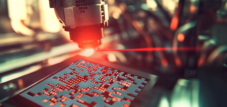
The choice between DataMatrix code (DMC) and Radio Frequency Identification (RFID)? – Image: Xpert.Digital
The optimal marking technology: How to make the right decision
RFID vs. DataMatrix? Smart solutions for manufacturing and logistics
Choosing between DataMatrix Code (DMC) and Radio Frequency Identification (RFID) is a crucial decision in modern manufacturing and logistics processes. Both technologies offer unique advantages and are optimized for specific applications. While DMC is a proven method for marking products, RFID enables wireless and automated data capture. The right choice depends on various factors such as cost, efficiency, environmental conditions, and a company's individual requirements.
This comprehensive guide highlights the characteristics, advantages and disadvantages as well as potential use cases of both technologies in order to provide a sound basis for decision-making.
Related to this:
Fundamentals of DataMatrix code and RFID
DataMatrix code (DMC)
The DataMatrix code is a two-dimensional barcode that stores information using a matrix of black and white modules. It can be either square or rectangular and is characterized by high data density in a small space. A typical DataMatrix code can store up to 1,556 bytes of data, including alphanumeric characters, special characters, and binary data.
The structure of a DMC consists of:
- Search pattern: An L-shaped boundary that serves as a guide.
- Alternating pattern: A boundary that defines the size and position of the matrix.
- Data area: This is where the actual information is stored and error correction is applied.
DMCs are frequently used in the automotive, aerospace and medical technology industries because they can fit even in small spaces and can be applied directly to surfaces such as metal or plastic.
Related to this:
Radio Frequency Identification (RFID)
RFID is a technology for the wireless identification and tracking of objects using electromagnetic fields. An RFID system consists of:
- RFID tags: Contain a microchip for storing information.
- Readers: Capture the data from RFID tags via radio waves.
- Antenna: Enables the transmission of data.
There are different types of RFID:
- Passive RFID: The tags have no power source of their own and use the electromagnetic field of the reader for transmission.
- Active RFID: The tags have their own power source and can bridge greater distances.
RFID is widely used in logistics, retail and industrial manufacturing because the technology enables fast and contactless capture of large amounts of data.
Comparison of technologies
Data volume and storage capacity
DMCs store static data records such as serial numbers, batch numbers, or manufacturing information. They are ideal for applications where dynamic data updates are not required.
RFID tags offer greater storage capacity and enable continuous data updates throughout a product's entire lifecycle. This is particularly advantageous in processes requiring ongoing monitoring, such as inventory management or production step tracking.
Reading speed and efficiency
DMCs must be read with a scanner, which requires direct line of sight. This can be time-consuming in fast production processes or with large quantities of objects.
RFID, on the other hand, allows multiple tags to be read simultaneously without line of sight. This leads to a significant increase in efficiency in automated processes, especially in high-throughput areas such as warehouses or production lines.
Environmental conditions and robustness
DMCs can be impaired in their readability by poor lighting conditions, low contrast, or dirt. Nevertheless, they have a high error tolerance and remain readable even with damage of up to 30%.
RFID tags are resistant to environmental influences such as dirt or moisture. However, metallic or liquid environments can interfere with signal transmission, leading to read errors or reduced range.
Costs and implementation
DMCs are cost-effective to implement because they can be printed or engraved directly onto the object and do not require expensive special equipment.
RFID systems have higher acquisition and implementation costs. However, the long-term benefits such as automation, error reduction, and tag reusability can justify this investment.
Application examples and decision criteria
Reusability of the marked object
- Closed-loop systems: When an object is used multiple times and remains within a closed system, RFID is advantageous due to the ability to update the tags.
- Open-loop systems: In open processes where the object leaves the process after a single use, a DMC is often sufficient and more cost-efficient.
Frequency of data updates
- Unique identification: DMC is ideal for serial numbers or fixed product information.
- Dynamic data update: RFID is advantageous when information needs to be continuously updated, e.g., in warehouse management.
Space availability for marking
- Limited space: DMCs can be installed in very small areas.
- Space availability: RFID tags require more space, but enable wireless data transmission.
The necessity of visual contact
- Direct line of sight is possible: DMC is sufficient.
- No line of sight possible: RFID enables reading even through packaging or obstacles.
Environmental conditions
- Dirty or poorly lit environments: RFID offers advantages because no optical detection is required.
- Metallic or liquid environments: DMC is less susceptible to interference and therefore better suited.
Related to this:
Combination of DMC and RFID
In many cases, companies don't have to choose between DMC and RFID, but can combine both technologies. A common example is an RFID label with DMC printed on it.
Advantages of a combination
- Redundancy: If an RFID tag cannot be read, the DMC is available as a backup.
- Flexibility: The DMC can be used for manual processes, while RFID supports automated systems.
- Enhanced functionality: While the DMC provides static information, RFID can store additional process data.
The choice between DataMatrix codes and RFID depends on various factors, including the type of application, environmental conditions, and cost. While DMCs offer a cost-effective, reliable solution for many identification tasks, RFID enables more efficient and automated data capture without line of sight. In many cases, combining both technologies provides the best solution to ensure both efficiency and flexibility.
Companies should conduct a detailed analysis of their requirements to select the optimal technology for their specific needs. The future of industrial marking will increasingly involve hybrid solutions that combine the advantages of both systems, further improving efficiency and transparency in manufacturing and logistics.
Expert partner in warehouse planning and construction

Technologies compared: When DataMatrix and when RFID make sense - background analysis
The question of whether to choose DataMatrix codes (DMC) or radio frequency identification (RFID) is a crucial one in many logistics and production processes. There's no single answer, as the best choice depends heavily on the specific requirements of each application. Both technologies have their strengths and weaknesses, and understanding these differences is essential for successful implementation. Let's consider some fundamental questions that can help you make your decision and delve into the details to provide a comprehensive overview:
The object's life cycle: Closed-loop vs. open-loop
One of the first questions to ask is whether the tagged object is reused or lost at the end of its journey within the process chain. Here, a distinction is made between "closed-loop" and "open-loop" applications. In a closed-loop application, such as the repeated use of reusable containers, RFID is often the better choice. Repeated use requires continuous tracking and updating of data, which can be achieved more efficiently with RFID. An RFID tag accompanies the object through multiple cycles and can be updated with new information. Open-loop applications, on the other hand, where the object leaves the process chain and does not return, such as with single-use packaging, are a typical use case for Data Matrix Codes (DMC). The Data Matrix code is applied only once and does not need to be changed. Here, the focus is on unique identification, which can also be automated via scans if required.
Data collection: One-time vs. repeated
Closely linked to the product lifecycle is the question of data acquisition. If the marking is done only once and the data remains unchanged, the Data Carrier (DMC) is often the most practical solution. It serves for one-time identification and can be printed on a wide variety of materials. However, if data needs to be read, written, or updated multiple times within the process chain, RFID offers the advantage. The contactless reading and writing of RFID tags enables flexible and dynamic processes. For example, imagine that in a production process, the RFID tag of a workpiece is tagged at various stations with the respective process data, such as timestamps, quality characteristics, or other relevant information.
Data volume: Low vs. High
The required data volume is another crucial factor. Data Management Modules (DMCs) are limited in the amount of data they can store. They are ideal for storing a unique serial number, article number, or other short alphanumeric information. For complex or extensive datasets, RFID is the more suitable technology. A single RFID tag can store far more information, including detailed product information, batch numbers, production data, or even instructions for further processing. This is particularly important when comprehensive traceability and documentation requirements exist.
Process data: Yes or No?
The question of whether process data should be stored on the object is often decisive in choosing between the two technologies. If only simple identification is required, the DMC (Digital Material Carrier) is usually sufficient. However, when it comes to capturing and tracking process data, RFID has a clear advantage. The ability to store process data directly on the tag enables decentralized data collection and management. The data is directly available on the object and can be accessed and updated in real time, which significantly improves process control and transparency. For example, it is possible to trace the entire life cycle of a product from production to recycling.
Processing speed: High or irrelevant?
Processing speed is another crucial aspect in many industrial environments. If high speed isn't critical, a DMC (Digital Mobile Code) might be the right choice. The code is then simply scanned manually or automatically. However, RFID systems are capable of capturing large quantities of objects simultaneously and at high speed, without direct line of sight. In a logistics center where thousands of products move per minute, the contactless and faster capture offered by RFID is clearly advantageous. Here, the time saved through automatic data reading can provide a decisive competitive edge.
Environmental conditions: light, contrast, and visual contact
Environmental conditions also play a role in the decision. DMC scanners typically require good lighting and sufficient contrast to reliably capture the codes. In poorly lit environments or on surfaces with low contrast, capture can be difficult or impossible. RFID systems are more tolerant in this respect, as the radio technology functions independently of light and contrast. They can therefore be used reliably even in dark or dirty environments.
Another important point is line of sight. While DMC scanners require direct line of sight to the code, RFID tags can also be read through non-metallic materials. This is a significant advantage when the tags are, for example, inside packaging or behind a cover.
Space requirements and sources of interference
The size of the available space for marking is also an important criterion. Digital Mobile Codes (DMCs) can be printed very small and are therefore well-suited for objects with limited space. RFID tags require more space, especially if they contain an antenna. Interference sources, such as dirt or liquids, can impair the readability of DMCs because the surface becomes dirty and contrast is lost. RFID tags, on the other hand, are less susceptible to contamination because they can be read without direct contact. Metals and liquids, in turn, can interfere with the radio waves of RFID systems, which can affect read range and reliability. In environments with many metals or liquids, using DMCs is often the better choice.
The synergy: DMC and RFID in combination
However, it doesn't always have to be an "either/or" situation. Often, a combination of DMC and RFID can be the optimal solution. A common scenario is an RFID label with a printed DMC. The DMC serves for direct identification on the object, for example, in goods receiving or quality control. The RFID tag, on the other hand, fulfills further tasks, such as tracking the object throughout the entire process chain and storing relevant process data. The advantage of this combination lies in its flexibility. The DMC enables simple and cost-effective identification, while RFID offers the ability to dynamically capture and manage data without requiring line of sight. For example, the data from the RFID tag can be used to track production progress, manage inventory, or ensure traceability. The combination of DMC and RFID also makes it possible to build redundant systems and increase the accuracy of data capture.
Specific use cases and their requirements
To better understand the advantages and disadvantages of both technologies, let's look at some specific use cases:
Logistics and Supply Chain Management
Both technologies are frequently used in logistics. RFID tags are used to track goods in large warehouses and distribution centers. They enable fast and automated recording of goods movements and ensure efficient warehouse management. Data carrier microcontrollers (DMCs) are used to identify items on boxes and pallets, especially when it comes to shipment tracking and sorting.
Production and manufacturing
Both digital microcontrollers (DMC) and RFID play a crucial role in production. DMC are often used for the direct identification of components and products to ensure traceability. RFID tags are used to monitor production progress, control material flow, and ensure product quality. They can be attached to tools, machines, or workpieces, for example, to monitor their usage and condition.
healthcare
In healthcare, RFID is used to identify patients, track medical devices, and monitor compliance with hygiene regulations. Digital Material Controllers (DMCs) are used here for marking medications and medical supplies to ensure counterfeit protection and correct allocation.
retail
In retail, RFID tags are used to speed up inventory, prevent theft, and improve the customer experience. Digital Mobile Communications (DMCs) are used to scan products at the checkout and capture information such as price and product features.
Optimized processes: Why the combination of DataMatrix and RFID is the future
Choosing between DataMatrix codes and RFID is not a simple decision and depends on a multitude of factors. It is crucial to thoroughly understand the respective advantages and disadvantages of both technologies to find the right solution for specific requirements. A careful analysis of the object's lifecycle, the required data volume, the necessary processing speed, environmental conditions, and potential sources of interference is essential for successful implementation. In many cases, combining both technologies can be the best solution to optimally leverage the advantages of each system. Ultimately, the decision is always a case-by-case one that should be based on a comprehensive analysis of the specific requirements and circumstances. The future will show that the technology continues to evolve, making its use and application ever more efficient, cost-effective, and faster. The challenge now is to recognize the advantages and use them to your advantage.
Related to this:

Xpert.Plus Warehouse Optimization - High-bay warehouses and pallet warehouses: Consulting and planning
We are here for you - Consulting - Planning - Implementation - Project Management
☑️ SME support in strategy, consulting, planning and implementation
☑️ Creation or realignment of the digital strategy and digitization
☑️ Expansion and optimization of international sales processes
☑️ Global & Digital B2B trading platforms
☑️ Pioneer Business Development

Konrad Wolfenstein
I would be happy to serve as your personal advisor.
You can contact me by filling out the contact form below or simply call me on +49 7348 4088 965 .
I'm looking forward to our joint project.
Write to me


Xpert.Digital - Konrad Wolfenstein
Xpert.Digital is a hub for industry focusing on digitalization, mechanical engineering, logistics/intralogistics and photovoltaics.
With our 360° Business Development solution, we support renowned companies from new business to after-sales.
Market intelligence, smarketing, marketing automation, content development, PR, mail campaigns, personalized social media and lead nurturing are part of our digital tools.
You can find more information at: www.xpert.digital - www.xpert.solar - www.xpert.plus
Keep in touch