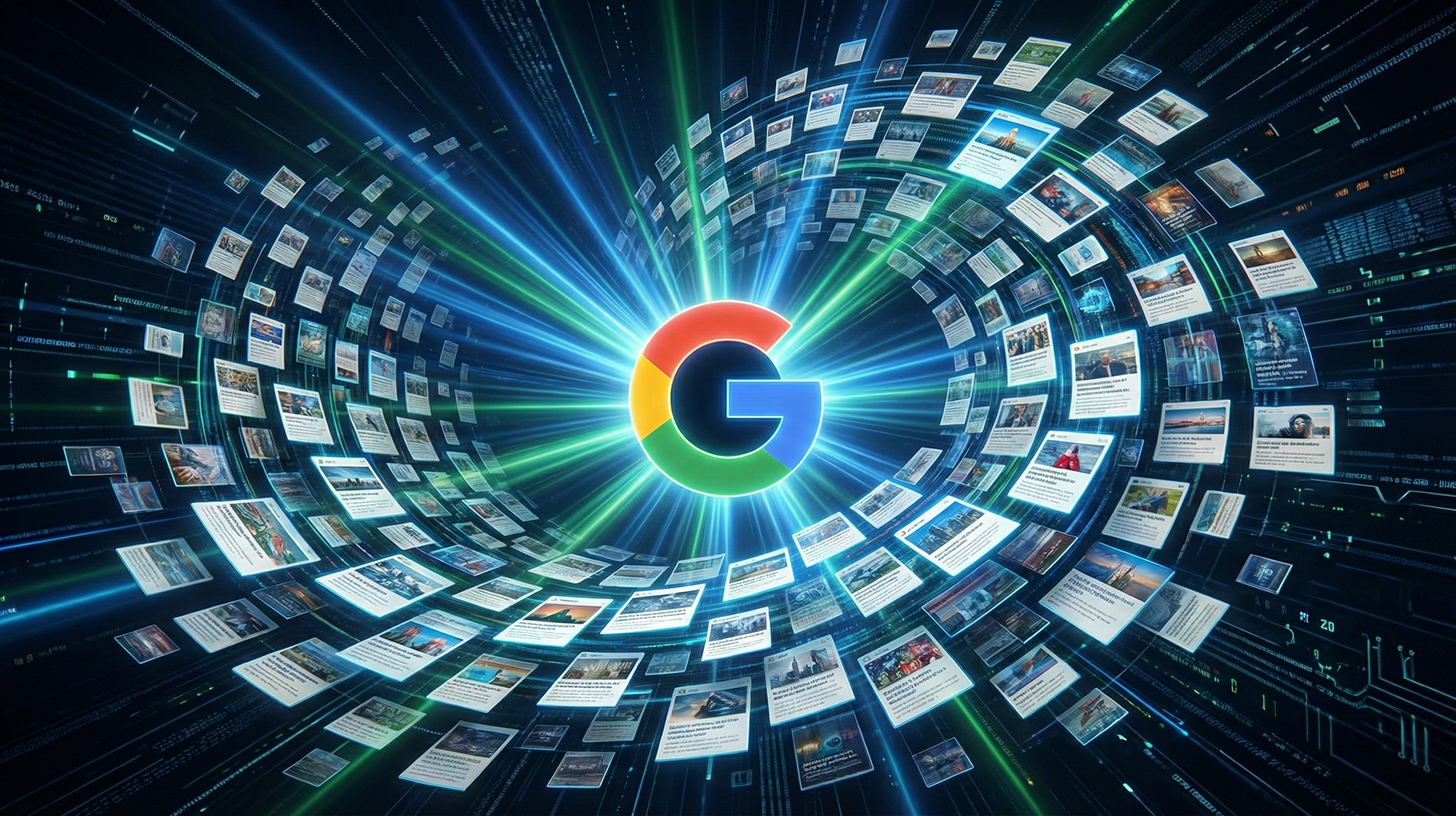
Google's first Discover algorithm overhaul is complete – and it took three weeks instead of two – Image: Xpert.Digital
When the feed god reshuffles the cards: Why publishers should be nervous now
The end of a historic rollout
On February 27, 2026, at 10:05 AM Central European Time, Google announced the completion of the February 2026 Discover Core Update. What began on February 5 and was originally planned to take a maximum of two weeks ultimately extended over exactly three weeks. The one-week delay may seem marginal at first glance, but it reveals the complexity of what Google undertook. This is the first core update in the company's history that focuses exclusively on Google Discover and leaves traditional web search completely untouched.
Until now, core updates have always been rolled out as a comprehensive overhaul of the entire search ecosystem, with Discover being affected as a secondary side effect. The fact that Google has now, for the first time, developed and rolled out a standalone update solely for the personalized content feed marks a paradigm shift in how this channel is evaluated. The Discover feed, that personalized news stream which displays content to smartphone users when they open the Google app or swipe left on Android devices, without ever having entered a search query, has undergone a quiet revolution.
The three pillars of the update
Google has clearly communicated the changes the update is intended to bring about. John Mueller, one of Google's most prominent SEO spokespeople, outlined three key objectives. First, the proportion of relevant local content should increase. Websites from users' geographic vicinity should be given preferential placement. Second, sensationalist and clickbait-oriented content should be consistently pushed back. Third, in-depth, original, and up-to-date content from websites with demonstrable expertise in their respective fields should be given greater weight.
These three pillars may initially sound like routine optimization, but they address fundamental structural problems with the Discover feed. In recent years, the platform has been increasingly infiltrated by sensationalist headlines, low-quality aggregators, and clickbait generators. Publishers with serious content have long complained that sensationalism was rewarded in the feed, while in-depth reporting was buried.
Discover's quiet rise to become the dominant traffic source
The full economic significance of this update only becomes apparent when considering the current traffic distribution for news portals. An analysis published in December 2025 by data provider NewzDash, which examined over 400 news publishers worldwide, reveals some striking figures. According to the analysis, Discover now accounts for 67.5 percent of all Google mobile traffic to news publishers. In 2023, this figure was only 37 percent. Simultaneously, the share of traditional Google Search as a traffic source plummeted from 51 percent to just 27 percent. NewzDash CEO John Shehata described this shift as the "Great Flip," a historic reversal of traffic distribution.
These figures clearly demonstrate why an exclusive Discover update is not a fringe issue. For news portals, magazines, and content platforms, Discover has become by far the most important channel for mobile traffic. An algorithmic intervention in this feed has a direct impact on reach, advertising revenue, and ultimately, the economic viability of entire newsrooms.
Regional restriction with a global signal
The update initially affected only English-speaking users in the US. However, Google has clearly announced that updates for other countries and languages will follow. For German-speaking users, this likely means a waiting period of several months, but the direction is unmistakable. The algorithm logic being tested in the US will also reach the European market in an adapted form.
This presents a strategic window of opportunity for publishers in the DACH region. Those who now align their content strategy with the three aforementioned criteria—local relevance, avoidance of clickbait, and demonstration of thematic expertise—will be better positioned when the update also applies to German-language content.
Impact on the SEO industry
The fact that Google Discover now treats it as a separate algorithmic area has far-reaching implications for search engine optimization as a whole. The previous SEO logic, which primarily focused on keyword rankings in web search, is now supplemented by a second, parallel optimization field. However, Discover optimization follows fundamentally different rules. There are no search queries to optimize for. Instead, content must be prepared in such a way that Google's algorithms proactively classify it as relevant, trustworthy, and user-friendly.
The traffic fluctuations experienced during the three-week rollout were significant for many publishers. As with any core update, there were marked swings in impressions and clicks. Some websites experienced significant drops, while others suddenly gained more visibility. This volatility will be repeated with the global rollout, challenging publishers to adapt their analytics tools and response mechanisms accordingly.
The economic dimension
Considering the economic implications of this update, nothing less than the redistribution of a multi-billion-dollar advertising market is at stake. If 67.5 percent of Google's mobile traffic flows through Discover, and Google fundamentally alters its weighting through an algorithmic update, the economic foundations of entire media companies will shift. Publishers who have previously profited from clickbait will suffer losses. Platforms with genuine expertise and local roots, on the other hand, are likely to see gains in reach.
The longer rollout time of three weeks instead of two also suggests that Google made adjustments during the process. The complexity of a Discover-only update was apparently higher than expected, indicating that the algorithm was changed more profoundly than with conventional core updates. For the industry, this means that the impact could be more lasting and fundamental than with comparable interventions in the past.
Your global marketing and business development partner
☑️ Our business language is English or German
☑️ NEW: Correspondence in your native language!

Konrad Wolfenstein
I and my team are happy to be available to you as your personal advisor.
You can contact me by filling out the contact form here wolfenstein@xpert.digital:or simply call me at +49 7348 4088 965. My email address is
I'm looking forward to our joint project.
☑️ SME support in strategy, consulting, planning and implementation
☑️ Creation or realignment of the digital strategy and digitization
☑️ Expansion and optimization of international sales processes
☑️ Global & Digital B2B trading platforms
☑️ Pioneer Business Development / Marketing / PR / Trade Fairs
B2B support and SaaS for SEO and GEO (AI search) combined: The all-in-one solution for B2B companies


B2B support and SaaS for SEO and GEO (AI search) combined: The all-in-one solution for B2B companies - Image: Xpert.Digital
AI search changes everything: How this SaaS solution will revolutionize your B2B ranking forever.
The digital landscape for B2B companies is undergoing rapid change. Driven by artificial intelligence, the rules of online visibility are being rewritten. For companies, it has always been a challenge not only to be visible in the digital mass, but also to be relevant to the right decision-makers. Traditional SEO strategies and managing local presence (geo-marketing) are complex, time-consuming, and often a battle against constantly changing algorithms and intense competition.
But what if there were a solution that not only simplified this process but also made it smarter, more predictive, and far more effective? This is where the combination of specialized B2B support with a powerful SaaS (Software as a Service) platform comes into play, specifically designed for the demands of SEO and GEO in the age of AI search.
This new generation of tools no longer relies solely on manual keyword analysis and backlink strategies. Instead, it leverages artificial intelligence to more accurately understand search intent, automatically optimize local ranking factors, and conduct real-time competitive analysis. The result is a proactive, data-driven strategy that gives B2B companies a decisive advantage: they are not only found, but perceived as the leading authority in their niche and location.
Here's the symbiosis of B2B support and AI-powered SaaS technology that transforms SEO and GEO marketing, and how your company can benefit from it to grow sustainably in the digital space.
More information here: