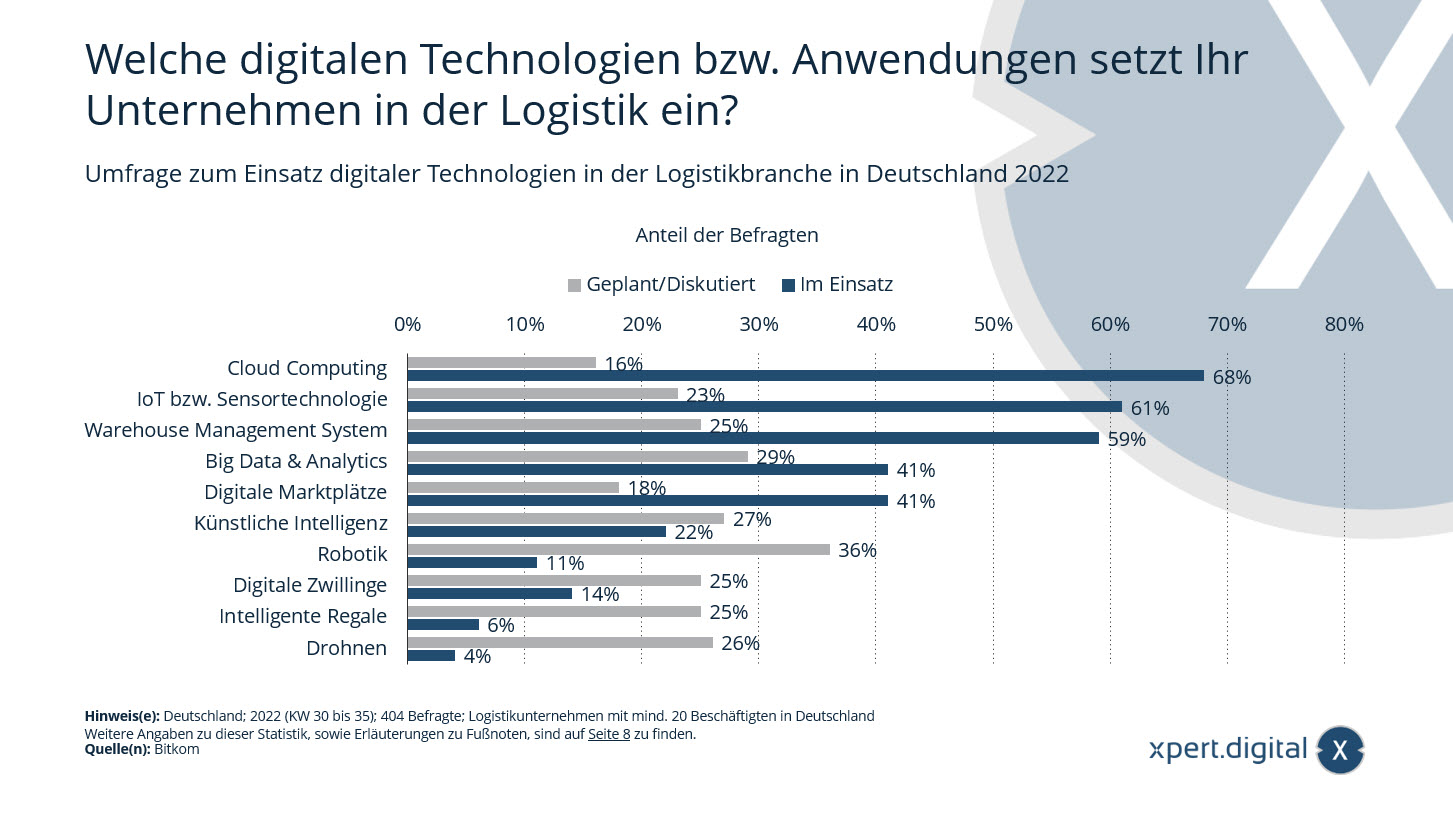
Which digital technologies or applications do companies use in logistics? – Image: Xpert.Digital
Digital technologies or applications used in logistics?
In the logistics industry, companies use a variety of digital technologies and applications to optimize and streamline their processes.
Cloud computing is used by more than two-thirds of the logistics companies surveyed in Germany. In the 2022 survey, 59 percent of the companies surveyed also stated that they already use warehouse management systems (WMS), while another six percent are at least planning to implement them. WMS are software programs for the digital management of warehouses.
Survey on the use of digital technologies in the logistics industry in Germany 2022
In use
- Cloud Computing – 68%
- IoT or sensor technology – 61%
- Warehouse Management System – 59%
- Big Data & Analytics – 41%
- Digital marketplaces – 41%
- Artificial intelligence – 22%
- Robotics – 11%
- Digital twins – 14%
- Smart shelves – 6%
- Drones – 4%
Planned/Discussed
- Cloud Computing – 16%
- IoT or sensor technology – 23%
- Warehouse Management System – 25%
- Big Data & Analytics – 29%
- Digital marketplaces – 18%
- Artificial intelligence – 27%
- Robotics – 36%
- Digital twins – 25%
- Smart shelves – 25%
- Drones – 26%

Xpert.Plus Warehouse Optimization - High-bay warehouses and pallet warehouses: Consulting and planning
Key digital technologies and applications used in logistics
Warehouse Management Systems (WMS)
WMS software enables efficient inventory management, optimization of warehouse space utilization, tracking of goods movements, and order picking. It provides real-time inventory information and improves the accuracy and speed of order fulfillment.
Transport Management Systems (TMS)
TMS software supports companies in planning, optimizing, and executing transport orders. It enables efficient route planning, freight cost optimization, shipment tracking, and communication with suppliers, freight forwarders, and customers.
Telematics systems
Telematics systems use GPS technology to track the location of vehicles in real time. These systems enable better fleet management, monitoring of vehicle performance and fuel consumption, and adherence to delivery schedules.
Automation and robotics
Automation technologies such as automated storage and retrieval systems, conveyor technology, and robotics are used in warehouses and distribution centers to improve the efficiency and speed of order processing. Robots can be used for picking, sorting, packing, and palletizing goods.
Internet of Things (IoT)
IoT applications enable the networking of devices, sensors, and machines in logistics. By collecting and transmitting real-time data, companies can monitor the condition of goods, storage conditions, and equipment wear and tear. This facilitates inventory management, maintenance, and the prediction of bottlenecks or failures.
Artificial intelligence (AI) and machine learning
AI and machine learning systems analyze large amounts of data to identify patterns, make predictions, and automate decisions. In logistics, they can be used for route optimization, demand forecasting, inventory planning, and fraud detection.
Blockchain technology
Blockchain enables secure and transparent tracking of goods deliveries along the supply chain. It offers seamless documentation of transactions, improves traceability, and supports product authentication.
➡️ These digital technologies and applications play a crucial role in optimizing logistics processes, improving supply chain efficiency, and meeting the increasing demands for speed, accuracy, and traceability.
Automation and robotics in logistics
Automation and robotics are playing an increasingly important role in the logistics industry to improve the efficiency, accuracy, and speed of logistics processes.
Automatic storage and retrieval systems
Automated storage and retrieval systems (AS/RS) are used in high-bay warehouses to automate the storage and order picking of goods. These machines can autonomously move up and down shelves, pick up and deliver goods. This reduces manual effort and optimizes the use of storage capacity.
Conveyor technology
Automated material handling systems, such as conveyor belts, sorters, and palletizers, are used in logistics centers to accelerate material flow and simplify the handling of goods. Automating the movement of goods minimizes bottlenecks and errors.
Robot-assisted order picking
Robots are increasingly being used in order picking to gather goods and prepare them for shipment. These robots can navigate autonomously through the warehouse, identify products, and place them in containers or on pallets. This improves the speed and accuracy of the order picking process.
Drones and autonomous vehicles
Drones and autonomous vehicles are used for the delivery and transport of goods. Drones can carry small packages over short distances, while autonomous vehicles are used for transporting larger loads on roads or in warehouses. These technologies enable faster and more efficient goods delivery.
Warehouse robotics
Warehouse robotics encompasses various types of robots used in warehouses to perform different tasks. These can include robotic arms that assist with packing and stacking goods, or mobile robots that transport goods to the correct storage locations. These robots often work in collaboration with human employees to increase efficiency.
Automation and robotics in logistics offer numerous advantages, such as increased efficiency, improved precision, reduced errors and bottlenecks, and faster throughput times. They enable companies to optimize their logistics processes and respond to rising demands for speed, flexibility, and customer satisfaction. The ongoing development and integration of these technologies are helping to guide the logistics industry toward an increasingly automated and efficient future.
Internet of Things (IoT) in logistics
The Internet of Things (IoT) plays a crucial role in the logistics industry, as it enables the networking of devices, sensors, and machines. By integrating IoT into logistics processes, companies can collect, analyze, and utilize real-time data to optimize their operations and increase efficiency.
Location tracking and asset management
IoT-enabled sensors can be attached to goods, vehicles, pallets, or other logistics assets to track their location in real time. This allows for precise monitoring of the flow of goods along the supply chain and improved planning of transport routes and warehouse space utilization.
Condition monitoring
IoT sensors can monitor the condition of goods, such as temperature, humidity, vibration, or other parameters relevant to specific products. This allows companies to ensure that product quality is maintained during storage and transport and that potential damage or loss is detected early.
Predictive Maintenance
IoT sensors on machines and vehicles can continuously collect data on their condition and performance. This data is analyzed to predict potential maintenance needs or failures. By planning maintenance in advance, companies can minimize unplanned downtime and maximize fleet efficiency.
Inventory management
IoT enables companies to monitor their inventory in real time. Sensors can automatically record stock levels and provide information on availability, reordering, and inventory turnover. This allows for optimized inventory planning and management to avoid shortages or overstocking and reduce warehousing costs.
Automated processes
IoT can enable seamless communication and integration between different logistics systems. By automatically transmitting data and information between warehouse management systems, transportation management systems, suppliers, and customers, processes can be made more efficient. This facilitates automated order processing, shipment tracking, and documentation.
➡️ The IoT offers logistics companies numerous advantages, including improved transparency, efficiency, and cost savings. It enables more precise supply chain management, faster response to changes, and better fulfillment of customer requirements. By intelligently leveraging IoT, companies can increase their competitiveness and overcome today's logistical challenges.
Artificial intelligence (AI) and machine learning in logistics
Artificial intelligence (AI) and machine learning have a significant impact on the logistics industry and offer diverse application possibilities.
Route optimization
AI algorithms can analyze large amounts of data to identify optimal transport routes. Based on factors such as traffic, weather conditions, delivery priorities, and costs, these algorithms can provide real-time or predictive route recommendations to make transport more efficient and faster.
Demand forecast
By analyzing historical data, AI models can predict demand for products or services. This allows companies to better plan their inventory, avoid shortages, and increase customer satisfaction. AI can also consider external factors such as holidays or seasonal trends to create more accurate forecasts.
Inventory planning
AI and machine learning enable companies to optimize their inventory. The algorithms analyze historical data, sales trends, seasonal fluctuations, and other factors to determine optimal stock levels. This helps avoid overstocking and shortages while simultaneously improving the efficiency and profitability of warehousing.
Image recognition and object recognition
AI models can analyze images or videos to recognize objects or products. In logistics, for example, they can be used for the automated identification of goods during incoming goods inspection or for monitoring packaging and order picking processes. This increases the speed and accuracy of logistics operations.
Fraud detection
AI can help detect and prevent fraud in logistics. By analyzing transaction data and behavioral patterns, suspicious activities or anomalies can be identified. This enables companies to take timely action to minimize financial losses and ensure the security of their supply chain.
Predictive Maintenance
AI and machine learning can also be used for predictive maintenance of vehicles, machinery, and other logistics equipment. By analyzing sensor data, potential failures can be predicted and maintenance measures planned in a timely manner. This helps companies minimize unplanned downtime and maximize the lifespan of their equipment.
➡️ The integration of AI and machine learning into logistics processes enables companies to increase their efficiency, reduce costs and improve customer satisfaction.
That's why Xpert.Plus offers consulting and planning for high-bay warehouses: Smart, fully automated high-bay warehouses / pallet warehouses with Industry 4.0 – IoT technology
Xpert.Plus is a project by Xpert.Digital. We have many years of experience in supporting and consulting on warehouse solutions and in warehouse optimization, which we combine under Xpert.Plus in a large network.

Konrad Wolfenstein
I would be happy to serve as your personal advisor.
You can contact me by filling out the contact form below or simply call me on +49 7348 4088 965 (Munich) .
I'm looking forward to our joint project.
Write to me


Xpert.Digital – Konrad Wolfenstein
Xpert.Digital is a hub for industry focusing on digitalization, mechanical engineering, logistics/intralogistics and photovoltaics.
With our 360° Business Development solution, we support renowned companies from new business to after-sales.
Market intelligence, smarketing, marketing automation, content development, PR, mail campaigns, personalized social media and lead nurturing are part of our digital tools.
You can find more information at: www.xpert.digital – www.xpert.solar – www.xpert.plus
Keep in touch