

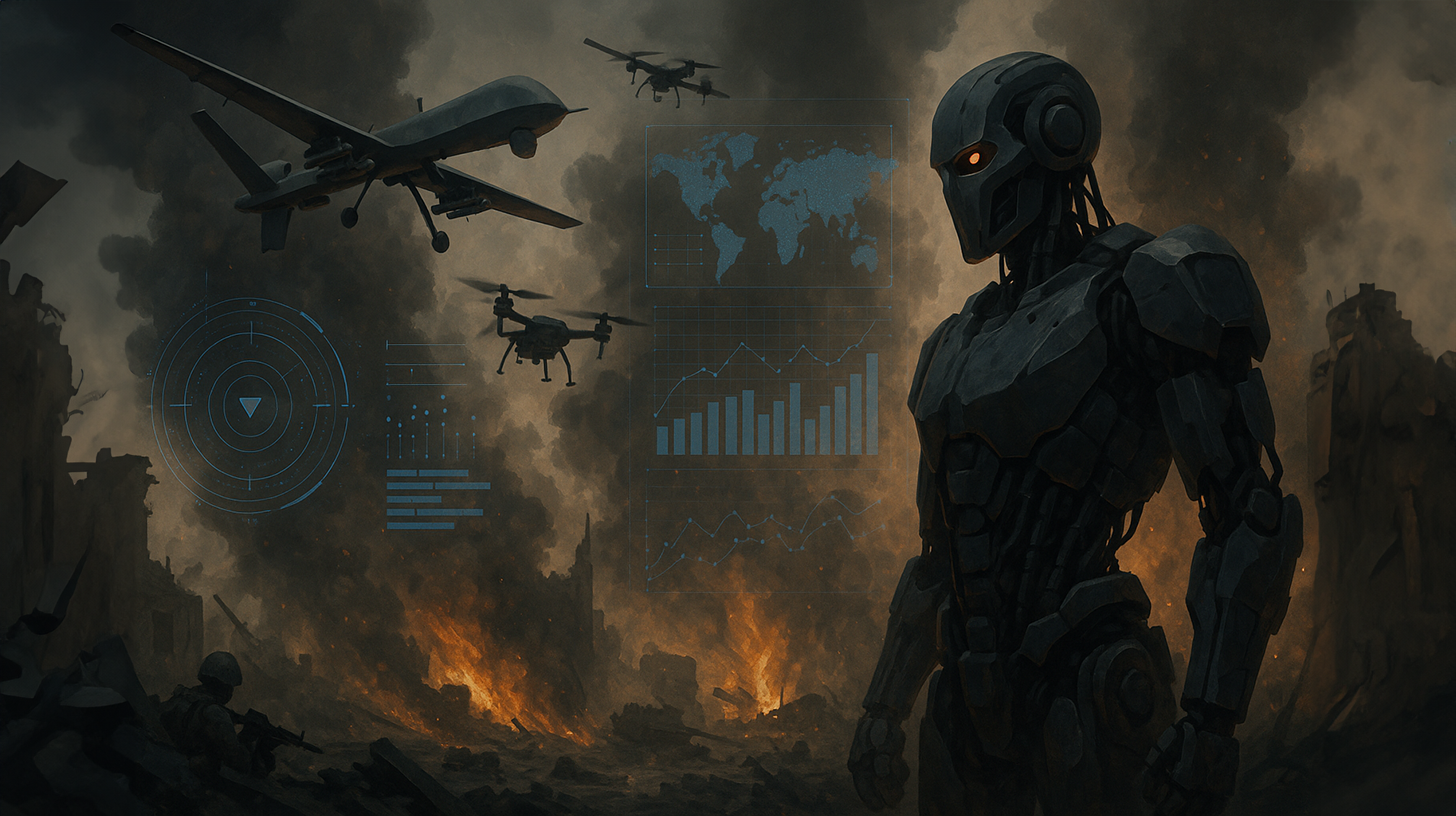
Artificial intelligence in war: The digital revolution on the battlefield – Image: Xpert.Digital
Artificial intelligence is revolutionizing modern warfare like gunpowder once did
From robotics to deception: The four pillars of the military AI revolution
Modern warfare is undergoing a fundamental transformation comparable to the invention of gunpowder or the development of nuclear weapons. Artificial intelligence has evolved from a science fiction concept into a real force that is already shaping military operations worldwide and revolutionizing how conflicts are fought. This technological revolution manifests itself in four key areas of application: the integration of AI into drone systems, the rise of autonomous robotics, enhanced data analytics for strategic planning, and the use of AI for deception and psychological warfare.
AI in War: Current headlines clearly show that AI is playing an increasingly important role in warfare. This includes the use of AI in drones, robotics, analytics, and for "deceiving" the enemy
The drone revolution: Autonomous systems in the sky
From remotely controlled aircraft to intelligent weapon system
Drones have evolved in recent years from simple remote-controlled aircraft to highly sophisticated, AI-driven weapon systems. Ukraine has demonstrated this transformation particularly impressively by using AI systems to identify and destroy enemy tanks and other military equipment. These systems are continuously trained to learn independently and expand their capabilities, giving them a decisive advantage over conventional systems.
The accuracy of these intelligent systems is impressive: While human-controlled drones achieve a hit rate of only 10 to 20 percent, autonomously controlled drones achieve a success rate of 80 percent. This dramatic improvement in precision makes AI-controlled drones a game-changer on the modern battlefield.
Related to this:

German innovations and international developments
Germany has delivered combat drones to Ukraine for the first time, piloted by a newly developed artificial intelligence. These 4,000 kamikaze drones are equipped with German-developed AI that enables them to autonomously navigate to their targets and evade electronic countermeasures. The drones can reach 30 to 40 kilometers inland and attack command posts and logistics hubs.
In parallel, other nations are working on similar systems. Sweden, together with Saab, is developing software for autonomous drone swarms capable of coordinating thousands of drones. These swarms can monitor areas of any size and automatically reorganize themselves if individual drones fail. They are operated via simple tablets or smartphones, significantly simplifying complex military operations.
Electronic warfare and countermeasures
The integration of AI into electronic warfare represents another dimension of modern warfare. Companies like Anduril have developed modular AI systems capable of coordinating electronic countermeasures, unmanned defense systems, and electronic attacks. These systems detect threats across the electromagnetic spectrum and can network with other devices to execute coordinated, real-time countermeasures.
Robotics and autonomous weapons systems: The future of warfare
Humanoid robots and fighting machines
The development of military robotics has accelerated considerably, with both the US and China making massive investments in this technology. American military planners estimate that the US armed forces could consist of one-third robots within 15 years. These robots encompass a wide range of systems: drones, underwater vehicles, humanoid robots, robot dogs, and other autonomous devices.
China has also made significant progress, integrating ChatGPT-like AI technology into its robotic systems. The Chinese People's Liberation Army already uses AI-assisted training models for daily flight training and is developing systems that could revolutionize decision-making in combat.
Related to this:
Collaborative combat systems
The US Air Force is working on collaborative combat aircraft that will operate alongside human-piloted planes. These autonomous systems primarily serve reconnaissance purposes, gathering information, diverting enemies with false signals, and attacking enemy targets. In parallel, the US Navy is developing a hybrid fleet of ships and submarines designed to support human sailors.
Lethal autonomous weapon systems
Fully autonomous weapon systems, also known as "Lethal Autonomous Weapon Systems" or colloquially as "killer robots," represent the next stage of evolution. These systems can independently analyze data, move freely within their area of operation, and control their weapons, such as machine guns, cannons, or missiles. They can operate in the air, on land, at sea, underwater, or in space.
So-called "loitering ammunition" is already a reality. These systems can circle over an area for hours; sensors detect potential targets and compare them to pre-programmed parameters. As soon as a target is identified, they attack autonomously without human intervention.
Related to this:

Analytics and data processing: AI as a strategic advantage
The information revolution on the battlefield
Modern warfare generates enormous amounts of data through sensors on the ground, on the water, underwater, in the air, in space, and in cyberspace. This flood of information far exceeds human processing capacity, which is why AI systems for automated processing have become indispensable. Artificial intelligence can recognize patterns that are difficult for humans to discern and, based on various data sources, identify hostile activities and provide warnings of attacks.
Military applications of data analysis
The Pentagon has defined four key application areas for AI technology in the military: logistics, reconnaissance, cyberspace, and warfare. AI applications are already in use in the first three areas, helping to optimize supply chains, predict necessary maintenance, identify vulnerabilities in software, and combine vast amounts of data into actionable information.
Israel already uses advanced AI systems like "Knowledge Well" and "Fire Factory" for military operations. The first system provides real-time overviews of enemy missile launches, while the second solves logistical problems, calculates ammunition loads, and creates action plans. These systems enable significantly faster target selection during air strikes.
The OODA loop and AI integration
The military use of AI can ideally be explained using the OODA loop (Observe, Orient, Decide, Act). In the "Observe" phase, AI combines information from drones, radios, optronics, helmet cameras, and satellite imagery to create a comprehensive situational awareness picture. In the "Orient" phase, digital command and control systems process image data more quickly and create 3D models of terrain, buildings, or streets. This integration ultimately leads to greater survivability for soldiers in the field.
Deception and psychological warfare: AI as a tool for manipulation
The new dimension of disinformation
Artificial intelligence has opened up a completely new dimension of psychological warfare. Traditional deception tactics aimed at manipulating human commanders are no longer sufficient. Modern military operations must deceive both human strategists and the AI systems they work with.
Russia has already systematically exploited these capabilities, building a well-funded network called "Pravda" that infiltrates Western AI models. The goal, unlike traditional disinformation campaigns, is not to directly deceive human readers, but to train AI models to disseminate Russian propaganda narratives undetected. Researchers found that leading generative AI models repeated Russian propaganda in 33 percent of cases without identifying it as such.
Automated cyberattacks and manipulation
AI-powered cyberattacks have reached a new level of sophistication. Cybercriminals are using advanced AI techniques to refine attack methods, autonomously spread malware, and bypass security protocols. Machine learning algorithms enable adaptive attack scenarios that pose new challenges to traditional security architectures.
The automation of phishing attacks through AI is particularly problematic. Artificial intelligence can create targeted attacks tailored to the online activities and preferences of the target, significantly increasing the success rate. AI tools quickly analyze large amounts of data, recognize patterns, and generate deceptively realistic fake login pages that are virtually indistinguishable from genuine ones.
Cyberspace arms race
Cybersecurity has evolved into a machine-versus-machine battle, with AI systems continuously deployed on both sides of the conflict. Advanced capabilities such as surface-level monitoring, darknet monitoring, and specialized honeypots offer a critical advantage and help organizations stay ahead of emerging threats.
Hub for Security and Defense - Advice and Information


Hub for Security and Defense - Image: Xpert.Digital
The Security and Defence Hub offers expert advice and up-to-date information to effectively support companies and organizations in strengthening their role in European security and defence policy. Working closely with the SME Connect Defence Working Group, it particularly promotes small and medium-sized enterprises (SMEs) that wish to further develop their innovative capacity and competitiveness in the defence sector. As a central point of contact, the Hub thus creates a crucial bridge between SMEs and European defence strategy.
Related to this:
Ukraine is showing the world the future of autonomous weapons systems, and AI warfare is permanently changing global power dynamics
Global power shifts and strategic implications
Ukraine as a test lab for AI warfare
Russia's war of aggression against Ukraine has become a test case for the future of AI-powered warfare. Ukraine is benefiting significantly from AI-based digital tools and is using software from companies like Palantir to collect satellite imagery, thermal imaging, and other crucial data. This allows the Ukrainian military to detect even the most concealed positions of Russian soldiers.
Experts see a clear technological advantage for Ukraine in this conflict. Kyiv uses AI more effectively than Moscow, particularly in geographic reconnaissance and target identification. Ukrainian systems are programmed to continuously learn independently, while Russia relies primarily on relatively simple kamikaze drones from Iran.
Related to this:


China's military AI ambitions
In 2017, China announced a comprehensive AI strategy and is investing tens of billions of US dollars in artificial intelligence, including for military applications. Chinese defense companies are showcasing innovative AI applications that have the potential to revolutionize decision-making in combat. The startup EverReach AI has developed an AI-supported training model that is already being used by the People's Liberation Army for daily flight training.
American counter-strategy
The US has responded with a comprehensive national security memorandum. The American strategy is based on three main objectives: securing global leadership in AI development, strategically deploying AI for national security purposes, and establishing a stable international framework for responsible AI development. National Security Advisor Jake Sullivan warned that the US risks squandering its hard-earned lead if it does not act faster than its rivals.
Ethical challenges and legal issues
The limits of human control
The integration of AI into military systems raises fundamental ethical questions. The greatest dangers of autonomous weapons lie in the lack of human control and ethical accountability. Autonomous weapons could make life-or-death decisions without human intervention, potentially leading to serious errors and unintended collateral damage.
A particularly problematic aspect is the difficulty of teaching machines moral judgment. The International Committee of the Red Cross categorically states that weapons systems without human oversight are illegal in any case. In the future, these systems could, entirely independently of human influence, identify a person, calculate the danger posed by that person, and then decide between life and death.
International law challenges
Currently, there is no legal framework that explicitly prohibits or regulates the use of autonomous weapons systems. Like all other weapons systems, autonomous weapons are subject to applicable international law, in particular Article 36 of Additional Protocol I to the Geneva Conventions. This obliges states to examine whether the use of new weapons is compatible with international humanitarian law.
Negotiations on banning autonomous weapons have repeatedly broken down without result. The US, Russia, and other states investing in autonomous weapons systems are blocking negotiations on a new treaty against so-called killer robots. Human Rights Watch and other organizations are calling on the member states of the UN Convention on Certain Conventional Weapons to begin negotiations on a treaty that enshrines human control over the use of force in international law.
Risks of the Militarization of AI
Studies reveal worrying trends in the use of AI for military planning. Researchers at Stanford University ran AI models through simulations of conflicts with real countries and found that the AI favored military escalation and tended toward unpredictable behavior. In various conflict scenarios, the AI models justified their decisions with statements such as, "We have the weapons, so we should use them.".
This development carries the risk of so-called "flash wars"—wars that arise out of nowhere and are triggered by machines. If the military relies too heavily on AI recommendations, this threatens to weaken human capability in diplomatic and military contexts.
Technological developments and future prospects
Machine Learning and Adaptive Systems
The foundation of modern military AI systems is machine learning, particularly the development of artificial neural networks. This technology enables systems to learn from experience and continuously improve their capabilities. In supervised learning, algorithms are fed labeled training data; in unsupervised learning, they independently search for patterns; and in reinforcement learning, they develop optimal strategies through rewards and punishments.
NATO initiatives and international cooperation
NATO has acquired Palantir's "Maven Smart System NATO," an AI-powered military system. The system utilizes generative AI, machine learning, and large-scale language models to equip commanders with enhanced situational awareness capabilities. This technology is intended to strengthen NATO's ability to respond quickly and decisively in an increasingly complex security environment.
German Armed Forces and AI Integration
The German armed forces are still struggling with the integration of AI in military operations. Problems exist even at the basic level of digitalization, and conceptual approaches have so far only been developed by individual branches of the armed forces. Nevertheless, highly automated weapons systems, such as the Patriot and MANTIS air defense systems, are already in use within the Bundeswehr, operating under human command and controlled by AI applications.
Related to this:
The future of warfare
Artificial intelligence has already fundamentally changed warfare and will accelerate this transformation in the coming years. The integration of AI into drones, robotics, analytics, and psychological warfare represents a revolution comparable to the historical turning points of the invention of gunpowder and the development of nuclear weapons.
Current developments show that a global arms race for AI-powered military technology has emerged. Countries like the US, China, Russia, and Israel are investing heavily in these technologies, while other nations are trying to catch up. Ukraine has impressively demonstrated how AI systems can offer a decisive strategic advantage.
At the same time, the ethical and legal challenges remain unresolved. The international community is still struggling to find appropriate regulatory approaches, while technological development progresses relentlessly. The danger of autonomous systems making life-and-death decisions without human oversight is becoming increasingly real.
The future of warfare will depend significantly on how successfully the balance between technological progress and human control can be maintained. It is clear that AI is now indispensable in the military sphere – the question is no longer whether it will be used, but how responsibly and responsibly this use will be carried out.
Consulting - Planning - Implementation

Markus Becker
I would be happy to serve as your personal advisor.
Head of Business Development
Chairman SME Connect Defense Working Group
Consulting - Planning - Implementation
Konrad Wolfenstein
I would be happy to serve as your personal advisor.
You can contact me at wolfenstein∂xpert.digital or
Just call me on +49 7348 4088 965 .
Your dual-use logistics experts
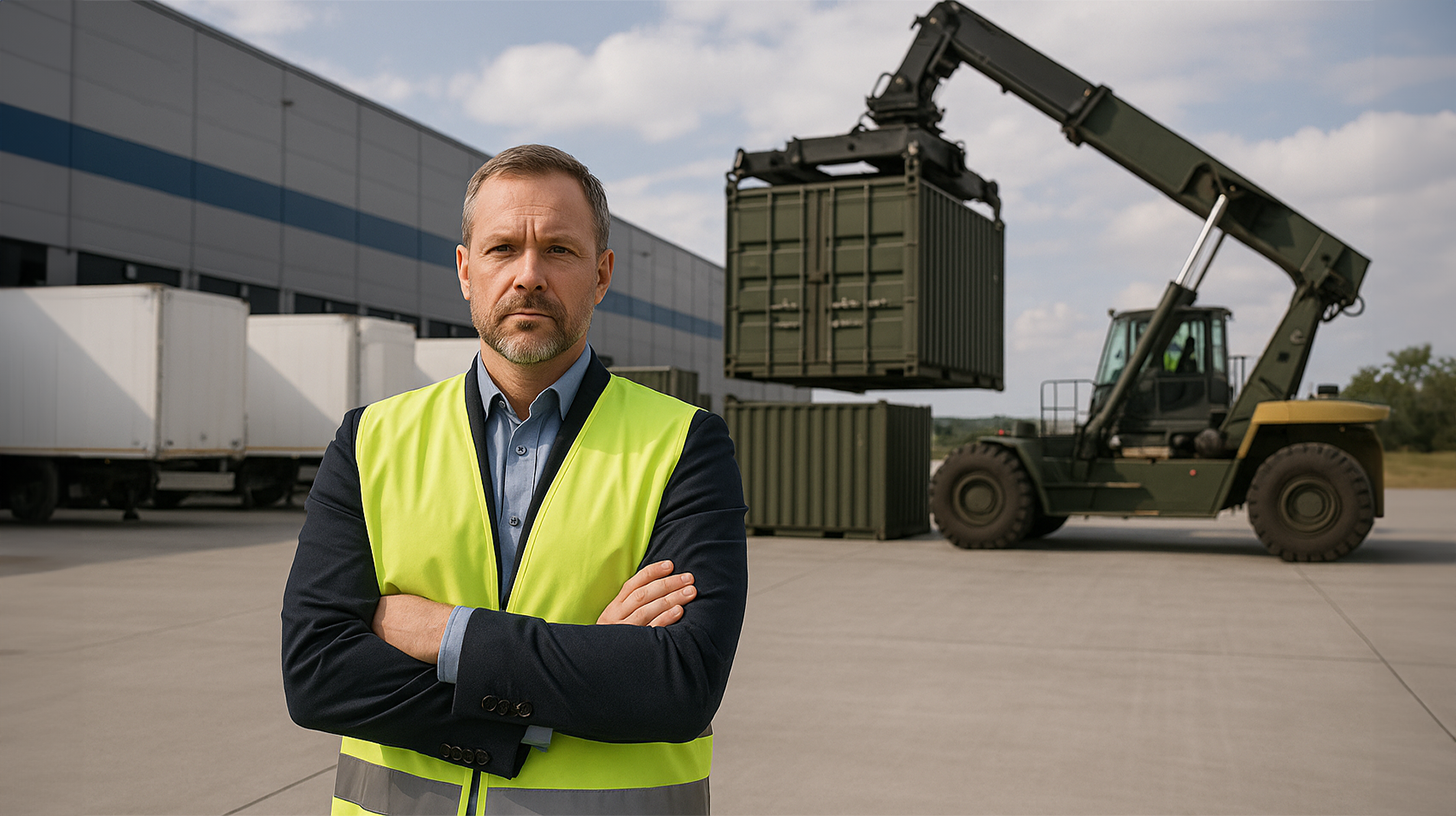
Dual-use logistics experts - Image: Xpert.Digital
The global economy is currently undergoing a fundamental transformation, a watershed moment that is shaking the foundations of global logistics. The era of hyper-globalization, characterized by the relentless pursuit of maximum efficiency and the "just-in-time" principle, is giving way to a new reality. This new reality is marked by profound structural breaks, geopolitical power shifts, and increasing fragmentation of economic policy. The once taken-for-granted predictability of international markets and supply chains is dissolving and being replaced by a period of growing uncertainty.
Related to this: