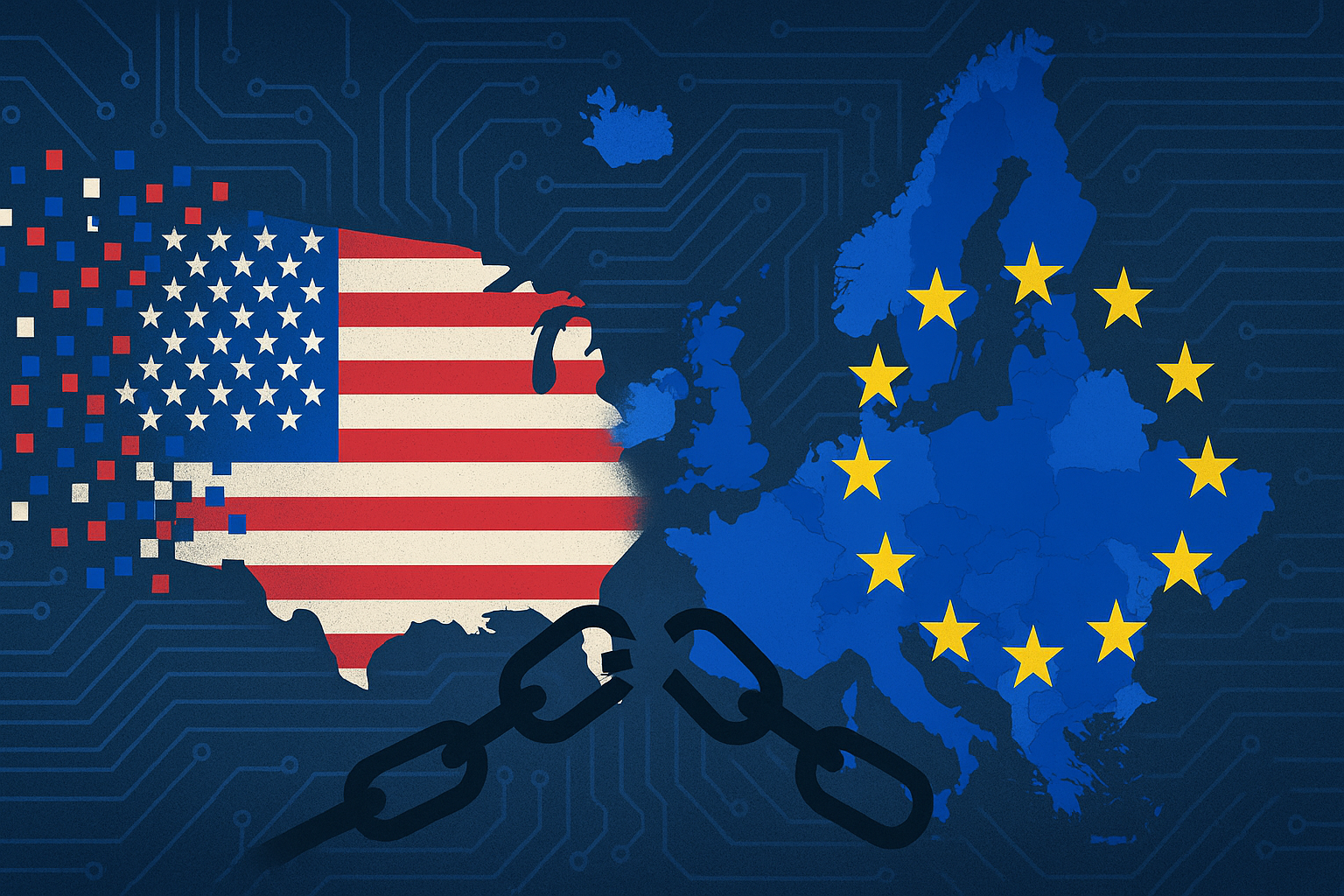
Digital independence: Europe's radical plan to break free from the USA – The Karim Khan case was a wake-up call – Image: Xpert.Digital
A bombshell in Brussels: The EU wants to turn its back on Microsoft – these are the alternatives
Ending dependency? What Europe's fight for data sovereignty means for all of us
The European Union is facing a significant turning point in its digital strategy. What began as a mere consideration is increasingly developing into a concrete realignment of European cloud policy, which could have far-reaching implications for the entire technology sector.
Related to this:


The current situation: dependence on American tech giants
The European Commission is currently in advanced negotiations with OVHcloud, the largest European cloud service provider, regarding a potential replacement of its existing Microsoft Azure infrastructure. These talks, which have been ongoing for several weeks, are part of a broader strategy to strengthen European digital sovereignty in the cloud sector.
The decision comes as no surprise given the current market situation. European companies and institutions have been heavily reliant on American cloud providers such as Amazon Web Services, Microsoft Azure, and Google Cloud for years. This dependence has proven problematic in a time of geopolitical tension, as it subjects European organizations to the legal and political influence of the United States.
The wake-up call: The Karim Khan case
A particularly significant event greatly increased the urgency of the debate surrounding digital sovereignty. Karim Khan, the chief prosecutor of the International Criminal Court, was locked out of his Microsoft-based email account due to US sanctions. This action came after the Trump administration imposed sanctions on the International Criminal Court to obstruct investigations into Israeli actions in the Gaza Strip.
Microsoft abruptly blocked Khan's email account, forcing the British prosecutor to switch to a Swiss email provider. Simultaneously, his bank accounts were frozen, and all 900 employees of the International Criminal Court were barred from entering the United States. This action is considered unprecedented by experts and has served as a wake-up call for all those responsible for the secure availability of governmental and private IT infrastructures.
The incident dramatically illustrated the risks associated with dependence on American technology companies. These companies can be forced to cease their services at any time if the US government orders it.
The European response: Structural changes in the EU Commission
The European Commission's response to these challenges was made possible by a key organizational change. For the first time, both of the Commission's central digital departments – the Directorate-General for Communications Networks, Content and Technology and the Directorate-General for Digital Services – are under the command of a single Vice-President.
Henna Virkkunen, the Finnish politician responsible for technological sovereignty, security, and democracy, embodies this new strategic direction. In an interview, she emphasized that technological sovereignty means having one's own capacities in all key sectors and not being dependent on a single company or third country for critical services. This consolidation of responsibilities has significantly facilitated the harmonization of the EU executive's political and technical priorities.
Legal problems with Microsoft: Data protection violations
Alongside the geopolitical concerns, significant legal problems have also arisen with Microsoft. Following a three-year investigation, the EU Data Protection Supervisor, Wojciech Wiewiórowski, concluded that the European Commission, by using Microsoft 365, had violated several provisions of the specific data protection regulation for EU institutions.
The main criticisms concerned the inadequate safeguards for the transfer of personal data to third countries such as the USA, as well as the lack of specification of the types of data to be collected and their purposes of use. Wiewiórowski called on the Commission to halt all data transfers to Microsoft and its partners in non-EU countries by December 2024.
The European Commission responded to these allegations by suing the data protection officer, emphasizing that its use of Microsoft 365 complied with data protection laws. At the same time, it argued that there were no viable alternatives. This legal dispute highlights the complex challenges of transitioning to sovereign cloud solutions.
The EuroStack initiative: A vision for European technological independence
The European Commission's efforts are supported by the EuroStack initiative, an industry-led movement aiming for a comprehensive European digital infrastructure. This initiative, which already unites over 250 signatories from various sectors, calls for massive investments in shared IT platforms, data spaces, standards, and coordinated strategies.
EuroStack sees itself not only as a technical initiative, but as a comprehensive industrial policy vision for Europe. The movement argues that Europe risks becoming a digital colony if it does not invest in its own technological capabilities. Francesco Bonfiglio, CEO of the Italian cloud platform Dynamo, emphasizes that the hegemony of tech giants, particularly in the cloud sector, poses a fundamental threat to the European economy and democracy.
European Cloud Alternatives: An Overview of the Competitors
The European Commission is not only considering OVHcloud as an alternative to Microsoft Azure. Several other European cloud providers are also under discussion, including IONOS from Germany, Scaleway from France, and Aruba from Italy.
These providers have already begun to coordinate and develop common standards. For example, IONOS and Aruba, together with Dynamo, have developed the Sovereign European Cloud API (SECA), an open standard for cloud infrastructure management. This initiative aims to improve interoperability between European cloud providers and avoid vendor lock-in.
Achim Weiß, CEO of IONOS, describes this development as an essential building block for constructing a secure, independent, and future-proof digital infrastructure that safeguards Europe's digital sovereignty. The SECA initiative is to be understood as the first building block of the broader EuroStack vision.
Related to this:
Microsoft's counter-response: Digital assurances for Europe
Microsoft has responded to growing sovereignty concerns with a series of digital commitments for Europe. The company announced five key pledges, including expanding its cloud and AI infrastructure in Europe, maintaining digital resilience even in geopolitically volatile times, and strengthening data protection measures.
With Microsoft Sovereign Cloud, the company offers both public and private cloud solutions specifically tailored to the needs of European customers. These include Data Guardian, which ensures that only Microsoft employees residing in Europe have remote access to systems, and External Key Management for customer-driven encryption.
The EU Data Boundary, which Microsoft introduced in 2023 and completed in 2025, promises that customer data from services like Azure, Dynamics 365, and Microsoft 365 will be processed within the EU by default. However, exceptions remain for cybersecurity threats and technical support, which may lead to data transfers outside the EU.
Despite these efforts, many European decision-makers remain skeptical. The fact that Microsoft, as an American company, is ultimately subject to US law makes structural changes to the dependency situation difficult.
Market dynamics: Growth of European cloud providers
The European cloud market is experiencing considerable growth, but remains heavily dominated by American providers. While the market has grown sixfold since 2017 and is expected to achieve an average annual growth rate of over 20 percent until 2030, European providers still hold only a small market share.
This discrepancy is partly due to the massive capital investments that American tech giants have made over decades. European providers already offer comprehensive Infrastructure-as-a-Service solutions in computing, storage, and networking, but still have some catching up to do in managed services and specialized functions.
Christian Scholz of Arvato Systems argues that no single European provider has the financial resources to compete with the US hyperscalers on all levels. Rather, cooperation between government and industry is needed to build internationally competitive European cloud alternatives.
Related to this:
Technical and practical challenges of migration
A complete migration from Microsoft Azure to European alternatives would present significant technical and logistical challenges. The European Commission uses Microsoft 365 for a wide range of applications, including Word, Excel, PowerPoint, Outlook, and online services such as OneDrive, Teams, and SharePoint.
A change would not only require data migration, but also extensive training for thousands of employees and the adaptation of numerous work processes. Furthermore, new security protocols would have to be implemented and compliance requirements met.
Nevertheless, experts see the potential migration as an important precedent. If the European Commission successfully switches to a European cloud provider, this could encourage other public administrations across Europe to take similar steps. The Commission consciously positions itself as a trendsetter, able to set the course for the entire European digital transformation through its example.
Geopolitical implications and the role of the USA
Developments in the European cloud sector are inextricably linked to the changing transatlantic relationship. Under the Trump administration, tensions between the US and Europe intensified in various areas, exacerbating European concerns about dependence on American technology companies.
The CLOUD Act, which allows US authorities to access data stored by American technology companies, even if that data is stored outside the US, is a key point of contention. This legal framework means that European data stored with American cloud providers is potentially subject to US law.
Marietje Schaake, former Member of the European Parliament and expert on cyber policy, emphasizes that there is a strong desire in Europe to minimize risks and reduce its over-reliance on US technology companies. This desire was reinforced in an open letter from over 100 organizations urging European politicians to achieve greater technological independence.
Economic impacts and future prospects
The European Commission's potential withdrawal from Microsoft Azure could have far-reaching economic consequences. For Microsoft, losing such a key customer would represent a significant setback, especially given the signal it would send to other European institutions and companies.
At the same time, a successful migration could open up significant growth opportunities for European cloud providers. OVHcloud and other European providers could benefit from increased demand for sovereign cloud solutions, which would considerably strengthen their market position.
However, the long-term implications could be even more far-reaching. A successful European cloud initiative could lay the foundation for greater technological independence for Europe. This would not only affect the cloud computing industry but could extend to areas such as artificial intelligence, quantum computing, and other strategic technologies.
A turning point for Europe's digital future
The European Commission's considerations regarding a shift from Microsoft Azure to European cloud alternatives mark a potential turning point in European digital policy. What began as a technical decision has evolved into a fundamental question about Europe's digital sovereignty and independence.
The combination of geopolitical tensions, legal challenges, and technological opportunities creates an environment in which radical changes appear not only possible but necessary. The Karim Khan case has vividly illustrated the risks associated with dependence on American technology companies.
At the same time, initiatives like EuroStack and SECA demonstrate that Europe possesses the technical capacity and industrial vision to build alternative digital infrastructures. The challenge now lies in translating this vision into concrete policy measures and investments.
Regardless of whether the European Commission ultimately switches entirely to a European cloud provider, current developments have already sparked an important debate about the future of European digital policy. Europe faces a choice between continued dependence on American tech giants or taking the bold step towards digital sovereignty. The decisions made in the coming months will shape Europe's digital landscape for decades to come.
Related to this:
Hub for Security and Defense - Advice and Information

Hub for Security and Defense - Image: Xpert.Digital
The Security and Defence Hub offers expert advice and up-to-date information to effectively support companies and organizations in strengthening their role in European security and defence policy. Working closely with the SME Connect Defence Working Group, it particularly promotes small and medium-sized enterprises (SMEs) that wish to further develop their innovative capacity and competitiveness in the defence sector. As a central point of contact, the Hub thus creates a crucial bridge between SMEs and European defence strategy.
Related to this:
Your AI transformation, AI integration and AI platform industry expert
☑️ Our business language is English or German
☑️ NEW: Correspondence in your native language!

Konrad Wolfenstein
I and my team are happy to be available to you as your personal advisor.
You can contact me by filling out the contact form here wolfenstein@xpert.digital:or simply call me at +49 7348 4088 965. My email address is
I'm looking forward to our joint project.