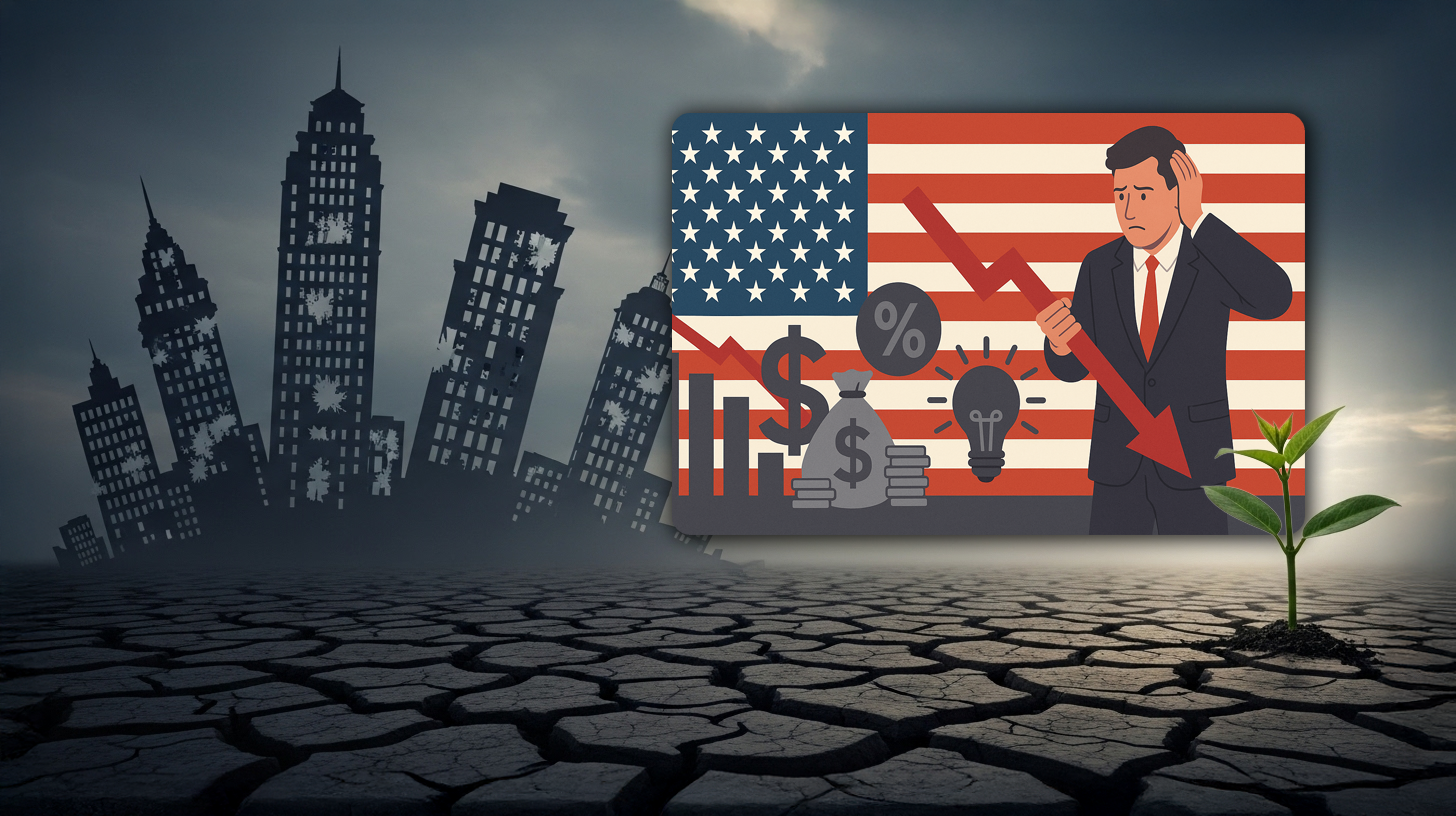
The biggest current problems facing the USA: Economic challenges and solutions – Image: Xpert.Digital
5 crises that are paralyzing the US economy: 37 trillion dollars in debt, job slump, inflation, loss of confidence, and trade policy
What are the most serious economic problems currently facing the USA?
The United States faces a multitude of complex economic challenges with both short-term and long-term repercussions for the country. Looking at the current situation, several critical problem areas have emerged that threaten the foundations of the American economy.
Perhaps the most pressing problem is the spiraling national debt of the United States. With current debt at nearly $37 trillion and a debt-to-GDP ratio exceeding 120 percent, the country is in a precarious fiscal situation. The development of interest payments is particularly worrying: by 2025, the US is expected to have to pay $794 billion to its creditors, and in just a few years, interest payments could surpass the $1 trillion mark annually. These debt service expenditures already exceed defense spending and tie up significant funds that would be needed for investment in infrastructure, education, and other vital areas.
Another serious problem is the erratic tariff policy under the Trump administration, which has led to considerable economic uncertainty. Tariffs on Chinese goods were raised to as high as 145 percent, prompting China to retaliate with tariffs of 125 percent. These trade conflicts have not only strained bilateral relations between the US and China but have also disrupted global supply chains and negatively impacted European companies.
Related to this:


How does the current tariff policy affect the American economy?
The effects of the tariff policy are already clearly noticeable and have led to a surprising contraction of the US economy in the first quarter of 2025. Gross domestic product fell by 0.3 percent, after economists had expected growth of 0.3 percent. This decline is largely attributable to the rush by US companies to increase their inventories before the comprehensive tariffs take effect.
The uncertainty caused by unpredictable tariff policies has led to many investment projects being put on hold. Companies lack the basis for their business decisions, as tariffs are announced, introduced, withdrawn, or postponed on a weekly basis. This planning uncertainty not only hampers investment but also leads to weakening domestic demand, as major retail chains have issued profit warnings and announced price increases.
Tariff policy also has an inflationary effect. Most economists expect inflation to rise in 2025, as US importers will pass on a large portion of the tariffs to end consumers. This hits lower-income US households particularly hard, as they spend a larger share of their income on imported goods.
What developments are showing in the American labor market?
The US labor market is showing worrying signs of weakness, which are seen as clear warning signs of a potential recession. The unemployment rate rose from 4.1 percent in June 2025 to 4.3 percent in August, the highest level since October 2021. Particularly concerning is the fact that only 22,000 new jobs were created in August, less than a third of the expected 75,000.
The situation for young professionals has drastically worsened. According to unanimous media reports, job prospects for school and university graduates have deteriorated significantly. Many companies are refraining from hiring new staff, and in April 2025, there was exactly one applicant for every newly created position, whereas two years earlier the ratio was 0.6.
The labor force participation rate has also fallen alarmingly. It dropped to 62.2 percent in July 2025, the lowest level since November 2022. This trend suggests that more and more people are leaving the labor market altogether because they cannot find employment opportunities or are discouraged.
How serious is the inflation trend in the USA?
Inflation trends in the US present a mixed picture with worrying tendencies. While overall inflation in September 2024 was 2.4 percent, close to the Federal Reserve's target of 2 percent, the core rate, excluding food and energy, remained stubbornly high and even rose by 0.1 percentage points to 3.3 percent. In August 2025, inflation accelerated again to 2.9 percent, the highest level since January.
The price trends in various categories are particularly problematic. Service prices are still rising noticeably, for example, housing costs, which have increased by 4.9 percent annually. Vehicle prices have also risen: used cars and trucks became 6 percent more expensive compared to 4.8 percent in the previous month, and new vehicles 0.7 percent more expensive than 0.4 percent.
Energy costs, which had long acted as deflationary factors, rose again in August 2025 for the first time in seven months. This could pose an upside risk to overall inflation, especially if oil prices continue to rise due to the escalating war in the Middle East.
What role does the Federal Reserve play in addressing these problems?
The Federal Reserve faces a difficult dilemma between combating inflation and supporting the weakening labor market. In September 2025, the Fed cut its key interest rate by 25 basis points to a range of 4.00 to 4.25 percent for the first time since December 2024. This decision was made against the backdrop of a deteriorating labor market, even though inflation is not yet fully under control.
The Fed is under considerable political pressure from President Trump, who has urged the central bank to make a "big cut." Newly appointed Governor Stephen Miran, previously Trump's chief economist, was the only one to vote for a larger interest rate cut of 50 basis points. This illustrates the internal tensions within the Fed regarding the appropriate course of monetary policy.
The central bank faces the paradoxical situation of needing to cut interest rates to support the economy while simultaneously fearing a renewed acceleration of inflation due to tariff policies. The Fed's projection for PCE inflation for 2026 has been revised upward from 2.4 to 2.6 percent, reflecting persistent inflation concerns.
How serious is the US debt problem?
The US debt problem has reached a dimension that threatens the country's long-term fiscal sustainability. National debt has doubled since 2015, from $18.2 trillion to its current level of $36.6 trillion. Without targeted countermeasures such as tax increases or spending cuts, the US could enter a significantly deeper debt spiral than previously anticipated.
KfW simulations paint a frightening picture: With an annual deficit increase of just 10 percent and an interest rate rise of only 0.1 percentage points per year, a debt-to-GDP ratio of over 170 percent is not unlikely within ten years. Even under more conservative assumptions, the debt-to-GDP ratio would rise to over 150 percent.
The interaction between rising interest costs and increasing expenditures is particularly problematic. Higher interest payments reduce available fiscal space and, combined with rising spending, exacerbate the dynamics of the debt-to-GDP ratio. International investors' confidence in the US dollar is already faltering, resulting in falling exchange rates and rising interest rates on US bonds.
What additional structural problems are burdening the American economy?
In addition to acute economic challenges, the US suffers from serious structural problems that threaten the country's long-term competitiveness. The country's infrastructure is in a deplorable state. The American Society of Civil Engineers rated US infrastructure a sobering "C-" in 2021 and estimated the investment gap for the current decade at nearly $2.6 trillion.
Approximately 60,000 bridges are in dire need of repair, and 43 percent of the country's roads are in poor or fair condition. This deterioration of infrastructure not only causes direct costs through necessary repairs but also indirect losses due to traffic jams and detours. America is already projected to lose roughly one trillion dollars within the next eight years simply due to traffic jams, detours, and other disruptions to transportation.
The healthcare system represents another structural burden. The US spends an average of $12,500 per person per year on healthcare, while in Germany the figure is less than half that. Despite these high expenditures, average life expectancy in the US is lower and infant mortality is higher than in Germany. 25 million Americans have no health insurance, while an equal number are considered underinsured.
How serious is the education crisis in the USA?
The education crisis in the US is primarily manifested in the exploding student loan debt. Currently, 44 million Americans are repaying a student loan, and five million are already in arrears. The total amount of outstanding student debt is $1.5 trillion, equivalent to Canada's gross domestic product.
The average university graduate leaves college with $35,051 in debt; for prestigious private universities and doctoral degrees, this figure can climb to over a quarter of a million dollars. On average, attending a US college costs $38,270 per year, forcing many young people to take out substantial loans.
The problem is exacerbated by the fact that this debt has a long-term impact on the economic behavior of graduates. Only once the debt is repaid can university graduates freely dispose of their income, buy houses and cars, and potentially start businesses. Economists increasingly view student debt as an impediment to growth.
What problems does the American real estate market exhibit?
The US housing market is in a difficult situation caused by multiple factors. Housing affordability has reached a near-historic low. Since 1999, rents have increased by 135 percent, while incomes have risen by only 77 percent over the same period.
A fundamental problem is the lack of available housing. Currently, there is a shortage of over three million housing units, which is driving prices continuously upward. The number of people without housing has risen to 650,000. Young people are particularly affected: around 45 percent of 18- to 29-year-olds still live with their parents – a figure not seen since the Great Depression of the 1930s.
The Federal Reserve's interest rate policy has exacerbated problems in the housing market. Mortgage rates rose from under three percent in 2021 to as high as eight percent at times. At the end of 2021, the rate for a 30-year mortgage was around 2.7 percent, peaking at nearly 7.8 percent at the end of October 2023.
The vacancy rate in the American commercial real estate market was over 19 percent in the third quarter of 2023, which is higher than in the aftermath of the 2008 financial crisis. Many construction projects are becoming unprofitable due to the higher interest rates and are therefore not being pursued further.
How is the US government trying to solve these economic problems?
The US government's approaches to solving economic problems are diverse, but often controversial and sometimes contradictory. In the area of tariff policy, the Trump administration is attempting to strengthen domestic industry and reduce the trade deficit through protectionist measures. Trump consistently promises that his tariff policy will make the country rich and the US economy more successful than ever.
However, the negative effects of this policy are already becoming apparent. While the US and China have reduced their tariffs from 145 percent to 30 percent, the fundamental trade conflicts remain. Substituting imported goods with US-made products is unrealistic, at least in the short term, because the necessary production capacity and expertise are not available to a sufficient degree.
The Biden administration took significant steps regarding infrastructure. The Infrastructure Investment and Jobs Act of 2021 allocates $1.2 trillion for various infrastructure improvements, including $40 billion specifically for bridge repairs. However, given the estimated investment gap of $2.6 trillion by 2029, these funds are only a start.
In the education sector, the Biden administration made efforts to reduce student debt, but structural reforms to the higher education system largely failed to materialize. The high tuition fees and the associated debt problems remain unresolved.
What monetary policy measures is the Federal Reserve taking?
The Federal Reserve pursues a cautious but flexible monetary policy to combat inflation while also supporting the weakening labor market. The first interest rate cut of 2025, a 25-basis-point reduction in September, was a balanced compromise between these competing objectives.
The Fed has adjusted its economic forecasts and expects to cut interest rates by a further 50 basis points by the end of 2025 and by a quarter of a basis point in 2026. At the same time, it revised its GDP growth forecast for 2025 upward from 1.4 to 1.6 percent, indicating a cautiously optimistic assessment of economic development.
However, the Fed is walking a tightrope. The central bank must fend off suspicions that it is loosening its monetary policy due to the constant pressure for low interest rates from the White House, thereby risking a loss of credibility in the financial markets. The persistent inflationary pressures stemming from tariff policies further complicate decision-making.
🔄📈 B2B trading platform support – Strategic planning and support for export and the global economy with Xpert.Digital 💡


B2B trading platforms - Strategic planning and support with Xpert.Digital - Image: Xpert.Digital
Business-to-business (B2B) trading platforms have become a critical component of global trade dynamics and thus a driving force for exports and global economic development. These platforms offer significant advantages to companies of all sizes, especially SMEs—small and medium-sized enterprises—which are often considered the backbone of the German economy. In a world where digital technologies are increasingly prominent, the ability to adapt and integrate is crucial for success in global competition.
More information here:
Crumbling infrastructure and US national debt: Why 2034 will mark a turning point – interest burden instead of growth – how debt is eating away at America's future
How effective are the measures taken so far to tackle national debt?
The measures taken so far to address the national debt are insufficient and, in some cases, counterproductive. The "Big Beautiful Bill" passed by President Trump could increase US debt by another three trillion dollars by 2034. Neither the Trump nor the previous Biden administration has taken any serious steps to reduce the structural deficit.
The US budget deficit currently stands at 5 to 6 percent of GDP, which Goldman Sachs economists describe as worrying. The longer-term fiscal outlook for the United States is in an "unsustainable position." Even large bond managers like Pimco are hesitant to buy more US Treasury bonds because doubts have arisen about the sustainability of the debt.
A sustainable solution would require significant tax increases or drastic spending cuts, but both options are politically difficult to implement. KfW Research's simulation shows that even with optimistic assumptions about cost-cutting efforts, the debt-to-GDP ratio will continue to rise.
Related to this:

What long-term effects will these problems have on the US economy?
The long-term effects of the current economic problems on the US are serious and could jeopardize the country's position as a leading economic power. The spiraling national debt is leading to a continuous displacement of productive spending by interest payments. Washington already spends more money on debt servicing than on defense, and this trend will only worsen.
The infrastructure crisis threatens the long-term competitiveness of the United States. If the estimated investment gap of $2.6 trillion is not closed, the US faces economic losses of $10 trillion by 2039. Dilapidated roads, crumbling bridges, and outdated utility systems reduce productivity and increase costs for businesses.
The education crisis is creating a burden on the economy that spans generations. The $1.5 trillion in student debt ties up the purchasing power of an entire generation and discourages investment in business start-ups, real estate, and consumption. This has a dampening effect on long-term economic growth.
The dysfunctional healthcare system places a disproportionate burden on both businesses and private households. High healthcare costs make American companies less competitive in the international arena and lead to a continuous weakening of the middle class's purchasing power.
How do experts assess the current solutions?
Experts' assessments of current solutions are predominantly critical. Regarding tariff policy, the International Monetary Fund warns that the trade war initiated by Trump will not benefit the US. US economists criticize the fact that import tariffs help neither US companies nor US workers. If America isolates itself, the middle class would lose 29 percent of its purchasing power.
The Federal Reserve is praised by experts for its cautious approach, but also criticized. LBBW Research sees the Fed in a dilemma between the unexpectedly sharp deterioration of the labor market and the continued threat of inflation due to tariff policy. The risk of monetary policy missteps is growing in this complex situation.
Regarding national debt, experts agree that urgent action is needed. KfW Chief Economist Dirk Schumacher sees "little doubt that, as a consequence of the law, the US debt mountain will continue to grow rapidly." The influential Brookings Institution in Washington has identified "dangerous cracks in the foundations of US democracy," which are also being exacerbated by the economic problems.
Infrastructure investments are generally welcomed, but considered insufficient. Although the Infrastructure Investment and Jobs Act represents significant progress, the $1.2 trillion allocated is not enough to close the estimated $2.6 trillion investment gap.
Related to this:

What alternative approaches are being discussed?
In the economic policy debate, various alternative approaches to solving structural problems are being discussed. Regarding national debt, economists propose a combination of tax increases and spending cuts. Specifically, higher taxes for corporations and the wealthy, as well as a review of social spending, are being discussed.
In the area of trade policy, many experts advocate a return to multilateral agreements and a less confrontational approach towards China. The European Chamber of Commerce views the trade war critically and warns of its negative impact on global supply chains.
Fundamental structural reforms to the healthcare system are being discussed, including a stronger role for the government in price negotiations with pharmaceutical companies. Some experts are even proposing a single-payer system modeled on the European system, although this would be politically difficult to implement.
In the education sector, both short-term debt relief programs and long-term cost-control reforms are being discussed. Proposals range from limiting tuition fees to increasing government funding for higher education.
For infrastructure, an increase in public investment is called for, possibly financed by special infrastructure taxes or a reform of the gas tax, which has not been increased since 1993.
How do these problems affect the international standing of the USA?
The US economic problems have already begun to weaken its international standing. International investors' confidence in the US dollar is wavering, resulting in falling exchange rates and rising interest rates on US bonds. This is particularly worrying because the dollar's status as the world's reserve currency is a key pillar of American economic power.
Trade policy conflicts have led other countries to diversify their trade relationships. China, for example, had already established alternative supply chains during Trump's first term and now imports more soybeans from Brazil than from the US. A professor at the Chinese European Business School predicts that economic relations between the EU and China will intensify, thereby reducing America's competitiveness.
The infrastructure crisis is damaging the US image as a technological leader. While other countries are investing in modern transportation and communication systems, the US is struggling with crumbling bridges and outdated infrastructure. This could reduce the country's long-term attractiveness for international investment.
Political instability, exacerbated in part by economic problems, is making the US a less reliable partner in international relations. The erratic policies of the Trump administration have already shaken the confidence of many allies.
What role does political polarization play in problem-solving?
Political polarization in the US has become a significant obstacle to solving economic problems. Even on clearly necessary measures, the parties struggle to agree on common solutions. The Infrastructure Investment and Jobs Act was only passed after protracted negotiations and with a significantly reduced budget of $1.2 trillion instead of the original $2.3 trillion.
On the issue of national debt, the parties are deadlocked: Republicans categorically reject tax increases, while Democrats oppose major spending cuts. This deadlock prevents necessary structural reforms and causes the problems to worsen.
Trade policy has become a political football, with short-term political gains often prioritized over long-term economic sense. Tariff policy is shaped more by political than economic considerations, leading to the observed unpredictability and resulting problems.
Even monetary policy is subject to attempts to exert political influence. President Trump has repeatedly put public pressure on the Fed and threatened to fire Fed members. This undermines the central bank's independence and makes sound monetary policy more difficult.
What impact do these problems have on American society?
The economic problems are having a profound impact on American society and exacerbating existing inequalities. Inflation is hitting lower-income groups particularly hard, as they have to spend a larger share of their income on basic necessities such as housing, food, and energy.
The housing crisis is exacerbating social inequality. While wealthier segments of the population can continue to acquire property, middle and lower-income groups are increasingly being squeezed out of the homeownership market. The number of homeless people has risen to 650,000, further intensifying social tensions.
Educational debt has intergenerational consequences. Young people have to postpone life decisions – such as starting a family, buying a house, or starting a business – until they have paid off their student loans. This leads to a delay in important life milestones and influences demographic development.
The dysfunctional healthcare system exacerbates insecurity among the population. Healthcare costs are a leading cause of personal bankruptcies, meaning that even insured Americans are not safe from financial ruin. This insecurity affects household spending habits and savings rates.
The dilapidated infrastructure negatively impacts the quality of life for all Americans. Motorists not only face higher fuel costs but also additional expenses for repairs due to poor road conditions. In Rhode Island, for example, drivers pay an extra $476 annually for repairs necessitated by the poor state of the roads.
What are the future forecasts for the American economy?
Future forecasts for the American economy are mixed, but mostly worrying. While the Federal Reserve has slightly revised its GDP growth forecast for 2025 upward to 1.6 percent, this is significantly below the historical average. Growth of only 1.8 percent is expected for 2026.
The International Monetary Fund has drastically revised its forecasts for the US economy downwards. While higher growth rates were initially expected, the IMF now anticipates growth of only 1.8 percent for 2025 and 1.7 percent for 2026. These figures are 0.9 and 0.4 percentage points below the original forecasts, respectively.
Particularly worrying are the long-term projections for public debt. Without fundamental reforms, the debt-to-GDP ratio could rise to over 170 percent by 2034. This would severely restrict the government's fiscal capacity and could lead to a crisis of confidence.
Inflation forecasts remain elevated. The Fed expects PCE inflation of 3 percent for 2025 and has revised its 2026 forecast upward from 2.4 to 2.6 percent. This suggests that tariff policy will continue to have inflationary effects.
A further deterioration is expected in the labor market. The Fed forecasts an unemployment rate of 4.5 percent for 2025, which is significantly higher than current levels and indicates continued weakness in the labor market.
What lessons can be learned from the current situation?
The current economic situation in the US offers important lessons for economic policy. First, it shows that protectionist trade policies can be counterproductive in a globalized world. Erratic tariff policies have caused more harm than good and increased economic uncertainty.
Secondly, it becomes clear that fiscal responsibility is also important in good times. The US failed to reduce its national debt during periods of economic strength and now faces a dangerous debt spiral. This underscores the importance of countercyclical fiscal policy.
Thirdly, the infrastructure crisis demonstrates that investments in public infrastructure cannot be postponed. Decades of neglected maintenance are now leading to exponentially rising costs and economic losses.
Fourth, the education crisis illustrates that high education costs can be counterproductive to economic development. A system that burdens young people with high levels of debt stifles innovation and entrepreneurship.
Fifth, it becomes clear that an efficient healthcare system is not only a social but also an economic necessity. High healthcare costs in the US burden both businesses and private households and reduce international competitiveness.
Experience also shows that political polarization significantly hinders the solution of economic problems. Only through cross-party cooperation can the structural challenges be addressed.
Finally, it becomes clear that the independence of the central bank is crucial for successful monetary policy. Political interference in the Fed undermines its credibility and makes it more difficult to combat inflation.
Your global marketing and business development partner
☑️ Our business language is English or German
☑️ NEW: Correspondence in your native language!

Konrad Wolfenstein
I and my team are happy to be available to you as your personal advisor.
You can contact me by filling out the contact form here wolfenstein@xpert.digital:or simply call me at +49 7348 4088 965. My email address is
I'm looking forward to our joint project.