Craftsmanship is a vital element of our entire economy: bureaucracy and a shortage of skilled workers are hindering development – Image: Xpert.Digital
🛠️📉 The backbone of the economy: The immense importance of skilled trades
🛠️👷 Craftsmanship is the essential element of our entire economy
The skilled trades form the backbone of our economy. They are not only an essential component of the economic structure, but also play a crucial role in providing for the population's daily needs. From construction to maintenance, from individual crafts to specialized services – the skilled trades cover a wide range of sectors and make a significant contribution to value creation.
The importance of skilled trades can be seen not only in numbers, but also in the role they play in society. Skilled tradespeople ensure that basic needs such as housing, food, clothing, and mobility are met. Particularly in Germany, where the dual vocational training system is firmly established, skilled trades hold a prominent position. However, despite this fundamental importance, skilled trades face a number of challenges that hinder their development.
🗂️ Bureaucracy
One of the biggest obstacles is bureaucracy. Many craft businesses struggle with a veritable flood of regulations and requirements that complicate their day-to-day operations. Instead of being able to concentrate on their core tasks, they are forced to invest more and more time and resources in administrative duties. These bureaucratic hurdles affect not only large craft businesses, but especially small and medium-sized enterprises (SMEs), which form the backbone of the skilled trades. Whether it's applying for permits, complying with safety regulations, or dealing with tax issues – complex requirements lurk everywhere, creating an unnecessary burden.
👨🔧 Skilled worker shortage
Another key problem is the shortage of skilled workers. This is no longer just a future scenario, but a harsh reality in many regions. Many companies are desperately searching for qualified personnel, but often cannot find suitable applicants. The reasons for this are manifold: Demographic change, increasing academicization, and declining birth rates mean that fewer and fewer young people are starting vocational training in skilled trades. Furthermore, skilled trades have lost social prestige in recent years, leading many young people to pursue an academic career rather than choosing a trade.
📉 Challenge and Development
"The skilled trades are the heart of our economy," many experts repeatedly emphasize. And indeed, it's clear that without skilled trades businesses, many everyday processes would cease to function. However, the combination of bureaucracy and a shortage of skilled workers poses a significant threat to the future of the skilled trades. While bureaucracy slows down many processes and restricts the flexibility of skilled trades businesses, the shortage of skilled workers means that fewer and fewer companies are able to complete their orders in a timely manner. This not only has economic consequences but also affects the quality of services offered to consumers.
🔍 Solutions
The question now is how to overcome these challenges. On the one hand, political measures are needed to reduce bureaucracy. Policymakers must recognize that skilled trades play a key role in economic prosperity and must therefore be relieved of burdens. This could be achieved by simplifying regulations, introducing digital processes to reduce administrative tasks, and creating a clear legal framework specifically tailored to the needs of skilled trades businesses.
🚀 Measures and digitalization
On the other hand, the skilled worker shortage must also be addressed. Various measures are conceivable here, ranging from improved career guidance in schools to a reform of the education system. In particular, skilled trades must be repositioned as an attractive option for young people. This requires not only an image campaign, but also concrete improvements to working conditions in many skilled trades. This includes fair pay, as well as opportunities for further training and career advancement within the sector.
Furthermore, digitalization could play a crucial role in addressing these challenges. Many craft businesses have already taken initial steps towards digitalization in recent years, whether through the introduction of online booking systems, the use of social media for customer acquisition, or the implementation of modern technologies in order processing. However, the potential of digitalization is far from exhausted. Particularly in areas such as the automation of work processes, the use of data analytics to optimize business operations, and the introduction of digital training opportunities, there are still many untapped possibilities.
📱 Digital Challenges and Opportunities
However, it must be emphasized that digitalization cannot solve all problems. Especially in the skilled trades, many activities are heavily reliant on human expertise and direct customer contact. Therefore, it will always be crucial to have well-trained specialists who have mastered their craft skills and are simultaneously able to use modern technologies effectively.
Despite the challenges it faces, skilled trades remain a central pillar of our economy. However, bureaucracy and a shortage of skilled workers are serious obstacles that urgently need to be addressed to secure the future of skilled trades. Strengthening skilled trades as an attractive and indispensable sector requires both political support and a shift in societal attitudes. Only then can skilled trades continue to successfully fulfill their significant role in the economy and in people's daily lives.
📣 Similar topics
- 🛠️ The importance of craftsmanship for the economy and society
- 📉 Challenges in the skilled trades: bureaucracy and skills shortage
- 🚀 Digitalization in the skilled trades: Opportunities and potential
- 🎓 Skilled trades and the dual vocational training system
- 👷♂️ Skilled worker shortage in the trades: causes and solutions
- 📑 Reducing bureaucracy: Political measures for the skilled trades
- 🌍 Craftsmanship as a key to economic value creation
- 📈 Crafts in transition: Future perspectives and strategies
- 💡 Innovations in the skilled trades: Modern technologies and solutions
- 🤝 Strengthening the social standing of skilled trades
#️⃣ Hashtags: #Crafts #SkillsShortage #Digitalization #BureaucracyReduction #Economy
🏗️ Business situation in German skilled trades

Craftsmanship in Germany – Image/PDF: Xpert.Digital
Related to this:
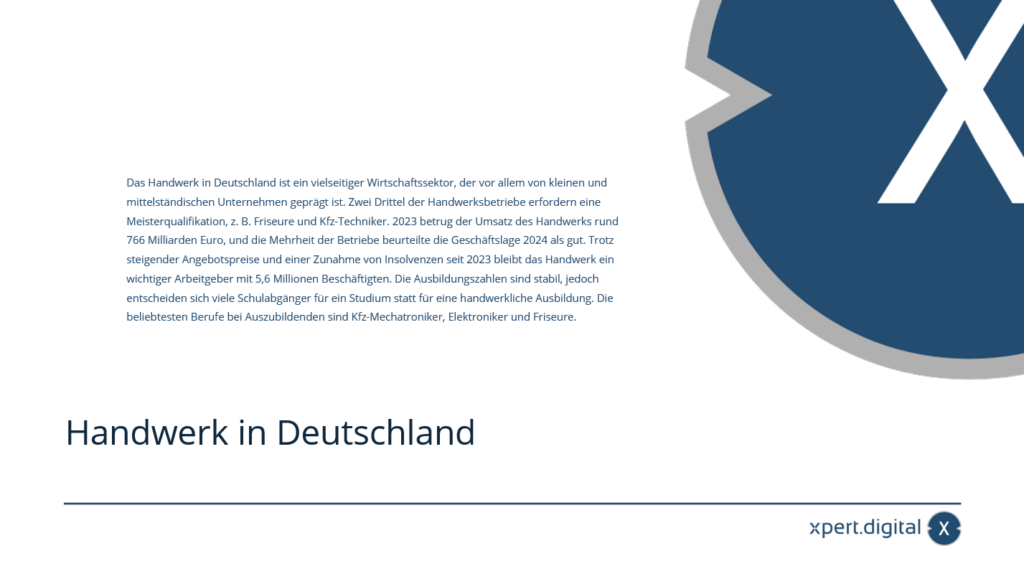
📈 According to the German Confederation of Skilled Crafts (ZDH), the skilled trades sector achieved an impressive turnover of around €766 billion in 2023. This demonstrates the importance of skilled trades to the German economy. A survey from spring 2024 reveals that approximately 55 percent of skilled trades businesses rate their current business situation as "very good" or "good." This optimism reflects the robustness and resilience of the sector, which remains strong even in times of economic challenges.
📉 However, there is another side to the story: Seven percent of businesses reported that they consider their business situation to be "poor" to "inadequate." This suggests that not all businesses have been able to benefit from the overall positive trend. Smaller and specialized craft businesses, in particular, often struggle with rising costs and fierce competition.
💹 A notable trend of the last two years is the rise in prices charged by tradespeople. In spring 2024, around 67 percent of companies reported that they had had to raise their prices in recent months. This can be attributed to several factors, including rising material costs, higher labor costs, and increased energy costs, which are putting a strain on many businesses.
📉 The development of insolvencies in the skilled trades sector is particularly relevant. While around 6,500 insolvencies were reported annually in 2009, this number declined significantly in subsequent years, reaching a low point in 2022. However, in 2023, the number of insolvencies rose again, exceeding 4,000 cases. This is a worrying trend and could indicate structural problems in the sector, such as insufficient liquidity or a lack of qualified young professionals in certain trades.
🛠️ Skilled trades are often described as the backbone of the German labor market, and for good reason: around 12 percent of the workforce in Germany, or approximately 5.6 million people, are employed in the skilled trades. This figure underscores the sector's importance not only for the economy but also for the country's social stability, as skilled trades offer a wide range of jobs that are often not available to the same extent in other sectors.
👷 Employment and training in the skilled trades
📚 Another essential aspect of skilled trades is the training of new professionals. In 2023, there were approximately 342,000 apprentices completing vocational training in the skilled trades. This number has decreased slightly compared to the previous year, highlighting a general problem: the shortage of young talent. Since 2000, the total number of apprentices in the skilled trades has declined by around 40 percent. The reasons for this are manifold. One of the main factors is that more and more young people are pursuing an academic career and opting for university studies instead of vocational training.
📈 Nevertheless, there are also positive developments: The number of newly concluded apprenticeship contracts rose slightly in 2023, reaching approximately 130,400. This shows that skilled trades remain attractive, especially for young people who prefer practical training. However, the challenge remains to make skilled trades more appealing to school leavers, particularly those with higher educational qualifications.
🎓 The fact that a large proportion of school leavers in Germany opt for university studies presents the skilled trades with additional challenges. In 2023, in particular, only around 21,400 new apprenticeship contracts were signed by individuals with a university entrance qualification. This means that the skilled trades are primarily dependent on young people with a secondary school leaving certificate (Realschulabschluss or Hauptschulabschluss). To counteract this, targeted measures must be taken to make the skilled trades more attractive to high school graduates (Abitur). These include, among other things, improved career opportunities, greater social appreciation of skilled trades, and targeted advertising campaigns to highlight the numerous advantages of vocational training in the skilled trades.
🔧 Particularly popular apprenticeships in the skilled trades remain automotive mechatronics technician, electrician, and plumbing, heating, and air conditioning technician. These professions not only offer good career prospects but are also indispensable in society due to the high demand for these services. Besides these classic skilled trades, professions such as carpenter and hairdresser also continue to enjoy great popularity.
🔮 Challenges and future prospects of the skilled trades
🏭 Although skilled trades have a long tradition in Germany and continue to play a significant role in the economic system, many businesses face major challenges. A crucial problem is the shortage of skilled workers, which has worsened in recent years. Many craft businesses report that they cannot fill vacancies due to a lack of qualified applicants. This shortage of skilled workers not only affects the businesses themselves but also the overall economy, as many orders cannot be processed or can only be completed with considerable delays.
🖥️ Another important point is digitalization in the skilled trades. Many businesses face the challenge of integrating digital technologies into their work processes. This affects not only administration and organization, but also the use of modern tools and techniques in practical work. While digitalization offers many opportunities, such as more efficient work processes and the development of new business areas, many skilled trades businesses also need support to successfully manage this transformation.
🌍 Sustainability and climate protection are also becoming increasingly important in the skilled trades. More and more customers value the use of environmentally friendly materials and methods when performing skilled trades services. Craft businesses that are able to meet these requirements can gain a clear competitive advantage in the future.
🔮 Overall, German skilled trades face an exciting yet challenging future. On the one hand, technological change and the increasing demand for sustainable solutions offer new opportunities; on the other hand, businesses must overcome the challenges of skilled labor shortages and growing competition from abroad. However, with its flexibility, innovative strength, and deep roots in German society, skilled trades have the potential to continue playing a central role in the country's economic and social fabric.
📣 Similar topics
- 📈 Business situation in German skilled trades
- 💡 Challenges in the trades
- 🛠️ Importance of German craftsmanship
- 📊 Sales development in the skilled trades 2023
- 💷 Price trends and costs in the skilled trades
- 🏢 Bankruptcies and their effects
- 👷 Skilled worker shortage in the trades
- 🌍 Sustainability and climate protection in the skilled trades
- 🚀 Digitalization and technological innovations
- 👨🔧 Apprenticeships and young talent in the skilled trades
#️⃣ Hashtags: #Crafts #Economy #SkillsShortage #Sustainability #Digitalization
We are here for you - Consulting - Planning - Implementation - Project Management
☑️ SME support in strategy, consulting, planning and implementation
☑️ Creation or realignment of the digital strategy and digitization
☑️ Expansion and optimization of international sales processes
☑️ Global & Digital B2B trading platforms
☑️ Pioneer Business Development

Konrad Wolfenstein
I would be happy to serve as your personal advisor.
You can contact me by filling out the contact form below or simply call me on +49 7348 4088 965 .
I'm looking forward to our joint project.
Write to me



Xpert.Digital - Konrad Wolfenstein
Xpert.Digital is a hub for industry focusing on digitalization, mechanical engineering, logistics/intralogistics and photovoltaics.
With our 360° Business Development solution, we support renowned companies from new business to after-sales.
Market intelligence, smarketing, marketing automation, content development, PR, mail campaigns, personalized social media and lead nurturing are part of our digital tools.
You can find more information at: www.xpert.digital - www.xpert.solar - www.xpert.plus
Keep in touch