
How the myth of "cost-effective" machine intelligence is bursting and driving companies into a historical dependency trap – Image: Xpert.Digital
Hidden price increases and oligopolies: The dangerous AI dependency of ChatGPT & Co.
Token tricks of tech giants: How companies are systematically ripped off on AI costs
The price of algorithms: Why the dream of free automation is bursting
For years, the promise of Silicon Valley tech giants sounded irresistible: artificial intelligence would soon be as ubiquitous and incredibly cheap as tap water. A deflationary revolution seemed imminent, in which complex cognitive tasks would be automated virtually free of charge. But this illusion is now shattering with full force. Instead of endless efficiency gains, AI development is revealing itself as one of the most resource-intensive and expensive undertakings in human history. While the prices for computing power, storage, and energy are exploding, dominant providers are exploiting their monopoly position to drastically drive up costs for companies – often through hidden adjustments deep within the algorithm. Those who blindly outsource their business processes to proprietary models are falling into a historical dependency trap. A new era of harsh economic realities is beginning, in which, surprisingly, human labor is once again becoming the more cost-effective alternative for many tasks. Those who fail to counteract this trend and build digital sovereignty now risk their competitiveness.
Related to this:


The end of the deflationary illusion and the myth of omnipresence
In recent years, the global economy has been presented with a tempting narrative that portrayed the development of artificial intelligence as an unstoppable journey toward limitless and, above all, virtually free availability. The tech industry's promises of salvation suggested that in the near future, artificial intelligence would flow as freely and cheaply as tap water. This paradigm rested on the assumption that the technological evolution of so-called frontier models would follow a kind of digital law of nature, similar to Moore's Law for microprocessors. It was assumed that the efficiency gains in computing and training models would inevitably be passed on to end users, so that complex cognitive tasks could soon be automated for fractions of a cent.
This promise is increasingly proving to be a fundamental miscalculation. Companies that based their long-term strategic planning on the premise that artificial intelligence would behave similarly to deflationary calculators or rudimentary software applications are now confronted with a harsh economic reality. They mistook a temporary business model, subsidized by massive venture capital, for an immutable technological law. The initially extremely low prices for access to sophisticated language models were not sustainable market prices, but rather strategic tools for rapid market penetration and the establishment of monopolistic ecosystems. The hardware on which these models operate, particularly highly specialized semiconductors and silicon chips, is subject to the harsh laws of supply, demand, and enormous production costs. These physical and infrastructural realities cannot be overridden by optimistic investor presentations or visionary keynotes. The price of computing power, and especially the extremely fast memory essential for running massive neural networks, is skyrocketing. The illusion of unlimited and inexpensive machine intelligence is giving way to the realization that cognitive automation is one of the most resource-intensive technologies in human history.
Related to this:

The infrastructural reality and the physical limits of scaling
To understand the current price explosions in the artificial intelligence market, one must consider the underlying infrastructure and its economic dynamics. The creation and operation of large language models require data centers of unprecedented size and complexity. These facilities not only consume enormous amounts of electrical energy but also rely on highly specialized graphics processing units (GPUs), the manufacturing of which operates at the physical limits of current technological feasibility. The supply chains for these components are extremely concentrated and vulnerable to geopolitical tensions and production bottlenecks. The physical reality of silicon is now forcing a drastic correction in price structures.
Every query to an advanced language model, every generation of text or analysis, requires what is known as inference. This inference is not a free digital act, but a highly energy- and computationally intensive process in which billions of parameters must be moved through the memory of graphics processing units (GPUs). As the complexity of the models grows, these inference costs also increase proportionally. While providers were initially willing to subsidize these costs to shape user habits and collect data, pressure from the capital markets now forces them to become profitable. The exploding storage prices and the exorbitant costs of expanding the global data center infrastructure are inevitably factored into pricing models for end customers and businesses. It is a classic economic principle: if the marginal costs of production rise due to physical and infrastructural limitations, the final product cannot become cheaper in the long run. The assumption that technological progress alone could compensate for these enormous cost increases has proven insufficient. Rather, we see that the models are becoming ever larger and more power-hungry, which more than negates the efficiency gains on the hardware side.
Hidden cost increases and the monetization of algorithms
The way costs are passed on to users is often subtle and not immediately apparent. Besides obvious price increases for monthly subscriptions, which for the most powerful models have now reached well over two hundred US dollars per month and in the absolute top tier even approach the two hundred and fifty US dollars mark, providers use profound technical adjustments to drastically increase their revenue per user. A key mechanism for this is the modification of so-called tokenizers.
A tokenizer is the interface that breaks down human language into machine-readable units called tokens. Billing for the use of artificial intelligence is based almost exclusively on these consumed tokens. If a provider algorithmically adjusts the architecture of its tokenizer in such a way that significantly more tokens are suddenly charged for the same source text, this amounts to a massive, hidden price increase. Recent market developments show that such updates can lead to between twelve and thirty-five percent more tokens being charged for identical text snippets. In practical terms, this means that a company that has outsourced its processes to these interfaces faces an unforeseen and immediate cost increase of around twenty percent at maximum utilization, without any improvement whatsoever in the quality or scope of the generated content. Such algorithmic adjustments allow providers to optimize their margins while the customer remains under the impression that the base price has remained stable. This lack of transparency in pricing poses a significant risk to any business calculation and reveals the power imbalance in this still young market.
Related to this:

The architecture of dependency in oligopoly
The strategic decision of many companies to outsource their entire artificial intelligence infrastructure to a handful of dominant US technology companies is increasingly proving to be a fatal error in risk management. In the euphoria of the early years, it seemed economically sensible to rely on the seemingly superior and easily accessible interfaces of these giants instead of building their own resources. This convenience is now leading to a historic dependency trap. Companies that have based their internal processes, customer interfaces, and data analysis entirely on proprietary third-party models now find themselves in the precarious position of a tenant whose contract can be terminated or whose rent dictated at any time and without warning.
This oligopoly of providers behaves exactly according to the classic script of established platform economies, already familiar from the development of the streaming market, except that the economic consequences for the dependent companies are far more existential. Initially, users were lured into the ecosystem with low barriers, low prices, and enormous performance. As soon as the integration costs for switching to another system become so high that they create a de facto lock-in, the rules of the game change. Sudden rate limits, i.e., the artificial throttling of the maximum number of requests per minute, force companies into more expensive premium contracts to maintain operations. The contract terms are unilaterally adjusted, and the companies have no choice but to accept them, since a failure of the now deeply integrated intelligent systems would mean an immediate operational standstill. This asymmetry of power represents the loss of digital sovereignty. Those who have completely delegated the core of their future value creation—namely, data-driven intelligence—to external gatekeepers lose control over their own means of production.
🎯🎯🎯 Data-driven B2B industry hub as a quasi-in-house solution

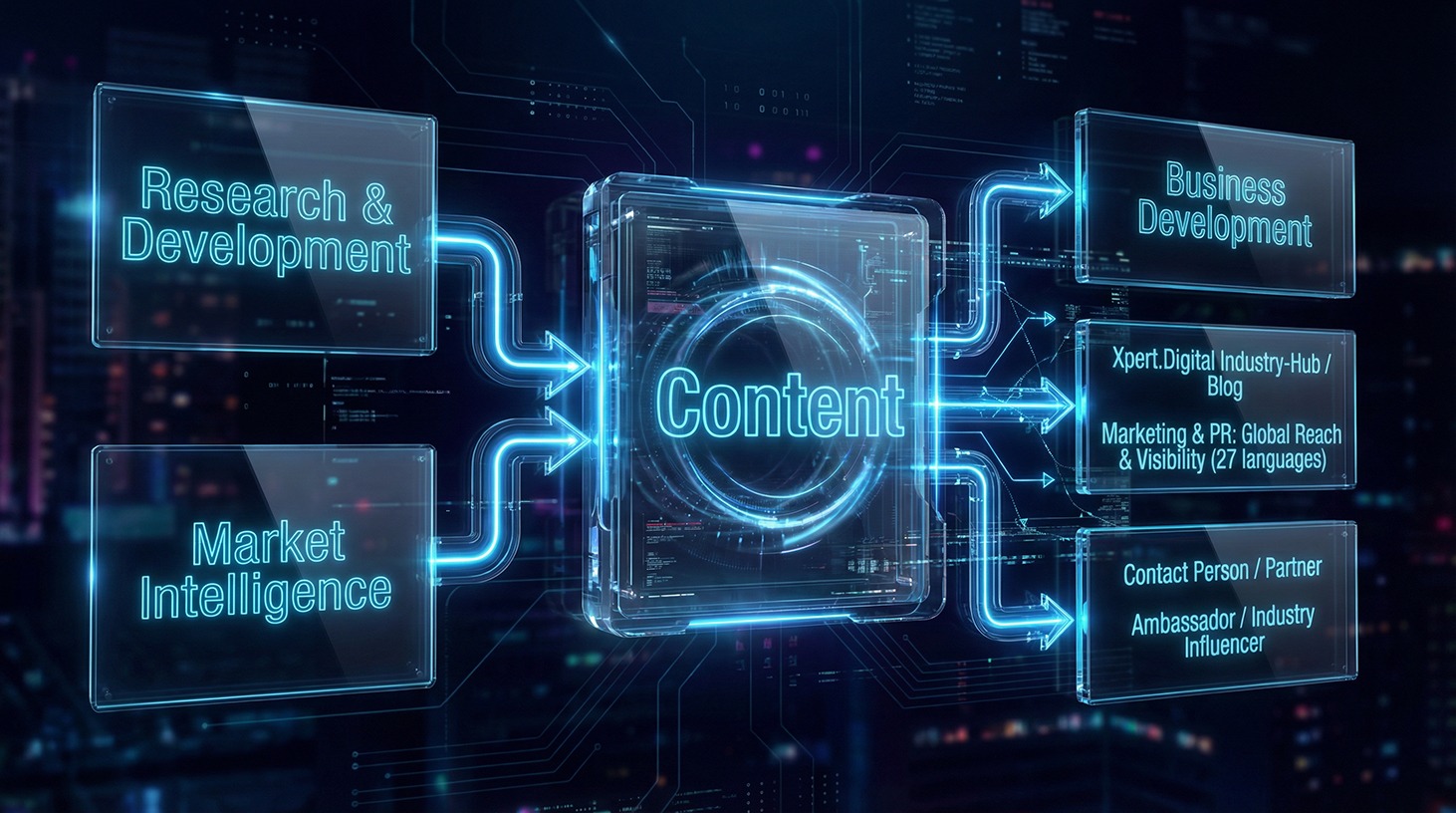
The quasi-in-house solution: How Xpert.Digital closes operational gaps in B2B marketing and sales – Smart Content-Driven Business - Image: Xpert.Digital
Xpert.Digital is a data-driven B2B industry hub led by Konrad Wolfenstein . The company acts as an external, quasi-in-house solution for industrial partners, closing operational gaps in marketing, content, and sales – without requiring additional resources on the client side.
More information here:
AI Cost Management: The New Duty for Managers – Why Autonomous AI Agents Are Turning Companies into a Cost Trap
Autonomous agents as incalculable cost drivers
The next stage of artificial intelligence development, marking the transition from reactive chatbots to proactive, autonomous agents, exacerbates this economic problem many times over. Autonomous agents are systems that don't just generate a single response, but operate in iterative loops, assign themselves tasks, search the internet, execute code, and independently correct errors. What is a tremendous leap forward from a technological perspective is developing into an incalculable cost driver in the real world of business.
The use of such agents leads to an exponential increase in token consumption. While a simple search query might require a thousand tokens, an autonomous agent solving a complex problem can consume tens or even hundreds of thousands of tokens in just a few minutes. The way these agents operate is reminiscent of a waste of resources; they go through countless iterations and discard flawed approaches, while the API cost counter keeps ticking relentlessly. The bill for this excessive consumption inevitably ends up with the user company at the end of the month, never with the platform provider. Since the underlying processes are often a black box for the user, the actual financial outlay for an agent to solve a task is almost impossible to reliably calculate in advance. The vision of replacing entire departments with legions of digital agents is already failing in many cases due to the exploding variable costs of inference. If solving a logistics problem with an AI agent costs more than the working time of an experienced dispatcher, the return on investment becomes negative.
Related to this:


Strategic imperatives for corporate sovereignty
This changed economic climate has a compelling consequence for management: building in-house expertise in artificial intelligence is no longer an optional add-on, but an essential requirement for ensuring a company's survival. This does not mean, however, that every company should now attempt to train its own massive foundation models from scratch. Such an undertaking would be as economically nonsensical as building a power plant in response to rising electricity prices. The investments required to train these foundation models are in the billions and remain the preserve of large technology companies.
Rather, the necessary core competency lies in developing profound orchestration capabilities. Companies must be able to precisely evaluate which specific model is sufficient for which concrete task. It is economically nonsensical to use the most expensive and powerful model for simple classification tasks, the aggregation of internal emails, or routine data extraction. Far smaller, resource-efficient open-source models can be used here, running either locally on the company's own servers or in a controlled private cloud environment. A strategic hybrid architecture is essential. For highly complex, creative, or highly variable tasks, resorting to the expensive premium interfaces of US corporations may still be justified. However, for the daily background noise of machine-based information processing, a separate, cost-effective infrastructure must be established. Those who fail to master this differentiation and route every single request, no matter how small, through the most expensive APIs will be crushed by the ongoing costs. The ability to evaluate models, an understanding of token economics, and the art of targeted prompt engineering to minimize failed attempts are the new core competencies of a resilient company.
The paradox of automation and the return of human labor
The exploding costs of artificial intelligence are casting a completely new light on macroeconomic discussions surrounding the labor market. Just a short time ago, it was predicted that artificial intelligence would render large parts of highly skilled knowledge work obsolete within a very short time. Many companies reacted to these predictions with premature restructuring and staff reductions, expecting to be able to replace these capacities seamlessly and far more cost-effectively with machine systems.
Current price trends are forcing a drastic reassessment. If the costs of inference continue to rise, the economic equation will reverse. Suddenly, human cognition will once again become competitive for certain tasks. The paradox of automation manifests itself in the fact that the attempt to completely replace human intelligence with machines simply becomes unprofitable beyond a certain point. When you add up the error rates, the effort required for constant system monitoring, the costs of correcting hallucinations, and the pure API costs, experienced employees are once again the significantly more economical solution in many specialized fields. Fears about rising energy prices or logistics costs could soon be overshadowed by concerns about the cost of cognitive computing power. The irony could be that companies will soon have to rehire precisely those specialists they laid off in their belief in the omnipotence and cost-free nature of artificial intelligence, and at significantly higher rates. Human experience, intuition, and the ability to grasp complex contexts without the massive consumption of computing resources are significantly enhanced in a world of extremely expensive machine intelligence.
Related to this:


Long-term perspectives and the economics of cognition
The developments of recent months mark the end of naivety regarding artificial intelligence. We are entering a phase of disillusionment, which is nevertheless essential for placing the technology on a sustainable economic foundation. The economics of cognitive power will become a central management issue of the twenty-first century. Artificial intelligence will not flow like water from a tap; rather, it will follow the same principles as rare earth elements or highly specialized industrial energy supplies: it is available, it is extremely powerful, but it comes at a significant and constantly fluctuating price.
The challenge for economies and individual market participants is to break free from their one-sided dependence on a few foreign providers without losing touch with the technological frontier. The market will have to diversify. We will see a flourishing of specialized niche models, extremely efficient and trained for narrow tasks, incurring only a fraction of the operating costs of large, general-purpose models. At the same time, an entirely new discipline will establish itself in finance and IT departments: Cloud cost management will be replaced by AI cost management. Precise monitoring of token consumption, model latency, and inference costs will become just as important as traditional controlling.
The path to the profitable use of artificial intelligence will be far more arduous, complex, and capital-intensive than the technology industry suggested in its initial marketing campaigns. Simply integrating an interface is insufficient to gain a competitive advantage; it is merely the entry ticket to an extremely costly game. Only those organizations that develop a nuanced, technology-agnostic, and economically rigorous AI strategy that minimizes dependencies and strictly manages resource allocation based on return on investment will be able to thrive in this new era of cognitive economics. The era of blind experimentation is over; the era of harsh economic realities has begun.
Your global marketing and business development partner
☑️ Our business language is English or German
☑️ NEW: Correspondence in your native language!

Konrad Wolfenstein
I and my team are happy to be available to you as your personal advisor.
You can contact me by filling out the contact form here wolfenstein@xpert.digital:or simply call me at +49 7348 4088 965. My email address is
I'm looking forward to our joint project.
☑️ SME support in strategy, consulting, planning and implementation
☑️ Creation or realignment of the digital strategy and digitization
☑️ Expansion and optimization of international sales processes
☑️ Global & Digital B2B trading platforms
☑️ Pioneer Business Development / Marketing / PR / Trade Fairs
📈🚀 From visibility to trust 👀🤝 Your scalable path with Xpert.Digital

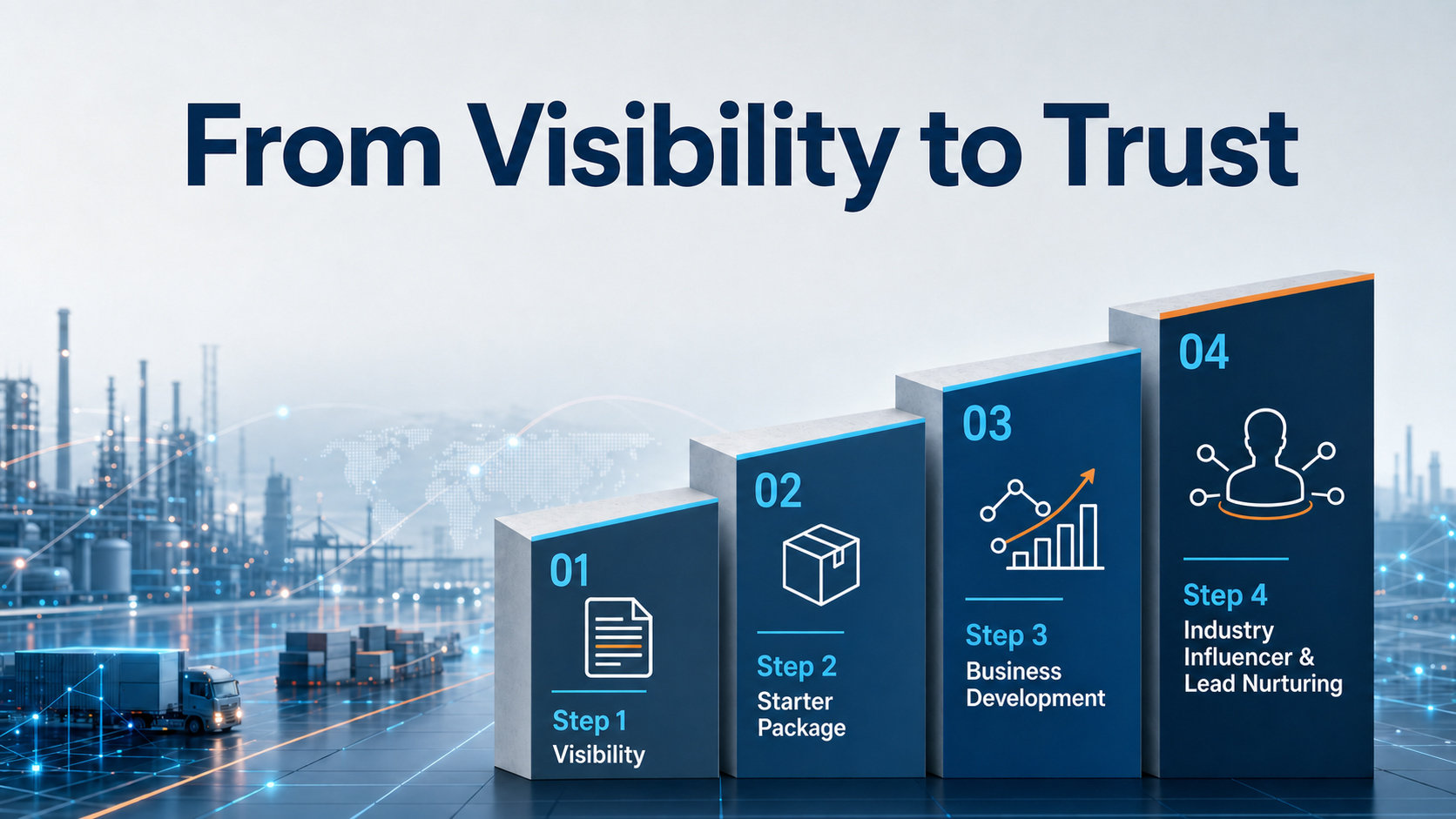
From visibility to trust: Your scalable path with Xpert.Digital - Image: Xpert.Digital
In industrial B2B, sustainable business relationships rarely emerge overnight. They develop step by step – through visibility, professional relevance, recurring touchpoints, and growing trust. Xpert.Digital's 4-stage model addresses precisely this: It offers a structured path that begins with a manageable entry point and can evolve into deeper collaboration in business development if needed.
Instead of relying on loud marketing promises, this model puts the relationship at the forefront. Companies start with clearly defined, easily calculable measures and then decide, based on their own experience, how far they want to expand the collaboration. A key factor for this undisturbed trust-building process: The platform completely avoids annoying advertising ads, so the editorial focus remains solely on the companies' expertise.
More information here: