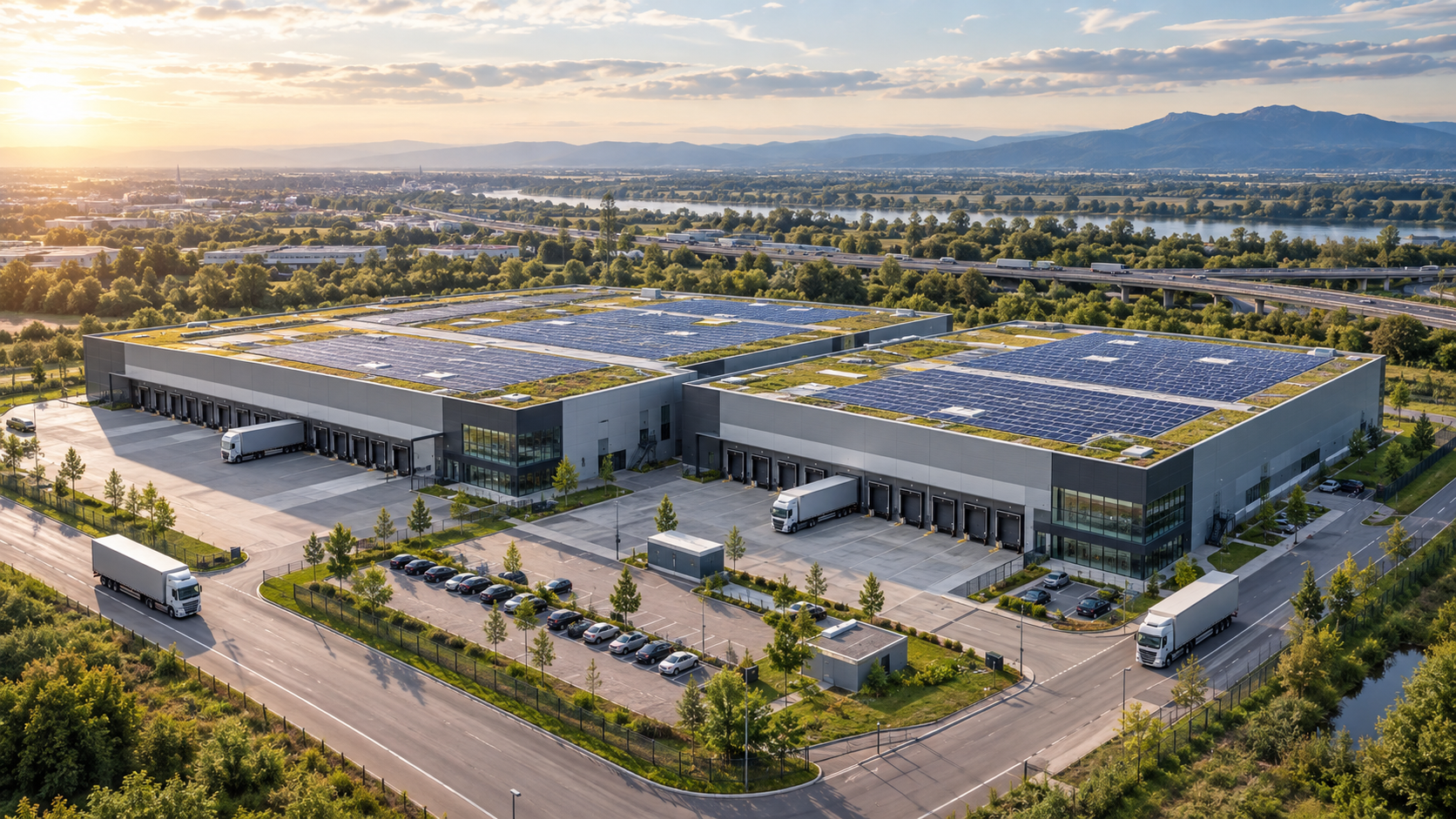
Modern logistics site in Rastatt with two halls, truck access, photovoltaics and Upper Rhine scenery – creative image on the topic, with AI: Xpert.Digital
Construction in a crisis: What's behind Verdion's mega-project in Rastatt
Despite the automotive crisis: This is why a new high-tech logistics park is being built in Rastatt
No tenants, but worth 45 million euros: Verdion's master plan for the Upper Rhine
The German logistics real estate market is at a turning point. While geopolitical uncertainties, rising interest rates, and profound structural changes in industry – especially in the automotive sector – are forcing many investors to exercise caution, the pan-European project developer Verdion is sending a strong, counter-cyclical signal. In Rastatt, Baden-Württemberg, the new "CoreHub," a state-of-the-art logistics center with a potential value of €45 million, is under construction. The remarkable aspect: it is being built without a pre-contracted tenant. What at first glance appears to be a highly risky, speculative venture on a brownfield site reveals itself upon closer inspection as a cleverly calculated strategic master plan. Verdion is fully capitalizing on the glaring shortage of energy-efficient and technologically future-proof existing buildings in Germany. The following analysis examines in detail why a huge quality gap is now emerging in the existing warehouse stock, what key role ESG standards and automation play, and why the Rastatt project is far more than just a simple bet on a location directly on the A5 motorway.
Verdion's 45 million euro bet on Rastatt: While Germany's industry struggles for its future, Verdion is building without a fixed tenant – and is banking on the lack of truly modern logistics space
A hall project of greater significance
With a planned total area of 19,573 square meters, the Verdion CoreHub Rastatt is not an exceptionally large logistics center. Nevertheless, the project is economically remarkable. The pan-European logistics real estate specialist Verdion has received building permits for two modern warehouse units, whose value potential is estimated at around €45 million. Goldbeck has been commissioned as the general contractor. Completion is scheduled for July 2027. The site at Hohlohstraße 13 is located in an established industrial park in Rastatt and less than a ten-minute drive from the A5 motorway.
At first glance, it appears to be a classic real estate development: An investor secures a plot of land, obtains building rights, constructs warehouses, and then leases them to companies in the logistics, industrial, or commercial sectors. Behind this simplified description, however, lies a complex economic decision. Verdion is investing at a time when German industry is suffering from weak demand, high costs, geopolitical risks, and profound technological changes. At the same time, financing and constructing commercial real estate has become significantly more challenging than during the long period of low interest rates.
Verdion's decision to proceed with construction despite these challenges sends a clear message. The company isn't simply banking on increasing freight volumes, but rather on a growing quality gap in Germany's existing industrial real estate. Many older warehouses fail to meet the requirements of modern logistics processes or current expectations regarding energy efficiency, automation, fire safety, working conditions, and sustainability documentation. Therefore, established industrial centers don't necessarily lack available space, but rather buildings that are readily available and meet the technical and regulatory requirements for the coming years.
The economic logic of the CoreHub therefore rests on three assumptions. First, the Upper Rhine region will remain a significant production and logistics corridor despite industrial transformation. Second, even during economic downturns, companies will need modern facilities if they want to make their processes more efficient, resilient, and energy-saving. Third, the supply of comparable new buildings will remain limited because high construction costs, land scarcity, and more restrictive financing are forcing many competitors to exercise greater caution. Whether these assumptions hold true will become clear not when the halls are completed, but when they are leased.
45 million euros is not the construction cost
The frequently cited figure of 45 million euros requires precise interpretation. Verdion uses this to describe the project's value potential. This term is not synonymous with the pure construction costs, nor with the capital already invested. The economic value of a completed logistics property primarily derives from the expected rental income, the operating costs, the creditworthiness of the tenants, the lease terms, and the return on investment that investors demand at any given time.
Development costs include not only the actual construction of the building, but also the land, planning, permits, site development, technical installations, outdoor areas, financing, marketing, and potential tenant improvements. Added to this are risks arising from price increases, construction delays, change orders, and a later start of leasing. A project can therefore be on budget in terms of construction costs but still fall short of economic expectations if the rent is lower than expected or the building remains vacant for an extended period.
In purely mathematical terms, 45 million euros equates to approximately 2,300 euros per square meter of total floor space. However, this simple division does not provide a reliable construction cost value. The 19,573 square meters comprise warehouse, office, technical, social, and mezzanine areas with varying costs and yield potential. Furthermore, the land value, outdoor facilities, and expected return on investment are factored into the valuation. A fully leased property with long-term leases can be worth significantly more than the same building without occupancy, even if both are technically identical.
The decisive economic factor is therefore not the publicly stated project sum, but the sustainable net return. Verdion must achieve rents that justify all development and financing costs while remaining competitive for businesses compared to existing premises. The higher the construction quality and technical standards, the greater the required rent premium. The tenant will only accept this premium if they receive measurable value in return, such as lower operating costs, more efficient processes, reduced default risks, or better achievement of their own sustainability goals.
Rastatt is more than just a motorway exit
The location is one of the project's strongest arguments. Rastatt lies in the Upper Rhine Corridor in southwestern Germany, between Karlsruhe, Baden-Baden, and Strasbourg. The A5 motorway connects the region to the Rhine-Main area to the north and to Freiburg, Basel, and Switzerland to the south. France is in close proximity. For companies serving German, French, and Swiss markets, the location offers a sensible starting point.
The short distance to the motorway is not a minor selling point. In logistics, additional kilometers and minutes add up to significant costs over thousands of trips. Short pre- and post-trip times reduce fuel consumption, driver time, vehicle wear and tear, and the likelihood of unplanned delays. Especially for time-critical deliveries to production facilities or with multiple daily routes, good transport connections can noticeably improve a location's competitiveness.
Rastatt is not merely a transit hub. The city and its surrounding area boast a broad industrial base with internationally active companies, medium-sized suppliers, and technical service providers. The Mercedes-Benz plant forms the largest industrial anchor. The plant site also includes an industrial park where suppliers can operate close to production. This creates demand for warehousing, sequencing, packaging, quality control, spare parts supply, and other logistics services.
The cross-border location also possesses strategic value. Companies can consolidate the flow of goods for Baden-Württemberg and Alsace or use the site as an intermediary in European supply chains. Proximity to Strasbourg expands the accessible economic area without Verdion being entirely dependent on a single national market. However, this advantage depends on efficient Rhine crossings, stable transport routes, and a smooth-running European single market.
The location is therefore strong, but not automatically superior. Highway congestion, construction sites, driver shortages, rising toll rates, and stricter emissions regulations can reduce transport cost advantages. The CoreHub benefits from the Upper Rhine Corridor, but like any road-oriented facility, it remains dependent on its functionality. The crucial question is whether users can actually leverage the combination of industrial environment, proximity to the border, and transport connections more effectively than alternative locations in the greater Karlsruhe area, in Alsace, or further south.
The automotive region as both an opportunity and a concentration risk
Focusing on companies in the automotive industry is a logical choice. Production plants operate with complex supply chains, short lead times, and the high costs of unplanned interruptions. A modern warehouse in close proximity can serve as a buffer storage facility, spare parts center, sequencing site, or base for production-related services. The shorter the distance to the plant, the easier it is to reduce inventory and synchronize deliveries.
Proximity to the Mercedes-Benz plant therefore generally improves leasing opportunities. At the same time, it creates a significant industry risk. The European automotive industry is undergoing a structural transformation, the consequences of which are difficult to predict for individual plants, suppliers, and service providers. Electrification, a focus on software, cost-cutting programs, and the growing competition from Chinese manufacturers are changing product ranges and procurement systems. Some components are losing importance, while batteries, power electronics, semiconductors, and digital systems are becoming more significant.
These changes don't simply reduce logistics. They also generate new flows of goods, new safety requirements, and new service needs. Batteries and certain chemicals, for example, require specific fire protection, storage, and insurance concepts. Electronic components place high demands on cleanliness, safety, and inventory control. At the same time, manufacturers can regionalize their supply chains to reduce dependencies. A location like Rastatt could benefit from this.
The risk arises when several regional players simultaneously reduce capacity. If production at a large plant declines, not only direct suppliers but also freight forwarders, staffing agencies, and technical service providers come under pressure. Vacant existing space could then be offered at lower prices and compete with the new construction. Verdion would either have to lower its rental expectations or focus more on attracting tenants outside the automotive industry.
The economically sound strategy, therefore, does not consist of complete specialization in automotive. The CoreHub should meet the high demands of the automotive industry without becoming dependent on it. Production, general contract logistics, technical wholesale, e-commerce, spare parts business, and regional distribution broaden the user base. The two warehouse units also allow for a mix of different industries. This diversification is the most effective protection for Verdion and the region against a one-sided industrial downturn.
Two halls reduce the rental risk
The planned total area is spread across two warehouse units. This allows Verdion to avoid dependence on a single tenant who would have to take over nearly 20,000 square meters at once. Medium-sized units can often be leased to a wider range of companies than a monolithic large warehouse. For regional logistics providers, suppliers, or trading companies, an area of approximately 8,000 to 10,000 square meters may better suit their actual needs.
Divisibility also increases the owner's flexibility. If a tenant moves out, the entire income is not necessarily lost. Different lease terms can spread the risk and allow for a gradual adjustment of rents to the market. Furthermore, two companies at the same location can utilize mutual services or share common transport and security infrastructure.
These advantages, however, come at a price. A multi-tenant property requires clearly separated areas, separate entrances, utility metering, fire safety plans, and organizational rules for shared spaces. Differing operating hours and traffic volumes can cause conflicts. Parking allocation, the use of outdoor areas, and responsibility for technical systems must also be clearly defined in the contract.
Two units do not completely eliminate the concentration risk. If one of the two tenants defaults, a significant portion of the rental income could still be lost. A more diversified approach would further spread the risk, but could impair operational efficiency and require additional renovations. Verdion is therefore opting for a middle ground between a single large tenant and a complex business park with many small tenants.
This balance makes economic sense. The units remain large enough for professional logistics and industrial processes, yet small enough to appeal to diverse user groups. This flexibility has its own value because it reduces the likelihood of the building remaining completely unused for an extended period after a change of tenant. In an uncertain economic environment, this capacity for alternative uses is more important than maximizing optimization for a single, specific process.
Technology becomes a selling point for renters
A modern logistics property no longer competes solely on location and rent. Technical specifications increasingly determine which processes are even possible. Hall height, floor load-bearing capacity, number of loading bays, fire protection, power supply, and maneuvering areas influence productivity and the degree of automation. Verdion is therefore striving to prepare the CoreHub for diverse applications.
Side loading options and multiple docking points improve the flow of goods. Ground-level gates allow access for certain vehicles or machines and facilitate the handling of bulky goods. A robust floor slab provides the necessary support for racking systems, heavy goods, and selected production-related activities. Office, technical, team, and mezzanine areas expand the facility's functionality beyond simple storage.
The electrical connection capacity is particularly relevant. Logistics buildings increasingly require electricity for conveyor technology, robotics, IT systems, heat pumps, charging infrastructure, and automated storage solutions. A building with an inadequate grid connection may appear technically advanced but still be unsuitable for demanding users. However, power requirements are evolving rapidly. What seems ample today could become insufficient in the future with extensive automation or the simultaneous charging of numerous commercial vehicles.
The possibility of 24/7 operation also increases economic benefits. Logistics companies earn their money through throughput and availability. Time restrictions can reduce capacity utilization and complicate supply chains. A permit for 24/7 operation is therefore valuable, even if a future user does not initially utilize it fully. At the same time, the requirements for noise management, lighting, staffing, and environmental considerations increase.
Technical quality only increases value if it meets demand. Oversized facilities increase construction costs without necessarily generating higher rents. Verdion must therefore establish a standard that is demanding but not unnecessarily specialized. The most economically advantageous building is not the one with the most advanced technical features, but rather the one whose features are actually paid for and used by the largest number of tenants.
Sustainability is no longer just a decoration
The CoreHub concept includes the targeted DGNB Gold certification, a high energy efficiency standard, photovoltaics, heat pump technology, and green roofs. These features are often summarized under the term sustainability, but have different economic impacts. They can reduce energy consumption, limit regulatory risks, facilitate financing, and increase attractiveness to larger companies.
For tenants, operating costs are the most crucial factor. Large halls have a comparatively low energy requirement per square meter, but their sheer size still results in considerable consumption. Lighting, heating, ventilation, conveyor systems, and IT equipment often run for many hours. An efficient building envelope and a heat pump can reduce this demand. Photovoltaics can generate electricity directly on-site and reduce dependence on market prices.
The actual benefit depends on the operating model. Solar power is primarily generated during the day, while some logistics processes have high consumption at night. Without storage or flexible load management, surplus electricity must be fed into the grid and drawn from it at other times. Crucial factors also include who operates the system, how the electricity is billed, and whether users benefit from low generation costs in the long term.
For Verdion, sustainability is also about safeguarding property value. Banks and institutional investors are increasingly examining energy performance indicators, climate risks, and the future-proofing of buildings. Older, inefficient buildings may face higher financing costs, renovation needs, or disadvantages in terms of rental potential. A new building that significantly exceeds current requirements reduces the risk of premature economic obsolescence.
The desired certification should not be confused with already proven performance. Only construction, documentation, and subsequent operation will show whether the goals are achieved. A photovoltaic system does not automatically make a building climate-neutral, because concrete, steel, technology, and construction processes also cause emissions. A reliable assessment must consider the entire life cycle. Sustainability thus becomes a question of yield and risk, not a green label.
Your intralogistics experts

Consulting, planning and implementation of complete solutions for high-bay warehouses and automated storage systems - Image: Xpert.Digital
More information here:
Vacancy or success story: The three scenarios for a risky construction bet on the Upper Rhine
Brownfield instead of green meadow
The project is being developed on a site already used for commercial purposes. This brownfield approach is gaining increasing importance in Germany. New commercial areas on undeveloped land often encounter political resistance, lengthy planning processes, and environmental concerns. At the same time, older or underutilized sites exist in industrial areas whose infrastructure and building rights can be economically revitalized.
Brownfield sites offer both opportunities and risks for investors. The locations are often already developed and well-connected to transportation networks. Existing industrial uses in the vicinity reduce conflicts with sensitive residential areas. On the other hand, environmental contamination, unknown soil conditions, demolition costs, and outdated utilities can lead to significant additional expenses. A thorough technical and legal assessment is therefore essential.
From an economic perspective, reusing existing commercial land is usually more sensible than comparable new development. Existing roads, networks, and municipal infrastructure are utilized more efficiently. The pressure on agricultural land and nature can decrease. However, these advantages only apply if renovation and new construction are implemented in a truly resource-efficient manner and not simply as a replacement of an old building with a larger, sealed structure.
The value increase of a brownfield site arises from the elimination of uncertainty. With clarified ownership, sound planning law, a building permit, and modern infrastructure, a potentially difficult-to-use plot of land becomes an institutionally investable asset. This process is precisely what a value-add strategy entails. Verdion assumes development risks and expects a higher return than from purchasing an already completed, fully let property.
For Rastatt, the reuse of the existing site is also more advantageous from an urban planning perspective than constructing a standalone logistics center at a completely new location. The CoreHub complements an existing industrial area and can streamline regional supply chains. However, the quality of this integration depends on how traffic, drainage, noise, lighting, and green spaces are managed during actual operation.
Verdion is deliberately building without a safety net
The project's main risk lies in its speculative development. This means that construction is proceeding without a confirmed long-term anchor tenant. Verdion is therefore assuming the leasing risk. If the halls remain empty after completion, financing, management, insurance, and maintenance will continue while rental income is lacking.
A speculative development is not automatically reckless. Companies need reliable handover dates when making location decisions. A project that is merely planned, without permits or construction start, is too uncertain for many users. With a building permit granted and a general contractor appointed, Verdion can make a more concrete offer to prospective buyers. Construction progress increases credibility and shortens the time between signing the contract and moving in.
This approach can be particularly effective when competitors are building less due to high interest rates and costs. A limited supply of new construction improves the position of the few projects that will be ready for occupancy in 2027. Companies that urgently need modern space cannot wait several years for new permits. Verdion is banking on being able to offer a limited supply of space precisely within this timeframe.
The counter-risk is a renewed economic downturn. If industrial and commercial companies postpone investments, the demand for space decreases, or existing tenants release halls for subletting. Such existing properties are often cheaper than new buildings, even if their energy efficiency and process quality are inferior. Price-sensitive companies might then decide against the CoreHub.
Speculative construction is therefore a gamble on timing, location, and product quality. Verdion not only needs to find demand in principle, but also attract tenants in time who are willing to pay the higher standards. Success depends less on the general headlines about a growing logistics market than on concrete lease negotiations in Rastatt and the surrounding region.
The German market is sending mixed signals
The German industrial and logistics real estate market presents a mixed picture. On the one hand, demand for modern space remains fundamentally robust. Supply chains need to become more resilient, companies are holding larger safety stocks, online retailers still require distribution capacity, and older buildings no longer meet new technical requirements. On the other hand, weak economic growth, high costs, and cautious corporate investment are slowing expansion.
New construction activity has declined in recent years. Developers reacted to increased financing costs, more expensive materials, and more difficult marketing. Particularly speculative projects were postponed or only started with pre-leasing. As a result, a supply shortage of high-quality space could arise in the medium term, even though vacancies still exist in the overall market.
This apparent contradiction is crucial. The market isn't made up of completely interchangeable square meters. An energy-efficient warehouse with sufficient power supply, good access, and 24/7 availability has limited competition with an older building in a less desirable location. At the same time, the price difference remains significant. Not every user requires the highest standards, and some companies accept technical drawbacks if the rent is considerably lower.
The advantage of the CoreHub is that Rastatt is not a speculative location without a solid industrial demand base. A disadvantage is the region's strong dependence on a cyclical industry. The local market could therefore perform better or worse than the national average. National sales figures provide some guidance, but they do not replace an analysis of specific users, rental offers, and competing properties in the Upper Rhine region.
Against this backdrop, Verdion's decision is counter-cyclical, but not irrational. The company is developing during a period of limited supply and banking on a later market improvement. This strategy offers greater opportunities than entering the market at the peak of a construction boom, but requires sufficient capital and patience in case the recovery is delayed.
VELF 2 does not follow a defensive strategy
CoreHub is part of the Verdion European Logistics Fund 2, or VELF 2 for short. The fund pursues a value-add strategy. Capital is not primarily invested in fully developed and long-term leased prime properties, but rather in real estate and land whose value can be increased through development, renovation, re-leasing, or improved management.
This strategy promises higher returns because the fund assumes risks that more conservative investors avoid. These include planning, construction, leasing, and financing risks. In Rastatt, value creation consists of several stages: securing the location, obtaining the building permit, constructing the facility, attracting suitable tenants, and stabilizing rental income. Only then is a property created that can potentially be sold to long-term investors or held permanently in the portfolio.
The building permit is a crucial milestone in this process. Building regulations create value by reducing uncertainty and enabling a realistic project schedule. The subsequent construction phase shifts the focus from planning risks to costs, deadlines, and leasing. With Goldbeck as the general contractor, the construction will be implemented using professional and standardized structures.
For the fund, Rastatt is part of a larger European and German strategy. Multiple projects in different regions can spread risks and create economies of scale in planning, procurement, marketing, and building management. At the same time, capital tied up increases if several speculative developments are not leased in time. Portfolio diversification offers only limited protection if a general economic or financial crisis affects all locations simultaneously.
The CoreHub thus fits logically into the fund's strategy, but it is not a defensive investment. Investors expect a premium for the risks assumed. Verdion must earn this premium through active value creation. A modern warehouse alone is not enough; what matters are leasing, tenant quality, lease terms, and a future property value that exceeds all development and capital costs.
Interest rates determine the value in the background
Logistics properties are often viewed as an operational matter, but their valuation is heavily dependent on the capital market. If the returns demanded by investors increase, the calculated property value decreases, assuming rents remain unchanged. Conversely, if return requirements fall, the value rises. This relationship can significantly alter the financial performance of a project, even if construction and leasing proceed according to plan.
The prolonged period of low interest rates had increased property values and facilitated financing. With the subsequent rise in interest rates, borrowed capital became more expensive, while buyers demanded higher initial yields. Project developers had to invest more equity, calculate more cautiously, and in some cases adjust land prices or building plans. Many projects lost their former profitability.
For Verdion, there is a significant period between obtaining the building permit and the planned completion date. Interest rates and transaction yields could move in either direction until July 2027. A more favorable financing environment would support the future value. If capital costs remain high, the property will need to generate stronger rental income to justify its €45 million valuation potential.
The best protection against capital market fluctuations is a stable cash flow. Long-term contracts with creditworthy companies, market-based rents, and low non-recoverable expenses make a property attractive even with higher return requirements. Vacancy, on the other hand, has a doubly negative impact: it results in lost income, and buyers factor in additional risks and rental costs.
Verdion's most important task, therefore, is not to accurately predict interest rate trends. The company must create a building that remains rentable under varying capital market conditions. Flexible spaces, low operating costs, and broad user appeal are more economically valuable than an optimistic bet on interest rates.
Jobs are not automatically guaranteed
New logistics properties are often justified by their employment effects. During the construction phase, contracts are generated for planning, construction companies, tradespeople, technical equipment, and services. However, how much added value actually remains in the region depends on the companies contracted, the supply chains, and the subcontractors.
During the operational phase, the employment impact is even more uncertain. A traditional, labor-intensive warehouse logistics operation can create numerous operational jobs. A highly automated center, on the other hand, might handle a larger volume of goods with significantly fewer employees. However, this would create more skilled jobs in maintenance, data analysis, IT, plant control, and process management. Without a confirmed user base, it is therefore impossible to reliably estimate the future number of jobs.
The quality of employment also depends on the operational concept. Shift work, wage levels, temporary employment, training requirements, and the degree of automation vary considerably. For the region, a location with production-related services and technical activities is often more valuable than a simple transit warehouse with little local integration. The building design allows for both options.
Accessibility for employees is becoming a key location factor. Logistics companies in many areas are competing for drivers, warehouse staff, and technical specialists. Public transport, safe cycle paths, and suitable shift connections can facilitate recruitment. Good motorway access alone is not enough if employees have difficulty reaching the location without their own car.
Even municipal revenues are not guaranteed. Property taxes and potential business taxes must be weighed against public costs for roads, fire services, drainage, and traffic management. Furthermore, the amount of business tax depends on the profitability, company location, and tax structure of the future users. Therefore, the regional benefit should not be assessed based on the size of the building, but rather on the actual added value it generates.
The traffic benefit generates external costs
Logistics properties depend on traffic. This presents a fundamental conflict of objectives. Proximity to the A5 motorway reduces operating costs and enables fast connections. At the same time, additional truck journeys generate noise, emissions, road wear and tear, and accident risks. 24/7 operation distributes traffic throughout the day but can increase nighttime congestion.
Separate entrances for cars and trucks, sufficient maneuvering space, and clearly organized gate occupancy improve safety and efficiency. Truck parking spaces and break areas prevent drivers from waiting haphazardly in public spaces. Digital time slot management reduces peak and idle times. Such measures are not only operationally beneficial but also influence public acceptance.
In the long term, the decarbonization of road freight transport will become increasingly important. Electric trucks require high charging capacities, space, and intelligent energy management. Photovoltaics and a high-performance grid connection provide a foundation, but the requirements of heavy commercial vehicles can be considerable. Future-proof retrofitting of charging infrastructure would strengthen the long-term value of the location.
The CoreHub itself is primarily road-oriented. A direct rail connection would likely be neither economically viable nor practical for all users of a facility of this size. Nevertheless, companies can indirectly integrate regional terminals, ports, or combined transport services. Rastatt's location in the Upper Rhine Corridor opens up several modes of transport, even if the immediate operations within the warehouse remain geared towards trucks.
The economic assessment is therefore twofold. For tenants and owners, the proximity to the motorway offers a clear advantage. However, for the general public, this results in costs that are not fully included in the rent or transport price. A responsible operator must limit these burdens through efficient traffic management, lower-emission vehicles, and good coordination with the local authorities.
Three scenarios until July 2027
In a favorable scenario, the German economy stabilizes, industrial demand recovers, and companies invest more heavily in modern supply chains. At the same time, the supply of new construction remains limited because many developers have postponed projects. Verdion leases both units to creditworthy tenants before or shortly after completion. Long-term leases and a more favorable interest rate environment support the value. The CoreHub would then be considered a successful counter-cyclical development.
In the realistic baseline scenario, the economy remains weak, while high-quality spaces are still in demand. One unit is leased quickly, while the search for a second takes longer. Verdion may have to offer rent-free periods, development subsidies, or more flexible contract terms. Cash flow starts later and is initially lower, but the property achieves stable occupancy within a manageable timeframe.
In the worst-case scenario, the downturn in the automotive industry intensifies. Suppliers reduce capacity, logistics companies avoid expansion, and additional existing space comes onto the market. At the same time, financing costs remain high. Verdion would have to lower rents or offer significant incentives. Prolonged vacancy would negatively impact earnings and thus the project's value.
A fourth, often underestimated risk lies in differing user requirements. Demand may exist, but it may require more electricity, additional fire protection technology, different gate configurations, special permits, or larger parking capacities. The later such requirements arise, the more expensive the adaptation becomes. The flexible basic structure reduces this risk, but cannot eliminate it entirely.
The timeframe until July 2027 is also an advantage for marketing. Larger companies often need many months for site assessment, internal approvals, contract negotiations, technical planning, and relocation. With a building permit and a fixed schedule, Verdion can begin binding discussions early on. The crucial point is not only to lease the space as quickly as possible, but also under economically viable conditions.
Success can be measured by four metrics
Whether the CoreHub will be economically successful should not be measured solely by full occupancy. The first crucial factor is the speed of letting. Every month of vacancy delays revenue and increases tied-up capital. However, rapid letting is only beneficial if it is not achieved through excessive concessions.
The second factor is the quality of the lease agreements. Creditworthiness, lease term, indexation, termination rights, and the distribution of operating and maintenance costs determine the stability of the cash flow. A long-term lease with a financially strong company can significantly increase the property value. Conversely, a short-term lease with a high nominal rent can involve greater risks.
The third factor is actual operational and energy efficiency. Real consumption figures are crucial, not just planned values or certificates. If heat pumps, building envelopes, lighting, and photovoltaics measurably reduce utility costs, a sustainable competitive advantage is created. If the savings fall short of expectations, it becomes more difficult to justify a new building surcharge on rent.
The fourth factor is demand diversification. If Verdion attracts users from multiple industries, its dependence on the automotive industry's performance will decrease. Companies that combine logistics with light manufacturing, technical processing, or regional distribution would be particularly valuable. This would generate more local value creation than a simple transit warehouse.
These four factors are more closely interrelated than they initially appear. Good technology facilitates leasing, a broad user base improves the contractual position, stable contracts increase the property value, and low operating costs strengthen tenant loyalty. The project's success, therefore, does not stem from a single characteristic, but rather from the interplay of location, building, and contract structure.
A justifiably positive, but sober assessment
The Verdion CoreHub Rastatt is economically sound and strategically logical. Its location combines an established industrial region with the A5 motorway and proximity to France. The two hall units limit the leasing risk, the technical equipment expands the user base, and the high sustainability standards address the increasing demands of companies, banks, and investors.
The combination of brownfield development and flexible building structure is particularly compelling. Verdion utilizes an existing industrial site instead of constructing an isolated large warehouse on a greenfield site. At the same time, it avoids creating an overly specialized property that only works for a single user. This improves long-term adaptability.
Nevertheless, the risks remain considerable. Speculative construction starts shift the entire leasing risk to the developer. The regional strength of the automotive industry is simultaneously a cyclical dependency. Interest rates, construction costs, and potential rental incentives can negatively impact the value potential. Sustainability features also only realize their economic benefits when they actually reduce operating costs and are valued by tenants.
The clear outlook is therefore cautiously positive. Verdion is not investing blindly in a general logistics boom, but rather specifically in the quality gap between modern requirements and an aging warehouse stock. The location and concept offer good prerequisites for benefiting from the limited supply of new construction. However, this does not guarantee success.
Ultimately, the project's significance isn't determined by the €45 million investment. The crucial factor is whether Verdion can find two suitable tenants by 2027, secure viable contracts, and translate the promised technical and energy-related quality into tangible operational benefits. If this succeeds, the CoreHub will become a robust component of the Upper Rhine Corridor and a compelling example of modern brownfield development. However, if demand remains too heavily dependent on the struggling automotive industry, or if securing leases requires significant concessions, the potential value will quickly diminish. The buildings can be completed as planned; whether they will ultimately become a strong property will be decided by the market.
Your global marketing and business development partner
☑️ Our business language is English or German
☑️ NEW: Correspondence in your native language!

Konrad Wolfenstein
I and my team are happy to be available to you as your personal advisor.
You can contact me by filling out the contact form here wolfenstein@xpert.digital:or simply call me at +49 7348 4088 965. My email address is
I'm looking forward to our joint project.