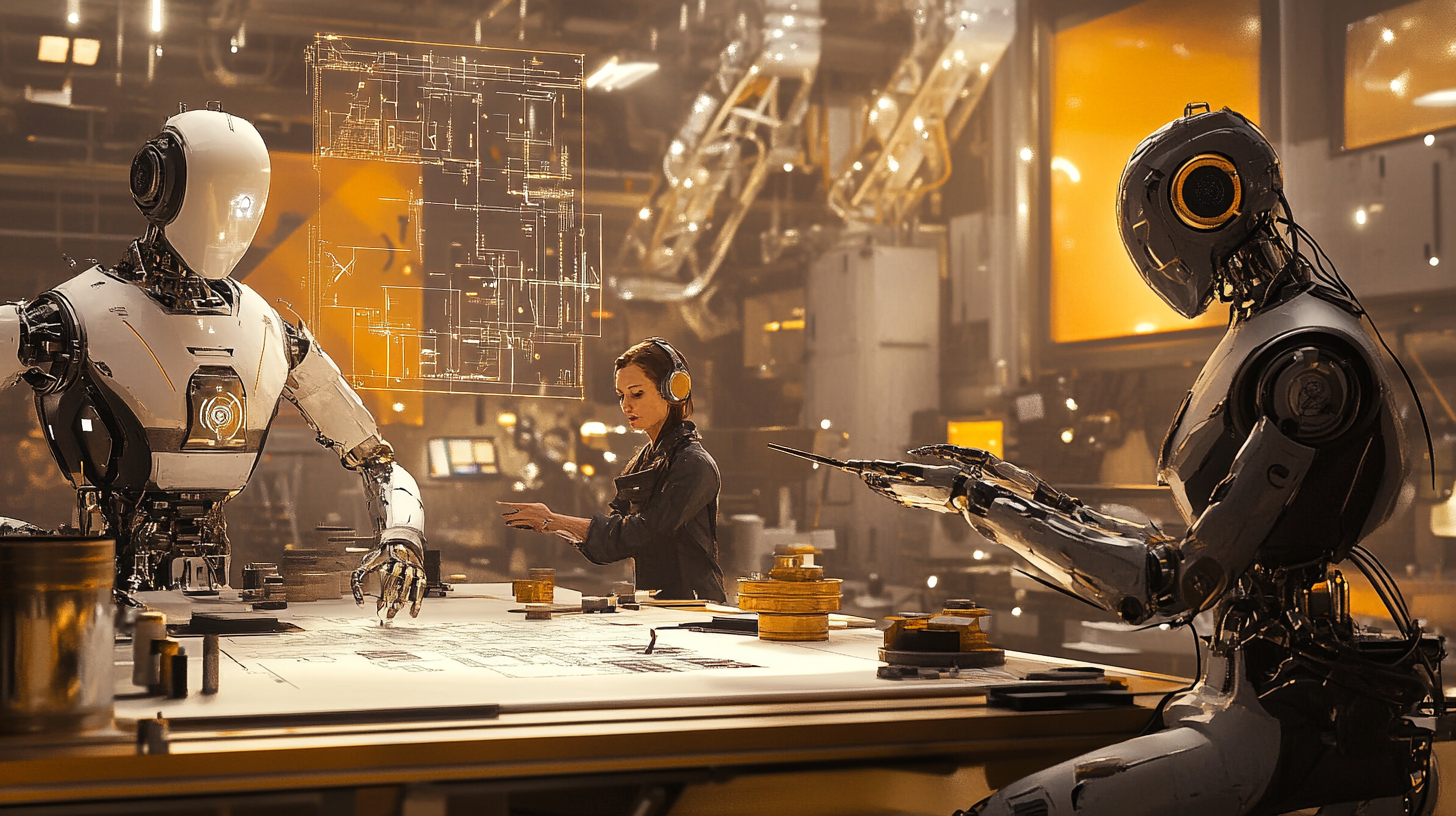
The future is interactive: cooperation instead of competition – the exciting development of IoT, AI and robotics – Image: Xpert.Digital
Synergy of Innovations: The Key Role of IoT, AI and Robotics in Industry
Between automation and efficiency: The power of tomorrow's technologies
The interplay of the Internet of Things (IoT), artificial intelligence (AI), and robotics is shaping the future of industry and many other areas of life. These technologies are not developing in isolation, but rather in a mutually reinforcing collaboration that creates new opportunities for efficiency, automation, and innovation. But what specific potentials and challenges arise from this exciting development?
IoT: The data foundation of the future
The Internet of Things forms the foundation of digital transformation. With the help of networked devices and sensors, data is collected in real time and made available for analysis. This data includes a wide range of information such as the condition, usage, temperature, and other parameters of machines and processes.
The role of IoT in modern industry
IoT enables unprecedented transparency and control. Companies can:
- Monitor operational processes in real time,
- Optimize energy consumption,
- Plan maintenance cycles proactively and
- Making processes more efficient through automated controls.
This not only creates potential savings, but also new opportunities for product development by directly incorporating customer wishes into the production process.
AI: The Intelligence Behind Automation
The data collected by IoT devices would be largely unused without AI. AI algorithms analyze these enormous amounts of data, recognize patterns, make predictions, and optimize processes. This interplay between IoT and AI is also known as **AIoT** (Artificial Intelligence of Things).
The most important functions of AI
- Data analysis: The AI recognizes patterns and correlations that would be invisible to humans.
- Predictions: Predictive analytics enables forecasts about maintenance needs, production bottlenecks, and demand trends.
- Automated decision-making: AI can make autonomous decisions based on real-time data.
- Continuous improvement: Learning algorithms dynamically adapt to new data and conditions.
Studies show that the integration of IoT and AI can enable efficiency gains of up to 30%, significantly increasing the competitive advantage of companies.
Robotics: The physical implementation of digital intelligence
Robotics translates insights from data analysis into physical actions. Collaborative robots, or cobots, play a particularly central role in this process. They work safely alongside humans and take over monotonous, dangerous, or complex tasks.
Advances in robotics
- Flexibility: Modern robots can adapt to changing environments and requirements.
- Autonomy: With the help of AI, robots can make independent decisions and perform complex tasks.
- Precision: In fields such as surgery, logistics, or microelectronics, robots deliver results that far exceed human capabilities.
- Cooperation: Cobots work seamlessly together with human colleagues and support them in daily tasks.
The synergy of IoT, AI and robotics
The combination of IoT, AI, and robotics enables entirely new applications. Some of the key trends are:
1. Autonomous Systems
AI-controlled robots are evolving into autonomous systems capable of handling complex tasks without human intervention. In logistics, for example, they optimize supply chains and reduce costs.
2. Predictive Maintenance
Predictive maintenance is achieved through the analysis of sensor data. Machines independently report their maintenance needs, thereby minimizing costly downtime.
3. Human-machine interaction
Human-machine interaction is becoming increasingly natural. Advances in AI enable robots to recognize and respond to human emotions and intentions. This improves collaboration in sensitive areas such as caregiving and education.
4. Natural Programming
Thanks to AI, programming robots is becoming increasingly intuitive. Instead of complex code, natural language or visual demonstrations are sufficient to prepare machines for new tasks.
5. New areas of application
Robotics is conquering new fields. In agriculture, healthcare, and rescue missions, robots offer innovative solutions that were previously unthinkable.
6. Miniaturization
Compact robots can penetrate areas inaccessible to larger machines. Examples range from endoscopy in medicine to the repair of pipelines in infrastructure.
7. Continuous learning
AIoT enables robots to exchange data and learn from each other across different locations. This collective learning process increases the efficiency of entire networks.
Despite the impressive progress, challenges still need to be overcome
- Skills shortage: The implementation of these technologies requires highly qualified personnel, who are currently lacking in many places.
- Data security: Networking increases the attack surface for cyberattacks, which requires robust security strategies.
- Ethical questions: The use of AI and robotics raises questions about responsibility, data protection and job losses.
At the same time, the development offers enormous opportunities:
- Companies can reduce costs and increase productivity.
- New jobs are being created in areas such as AI development and robotics maintenance.
- Societal challenges such as skills shortages or demographic change can be better addressed.
Cooperation as the key to the future
The convergence of IoT, AI, and robotics has the potential to fundamentally change the world. These technologies not only enable more efficient and flexible processes but also create space for innovation and new business models. However, for this development to remain sustainable and socially acceptable, security issues, ethical considerations, and the development of specialized expertise must be addressed concurrently.
The future is interactive – and it will be shaped not by competition, but by cooperation. The path there is challenging, but full of exciting opportunities.
Our recommendation: 🌍 Limitless reach 🔗 Connected 🌐 Multilingual 💪 Sales power: 💡 Authentic with strategy 🚀 Innovation meets 🧠 Intuition


From local to global: SMEs conquer the world market with a clever strategy - Image: Xpert.Digital
In an era where a company's digital presence determines its success, the challenge lies in creating an authentic, personalized, and far-reaching presence. Xpert.Digital offers an innovative solution that positions itself as the intersection of an industry hub, a blog, and a brand ambassador. It combines the advantages of communication and sales channels in a single platform and enables publication in 18 different languages. Cooperation with partner portals and the ability to publish articles on Google News and a press distribution list with approximately 8,000 journalists and readers maximize the reach and visibility of the content. This represents a crucial factor in external sales and marketing (SMarketing).
More information here:
Technology trio of the future: How the synergy of AI, IoT and robotics is changing our world
The way we live, work, and interact is fundamentally changing
The way we live, work, and interact is on the cusp of profound change. At the heart of this transformation lies the dynamic interplay of the Internet of Things (IoT), Artificial Intelligence (AI), and robotics. These three technological pillars are no longer isolated entities but are merging into a powerful ecosystem with the potential to reshape industries, simplify our daily lives, and unlock entirely new avenues for innovation. Instead of a competition between individual technologies, we are witnessing a fascinating collaboration in which each component contributes its specific strengths to achieve more together.
The Internet of Things (IoT): The nervous system of our networked world
The Internet of Things (IoT) forms the nervous system of this intelligent world. Imagine a vast, ever-expanding collection of physical objects—from tiny sensors in machines to complex industrial plants—all interconnected and constantly exchanging data. These devices continuously gather a flood of information about their condition, their environment, their usage, and countless other parameters in real time. Consider a manufacturing plant where numerous sensors monitor machine temperatures, measure conveyor belt speeds, and track material flow. Or a smart home where thermostats, lighting systems, and household appliances communicate with each other to optimize energy consumption and enhance comfort. The IoT thus creates a digital representation of the physical world, a foundation for profound insights and intelligent decision-making.
Artificial Intelligence: The Brain of Intelligent Systems
But simply collecting data isn't the key to transformation. This is where artificial intelligence comes in. AI acts as the brain of this intelligent ecosystem, analyzing and interpreting incoming data streams. By employing machine learning algorithms and deep learning technologies, it can identify patterns and anomalies in massive datasets that would be invisible to the human eye. It can predict future developments, such as a machine failure before it occurs, or the optimal time for maintenance. AI enables systems to make independent decisions and continuously optimize processes without constant human intervention. AI's ability to learn from experience and adapt to changing conditions makes it an invaluable tool for increasing efficiency and creating intelligent, responsive systems. In this way, mere data collection becomes a valuable foundation of knowledge.
Robotics: The muscles and limbs of our technological future
Robotics, finally, represents the muscles and limbs of this intelligent system. Robots, especially the increasingly advanced collaborative robots (cobots), put the insights gained through AI into practice. They are able to react flexibly to changes, perform complex tasks autonomously, and work safely alongside humans. Imagine a cobot on a production line, using AI-powered image recognition to sort out defective products or perform precise assembly work. Or consider autonomous mobile robots in a warehouse, efficiently picking and transporting goods based on real-time data and AI optimization algorithms. Robotics transcends the boundaries of the purely digital world, enabling intelligent decisions to be translated into physical actions.
Collaboration between IoT, AI and robotics: The power of synergy
The true strength of this technological triad lies in its synergy. The IoT provides the data, which AI analyzes and interprets, and robotics puts the resulting insights into action. This close integration leads to an exponential increase in performance and opens up entirely new fields of application. For example, by combining IoT sensors on wind turbines with AI-supported analysis, impending failures can be detected early (predictive maintenance). Robots can then autonomously carry out maintenance work before a costly shutdown occurs. In agriculture, IoT sensors enable the monitoring of soil moisture and nutrient content. AI algorithms analyze this data and autonomously control irrigation and fertilization systems, thereby conserving resources and maximizing yields.
Further development: Integration, innovation and new opportunities
The development of these technologies is progressing rapidly and promises even deeper integration in the future. Autonomous systems are becoming increasingly intelligent and capable of handling complex tasks in dynamic environments. AI-powered robots will increasingly act independently and make decisions that were previously reserved for humans. Human-machine interaction will become more intuitive and natural. Robots are learning to better understand human emotions and intentions, making collaboration even smoother and more efficient. Programming robots is being simplified by AI-driven interfaces, enabling even those without in-depth programming knowledge to operate and customize them.
Applications and uses: From industry to everyday life
The applications of combined technologies will continue to expand. Beyond traditional fields in production and logistics, intelligent systems are conquering new industries. In healthcare, AI-supported diagnostic systems assist physicians in the early detection of diseases, and robots assist in complex surgeries. In agriculture, autonomous drones help monitor fields and apply pesticides in a targeted manner. Even the service sector is seeing the rise of robots, for example, as service robots in hotels and restaurants or as assistance systems in elderly care. The miniaturization of robots enables their use in previously inaccessible areas, such as for inspections in narrow pipes or for minimally invasive medical procedures.
AIoT and continuous learning: A self-improving future
One particularly exciting trend is continuous learning through AIoT. By aggregating and analyzing data from a multitude of machines and locations, algorithms can make increasingly accurate predictions and optimize processes. A fault that occurs on one machine in one factory can help prevent similar problems on other machines in other factories. This collective learning leads to a continuous improvement in overall system intelligence.
Cooperation and societal changes
The collaboration between IoT, AI, and robotics extends far beyond the purely technical level. It also reflects a fundamental shift in mindset—towards a greater emphasis on collaboration rather than pure competition. Interdisciplinary teams of engineers, computer scientists, data scientists, and subject matter experts work closely together in the development of these technologies. The networking of devices and systems requires open standards and interfaces that enable seamless communication. Sharing data and algorithms can lead to faster innovation and better results.
The impact on the labor market is a crucial aspect of this development. While robots are taking over some repetitive and dangerous tasks, new jobs are simultaneously emerging in the development, maintenance, and operation of intelligent systems. Investing in the training and further education of skilled workers will be essential to prepare people for the changing demands of the labor market. The ability to collaborate with intelligent machines and utilize their potential will become a key qualification for the future.
Data protection and ethics as key topics
Besides its undeniable advantages, the convergence of IoT, AI, and robotics also presents challenges. Data security is of paramount importance, as ever-increasing amounts of sensitive data are collected and processed. Robust security measures must be implemented to prevent misuse and unauthorized access. Ethical questions are also playing an increasingly significant role. How do we ensure that AI systems operate fairly and impartially? How do we address the potential societal impacts of automation? These questions require broad public discourse and the development of clear ethical guidelines.
Interactive intelligence and networking
The future is undoubtedly interactive. The collaboration of IoT, AI, and robotics is not just a technological trend, but a fundamental transformation that will sustainably shape our world. By responsibly harnessing the potential of these technologies and actively addressing the challenges, we can create a future where innovation, efficiency, and humanity go hand in hand. The era of isolated progress is over; the age of intelligent networking has begun.
We are here for you - Consulting - Planning - Implementation - Project Management
☑️ SME support in strategy, consulting, planning and implementation
☑️ Creation or realignment of the digital strategy and digitization
☑️ Expansion and optimization of international sales processes
☑️ Global & Digital B2B trading platforms
☑️ Pioneer Business Development

Konrad Wolfenstein
I would be happy to serve as your personal advisor.
You can contact me by filling out the contact form below or simply call me on +49 7348 4088 965 .
I'm looking forward to our joint project.
Write to me


Xpert.Digital - Konrad Wolfenstein
Xpert.Digital is a hub for industry focusing on digitalization, mechanical engineering, logistics/intralogistics and photovoltaics.
With our 360° Business Development solution, we support renowned companies from new business to after-sales.
Market intelligence, smarketing, marketing automation, content development, PR, mail campaigns, personalized social media and lead nurturing are part of our digital tools.
You can find more information at: www.xpert.digital - www.xpert.solar - www.xpert.plus
Keep in touch