
From chatbot to digital employee: Google is reaching for the control center of corporate work – creative image on the topic, with AI: Xpert.Digital
Cost control and efficiency: How Google is changing the business landscape with Gemini
Agent logic and business processes: What Google's new AI means for SMEs
The new era of AI agents: What role does trust play in digital transformation?
In the rapidly changing world of digital technologies, Google is taking a fundamentally strategic step with its new AI system, Gemini. Instead of merely acting as a language model, Gemini aims to function as an independent digital employee that not only processes information but also actively makes decisions and takes on complex tasks within companies. This development marks a paradigm shift in the use of artificial intelligence: the technology is no longer viewed simply as an occasional productivity tool, but as an integral part of business processes that can automate and optimize a multitude of operations.
With its ability to manage complex projects over extended periods, aggregate information from various applications, and make autonomous decisions, Gemini is becoming a crucial player in the modern business landscape. This transformation could not only revolutionize how companies manage their operations but also elevate the economic significance of AI to a new level. In this context, it is essential to recognize the challenges and opportunities associated with the adoption of such agent-based systems. Companies must prepare for how to integrate these technologies, what responsibilities they bear, and how to maximize benefits while remaining mindful of risks.
Whoever controls AI agents will in future control costs, processes – and a growing share of the value creation
With the expansion of Gemini, Google is taking a strategic step that goes far beyond simply being the next generation of AI assistant. The focus is no longer on whether a language model can formulate convincing answers, but rather on whether a digital system can independently understand goals, plan work steps, select tools, distribute subtasks, and deliver a usable result within existing enterprise systems. The aim is to transform a mere dialog window into an operational actor. This shift fundamentally alters the economic significance of artificial intelligence: AI is evolving from a selectively used productivity tool to an execution layer for business processes.
Gemini is designed to handle complex projects lasting hours or even days, merging information from diverse applications, writing code, coordinating plans, and collaborating with specialized sub-agents. The system is given its own digital identity, can be accessed via email, group communication, or direct assignments, and leaves traceable activity trails. The crucial innovation, therefore, lies not merely in a more powerful model. It lies in the integration of models, data, permissions, applications, cost control, and governance into a central platform. From an economic perspective, Google is attempting to reduce the coordination costs of knowledge-intensive work while simultaneously controlling the technical infrastructure on which this work will increasingly take place.
The real leap lies in the execution
Previous generative AI primarily increased the speed of individual tasks. It summarized texts, created drafts, translated content, or suggested program code. However, humans remained the central point of contact: they formulated each request, transferred results between applications, checked intermediate steps, and then initiated the next step. The productivity gains were real, but often locally limited. One employee worked faster, while the process as a whole remained largely unchanged.
Agent-based systems take a different approach. The user defines a goal, rather than necessarily every single step. An agent can then develop a work plan, select appropriate data sources, parallelize subtasks, deploy additional agents as needed, and store the result in the relevant business applications. This shifts the focus from accelerating human input to partially automating entire workflows. This is precisely where the greater economic potential lies, because not only is processing time reduced, but also handoffs, waiting times, queries, and coordination efforts.
The difference is comparable to the transformation from a search engine to an executing service provider. A search engine provides information, while the user does the actual work. An agent is meant not only to find information but also to derive actions from it and implement them within defined boundaries. This increases the system's usefulness but simultaneously increases its responsibility. Every additional action option unlocks productivity potential while also creating new risks of errors, security breaches, and liability.
One billion users as a strategic starting advantage
With over one billion monthly active users, Gemini boasts a reach that few digital platforms have ever achieved. Added to this is its strong presence in the enterprise market: nearly 90 percent of Fortune 100 companies use Gemini Enterprise. These figures are not only economically relevant as indicators of popularity. They demonstrate that Google is not introducing the new agent logic from a niche position, but can build upon an existing user base, a global cloud infrastructure, and established business relationships.
The advantage of a large user base lies in lower distribution costs. Companies don't have to teach their employees a completely unfamiliar user interface if Gemini is already known from other contexts. At the same time, Google can integrate agent-based functionality into existing contracts, cloud environments, and workplace solutions. This lowers the barrier from pilot project to widespread adoption. For enterprise software, the deciding factor is often not the theoretically best individual product, but rather the solution with the least organizational friction, the most readily available interfaces, and the most credible scalability.
However, reach should not be equated with economic success. One billion monthly users says little about how intensively the application is used, what tasks it performs, and whether companies are achieving measurable improvements in their bottom line. Similarly, use by large corporations does not automatically mean that Gemini is already autonomously executing business-critical processes for them. There are significant differences between an available service, a limited test, and deep operational integration. Google's starting position is strong, but proof of sustainable value creation must be demonstrated in concrete processes.
The platform will become more important than the individual model
For a long time, the AI competition was primarily driven by model performance. Larger context windows, better test results, multimodal capabilities, and lower error rates shaped public perception. However, for companies, the decision criterion is shifting. A high-performing model alone is insufficient if it cannot securely access company data, respect permissions, operate programs, and document its actions. Therefore, the economic value increasingly lies in orchestration. This refers to the ability to bring together the appropriate model, the right data, the necessary tools, and a controlled execution path for a given task. Those who master this level become the intermediary between human task and digital value creation.
Google's multi-model approach addresses this development. In addition to its own Gemini models, third-party models such as Anthropic's Claude can also be used; private and open-source models are intended to complement the offering. This allows Google to separate the visible agent from the underlying model. This separation is strategically important because companies don't need the most expensive and powerful model for every task. Complex planning can be handled by a top-tier model, while simpler subtasks can be distributed among more cost-effective models. The platform thus optimizes not only quality, but also speed and cost.
From the customer's perspective, such an architecture reduces dependence on a single model. From Google's perspective, however, it strengthens the bond with the platform. Even if a company can use different models, identity management, data connections, monitoring, cost control, and agent registries may remain within Google's infrastructure. The classic lock-in thus shifts from the model to the orchestration layer. Paradoxically, interchangeability at the model layer can create a stronger dependence on the platform that organizes this interchangeability.
Interfaces become the economic nervous system
Connectivity to Google Workspace, Microsoft 365, Slack, Jira, Confluence, ServiceNow, Snowflake, BigQuery, Databricks, PostgreSQL, and other systems is not merely a convenient add-on. It determines whether an agent can actually work. Company knowledge is rarely located in a single place. It is distributed across emails, documents, ticketing systems, databases, project platforms, customer management systems, and individual files. An agent without access to these sources remains an intelligent observer. Only through interfaces does it become an active participant in the process.
The Model Context Protocol and other open connectivity standards aim to simplify access to internal and external tools. Theoretically, this reduces integration costs because a separate connection doesn't need to be developed for every combination of model and application. The economic benefits are similar to standardized containers in logistics: it's not the goods being transported that are standardized, but rather the interface through which very different goods can be moved efficiently. A common tool standard could have a comparable scaling effect for AI agents.
However, the attack surface grows with the number of connections. An agent that is only allowed to read data poses different risks than a system that can modify data records, send messages, trigger orders, or adjust access rights. Chained permissions are particularly critical: Several individually limited tools can, when combined, enable far-reaching actions. Therefore, technical integration only becomes a competitive advantage when it is coupled with precise rights management, clear responsibilities, and ongoing behavior monitoring.
Productivity doesn't come from simply sitting on top of things
The temptation is great to deploy an agent on existing processes and expect immediate, significant savings. In practice, however, this approach often limits the benefits. Many business processes have evolved organically over time, containing duplicate checks, media breaks, and informal exceptions. If a company automates a flawed process, it initially ends up with primarily a faster, flawed process. The greater economic impact only materializes when the process is redesigned and the workload is meaningfully distributed between humans, rule-based software, generative AI, and autonomous agents.
For standardized, frequently recurring tasks, traditional automation often remains more cost-effective and reliable. An agent is particularly useful where multiple steps need to be coordinated, unstructured information processed, and changing situations assessed. For simple data entry, a fixed set of rules can be superior. However, when analyzing a complex customer case that combines information from contracts, emails, delivery data, and internal guidelines, an agent can demonstrate its strengths. The economically sound solution is not to deploy agents everywhere, but rather to choose the appropriate form of automation for each process.
Measurable productivity must encompass more than just saved working minutes. Relevant factors include throughput time, error rate, rework costs, service quality, revenue impact, capital commitment, and risk costs. If an agent completes a task twice as fast but requires frequent checks or corrections, the net effect may be disappointing. Conversely, even a moderate time saving can be economically valuable if the system eliminates bottlenecks, is available 24/7, or stabilizes processing quality.
The invisible equation of autonomy
Autonomous systems generate new types of costs. In addition to model usage and cloud infrastructure, expenses arise for data preparation, interfaces, testing, security audits, monitoring, training, and organizational adjustments. Furthermore, there is the effort required to monitor running agents. Employees must review results, investigate unusual occurrences, and intervene in case of errors. This so-called oversight effect can consume a significant portion of the expected productivity gains, especially if companies do not yet trust the system or if the processes are poorly defined.
Google's real-time spending limits and intelligent model routing address a significant part of this problem. With a chatbot, a query is usually short and its resource consumption relatively manageable. An autonomous agent, on the other hand, can trigger numerous model calls, launch sub-agents, and operate for extended periods. An imprecise goal setting or a loop can therefore lead to unexpectedly high costs. Budget limits per project, department, or agent are thus not merely a financial function, but an operational safety measure.
Optimal cost control does not follow the principle of performing every task as cheaply as possible. A model that is too weak can produce errors, trigger additional iterations, and ultimately be more expensive than a higher-quality model on the first attempt. Conversely, the continuous use of a top-tier model for routine tasks is economically inefficient. The crucial factor is the risk-adjusted price of a correct result. Platforms that consider quality, latency, model price, and the consequences of errors together can develop a greater competitive advantage than providers with the nominally most powerful single model.
Software budgets are becoming digital personnel costs
With their own accounts, email addresses, and assigned roles, agents are organizationally approaching the structure of a digital workforce. This is more than just marketing; it changes how costs are planned and responsibilities are distributed. Previously, software licenses were primarily calculated per user, computing power, or transaction. With autonomous agents, a hybrid model emerges: The system is software that consumes variable computing resources and simultaneously replaces or complements human labor.
For effective business management, a new cost accounting system is therefore necessary. An agent should not only be evaluated based on technical metrics, but also on its contribution to a process. Direct usage costs, integration and control efforts, avoided personnel costs, additional revenue, quality changes, and risks must be recorded. Without this allocation, a situation arises in which many departments use seemingly inexpensive agents, while the overall costs for models, interfaces, and monitoring grow unnoticed.
At the same time, variable digital capacity opens up new business opportunities. Companies can handle peak loads without immediately hiring permanent staff. For example, an agent can provide additional capacity for month-end closings, seasonal customer inquiries, or short-term analysis projects. This advantage is similar to the elasticity of cloud computing. Labor is partially shifting from a fixed to a variable cost. This increases flexibility but can also intensify the pressure to view human activity solely from a short-term cost perspective.
🎯🎯🎯 Data-driven B2B industry hub as a quasi-in-house solution

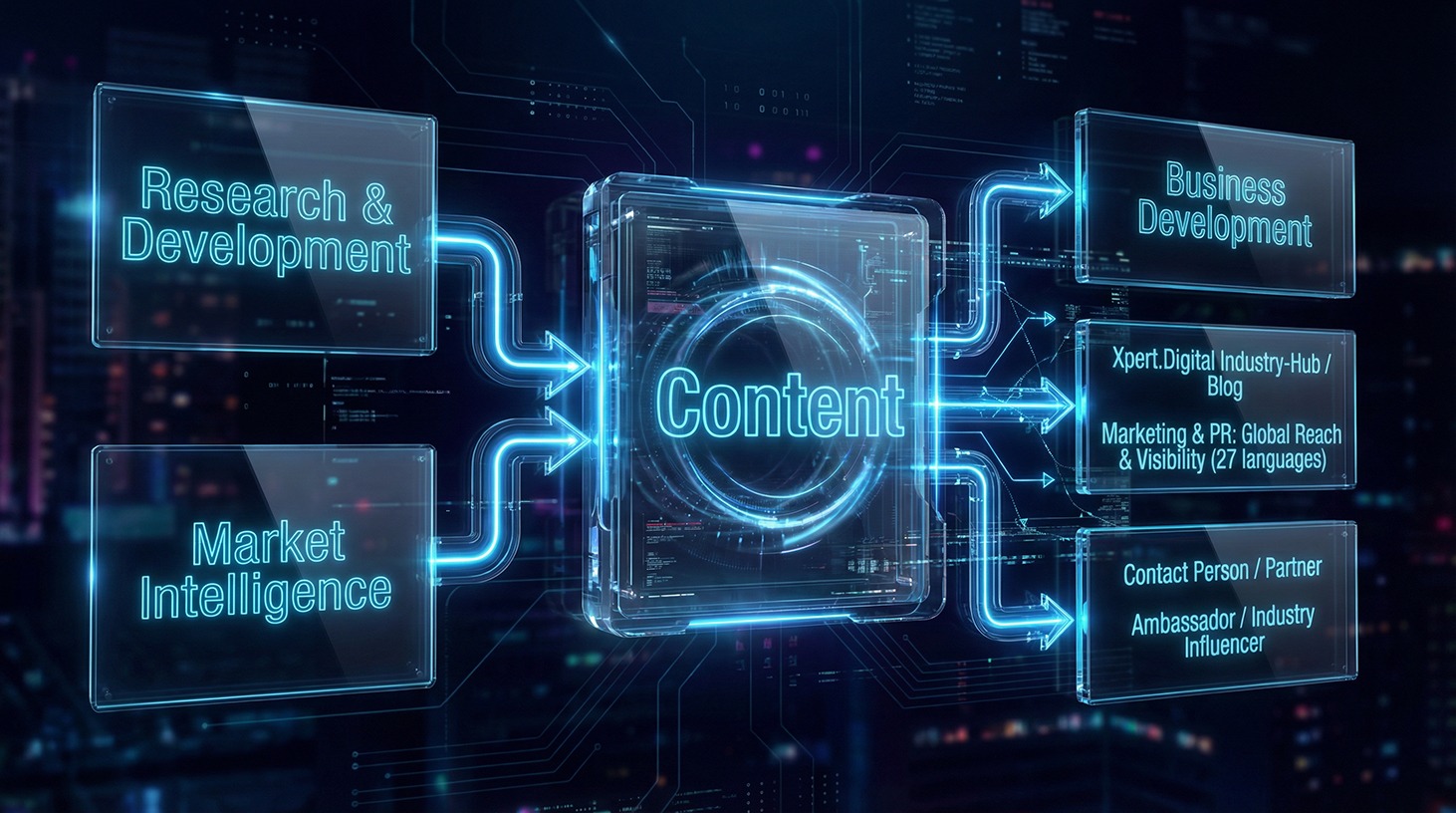
The quasi-in-house solution: How Xpert.Digital closes operational gaps in B2B marketing and sales – Smart Content-Driven Business - Image: Xpert.Digital
Xpert.Digital is a data-driven B2B industry hub led by Konrad Wolfenstein . The company acts as an external, quasi-in-house solution for industrial partners, closing operational gaps in marketing, content, and sales – without requiring additional resources on the client side.
More information here:
The future of work: How Google is introducing AI agents
Work doesn't disappear, but it gets re-edited
The immediate consequence of agent-based AI is likely to be less the complete abolition of entire professions than the redistribution of their tasks. Routine research, initial analyses, documentation, scheduling, data preparation, and standardized communication can increasingly be delegated. People can focus more on goal setting, evaluation, relationship building, negotiation, exceptional cases, and accountability. This shift can enhance the value of skilled work if employees are relieved of administrative burdens.
However, it can also lead to the erosion of entry-level roles. Many young professionals develop their judgment by initially gathering data, drafting proposals, and handling routine cases. If agents take over precisely these tasks, companies must create new learning pathways. Otherwise, they save costs in the short term but lose out on building their own expertise in the long run. A company that only needs experienced auditors must be able to explain where these experienced auditors will come from in the future.
Performance evaluation is also changing. When an employee manages multiple agents, their result no longer depends solely on their own processing speed. The quality of the tasks, the selection of appropriate tools, the control of critical points, and the ability to identify errors early become more important. Managers must therefore avoid interpreting sheer output volume as productivity. A thousand automatically generated documents represent no progress if only a small fraction are needed or if reviewing them takes more time than creating them.
Control must be part of the architecture
A central task overview, logging, and real-time monitoring are essential components because autonomous work without visibility is irresponsible. A task inbox can show which agents are active, where there are outstanding questions, which errors have occurred, and which processes have been completed. Audit trails assign actions to a digital identity. This makes it possible to trace retrospectively which agent triggered an action and on what basis.
Traceability alone, however, does not prevent damage. A perfect log can explain why an incorrect data record was deleted, but it does not automatically restore it. Therefore, companies need tiered access rights. Low-risk, reversible processes can largely run autonomously. Financial obligations, changes to access rights, sensitive personnel decisions, or irreversible data operations should require additional approvals. The appropriate threshold depends not only on the probability of an error, but also on its potential damage and its reversibility.
The principle of least privilege is therefore gaining importance. An agent should only have access to the data and functions it needs for its defined task. Time-limited rights can further reduce the risk. Equally important is clear ownership: For every agent used in production, a responsible person or function must be designated. A digital identity must not lead to a lack of organizational accountability.
Trust is a business variable
The economic benefit of an agent depends heavily on the level of trust placed in them. If trust is too low, employees scrutinize every step, and efficiency gains diminish. If trust is too high, errors are uncritically accepted and can spread across multiple systems. The challenge lies in calibrating trust based on the task, experience, and risk involved.
This trust is not built on general promises of quality, but on measurable performance in a specific process. Companies should continuously track success rates, correction costs, dropout rates, costs per completed process, and the types of errors. Equally important are tests under unusual conditions. An agent might function perfectly in typical scenarios but fail miserably in rare exceptions that cause particularly high damage.
Another risk factor is the persuasive language of modern AI. Fluent phrasing can mask uncertainty and convey a lack of reliability to users. This problem is exacerbated with agents because the output can not only be read but also directly translated into actions. Good governance must therefore not only detect technical errors but also consider human tendency towards automation. Employees need the freedom and the authority to disagree with the system.
Europe forces benefit and responsibility together
For European companies, the expansion of agent-based systems coincides with a period of stricter regulation. Since August 2026, key parts of European AI law have been in effect, including transparency obligations and enforcement powers. Depending on the area of application, additional requirements may apply, particularly when AI is used in sensitive areas such as employment, critical infrastructure, or other high-risk contexts. For companies, this means that technical scaling and regulatory classification cannot be treated separately.
A centralized platform architecture can facilitate compliance because identities, access rights, logs, and permissions are managed uniformly. However, this also creates a concentration risk. When numerous processes run on a single platform, a misconfiguration can have a significant impact. Furthermore, the user remains responsible for evaluating their specific use case. Adherence to general platform standards does not replace an analysis of one's own process, its data, and the consequences of automated decisions.
For German companies, co-determination, data protection, information security, and industry-specific regulations also come into play. Especially with personal data or employee information, the purpose, access, and storage must be clearly defined. Agentic AI should therefore not be launched as a purely IT project. Business units, data protection, information security, legal, employee representatives, and controlling must be involved early on. This coordination slows down the initial phase but increases the likelihood that a solution can actually be scaled later.
Google is attacking multiple markets at once
With Gemini Enterprise, Google is not only competing with OpenAI, Anthropic, and Meta for the quality of AI models. The company is also targeting markets for office software, cloud platforms, process automation, data integration, enterprise search, and IT service management. As soon as an agent coordinates tasks across multiple applications, power shifts from the individual application to the higher-level control layer. The application remains important, but the agent increasingly decides when and how it is used.
This puts traditional software vendors under pressure. If users no longer interact directly with every application, the user interface loses some of its strategic importance. Programming interfaces, data quality, and the ability to integrate into agent-based workflows become crucial. Vendors can respond with their own agents, enter into partnerships, or offer their services through marketplaces. The result is unlikely to be a market with just one agent, but rather an ecosystem of general-purpose control agents and specialized, expert agents.
OpenAI enjoys strong brand recognition and a broad developer base. Anthropic positions itself with powerful models and a strong security profile. Meta promotes open models and can thus increase price pressure. Google's particular strength lies in the combination of models, cloud computing, data platforms, workplace software, Android, and global infrastructure. This vertical integration could be crucial, especially in the enterprise market, provided customers perceive it as a simplification rather than an excessive dependency.
Transparency determines the negotiating power of customers
Supporting various models and open protocols initially appears customer-friendly. It allows companies to distribute tasks based on quality, cost, or data protection requirements. Such an architecture can accelerate innovation because new models can be integrated without redesigning the entire process logic. It also improves a company's negotiating position with individual model providers.
The crucial question, however, is whether this openness works in practice. Models must not only be selectable, but also offer comparable interfaces, verifiable performance data, and portable agent definitions. Protocols for identity, storage, tools, and agent communication must also be interoperable. If core functions remain proprietary, a theoretically open system can be difficult to leave in practice.
Companies should therefore plan for an exit strategy right from the start. This includes exportable protocols, documented interfaces, separate data storage, interchangeable models, and clear contractual rules for model changes. The lowest initial price is of little economic value if subsequent switching costs are very high. Strategic procurement must therefore consider total operating costs and dependencies over several years.
Medium-sized businesses gain access, but not automatically an advantage
For medium-sized businesses, a centrally managed agent platform can facilitate access to advanced AI. Developing their own models and complex infrastructures is expensive. Pre-built connectors, low development barriers, and standardized security features lower the entry price. This could enable a medium-sized company to automate processes that were previously economically unattractive for traditional custom software due to small sample sizes.
The bottleneck often lies not in the model's performance, but in data and processes. Inconsistent master data, poorly documented workflows, a lack of interfaces, and informal knowledge limit an agent's effectiveness. Large corporations tend to have specialized teams for data, security, and integration, but suffer from more complex structures. Medium-sized businesses can make decisions faster, but must strategically deploy their scarce skilled workforce.
A sensible approach begins with a clearly defined process, sufficient volume, and measurable benefits. Suitable examples include research and analysis processes, sales support, technical documentation, internal knowledge retrieval, or the preparation of standardized service cases. Processes with irreversible consequences, unclear data, or significant legal implications are less suitable at the outset. The pilot should not only demonstrate technical feasibility but also allow for a reliable comparison before and after implementation.
The business case needs tougher standards
A compelling business case distinguishes between gross and net impact. On the gross side are saved processing time, faster turnaround times, increased availability, additional capacity, and potential revenue growth. On the cost side are licenses, computing power, integration, data preparation, training, monitoring, troubleshooting, and compliance. Added to this is the value of the risk, i.e., the expected costs of potential errors or security incidents.
A process-oriented approach is suitable for evaluation. First, the current effort per process is recorded. Then, the actual workload handled by the agent, the frequency of human intervention, and the achieved quality are measured. It is crucial to compare the results per successfully completed process, rather than per model call. Only in this way can repetitions, cancellations, and rework become apparent.
Companies should also distinguish between capacity gains and realized savings. When employees save time, costs don't automatically decrease. Economic value only arises when the freed-up time is used more productively, additional business is handled, or an actual need for resources is avoided. This distinction explains why impressive time studies don't always translate into tangible results. Agentic AI can be highly productive, but its impact must be translated into decisions about processes, roles, and capacities.
Introduction as an organizational project
A robust implementation begins with a process map. Companies should identify areas with numerous manual handoffs, unstructured information, long waiting times, or recurring coordination problems. Tasks are then prioritized according to complexity, data availability, potential for damage from errors, and reversibility. This analysis prevents prioritizing technically attractive but economically insignificant use cases.
In the second step, every agent needs a clear mandate. This includes the objective, permitted data sources, allowed tools, budget, quality standards, escalation procedures, and responsible party. An agent without a clearly defined area of responsibility is like a new employee without a job description and without a supervisor. Technical flexibility should not be confused with organizational arbitrariness.
In the third step, autonomy is gradually increased. Initially, the agent can create drafts, then provide recommendations, and later execute selected actions. Further permissions should only be granted once performance and error patterns have been observed over a sufficient period. This approach slows down the process of achieving maximum automation but builds robust trust and limits the consequences of unexpected behavior.
Finally, ongoing operations require a form of digital personnel and asset management. Agents must be inventoried, updated, tested, and, if necessary, decommissioned. Changes to models or interfaces can affect their behavior. Therefore, versioning, regular testing, and documented change management are essential. Those who use agents as continuously learning and networked systems cannot treat them like software that has been installed once.
The bottleneck is shifting from knowledge to judgment
When agents can gather, summarize, and transform information into work products with virtually unlimited capacity, the mere acquisition of information becomes less scarce. More valuable become well-defined goals, robust criteria, and the ability to assess results within their context. Companies with clear processes and high-quality institutional knowledge are better able to manage agents than organizations whose decisions are largely based on unspoken assumptions.
This increases the importance of management quality. An agent cannot permanently resolve conflicting goals if the organization itself does not set priorities. It can optimize key performance indicators, but cannot decide which side effects are acceptable. The more efficient the system becomes, the more crucial the precision of corporate governance becomes. Poor goals are not improved through automation; they are simply pursued more quickly and consistently.
The provocative thesis is therefore: The biggest difference between successful and unsuccessful AI projects will not be the model itself, but the quality of the organization that uses it. Google can provide infrastructure, models, connections, and control tools. However, the economic value is only generated by the company that restructures processes, clarifies responsibilities, and transforms technical possibilities into a better way of working.
A power struggle over digital corporate governance
The expansion of Gemini marks a turning point because Google aims not only to support individual tasks but also to take over the coordination of digital work. If successful, the agent platform will become a strategic layer between employees and applications. It will decide which model operates, which data is fed in, which systems are addressed, and how costs are distributed. This position carries considerable economic weight.
For companies, this opens up realistic potential for shorter lead times, elastic capacity, and a new level of process automation. At the same time, dependencies, the need for control, and the consequences of technical errors increase. Therefore, a central task overview, individual agent identities, audit trails, spending limits, and multi-model routing are not secondary functions. They form the operating system of a digital workforce, whose benefits can only scale with effective governance.
With its reach, access to enterprise software, and cloud infrastructure, Google has an exceptional head start. Nevertheless, the competition is wide open. Companies will weigh performance, cost, security, interoperability, and regulatory resilience against each other. The winner won't necessarily have the best model. More likely, the platform that most reliably translates autonomous work into real-world processes without taking away customer control over data, costs, and responsibility will prevail.
The crucial economic perspective is therefore neither euphoric nor defensive. Agentic AI is not a virtual employee in the human sense, but it can become a productive, scalable, and increasingly autonomous operational capacity. Its value arises not from maximum autonomy, but from purposeful autonomy. Companies that clearly define this boundary can reap significant benefits. Companies that mistake autonomy for blind trust, on the other hand, automate not only work but also their own flawed decisions.
📈🚀 From visibility to trust 👀🤝 Your scalable path with Xpert.Digital

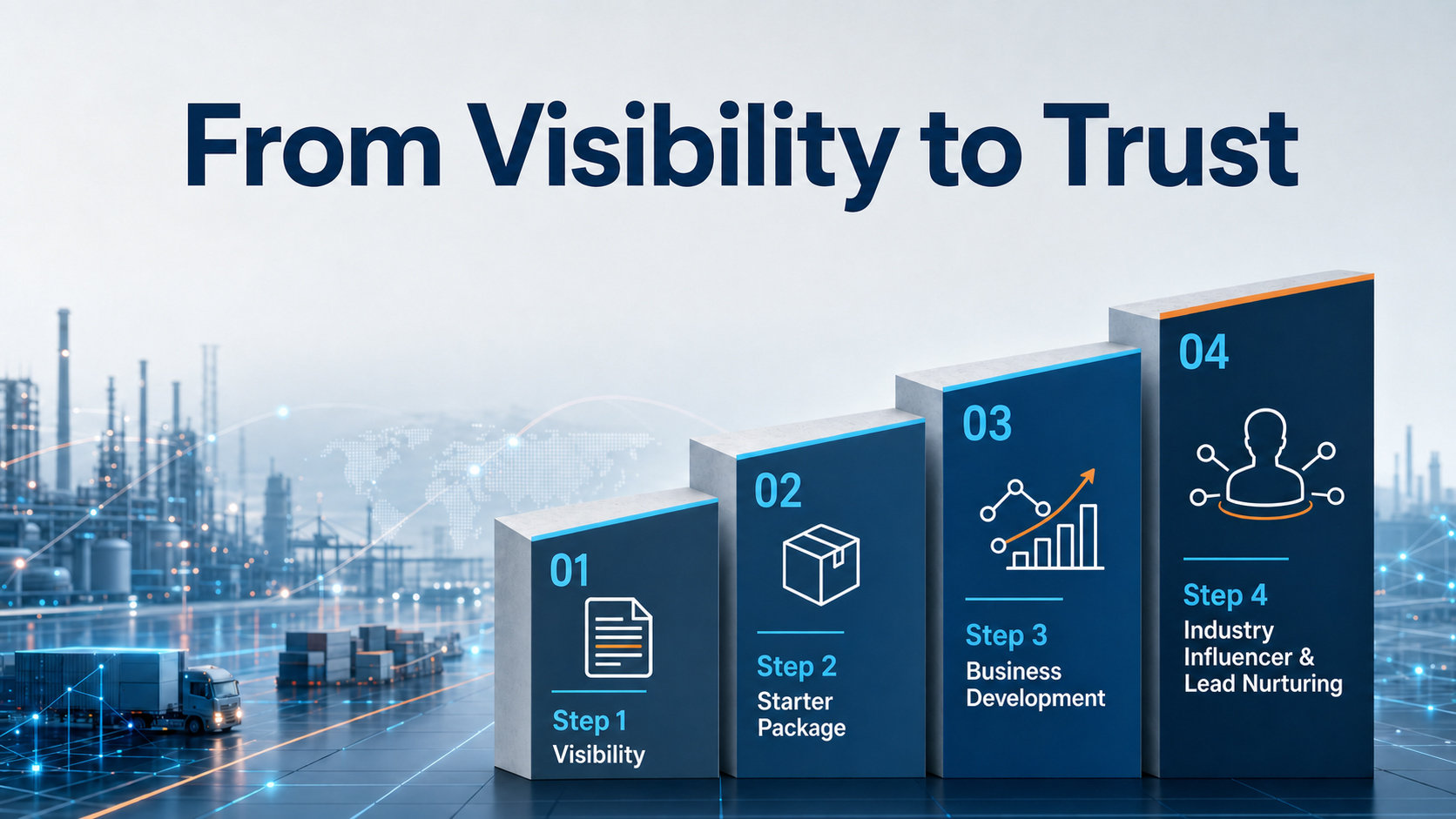
From visibility to trust: Your scalable path with Xpert.Digital - Image: Xpert.Digital
In industrial B2B, sustainable business relationships rarely emerge overnight. They develop step by step – through visibility, professional relevance, recurring touchpoints, and growing trust. Xpert.Digital's 4-stage model addresses precisely this: It offers a structured path that begins with a manageable entry point and can evolve into deeper collaboration in business development if needed.
Instead of relying on loud marketing promises, this model puts the relationship at the forefront. Companies start with clearly defined, easily calculable measures and then decide, based on their own experience, how far they want to expand the collaboration. A key factor for this undisturbed trust-building process: The platform completely avoids annoying advertising ads, so the editorial focus remains solely on the companies' expertise.
More information here:
Your global marketing and business development partner
☑️ Our business language is English or German
☑️ NEW: Correspondence in your native language!

Konrad Wolfenstein
I and my team are happy to be available to you as your personal advisor.
You can contact me by filling out the contact form here wolfenstein@xpert.digital:or simply call me at +49 7348 4088 965. My email address is
I'm looking forward to our joint project.