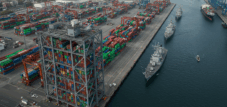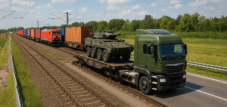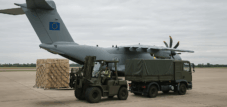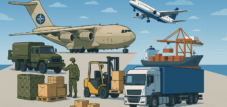
Container terminal systems for road, rail and sea transport in the dual-use logistics concept of heavy-lift logistics – Creative image: Xpert.Digital
Europe's Future: How we can make our supply chains resilient with dual-use strategies – The triple dividend of smart dual-use logistics
Dual-use container terminal systems as the backbone of civilian modernization and defense logistics in Europe
In a world marked by geopolitical upheavals, fragile supply chains, and a new awareness of the vulnerability of critical infrastructure, the concept of national security is undergoing a fundamental reassessment. A state's ability to guarantee its economic prosperity, the provision of goods to its population, and its military capability increasingly depends on the resilience of its logistics networks. In this context, the term "dual-use" is evolving from a niche export control category to a broader strategic doctrine. This shift is not merely a technical adaptation but a necessary response to the paradigm shift that demands a profound integration of civilian and military capabilities. This article analyzes how dual-use container terminal systems for road, rail, and sea form the core of this new strategic symbiosis. It demonstrates how targeted, defense-driven investments can accelerate the long-overdue modernization of civilian logistics infrastructure while simultaneously creating a high-performance, resilient logistics system for national and collective defense.
Redefining dual-use: From export control to national resilience doctrine
Traditionally, the term "dual-use" is closely linked to the complex field of export control. Dual-use goods are products, software, and technologies that can be used for both civilian and military purposes. This dual usability carries the risk of misuse, which is why trade in such goods is subject to strict international and national controls. The central legal basis in the European Union is the Dual-Use Regulation (EU) 2021/821, which controls the export, transfer, and technical assistance of such goods to prevent the proliferation of weapons of mass destruction and to ensure respect for human rights. For companies, dealing with listed goods involves considerable administrative effort, as exports to third countries generally require authorization from national authorities such as the Federal Office for Economic Affairs and Export Control (BAFA) in Germany.
However, today's security environment necessitates a strategic expansion of this concept. The focus is shifting from controlling individual, sensitive goods to the targeted use of entire systems—transport networks, terminals, digital platforms, and storage capacities—for both civilian and military purposes. This development is a direct consequence of the recognition that national resilience and military capabilities are inextricably linked to the functionality of civilian infrastructure. The term "Double Dual-Use Logistics" (Du-Logistics²) encapsulates this new paradigm: it refers to the dual integration of transport modes (rail/road) and user groups (civilian/military). Although a physical infrastructure such as a terminal or a bridge is generally not on export control lists, its ability to transport military forces and potentially controlled military or dual-use goods, as well as its overall importance for national and collective defense, gives it a strategic dual-use character.
This realignment of the dual-use concept is more than a semantic adjustment; it functions as a crucial political and fiscal catalyst. Germany faces two simultaneous, enormous challenges: a massive, decades-long backlog of investment in its national transport infrastructure and the urgent need to comprehensively modernize the Bundeswehr (German Armed Forces) following the proclaimed "turning point." The Bundeswehr's special fund of €100 billion is criticized for being spent without a coherent strategic direction. At the same time, infrastructure deficiencies, such as dilapidated bridges, are so severe that they directly impair military mobility and thus Germany's ability to fulfill its alliance obligations within NATO. Against this backdrop, the expanded dual-use concept becomes a powerful political instrument. It provides the strategic justification for directing defense funds specifically toward national infrastructure projects. This justifies expenditures not as narrowly defined "military" items, but as broader "national resilience projects." This approach aligns the interests of the Ministries of Defense, Transport, and Economic Affairs toward a common goal and counters criticisms of incoherent spending by linking it to a tangible, nationally beneficial purpose. This makes the massive investments both more politically viable and strategically sound.
Germany as NATO's central logistics hub ("Hub Germany")
Germany's geostrategic location in the heart of Europe, bordering nine neighboring countries, makes it an indispensable logistical hub for NATO. This role includes providing comprehensive Host Nation Support (HNS) for allied forces moving through the country. NATO's New Force Model envisions the capability to move massive troop contingents—potentially up to 800,000 soldiers—and their heavy equipment across Europe at short notice, placing an immense strain on German infrastructure. The establishment of NATO's Joint Support and Enabling Command (JSEC) in Ulm, tasked with coordinating and securing military movements across the continent, further cements this central role for Germany.
Germany's role as a "hub" means that the state of its infrastructure is no longer a purely national matter; it is a cornerstone of NATO's collective defense and deterrence capabilities. The ability to rapidly deploy forces to the eastern flank is a crucial element of credible deterrence. Any failure in German logistics has far-reaching consequences for the entire alliance. Exercises like "Brave Schweppermann" vividly demonstrate the practical dependence on civilian infrastructure and local support networks to fulfill this mission.
This mission necessitates a paradigm shift from expeditionary to territorial logistics. For decades, the Bundeswehr's logistics were optimized for smaller, remote deployments abroad, such as in Afghanistan. This paradigm shift now requires a fundamental realignment towards large-scale national and collective defense. This change renders previous logistical assumptions obsolete. Instead of relocating a few thousand soldiers over months, the requirement is now to move hundreds of thousands within days or weeks. This demands a completely different logistical scale and philosophy: away from customized, self-sufficient systems and towards the mass mobilization and integration of national civilian capacities. For this reason, partnerships with companies like Deutsche Bahn are no longer optional, but mission-critical. The entire national transportation system is becoming an integral component of the defense architecture.
The economic and ecological dividend of a dual-use strategy
A key argument for dual-use infrastructure is the ability to share high fixed costs between civilian and military users. This leads to significant cost savings compared to operating parallel, redundant systems. Modernizing combined transport (CT) rail networks and terminals to meet the requirements for transporting heavy military equipment (e.g., military load class MLC 80 for tanks) directly benefits civilian heavy goods traffic. Shifting freight from road to this upgraded rail network can reduce CO2 emissions on long-distance routes by up to 80% and is five times more energy-efficient.
This creates a compelling "win-win-win" narrative. The military receives the robust infrastructure it needs. The economy benefits from more efficient, cost-effective, and reliable supply chains, boosting competitiveness. Society benefits from reduced traffic congestion, less noise pollution, and a significant contribution to national climate goals. This triple dividend is crucial for securing the broad political and public support required for these large-scale, long-term investments.
Furthermore, the dual-use strategy acts as a mechanism for minimizing the risks associated with the green transport transition. The shift to more environmentally friendly, rail-based freight transport faces significant financial and political hurdles, as the investments are massive and only pay off in the long term. The dual-use argument introduces a new, urgent justification: national security. By linking the "green" agenda (shifting freight to rail) with the "security agenda" (military mobility), projects gain a second, more immediate legitimacy. This allows policymakers to access various funding sources (e.g., from defense, climate, transport, and EU funds) and build a broader coalition of support. The security imperative thus effectively reduces the political and financial risk associated with the green transition and accelerates projects that would otherwise stagnate due to costs or a lack of immediate commercial viability.
Modernization of civilian logistics through defense policy integration
The strategic realignment towards dual-use logistics is not merely a theoretical construct, but a pragmatic mechanism that generates concrete and measurable benefits for the civilian economy. By leveraging military requirements and funding as a driving force for the modernization of national infrastructure, a positive feedback loop is created: the investments necessary for defense capabilities directly lead to increased efficiency, resilience, and technological advancement in the civilian logistics sector. This section of the article examines the specific ways in which this symbiosis is being realized – from overcoming the investment backlog and transferring technological knowledge to establishing new, innovative partnership models.
Investment as a catalyst: Overcoming the “investment backlog”
Germany suffers from a chronic investment backlog, particularly affecting its transport infrastructure. Rail networks, bridges, and waterways are in dire need of modernization, which restricts the country's economic performance and now also its military mobility. A special requirement of €30 billion has been estimated for militarily relevant transport routes alone. Economic stimulus packages from the federal government are also being identified as a potential source of funding to accelerate the modernization of the Bundeswehr's fleet, which in turn has spillover effects on civilian logistics.
The demands of military mobility provide an effective lever for prioritizing and funding urgently needed infrastructure projects. The necessity of transporting heavy combat vehicles necessitates the upgrading of bridges and railway lines to higher load classes, such as UIC-D4. This directly benefits civilian logistics companies, as they can subsequently transport heavier or oversized goods more efficiently. Furthermore, the military's focus on creating resilient and redundant routes increases the overall robustness of civilian supply chains against disruptions of all kinds.
This development is leading to the establishment of a "resilience premium" in the evaluation of infrastructure projects. Traditionally, such projects were primarily assessed based on economic indicators such as return on investment (ROI) or traffic volume. The dual-use concept introduces a new, non-financial metric: the "resilience value" or "security contribution." A project that, for example, creates a redundant east-west rail corridor may have a lower purely economic ROI than another north-south connection. However, its value for national and alliance security is immense. This necessitates a fundamental change in how projects are evaluated and selected. Such a "resilience premium" can justify projects that would be rejected based on purely economic criteria. This requires the development of new, cross-departmental evaluation frameworks that can quantify and weight this security contribution, fundamentally transforming national infrastructure planning.
Technological spillover (transfer effect) from "Logistics 4.0"
Both military and civilian logistics are currently undergoing a profound transformation, summarized under the term "Logistics 4.0." This change is driven by technologies such as artificial intelligence (AI) for predictive analytics and route optimization, the Internet of Things (IoT) for real-time tracking, digital twins for simulations, and additive manufacturing (3D printing) for the decentralized production of spare parts. The modernization of the Swiss Army's ERP system to SAP S/4HANA is a prime example of the effort to unify and standardize logistics processes to increase efficiency, even though ensuring self-sufficient operation in a crisis presents a particular challenge.
Although the civilian sector is a leader in many areas of logistics innovation, the specific requirements of the military—particularly regarding security, redundancy, and operational capability in combat environments (e.g., during GPS failures)—drive development in certain niche areas. Military needs are pushing the development of robust, secure data platforms and edge computing solutions to ensure functionality even with limited network connectivity. Once developed and field-tested, these hardened technologies and processes can be adopted by civilian actors who also have higher demands for the security and resilience of their supply chains, for example, when transporting high-value or sensitive goods.
Military requirements are thus accelerating the shift from a purely efficiency-oriented to a resilience-oriented approach in civilian technology adoption. Civilian logistics has historically optimized for just-in-time efficiency, often at the expense of resilience. In contrast, the primary drivers of military logistics are mission safety, protection, and operational capability under the most adverse conditions. By integrating civilian technologies, the military demands higher standards of security and robustness, such as the cybersecurity of IoT devices or the redundancy of cloud systems. This military demand is creating a market for more resilient versions of commercial technologies. As global supply chains become increasingly fragile due to pandemics, geopolitical conflicts, and other crises, the civilian sector is also recognizing the growing need for greater resilience. The technologies and standards being developed to meet military dual-use requirements are therefore perfectly positioned to serve this new civilian demand. This is accelerating the overall market shift from pure efficiency to a balanced approach that considers both efficiency and resilience.
The formation of public-private military partnerships (PMPs)
The German Armed Forces Logistics Command has launched an innovative initiative, "Future-Oriented Cooperation in Logistics," to systematically establish partnerships with the private sector. These collaborations encompass four key areas: material management/storage, logistical support for troop deployments, maintenance/manufacturing, and cooperative personnel models. This includes long-term framework agreements with companies for services such as ammunition storage, the operation of convoy rest areas, and even "shoulder-to-shoulder" maintenance at German Armed Forces facilities. Cooperation with the transport sector is essential but faces challenges such as differing objectives, driver shortages, and the contractual allocation of risk.
These public-private military partnerships (PPMPs) represent a fundamental shift in the procurement of logistics capabilities by the German Armed Forces. They mark the transition from simple, transactional procurement processes to deep, long-term integration. For civilian companies, this offers predictable, long-term revenue streams and the opportunity to invest with greater certainty in specialized equipment and personnel training. For the German Armed Forces, it means access to the enormous capacity, flexibility, and innovative strength of the commercial sector, which it could never replicate on its own.
Such partnerships act as a catalyst for a national ecosystem of capabilities and standards. Effective PPMPs require more than just contracts; they require a shared understanding of processes, standards, and qualifications. Civilian drivers must be trained in military convoy procedures and communication systems, while military logisticians need to understand commercial operations. This necessitates the joint development of training curricula and certifications. The requirement for equipment to be "identical" to military vehicles, such as trailers, to enable interoperability with military tractors, effectively creates an industry standard. Over time, this collaborative effort will create a national ecosystem of logistics professionals and equipment that is inherently dual-use. This forms a strategic reserve of capabilities and resources that is far more valuable and flexible than any purely military reserve and strengthens national resilience as a whole. Cooperative personnel models, such as the one with the DHL Group, formalize this exchange of talent and create a seamless transition between military service and civilian careers.
Consulting - Planning - Implementation

Markus Becker
I would be happy to serve as your personal advisor.
Head of Business Development
Dual-use container terminals: Key to sustainable logistics transformation
Analysis of dual-use container terminal systems
The heart of dual-use logistics lies in the terminals – those critical infrastructure hubs where road, rail, and sea transport converge and where the efficiency of the entire supply chain is determined. Their modernization and alignment for dual use are crucial for realizing the strategic symbiosis of civilian competitiveness and military readiness. This section of the article analyzes the specific requirements, technological potential, and operational challenges of intermodal transport terminals, maritime seaport terminals, and the pioneering technologies that will define their performance.
The intermodal hub: Combined transport (CT) terminals
Intermodal terminals are crucial transshipment points for transferring standardized loading units such as containers and swap bodies between road and rail. To achieve effective dual-use capability, they must be upgraded to handle heavy military equipment. This includes reinforcing parking areas and crane systems for higher military load classes (MLC) and installing roll-on/roll-off (Ro-Ro) ramps that allow tanks and armored vehicles to drive directly onto trains. However, many existing terminals in Germany are already operating at capacity, and the German rail network suffers from a significant backlog of investment and outdated signaling technology.
The modernization of intermodal terminals is a prime example of dual-use synergy. A terminal upgraded for military purposes—offering higher capacities, faster turnaround times, and heavy-load capabilities—simultaneously becomes significantly more efficient for civilian freight transport. This makes rail a more attractive option for commercial logistics and supports the desired modal shift. The operational challenge lies in implementing this dual-use approach: clear prioritization mechanisms must be established to ensure that military transport can be given priority in a crisis without unduly disadvantaging civilian users during peacetime.
Digitizing terminals is key to solving this "prioritization dilemma." The core conflict in a dual-use terminal is the allocation of scarce resources: Who gets crane capacity, track access, or storage space? In a manual, analog system, this leads to a zero-sum game, causing delays and friction between civilian and military users. A fully digitized terminal, operating with a digital twin and AI-powered time slot management, can dynamically manage this complexity. Such a system can simulate the impact of a prioritized military convoy in real time and automatically reroute and reschedule civilian containers to minimize disruptions. It can identify latent capacities and optimize traffic flows for both user groups simultaneously. Investments in digitization, for example in a "smart logistics backbone," therefore not only increase efficiency; they are the fundamental key technology that makes the operational concept of shared use and dynamic prioritization feasible in the first place.
The maritime gateway to the world: Seaport terminals (Hamburg, Bremerhaven, Rostock, Wilhelmshaven)
German seaports are critical hubs for both the national economy and as deployment and transshipment points for NATO. The port of Rostock is explicitly designated as a central logistics hub for NATO and the German Armed Forces. Bremerhaven and Hamburg are highlighted for their high rail freight volumes and their dual-use capabilities in supporting military mobility. Wilhelmshaven is an important energy hub (LNG) and naval base. However, all German ports suffer from a significant investment deficit, particularly regarding dilapidated quay walls and hinterland connections, which jeopardizes their competitiveness and their ability to fulfill their HNS (High-Speed Network) tasks.
The dual-use argument is being used to justify a proposed €15 billion investment in port modernization, which could potentially be financed from defense budgets. The logic is that the investments required for military mobility – robust quays, heavy-duty storage areas, efficient rail links – are the same investments needed to increase commercial competitiveness against rivals like Rotterdam and Antwerp.
At the same time, foreign investment in terminals creates a dual-use security dilemma. German ports like Hamburg have sought foreign investment, such as COSCO's stake in the Tollerort container terminal, to remain competitive. However, this entails a significant security risk. A terminal with foreign participation, particularly by a state-owned enterprise from a systemic rival like China, poses risks to its use as a secure military logistics hub. The danger does not necessarily lie in an outright denial of military use, but rather in more subtle threats: the potential for espionage, data extraction from terminal operating systems, and strategic interference with a critical national asset. This necessitates a difficult political compromise between economic competitiveness, which requires investment, and national security, which demands oversight. It demonstrates that a comprehensive dual-use strategy must not only address physical infrastructure but also include robust procedures for vetting foreign investment and binding cybersecurity mandates for all operators of critical terminals.
The technological front: Automated high-bay warehouse systems (AHRS) and digital twins
Conventional container terminals are inefficient, require a lot of space, and necessitate unproductive container restacking. Automated high-bay racking systems (AHRS) or high-bay warehouses (HRL) offer a revolutionary alternative by storing containers vertically in a dense, automated racking system. This can triple storage capacity on the same footprint and, crucially, allows direct, predictable access to each individual container without having to move others. This technology is a core component of the proposed modernization of German seaports.
The decisive advantage of AHRS for dual-use applications lies in its predictability and speed. In a commercial context, this enables highly efficient just-in-time logistics. In a military context, it is transformative. The ability to access a specific container of critical military equipment within a precisely defined, short timeframe, regardless of its position in the stack, is a massive operational advantage over a conventional warehouse where it could be buried under hundreds of other containers. This technology, combined with a digital twin of the port, enables the precise, rapid, and scalable handling of military and civilian cargo flows.
AHRS technology fundamentally changes the nature of strategic reserves. Traditionally, military logistics relies on dedicated, separate depots for strategic stockpiles of munitions and materiel. This is costly, inefficient, and creates large, static, and vulnerable targets. AHRS technology makes it possible to integrate strategic military reserves directly into the commercial logistics flow. A certain number of containers of military goods could be stored within a large civilian AHRS terminal. Because each container is individually and quickly accessible, these military containers can be retrieved when needed without disrupting commercial operations. This concept of "distributed, integrated reserves" is far more resilient (no single, large target), more efficient (utilizing existing infrastructure), and more secure (military goods are "hidden" within a massive civilian system). It represents a complete paradigm shift in strategic stockpiling, made possible directly by the new terminal technology.
Case study: The REGIOLOG SOUTH blueprint
REGIOLOG SÜD is a pilot project for a modular, automated dual-use logistics warehouse with direct road and rail connections in southern Baden. In peacetime operation, it serves civilian purposes such as e-commerce processing and supplying rural areas. In a crisis or national emergency, it can be converted into a military depot for storing and distributing supplies. The project is designed as a blueprint for a future network of such regional dual-use centers ("ZivLog-D").
REGIOLOG SÜD operationalizes the dual-use concept at the regional level. It demonstrates how a modular, scalable infrastructure can be built that is economically viable in peacetime while simultaneously providing critical capabilities for defense. Its key features—modularity, automation, and multimodal connectivity—represent a microcosm of the principles that must be applied to the larger national system. The project serves as a real-world laboratory to test the technical, operational, and financial models of dual-use logistics before a nationwide rollout.
This concept also addresses the "last mile" problem of national resilience. Large-scale logistics often concentrates on major hubs such as seaports and national corridors. However, resilience also depends on the "last mile"—the ability to distribute essential goods (civilian and military) to decentralized, regional, and local areas, especially when primary hubs are disrupted. A network of regional hubs, as envisioned by the REGIOLOG SÜD concept, creates a decentralized, more resilient distribution system. In a crisis, these regional hubs can act as buffer stores, keeping supplies closer to where they are needed and reducing reliance on a few central, vulnerable points. They can supply both deployed military units within their area of responsibility and the local civilian population, thus fulfilling a key principle of national defense. This makes the concept a crucial building block for bridging the gap between strategic logistics at the national level and operational needs at the local level.
Ensuring military access and operational superiority
A modernized, dual-use logistics system is only of strategic value if seamless and prioritized access by military forces is guaranteed in the event of a crisis or defense. Physical infrastructure alone is insufficient; it must be complemented by robust legal frameworks, proven procedures, technological interoperability, and comprehensive security concepts. This section analyzes the critical success factors and persistent challenges that determine whether the theoretical symbiosis translates into operational superiority in practice. It addresses overcoming bureaucratic hurdles, closing interoperability gaps, and securing the entire logistics chain against physical and digital threats.
Seamless access in a crisis: From theory to practice
A functioning dual-use system requires predefined legal and procedural frameworks to ensure that the military can access civilian infrastructure and capabilities when needed. These include national plans such as OPLAN DEU 16, Host Nation Support agreements, and service obligation laws. Exercises are crucial for testing these procedures and building trust between military and civilian actors. Contracts with private companies must explicitly cover service provision in defense and alliance scenarios.
The primary challenge lies in transitioning from cooperation in peacetime to prioritization in crisis. This requires clear, pre-agreed rules and trigger mechanisms. Who has the authority to declare a “military priority”? How are civilian partners compensated for disruptions? How is liability handled if civilian assets are damaged during military operations? Without these questions being addressed beforehand, “seamless access” will be fraught with legal and operational friction precisely when speed is paramount.
The gap in "human interoperability" is just as critical as the technical one. Much of the focus is on technical and procedural interoperability. However, exercises like the one in Nienburg demonstrate that the biggest hurdles are often cultural and relational in nature. Civilian administrators and military commanders speak different "languages," have different planning cycles, and operate under different assumptions. Building "human interoperability" through regular joint training, liaison officers, and shared planning platforms is essential. Trust, personal relationships, and a shared understanding of each other's constraints and capabilities, cultivated over years in peacetime, will be the true lubricant of civil-military cooperation in a highly stressful crisis. This "soft" factor is a crucial prerequisite for success.
The challenge of interoperability and the “Military Schengen”
Military mobility is significantly hampered by a patchwork of national regulations. Bureaucratic hurdles such as differing permit requirements for cross-border transport, unharmonized customs procedures (even with forms like Form 302), and varying railway track gauges cause considerable delays. The Military Schengen initiative aims to create seamless movement corridors, but progress is slow. Interoperability must also be ensured with NATO standards and allied partners.
A modernized German terminal is of limited use if a military convoy has to wait for days at the Polish border for approval. True operational speed requires end-to-end harmonization. This is as much a political and diplomatic challenge as it is a technical one, requiring sustained efforts both within the EU (e.g., via PESCO) and NATO to align national regulations. The lack of interoperability is a critical weakness that undermines the entire logic of rapid reinforcement.
Inconsistent national implementations of EU/NATO directives create new strategic vulnerabilities. The EU and NATO set overarching goals for military mobility and dual-use capabilities. However, implementation is a national responsibility, leading to uneven progress. Some nations invest heavily while others lag behind. This creates a "chain is only as strong as its weakest link" problem. An adversary does not need to attack the strongest parts of the network; they can exploit the gaps and bottlenecks created by the least prepared nations. Germany, for example, may have a state-of-the-art terminal system, but if a neighboring country has not modernized its rail lines or streamlined its customs procedures, the entire corridor is compromised. This "implementation gap" becomes a predictable and exploitable vulnerability for hybrid warfare or sabotage.
Securing the “soft underside”: Cybersecurity and hybrid threats
The increasing digitalization and networking of logistics systems is creating a massive new attack surface. SCADA/ICS systems that control ports and railways, as well as the IT systems that manage logistics flows, are prime targets for cyberattacks and sabotage. The reliance on civilian infrastructure, which is often privately owned and may not meet military security standards, represents a strategic vulnerability. Supply chains for critical technology components (e.g., chips, sensors) also pose a risk.
A dual-use terminal is a concentrated point of vulnerability. A successful cyberattack could simultaneously cripple military deployments and civilian supply chains, thus having a massive strategic impact. Therefore, cybersecurity must not be an afterthought; it must be a core design principle for every dual-use system ("security by design"). This requires robust, multi-layered security architectures, stringent standards for all public and private partners, and regular joint cyber defense exercises involving both civilian operators and the military.
The convergence of IT and OT security in dual-use logistics necessitates a new, unified governance model. Traditionally, information technology (IT) security, which protects data and business systems, and operational technology (OT) security, which protects physical processes and industrial controls such as cranes and switches, were separate domains. In a digitized, automated dual-use terminal, IT and OT are deeply intertwined. A hacker attack on the IT-based Terminal Operating System (TOS) can be used to manipulate OT-based cranes and automated guided vehicles (AGVs). This convergence blurs the lines of responsibility. Is a cyberattack on a port's crane system a matter for the company's CISO (IT), the port authority (civilian infrastructure), the BSI (German Federal Office for Information Security), or the German Armed Forces' Cyber and Information Domain Command (KdoCIR)? Effective defense requires a unified governance model that breaks down these silos. This means creating integrated civil-military cyber defense centers, shared platforms for exchanging threat intelligence, and joint incident response teams with the legal authority and technical capability to operate across IT/OT and civil/military boundaries. Without this, the response to an attack will be fragmented and slow.
Strategic recommendations and future outlook
The preceding analysis highlighted the immense strategic importance, technological potential, and complex challenges of dual-use container terminal systems. The transformation toward an integrated, resilient logistics network is not an end in itself, but a necessity for the economic future and security policy capabilities of Germany and Europe. However, realizing this vision requires concerted, decisive, and strategically aligned measures from both policymakers and businesses. This final section of the article synthesizes the findings into concrete, action-oriented recommendations and outlines a future vision of a logistics network that serves as the backbone of European strategic autonomy.
Recommendations for policymakers
Financing & Investment: A permanent, cross-departmental "National Resilience Fund" should be established, pooling budgetary resources from the defense, transport, and economy sectors to ensure long-term and predictable financing for dual-use infrastructure projects. EU financing instruments such as the Connecting Europe Facility (CEF) Military Mobility, the SAFE instrument, and the European Defence Fund must be used aggressively, with national projects consistently aligned with EU criteria.
Regulatory streamlining: The enactment of a "Military Mobility Acceleration Act" is necessary to create a uniform national legal framework for military transports. This law should eliminate permit requirements between the German federal states and establish clear liability and compensation regulations for private partners. At the EU/NATO level, Germany should advocate for a binding "Military Schengen" agreement to harmonize cross-border procedures and stipulate a maximum processing time of 72 hours for all permits.
Governance & Security: The establishment of regional "dual-use security clusters" should be mandated. These clusters should bring together operators of critical infrastructure (KRITIS), state and federal authorities, and the German Armed Forces to develop and practice joint protection and response plans. A "National Council for Dual-Use Logistics" should be established to provide strategic oversight and coordinate priorities across ministries. Stringent cybersecurity standards based on a unified IT/OT model must be a prerequisite for any company's participation in dual-use logistics.
Recommendations for the industry (logistics & defense sector)
Strategic repositioning: Companies should proactively develop dual-use service offerings that integrate military security and resilience requirements into commercial logistics solutions. Investments in the necessary technologies (e.g., certified secure data platforms, heavy-duty equipment) and personnel capabilities (security-cleared staff, military-trained drivers) are required to become a preferred partner in PPMPs.
Promoting collaborative innovation: Active participation in pilot projects such as REGIOLOG SÜD and cooperation with the Bundeswehr's innovation hubs are crucial. The formation of industry consortia to bid for large-scale, long-term PPMP contracts for the operation of entire logistics hubs (e.g., terminal operations, convoy support) should be pursued.
Developing a "Resilience as a Service" business model: Logistics companies should move beyond mere transportation and warehousing and offer integrated solutions that guarantee supply chain resilience. This could include secure, auditable tracking, certified cybersecurity, and guaranteed crisis capacity. This enhanced security can also be marketed as a premium service to high-value civilian clients.
The vision for the future: A resilient European logistics network
The end state of this transformation is a fully integrated, intelligent, and resilient European logistics network. This network is characterized by a "Smart Logistics Backbone"—a digital nervous system that connects automated, dual-use terminals, enabling a seamless, real-time optimized flow of information and goods. In this system, civilian efficiency and military effectiveness are no longer opposites, but two sides of the same coin. Automated high-bay warehouses in seaports allow rapid access to strategic reserves, while regional intermodal terminals ensure flexible distribution to the hinterland.
Such a fully functional dual-use network is a cornerstone of European strategic autonomy. It reduces dependence on external actors, strengthens the industrial base, and creates the sovereign capacity to act decisively in crises – be it a military conflict, a pandemic, or a natural disaster.
In conclusion, it can be stated that the investment in dual-use container terminal systems is not merely a defense expenditure or a transport policy measure. It is a fundamental, strategic investment in the future economic prosperity, social resilience, and collective security of Germany and Europe in an increasingly uncertain world.
Consulting - Planning - Implementation
Markus Becker
I would be happy to serve as your personal advisor.
Head of Business Development
Consulting - Planning - Implementation
Konrad Wolfenstein
I would be happy to serve as your personal advisor.
You can contact me at wolfenstein∂xpert.digital or
Just call me on +49 7348 4088 965 .