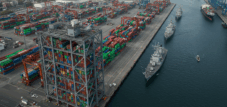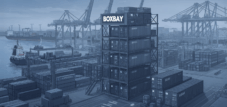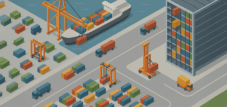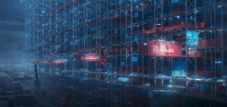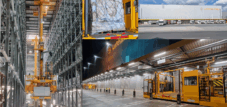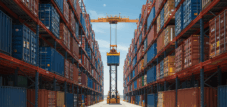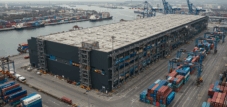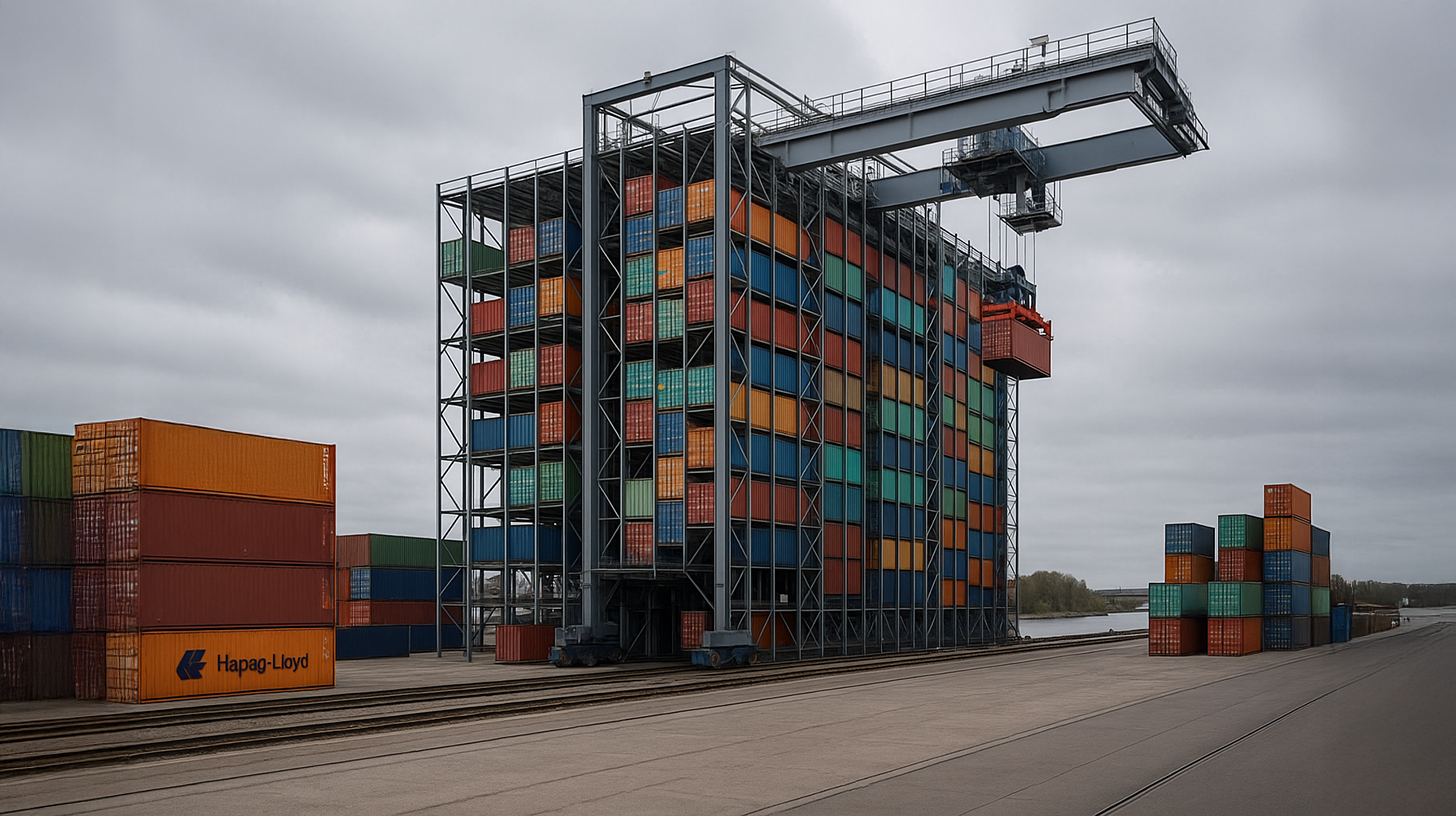
Container terminal logistics in the European inland area: High-bay container warehouses for inland ports and the internal market – Creative image: Xpert.Digital
Increased efficiency in container logistics through high-bay warehouse technology
Automation meets container handling: New solutions for growing trade flows
As global trade continues to grow and container flows steadily increase, traditional handling methods are reaching their limits. The answer to this challenge comes from an unexpected direction: industrial heavy-lift intralogistics. What has proven itself for decades in steel mills and production halls is now revolutionizing container logistics – the automated high-bay warehouse.
Related to this:

From vision to reality
The idea is brilliantly simple yet revolutionary: Instead of stacking containers horizontally on top of each other across large areas, as is currently the norm, they are stored vertically in huge racking systems. Each container has its own permanently assigned storage space and is directly accessible at any time – without time-consuming restacking.
This seemingly simple solution addresses one of the biggest problems in traditional container logistics. In conventional container yards, an average of 30 to 60 percent of all container movements are solely for restacking other containers to reach a specific one. These unproductive movements cost time, energy, and money.
The technology behind it
The heart of modern container high-bay warehouses consists of fully automated storage and retrieval machines that move with impressive precision through the aisles between the rows of racks. These machines can effortlessly handle containers weighing up to 40 tons – a technology originally developed for handling heavy steel coils in the metal industry.
The systems achieve impressive performance levels:
- Stacking heights of 7 to 18 layers (compared to a maximum of 4-6 layers in conventional systems)
- Turnover speeds of up to 22 moves per hour
- Triple the storage capacity on the same footprint
- Direct access to each individual container without restacking operations
Germany's innovation lead
Germany plays a leading global role in container high-bay warehouse technology. A long-established German plant engineering company, together with an international port operator, has developed a groundbreaking system that was awarded the prestigious German Logistics Prize in 2022.
From heavy industry to the port revolution
The roots of this revolutionary technology lie in German heavy industry. For decades, fully automated high-bay warehouses for metal coils weighing up to 50 tons were developed in steel mills. This proven technology has been successfully adapted to the specific requirements of container logistics – containers are no longer stacked on top of each other, but stored in fixed shelves, like in a giant bookshelf.
The award-winning system allows containers to be stored on up to eleven levels in a 50-meter-high steel rack. Each container is directly accessible without the need to restack other containers. This eliminates the biggest inefficiency of traditional container storage facilities, where 30 to 60 percent of all movements involve unproductive restacking.
Impressive performance data
The technology offers up to three times the storage capacity of conventional systems on the same footprint. Handling speed at the quay is increased by up to 20 percent. Particularly noteworthy: the system operates completely emission-free using electricity and can be operated CO2-neutrally with rooftop photovoltaic systems.
The first facility went into operation in Dubai in 2021 as a proof-of-concept. By the end of June 2022, over 150,000 container movements had been carried out there under realistic conditions.
German expertise in heavy-duty intralogistics
Besides the award-winning system, other German companies have established themselves as leading providers. They all share expertise in heavy-duty intralogistics and the ability to develop complex automation solutions
- A Finnish crane manufacturer with a strong German presence has developed an innovative system that enables storage heights of up to 14 levels
- A plant engineering company from Weinsberg is transferring decades of experience from heavy-duty intralogistics to container logistics with modular concepts for up to eight levels
- An Austrian company built one of the world's first container high-bay warehouses for the Swiss Army back in 2011
Technological excellence
The German systems are based on:
- High-precision storage and retrieval machines with telescopic grippers and frequency-controlled drives
- Consistent software architecture with intelligent warehouse control systems
- Modular design for gradual scaling without operational interruption
- Digital twins for simulation and optimization
- Predictive maintenance for proactive maintenance
German port technology companies achieve an annual production value of over 23 billion euros in the value chain.
Innovation promotion and future prospects
The German Federal Government actively supports this development through the funding program “Innovative Port Technologies” (IHATEC), which has a budget of 64 million euros until 2025.
German ports are massively accelerating automation. Hamburg operates one of the most modern and highly automated terminals in the world. Currently, Germany's largest container terminal is also being automated – the largest automation project in the history of the German port industry.
The future belongs to further digitalization: 5G campus networks enable real-time communication for autonomous vehicles. Artificial intelligence optimizes storage strategies and traffic flows.
Through these innovations, Germany is consolidating its position as a leading export nation and technology leader in port logistics.
Inland ports as new logistics centers
The importance of this technology is particularly evident in Germany's inland ports. The Port of Duisburg, Europe's largest inland port, handles over 50 million tons of goods annually, including 3.6 million TEU containers. With the opening of the Duisburg Gateway Terminal in September 2024, it will become the largest container terminal in inland Europe, offering an additional capacity of 850,000 TEU upon completion.
But Duisburg is not the only city benefiting from this development. Along Germany's waterways – from the Rhine to the Main and the Elbe – modern container terminals are being built, optimally connecting water, rail, and road as trimodal hubs
- Hamburg with its inland port share of 12.2 million tons
- Cologne with a total throughput of 15.6 million tons
- Mannheim with 8.3 million tons
- Karlsruhe with 6.5 million tons
The advantages of the vertical revolution
The implementation of container high-bay warehouses brings with it a multitude of advantages:
Space efficiency
Three times the number of containers can be stored on the same footprint. In times of scarce and expensive commercial space, this is a decisive competitive advantage.
speed
Handling times for trucks and trains are reduced by up to 20 percent. Every container is immediately accessible without the need to move other containers.
sustainability
Energy consumption is reduced by up to 29 percent compared to conventional systems. Many systems can also be operated CO2-neutrally with rooftop photovoltaics.
economy
Despite higher initial investments, the systems pay for themselves through lower operating costs, higher throughput and better space utilization.
Challenges and solutions
Of course, automation also presents challenges. Initial investments are substantial – a fully equipped high-bay warehouse can cost several hundred million euros. Furthermore, the technology requires specialized maintenance personnel and is less flexible than manual systems.
However, the advantages outweigh the disadvantages, especially in high-frequency environments. Automation already pays for itself with more than 150 container movements per day. The systems operate around the clock, regardless of shift schedules or staff shortages.
The future of container transport
The containerization of global trade is progressing relentlessly. In Germany alone, over 13.3 million TEU were handled in seaports in 2024. A large proportion of these containers must be transported inland – a task that is increasingly being taken over by automated high-bay warehouses.
This technology enables not only more efficient handling but also new logistics concepts. Inland ports can act as buffer warehouses, compensating for fluctuations in maritime traffic. Containers can be temporarily stored there and distributed to recipients as needed.
Sustainability as a driver
A key aspect of the new technology is its sustainability. Inland waterway transport produces only a fraction of the CO2 emissions per ton-kilometer compared to road traffic. One inland vessel can transport the cargo of up to 150 trucks.
Modern container terminals also rely on electric drives, energy recovery, and renewable energies. The Hamburg container terminal Altenwerder, for example, already operates almost CO2-neutrally with electric automated guided vehicles (AGVs) and green electricity.
Related to this:
The European context
The development of container high-bay warehouses takes place within the context of the European Single Market, which, with its over 440 million consumers, represents one of the world's largest economic areas. The free movement of goods within the EU requires efficient logistics solutions that support cross-border supply chains.
German technology companies are already exporting their high-bay warehouse systems worldwide. Following successful pilot projects in Dubai, commercial installations are now underway in South Korea, and further projects in Europe, America, and Asia are in the planning stages.
Integration into existing systems
A key success factor is the seamless integration of high-bay warehouses into existing port infrastructure. The systems must be compatible with existing container cranes, transport vehicles, and IT systems. Modern systems therefore feature standardized interfaces and can be implemented in stages.
Digitalization plays a key role in this process. All container movements are recorded and optimized in real time. Predictive analytics enable proactive maintenance and maximum system availability.
How container high-bay warehouses will shape the logistics of tomorrow
Container high-bay warehouse technology is still in its early stages of development. Experts predict strong growth in the coming years, driven by increasing handling volumes, land scarcity, and sustainability requirements.
New developments such as foldable containers, which address the empty container problem, or the integration of artificial intelligence to further optimize processes will increase efficiency even further.
For the European single market, this means a strengthening of competitiveness. Efficient logistics is a crucial location factor, and German innovations in container high-bay warehouse technology are setting global standards.
Heavy-duty intralogistics has thus proven that established industrial technologies can be successfully transferred to new fields of application. What began in steel mills is now revolutionizing global container logistics – made in Germany.
Related to this:
Consulting - Planning - Implementation

Markus Becker
I would be happy to serve as your personal advisor.
Head of Business Development
Consulting - Planning - Implementation
Konrad Wolfenstein
I would be happy to serve as your personal advisor.
You can contact me at wolfenstein∂xpert.digital or
Just call me on +49 7348 4088 965 .
Your container high-bay warehouse and container terminal experts
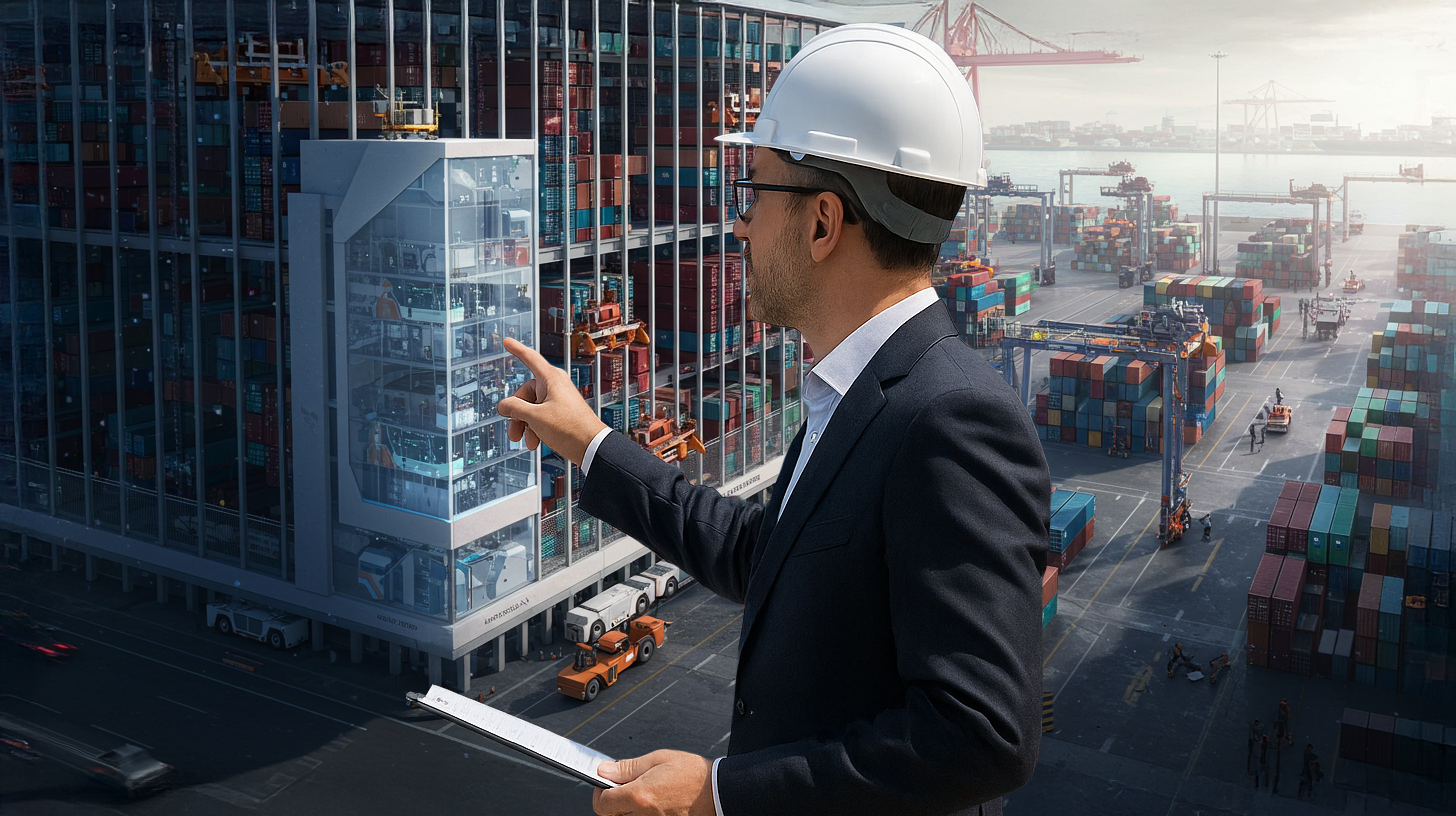
Container high-bay warehouses and container terminals: The logistical interplay – expert advice and solutions - Creative image: Xpert.Digital
This innovative technology promises to fundamentally change container logistics. Instead of stacking containers horizontally as before, they will be stored vertically in multi-story steel racking structures. This not only allows for a drastic increase in storage capacity within the same area, but also revolutionizes all processes at the container terminal.
More information here: