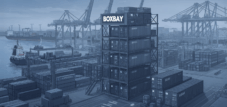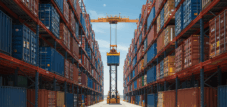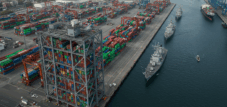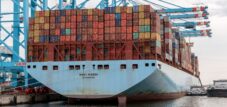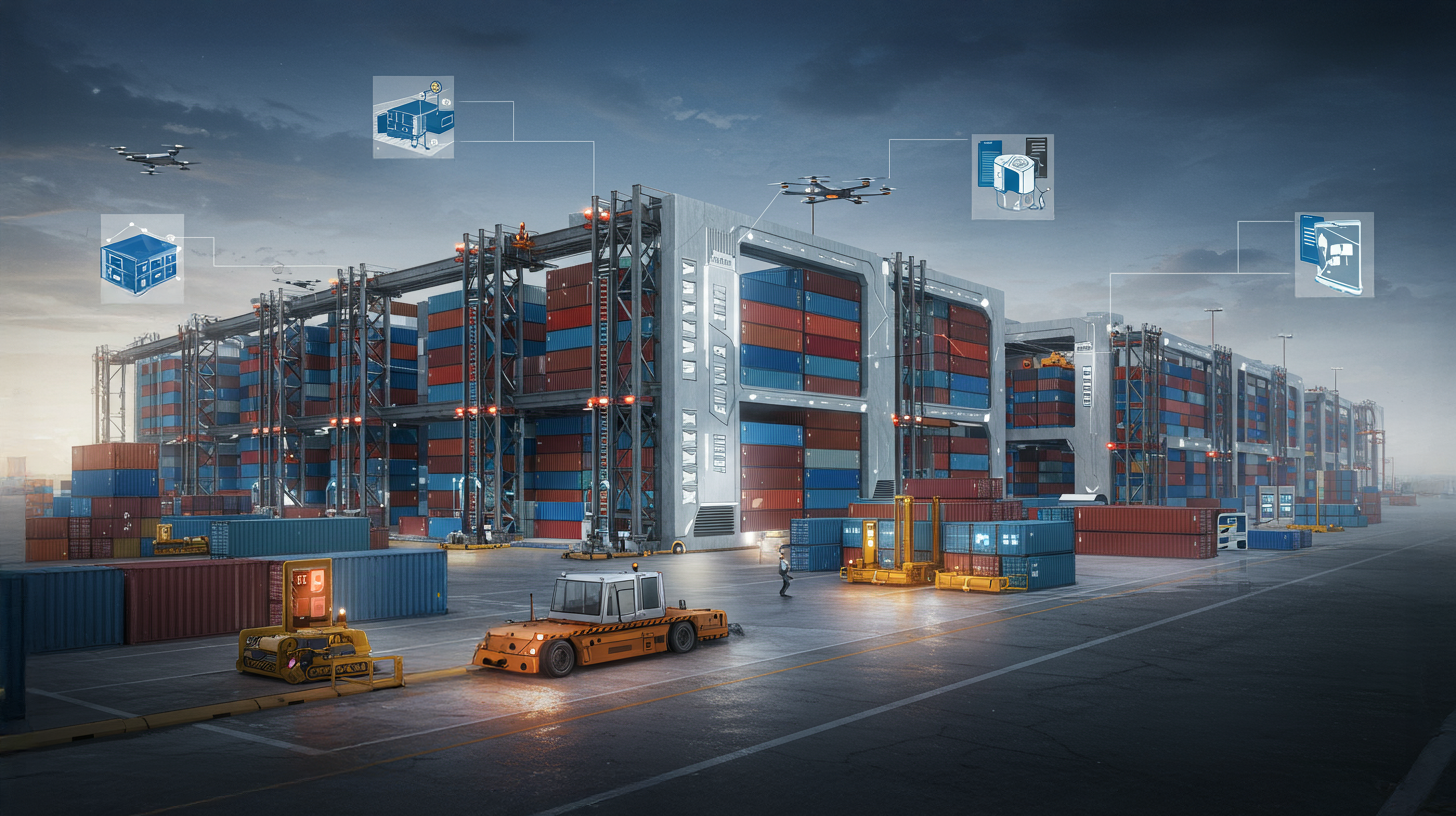
Alternatives to BOXBAY container storage: A comprehensive analysis of container high-bay warehouses and other options – Image: Xpert.Digital
More than just stacking: How new systems are transforming container storage – How modern technology is changing container logistics
Why are traditional methods of container storage under unprecedented pressure today?
Global supply chains, and with them the seaports that serve as their central hubs, are undergoing profound change. Traditional container storage methods, which have been the standard for decades, are increasingly reaching their physical and operational limits. This pressure does not stem from a single cause, but rather from the convergence of several mutually reinforcing factors that necessitate a fundamental reassessment of storage technology.
The most obvious driver is the steady growth of global trade and the associated container traffic. However, the quantitative increase alone does not explain the urgency of the situation. A far more critical factor is the dramatic increase in ship size. The introduction of Ultra Large Container Ships (ULCS) has fundamentally changed the dynamics of container handling. While around the turn of the millennium a ship transported approximately 8,000 TEU (twenty-foot equivalent units), today ships have a capacity of up to 24,000 TEU. These giants of the seas deliver an immense number of containers at once per port call. A modern ULCS can transport over 500 containers per bay, compared to 220 in the past. This leads to extreme demand peaks that quickly push a port's land-based infrastructure to its limits.
These peak demands coincide with an infrastructure that often hasn't kept pace. Many large ports have grown organically over time and are located in densely populated urban areas, making physical expansion extremely difficult and expensive. Land reclamation, often the only option for expansion, is not only costly—ranging from €2,000 to €3,000 per square meter and more—but also environmentally problematic and faces increasing regulatory resistance.
This scarcity of space forces terminal operators to build upwards, stacking containers ever more densely. In conventional container yards, served by cranes such as rubber-tired (RTG) or rail-mounted (RMG) gantry cranes, containers are stacked directly on top of each other, often five to six layers high. This reveals the fundamental conflict of objectives inherent in traditional storage logic: to increase space efficiency (stacking higher), operational efficiency is sacrificed. Once the occupancy of such a storage block exceeds a critical point of around 70-80%, performance drops dramatically. The reason for this is so-called "unproductive handling" or "reshuffling." To access a container at the bottom of a stack, all the containers above it must first be moved. These unproductive movements can account for a staggering 30% to 60% of all crane movements.
The arrival of the ULCS has transformed this inherent conflict from an operational annoyance into an existential threat to the competitiveness of major ports. The economies of scale that larger vessels are meant to achieve at sea are negated on land by massive inefficiencies. This leads to longer ship layovers, congested terminals, and rising costs throughout the supply chain. Added to this are stricter environmental regulations, noise abatement requirements, and a growing shortage of skilled workers, such as crane operators.
In this complex environment of increasing volume, growing complexity, limited space, and pressure for efficiency, new technological approaches are emerging. These aim not only to improve storage but also to resolve the fundamental conflict between space utilization and operational access. Systems like BOXBAY are a direct response to these challenges and are redefining the paradigms of container storage.
Related to this:

1. What exactly is the BOXBAY high-bay warehouse system and how does it work technologically?
The BOXBAY system represents a paradigm shift in container storage by adapting the proven principles of industrial high-bay racking to the specific requirements of seaports. It is the result of a joint venture between DP World, one of the world's largest port operators, and the German SMS group, a specialist in industrial plant engineering.
The system's technological origins are a crucial factor in its design and market acceptance. The core technology wasn't reinvented for port logistics, but rather adapted by SMS subsidiary AMOVA. For decades, AMOVA has been a leading provider of fully automated high-bay warehouses for storing extremely heavy loads in the metal industry, such as steel or aluminum coils weighing up to 50 tons in racks up to 50 meters high. This decades-long experience in 24/7 operation under harsh industrial conditions, handling even heavier loads than containers, gives BOXBAY technology inherent robustness and reliability. Transferring this proven technology significantly reduces the perceived risk for port operators, who are traditionally very conservative when it comes to adopting new, untested systems. It's less a technological leap into the unknown and more a smart application of a proven solution to a new challenge.
The basic principle of BOXBAY is simple yet revolutionary: Instead of stacking containers directly on top of each other, each individual container is placed in its own compartment within a massive steel racking system. These racking systems can reach a height of up to eleven container levels. At the heart of the system are fully automated, rail-guided stacker cranes that move at high speed through the aisles between the racks. Using a spreader arm, these cranes can directly access and retrieve or store any container without moving any other container. This direct access is the key to resolving the conflict between storage density and efficiency described above.
2. What specific advantages in terms of speed, intelligence, and sustainability (Fast, Intelligent, Green) does BOXBAY claim for itself?
BOXBAY summarizes its performance promises under the keywords "Fast, Smart, Green", which describe the core advantages of the system.
Fast
The speed advantage stems primarily from the complete elimination of unproductive handling movements. Since each container is directly accessible, the 30-60% of crane movements typically spent on reshuffling in conventional systems are eliminated. This results in consistent and, above all, predictable performance, independent of the warehouse's fill level – a crucial difference compared to conventional yards, whose performance plummets under high load. This predictability and reliability enable the optimization of downstream processes. For example, truck turnaround times of well under 30 minutes are targeted. Furthermore, an increase in the productivity of ship-to-shore cranes of up to 20% is expected, as so-called "dual-cycle" operations (simultaneous unloading and loading of the ship) can be reliably planned and executed without waiting for the correct container from the yard.
Intelligent
BOXBAY is designed as a fully automated, integrated system, spanning from Level 0 (field devices) to Level 3 (process control), and supplied by a single provider. This reduces interface issues and increases system reliability. The system includes its own Warehouse Management System (HBS TOS) that can seamlessly communicate with any higher-level Terminal Operating System (TOS) in the port. Another intelligent feature is its modular and scalable architecture. A terminal can start with a smaller number of aisles and gradually expand the system while the rest of the port remains operational. Each new module increases capacity and throughput without disrupting ongoing operations.
Sustainable
The environmental benefits are numerous. The most important aspect is its immense space efficiency. BOXBAY triples storage capacity on the same footprint or requires only one-third of the space for the same number of containers compared to a conventional RTG yard. This reduces the need for expensive and environmentally damaging land reclamation. The system is fully electric and features energy recovery systems (recuperation) that generate energy when containers decelerate or are lowered, feeding it back into the system. In combination with a photovoltaic system on the large roof area, BOXBAY can operate in a CO2-neutral or even CO2-positive manner by generating more energy than it consumes. Because the fully automated operation requires no lighting and the structure can be encapsulated, noise and light emissions are drastically reduced, significantly improving acceptance in residential areas.
3. What configurations does BOXBAY offer and for which use cases are they designed?
To enable flexible integration into different terminal layouts and existing transport logistics, BOXBAY was developed as a modular system with two basic configurations: SIDE-GRID® and TOP-GRID®, which are complemented by a hybrid variant. Both use the same technological components but differ mainly in the design of the waterside interface.
SIDE-GRID®
This configuration was implemented in a pilot project in Dubai. It is designed for operation on the waterside using conventional or automated straddle carriers or shuttle carriers. These vehicles transport the containers to the end of the storage aisles and transfer them there onto special transfer tables that act as buffers, decoupling the movements of the external vehicles from the internal stacking cranes.
TOP-GRID®
This variant is designed for even deeper automation integration. It is optimized for operation with automated guided vehicles (AGVs) or automated trucks. These vehicles drive directly beneath the aisles of the high-bay warehouse. The stacking cranes can then pick up or set down the containers directly from above. This enables a particularly fast and seamless transfer between the warehouse and horizontal transport.
Hybrid grid
This variant combines elements from both systems to create tailor-made solutions for specific terminal requirements.
The landside interface for handling external trucks is similar in both main variants. The trucks drive through a one-way loop spanned by separate, automated transfer cranes. These cranes pick up the containers from the trucks and transfer them to an internal conveyor system, which transports them to the stacking cranes, or vice versa. This concept ensures a safe separation of external truck traffic from the internal automated operations.
4. What practical experience and performance data are available from the pilot project in Jebel Ali and the first commercial contract in Busan?
Validating such a disruptive concept with real-world operational data is crucial. BOXBAY has two important references to demonstrate this.
Pilot project in Jebel Ali, Dubai
The proof-of-concept system was installed in Terminal 4 of the Port of Jebel Ali and commissioned in January 2021. The facility, which has 792 container slots (approximately 1,300 TEU), served to test and optimize the technology under real port conditions. By the end of 2024, over 330,000 container movements had been carried out. The results of the test phase exceeded initial expectations. The measured performance data was higher than simulated: throughput reached 19.3 movements per hour at the waterside interface and 31.8 movements per hour at the landside truck-mounted cranes. At the same time, the system proved to be more energy-efficient than predicted, with energy costs 29% lower than expected, while maintenance costs were also significantly reduced. In September 2022, the system was officially declared ready for market.
Commercial project in Busan, South Korea
The first commercial order was signed in March 2023 with Pusan Newport Corporation (PNC) in South Korea. This project is of particular strategic importance as it is a brownfield project – the retrofitting of the system into an existing, already state-of-the-art and operational terminal. The BOXBAY system will be seamlessly integrated into existing operations with automated rail-mounted gantry cranes (ARMGs) and trucks. The stated goal is to eliminate 350,000 unproductive handling movements annually and improve truck turnaround time by 20%. The success of this project will be a crucial indicator of HBS technology's ability to play a key role not only in new construction projects but also in the modernization of existing port infrastructure worldwide.
5. How do conventional container storage facilities based on rubber-tired (RTG) and rail-mounted (RMG) gantry cranes work?
To understand the level of innovation in high-bay warehouse systems (HBS) like BOXBAY, an understanding of the established status quo is essential. For decades, the workhorses of modern container terminal logistics have been rubber-tired (RTG) and rail-mounted (RMG) gantry cranes.
Rubber Tired Gantry Cranes (RTGs)
RTGs are large gantry cranes that run on rubber tires. Their greatest strength is their flexibility and mobility. They can move freely within the container yard and, if necessary, even switch from one storage block to the next by turning their wheels 90 degrees. This makes them particularly versatile and adaptable to changing operational requirements. Infrastructure costs for RTG yards are comparatively low, as no elaborate rail foundations are required; a paved, level surface is sufficient. Traditionally, RTGs are powered by diesel engines, which gives them autonomy from an external power supply, but also results in significant local CO2 emissions, noise, and higher maintenance costs. Modern versions are also available as hybrid or fully electric e-RTGs.
Rail Mounted Gantry Cranes (RMGs)
RMGs move on fixed rails that run alongside the storage blocks. This rail constraint limits their flexibility compared to RTGs, but gives them greater stability, precision, and speed. Because their movements follow predefined paths, RMGs are significantly easier to automate than RTGs. They are typically electrically powered, making them more environmentally friendly and less expensive to operate (no fuel costs, reduced maintenance). However, their installation requires high initial investments (CAPEX) in the rail infrastructure and careful, long-term planning of the terminal layout.
6. What are the inherent operational limitations of these systems?
Despite their widespread use and continuous development, both RTG- and RMG-based systems suffer from a fundamental, inherent limitation: the principle of block stacking. Containers are stacked directly on top of each other in blocks, leading to a cascade of operational inefficiencies.
Unproductive turnover movements (“reshuffling”)
This is the biggest weakness. To reach a specific container that isn't at the top of a stack, all the containers above it must first be lifted and temporarily stored elsewhere. Only then can the target container be retrieved, and subsequently, the temporarily stored containers often have to be moved back again. These unproductive, time-consuming, and energy-intensive movements can account for between 30% and 60% of all crane movements in a yard.
Low land use efficiency
The need for reshuffling means that a storage block can never be filled to 100% capacity, as space is always required for temporary container storage. In practice, effective utilization is limited to approximately 70-80%. If this threshold is exceeded, the number of required handling movements increases exponentially, and the terminal's performance plummets. Productivity becomes unpredictable and difficult to plan.
Environmental and safety aspects
Diesel-powered RTGs, in particular, are a source of significant local CO2, particulate matter, and noise emissions. Manual operation in a busy yard also poses higher safety risks for ground personnel.
7. How do automated stacking cranes (ASCs) compare directly to manually operated RTGs and RMGs?
Automated stacking cranes (ASCs) – often also referred to as automated RMGs (ARMGs) – are the next logical step in the evolution of conventional warehouse technology. They take the concept of the RMG and replace the human crane operator with an automated control and positioning system.
Advantages of ASCs
Automatic crane systems (ASCs) offer significant advantages over manual systems. They operate around the clock with consistent, predictable performance and increase safety, as fewer personnel are present in the cranes' hazardous working area. Precise, computer-controlled movements allow containers to be stacked more densely and higher, significantly increasing storage density and thus capacity within a given area. An example from Hamburg demonstrates that the use of ASCs doubled storage capacity on the same footprint. Furthermore, they are more energy-efficient than manual or diesel-powered cranes.
The fundamental distinction from HBS
Although ASCs represent a significant improvement, they do not solve the core problem of block stacking. They are a form of process optimization, not process replacement. An ASC system takes the existing, inherently inefficient process of block stacking and automates it to perform it faster, more accurately, more safely, and more densely. However, the basic process—stacking containers on top of each other and the necessary re-sorting—remains the same.
A high-bay warehouse system (HBS) like BOXBAY takes a radically different approach. It completely replaces the block stacking process with the principle of direct, individual access. Each container has its own fixed storage location on a rack and can be accessed at any time without moving another container.
For a terminal operator, this represents a fundamental strategic decision. Investing in ASCs means perfecting the familiar and proven block storage model. This often appears to be the less risky, evolutionary path, but retains the systemic limitations of reshuffling. Investing in a HBS is a revolutionary step. It carries potentially higher initial risks and requires a complete rethink of operations, but has the potential to completely overcome the old limitations and achieve a new level of efficiency.
Your intralogistics experts
Consulting, planning and implementation of complete solutions for high-bay warehouses and automated storage systems - Image: Xpert.Digital
More information here:
Alternatives to the BOXBAY system – Other container high-bay warehouse concepts
8. Are there any other companies besides BOXBAY that develop or offer high-bay warehouse systems (HBS) for ISO containers?
While BOXBAY has gained significant media attention through its prominent joint venture and pilot project in Dubai, it is by no means the only player in the emerging market for high-bay storage systems for containers. The idea of transferring the principles of Automated Storage and Retrieval Systems (ASRS) from industrial and warehouse logistics to containers is not new – the first patents for this were filed as early as 1968. Today, several established logistics and crane manufacturers are working on their own concepts, which differ significantly from BOXBAY in their technological philosophies. This indicates that the market is in a phase of technological differentiation. There is no single "one" HBS approach. The main differences lie in the type of gripping (from above or below), the architecture of the crane system (pure stacker crane, hybrid solutions), and the design of the interfaces with the rest of the terminal. This diversity arises because suppliers are applying their respective core competencies from other areas of intralogistics – be it steel, paper, or general warehouse logistics – to the challenge of container storage. For port operators, this means that in the future they will likely be able to choose from a range of specialized HBS solutions tailored to their specific requirements.
Related to this:
Konecranes & Pesmel
In April 2022, Finnish crane manufacturer Konecranes, in partnership with Pesmel, a specialist in ASRS for the paper and metal industries, presented a concept called "Automated High-Bay Container Storage" (AHBCS). This system is designed for a stacking height of up to 14 containers and combines an automated stacking crane for in-aisle storage and retrieval with separate overhead cranes that handle the transfer to the loading zones for trucks or trains. The containers are stored lengthwise, which could allow for direct access to the gates of distribution centers.
LTW Intralogistics
This Austrian company has already implemented a functioning HBS (High-Borne Storage) system for the Swiss Army. The technological innovation of the LTW system is that the containers are lifted from below and placed onto the racking beams, instead of being lifted from above (top-lift) as with BOXBAY or Konecranes. This is achieved using a stacking crane that carries special onboard shuttles, known as "gangway vehicles." This method also enables double-deep storage, further increasing storage density.
AMOVA
The SMS subsidiary, whose technology forms the basis for BOXBAY, also operates as an independent provider of HBS solutions for port logistics. Its portfolio comprises the complete system of racking structure, stacking cranes, and warehouse management software, based on decades of experience in heavy-lift logistics.
Further and historical concepts
Besides the aforementioned key players, there are other concepts and earlier projects. These include the "Container Hangar," an early Japanese HBS project by NYK and JFE Engineering, which went into operation as early as 2011. Other patented systems include "Multistaka" by Peter Cannon and a concept by the German company Vollert, which is also based on a central stacking crane.
The following table provides a structured overview of the most important providers and their technological approaches:
Market overview – Suppliers of high-bay storage systems for containers
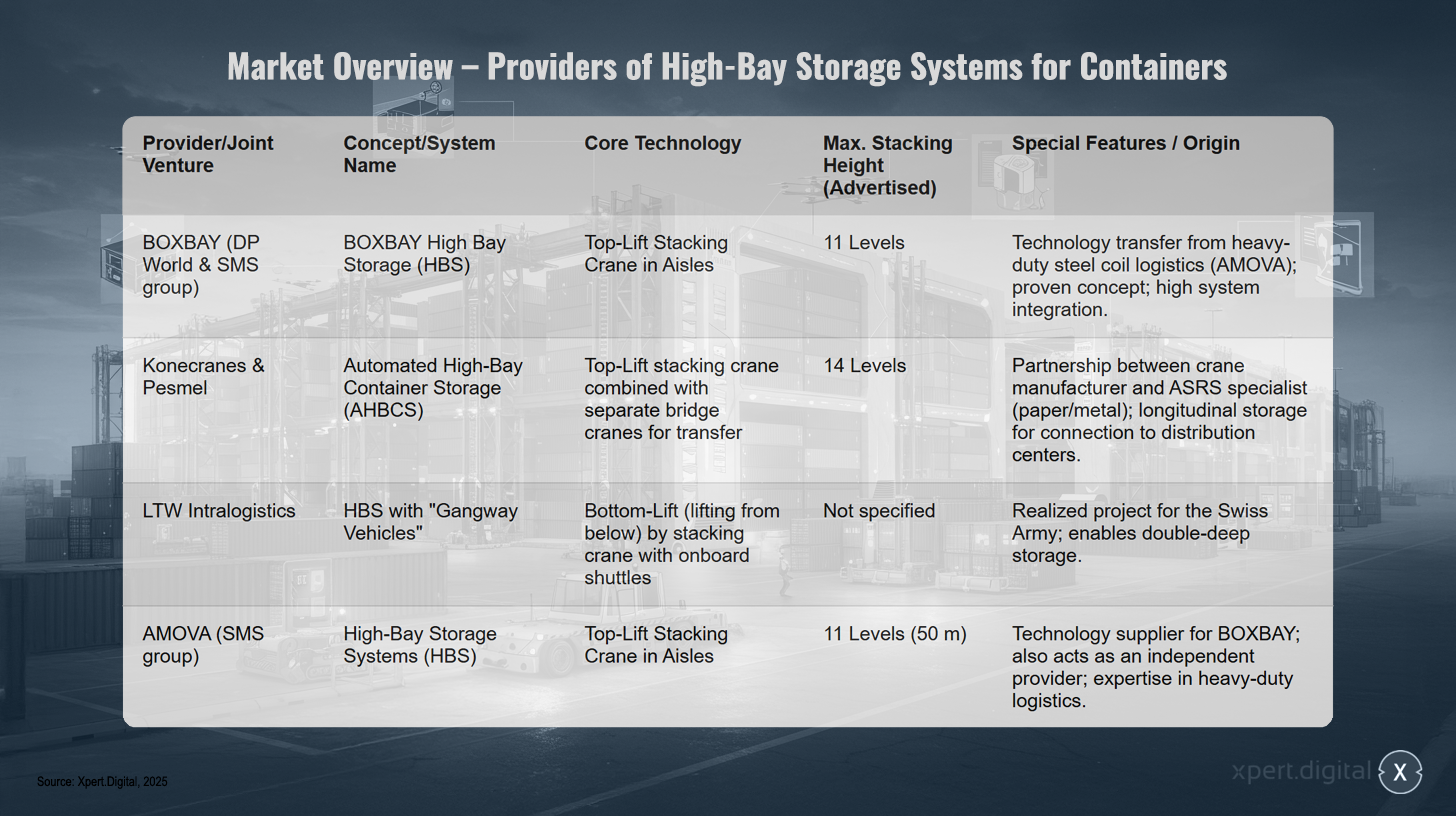
Market overview – Suppliers of high-bay warehouse systems for containers – Image: Xpert.Digital
The market overview showcases various providers of high-bay storage systems for containers, each with their own innovative technologies. BOXBAY, a joint venture between DP World and SMS group, presents its High Bay Storage (HBS) concept, featuring a top-lift stacking crane capable of reaching up to 11 levels. This system is based on technology transfer from heavy-duty steel coil logistics and is characterized by a high degree of system integration.
Another solution comes from the partnership between Konecranes and Pesmel. Their Automated High-Bay Container Storage (AHBCS) also uses a top-lift stacking crane, supplemented by separate bridge cranes for transfer. This concept enables storage of up to 14 levels and is particularly suitable for connecting to distribution centers.
LTW Intralogistics is pursuing a different approach with a high-bay storage system that utilizes bottom-lift technology with onboard shuttles. The company has already implemented a project for the Swiss Army, enabling double-deep storage.
AMOVA, part of the SMS group, acts both as a technology supplier for BOXBAY and as an independent provider. Their high-bay storage systems also utilize a top-lift stacking crane and can handle storage heights of up to 50 meters and 11 levels, based on their expertise in heavy-lift logistics.
9. Radical Alternatives – Beyond the High-Bay Warehouse: What unconventional approaches to container logistics exist, such as underground systems?
While high-bay warehouses solve the problem of limited vertical space, more radical approaches aim to banish container traffic and its associated problems – congestion, noise, emissions – from the surface. The leading concept in this area is Underground Container Logistics (UCL), also known as Underground Logistics System (ULS).
UCL's basic idea is to create a dedicated underground transport network for containers. Instead of transporting containers by truck along congested roads, they are moved through tunnels or large-diameter tubes between different points in the port area or even to logistics parks in the hinterland. This is done fully automatically using special, often electrically powered vehicles. Research and patents in this area describe systems in which containers are transported via vertical shafts from the surface into the underground network and back, with automated cranes handling the transfer to driverless transport systems (AGVs) at the surface.
The advantages of such a system are obvious
- Relief for surface infrastructure: Reduction of truck traffic, congestion and the associated costs and delays.
- Environmental friendliness: Electric, emission-free and quiet transport underground.
- High reliability and efficiency: A dedicated, weather-independent and fully automatic system enables planned 24/7 operation with high capacity.
- Releasing valuable land: Areas currently used for roads and shunting zones could be repurposed for other uses.
10. How does Denys' "Underground Container Mover" (UCM) concept work and what problems is it intended to solve?
One of the most concrete and advanced concepts in the UCL sector is the "Underground Container Mover" (UCM), presented by the Belgian construction company Denys. The UCM project, also known as "Port Loop," is designed as a fully automated, multimodal transport system specifically for traffic within large port areas like Antwerp.
The concept is based on three technological pillars that form an integrated system:
- A minimalist tunnel network: Instead of large, expensive tunnels, a network of tubes with a minimal cross-section is constructed in a loop. This network connects strategic points in the port – such as various terminals, quays, rail loading points, and distribution centers – while bypassing existing surface obstacles.
- Autonomous Electric Vehicles (AEVs): Intelligent, self-driving, and electrically powered vehicles are the means of transport in the tunnel. They are designed to flexibly navigate the loop system, enter and exit at the junctions, and thus achieve a high container throughput.
- Automated stacking systems at the junctions: Automated storage systems are planned at the entrance and exit points of the tunnel system. Denys explicitly mentions "automated container stacking systems" here, which triple the storage capacity per square meter and allow direct access to all containers – a clear reference to high-bay warehouse technology. These systems serve as a buffer and interface between underground transport and above-ground logistics.
This concept highlights a crucial strategic insight: underground systems like UCM are not direct competitors to high-bay warehouses like BOXBAY, but rather potentially symbiotic technologies. While an HBS solves the problem of static storage density at a specific point, a UCL system addresses the problem of dynamic transport between these points. An HBS optimizes the vertical dimension of storage; a UCL system optimizes the horizontal dimension of transport.
The combination of these two technologies could represent the ultimate "smart port" concept of the future: a network of highly dense, fully automated storage nodes (the high-bay warehouses) connected by an invisible, fast, and also fully automated underground transport network (the UCM). In such a scenario, a container would be unloaded from a ship and stored directly in a high-bay warehouse at the quayside. Instead of being loaded onto a truck stuck in traffic, it could, when needed, be transferred directly from the high-bay warehouse to an automated electric vehicle (AEV) within the UCM system and transported underground to the rail terminal, where another high-bay warehouse serves as a buffer for train loading. The debate, therefore, is not "high-bay warehouses versus UCL," but rather "high-bay warehouses plus UCL." This shifts the strategic perspective from selecting a singular technology solution to designing an integrated, multimodal logistics ecosystem.
11. Quantitative and Qualitative Comparison of Storage Systems
A well-informed decision for or against a particular storage technology requires a detailed comparison based on quantitative key performance indicators (KPIs) and qualitative characteristics. The following analysis compares conventional systems with new high-bay warehouse concepts.
Comparative overview of container storage technologies
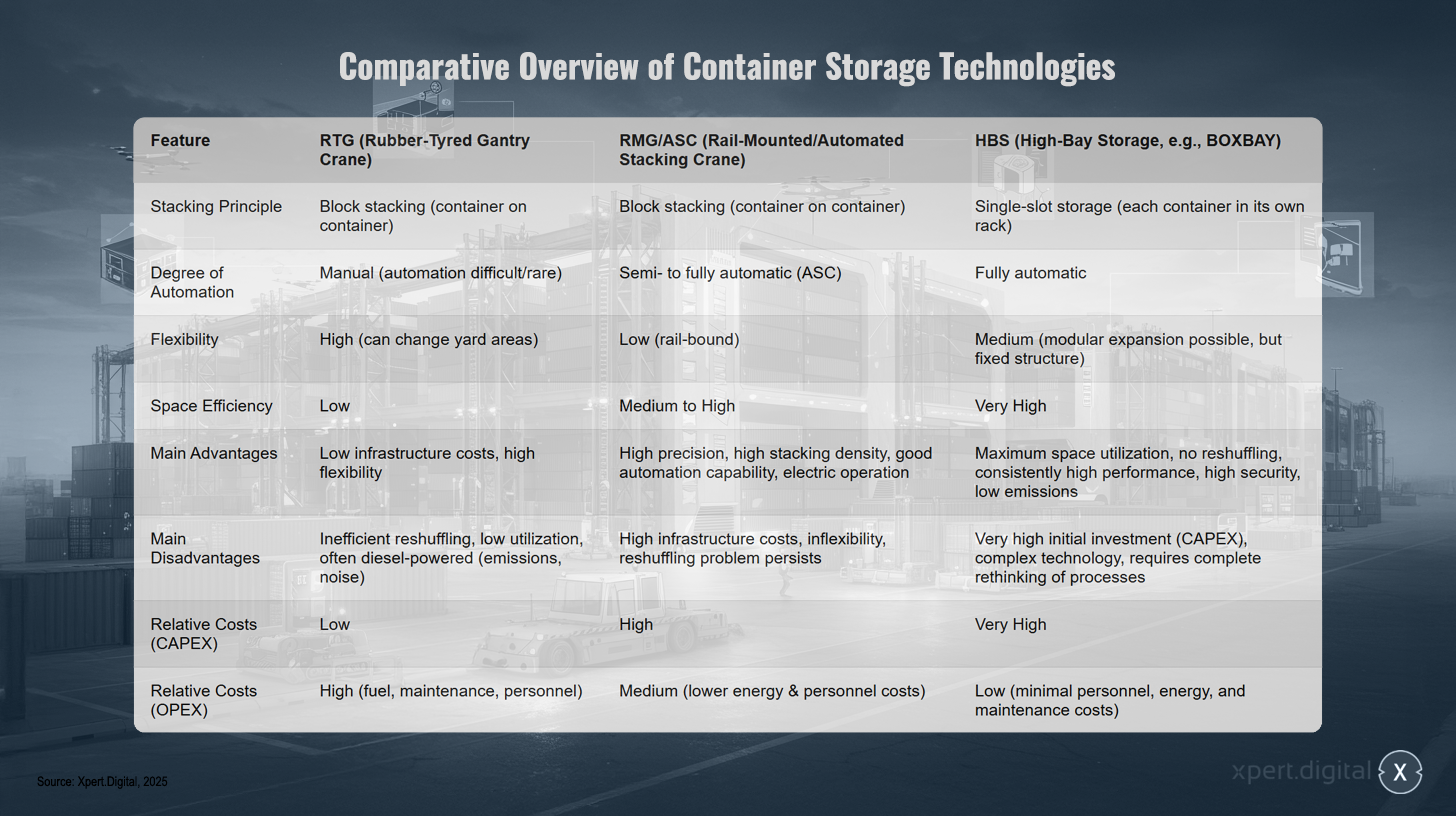
Comparative overview of container storage technologies – Image: Xpert.Digital
Container storage technologies differ significantly in several aspects. The RTG (rubber-tired gantry crane) is based on block stacking and offers high flexibility because it can move around the yard. Its main advantages are low infrastructure costs, but it suffers from inefficient reshuffling and often uses diesel engines with corresponding emissions.
In contrast, the RMG/ASC (Rail-Mounted/Automated Gantry Crane) operates semi- to fully automatically. It enables high precision and stacking density, but is bound to rails and has higher infrastructure costs. Despite electric operation, the reshuffling problem persists.
The HBS high-bay warehouse (similar to BOXBAY) represents a completely different approach to single-location storage. It is fully automated and offers maximum space utilization without reshuffling. The technology impresses with consistently high performance, low emissions, and high safety. However, it requires a very high initial investment and a complete rethinking of logistics processes.
The choice of technology depends on specific requirements: flexibility, cost, degree of automation and space efficiency play a crucial role in the evaluation.
12. How do the different systems compare in terms of land efficiency, measured in TEU per hectare?
Storage density is one of the most critical indicators for ports with limited space. This is where the most dramatic differences between technologies become apparent.
Conventional RTG yard
Data on storage density varies, but a frequently cited figure is around 1,900 TEU per hectare. Other analyses, particularly for US ports, arrive at significantly lower figures of approximately 190 TEU slots per acre, which translates to roughly 470 TEU slots per hectare. This discrepancy illustrates that the actual density is highly dependent on operational organization.
Automated ASC yard
More precise stacking and taller blocks allow ASCs to double the capacity on the same area compared to a straddle carrier yard. Based on the RTG value, this would enable a density of potentially up to approximately 3,800 TEU per hectare.
BOXBAY HBS
BOXBAY's system achieves a static storage capacity of over 3,000 TEU per hectare for mixed container sizes. For empty containers, which can be stacked higher, this figure even increases to over 5,200 TEU per hectare. AMOVA and BOXBAY also report an annual throughput of over 160,000 TEU per hectare, underscoring the system's high throughput.
13. What differences are there in key performance indicators such as handling capacity, truck processing time and throughput?
Operational performance determines the competitiveness of a terminal.
Truck Turnaround Time (TTT)
BOXBAY promises a time-to-ship (TTT) of well under 30 minutes. Automation can generally improve TTT by standardizing and accelerating processes. However, practical experience reveals the complexity: A study of a brownfield automated storage and control (ASC) system showed a 124% decrease in TTT. This was due to prioritizing the seaside handling of ships and assigning only one crane per block to both the seaside and landside, resulting in long waiting times for trucks. This underscores that theoretical performance depends on operational prioritization and system design.
Crane Productivity (Moves Per Hour, MPH)
The productivity of quay cranes is a crucial factor in ship handling time. Conventional, manually operated cranes achieve peak values of around 35 MPH. However, highly automated terminals in China have set new standards, achieving average operating values of over 33 MPH and peak values of up to 60.9 MPH. BOXBAY aims to increase quay crane performance by 20% by eliminating waiting times and enabling efficient dual cycles through its constant and rapid container delivery.
Total throughput
An analysis of terminal performance during the COVID-19 pandemic showed that fully automated terminals exhibited significantly better and more stable throughput than non-automated terminals. While the latter struggled with disruptions, the former were able to maintain or even increase their performance. This suggests that the main advantage of automation lies less in absolute peak performance and more in the robustness and predictability of operation under variable conditions.
🎯🎯🎯 Benefit from Xpert.Digital's extensive, five-fold expertise in one comprehensive service package | BD, R&D, XR, PR & Digital Visibility Optimization


Benefit from Xpert.Digital's extensive, five-fold expertise in a comprehensive service package | R&D, XR, PR & Digital Visibility Optimization - Image: Xpert.Digital
Xpert.Digital possesses in-depth knowledge across various industries. This allows us to develop tailored strategies precisely aligned with the requirements and challenges of your specific market segment. By continuously analyzing market trends and monitoring industry developments, we can act proactively and offer innovative solutions. The combination of experience and expertise generates added value and provides our clients with a decisive competitive advantage.
More information here:
From crane to high-tech system: The incredible evolution of container handling
14. What does a comparative cost analysis look like (CAPEX, OPEX, ROI)?
Economic considerations are often the decisive factor in investment decisions.
Related to this:
Basic rule
The introduction of automation fundamentally shifts the cost structure. Initial investment costs (CAPEX) are very high, while ongoing operating costs (OPEX) decrease. Over the entire lifespan of a project (Total Cost of Ownership, TCO), the total costs of a manual and an automated terminal can converge.
CAPEX (investment costs)
Implementing a fully automated system is extremely capital-intensive. The cost of a greenfield project can range from hundreds of millions to over a billion US dollars. Examples include the Qingdao Terminal at approximately 468 million USD and the Long Beach Container Terminal at 1.5 billion USD. These high initial investments represent a significant hurdle, especially for smaller operators. However, BOXBAY argues that the cost savings from the reduced land requirement can offset a substantial portion of the CAPEX. Saving three hectares of land can represent a value of 60-90 million euros at prices of 2,000-3,000 EUR/m².
OPEX (Operating Expenses)
This is where the greatest potential for savings through automation lies. Studies and practical examples indicate that operating costs can be reduced by 25% to 55%. Labor costs, the largest expense in manual terminals, can be reduced by up to 70%. Additional savings can be achieved in energy and maintenance. Tests conducted by the BOXBAY pilot project showed energy costs that were 29% lower than expected, while simultaneously reducing maintenance costs significantly.
ROI (Return on Investment)
The payback period for automation projects can be long, often exceeding six years. However, there are also reports of extremely rapid amortization, such as the Qingdao terminal, which reportedly became profitable after only 10 months. The ROI is heavily dependent on local factors, particularly land and labor costs. In regions with high costs in these areas, automation will pay for itself more quickly.
15. What are the environmental impacts of the different systems?
Sustainability has gone from being a "nice-to-have" to a hard requirement for port operators, driven by regulations, customer demands and public pressure.
Emissions and energy
The greatest environmental advantage of modern automation lies in electrification. Systems like ASCs and HBS are fully electric, thus eliminating the local CO2, nitrogen oxide, and particulate matter emissions caused by diesel-powered RTGs and trucks. Combined with green electricity or, as in the case of BOXBAY, with on-site rooftop solar power generation, these systems can operate in a CO2-neutral or even CO2-positive manner. Optimized, computer-controlled processes also reduce energy consumption by minimizing crane idle times and vehicle waiting times.
Noise and light
Fully automated, encapsulated systems like BOXBAY drastically reduce noise and light pollution. Operation requires no yard lighting, and the steel structure can be clad with sound-absorbing panels. This significantly improves the quality of life for residents and greatly increases the acceptance of port facilities in urban areas.
One of the most important findings from the comparison is the discrepancy between the theoretical promises of automation and the often complex practical reality. While vendors advertise impressive performance gains and cost reductions, independent reports paint a mixed picture. Productivity can even decline in the initial phase, and costs can skyrocket, especially when retrofitting existing terminals (brownfield). The decisive factor for success is not the isolated performance of a single machine, but the robustness of the overall system to disruptions and exceptions. A manual system is inherently flexible and can respond to unforeseen events—a damaged container, a delayed vessel, a system failure—with human improvisation. An automated system is inherently rigid and relies on defined processes. Its success, therefore, depends less on the robotics technology itself than on the operator's ability to standardize processes, seamlessly integrate interfaces, and establish effective exception handling for unforeseen events. Purchasing the technology is the easy part; The real challenge lies in the organizational and procedural transformation necessary for the technology to reach its full potential.
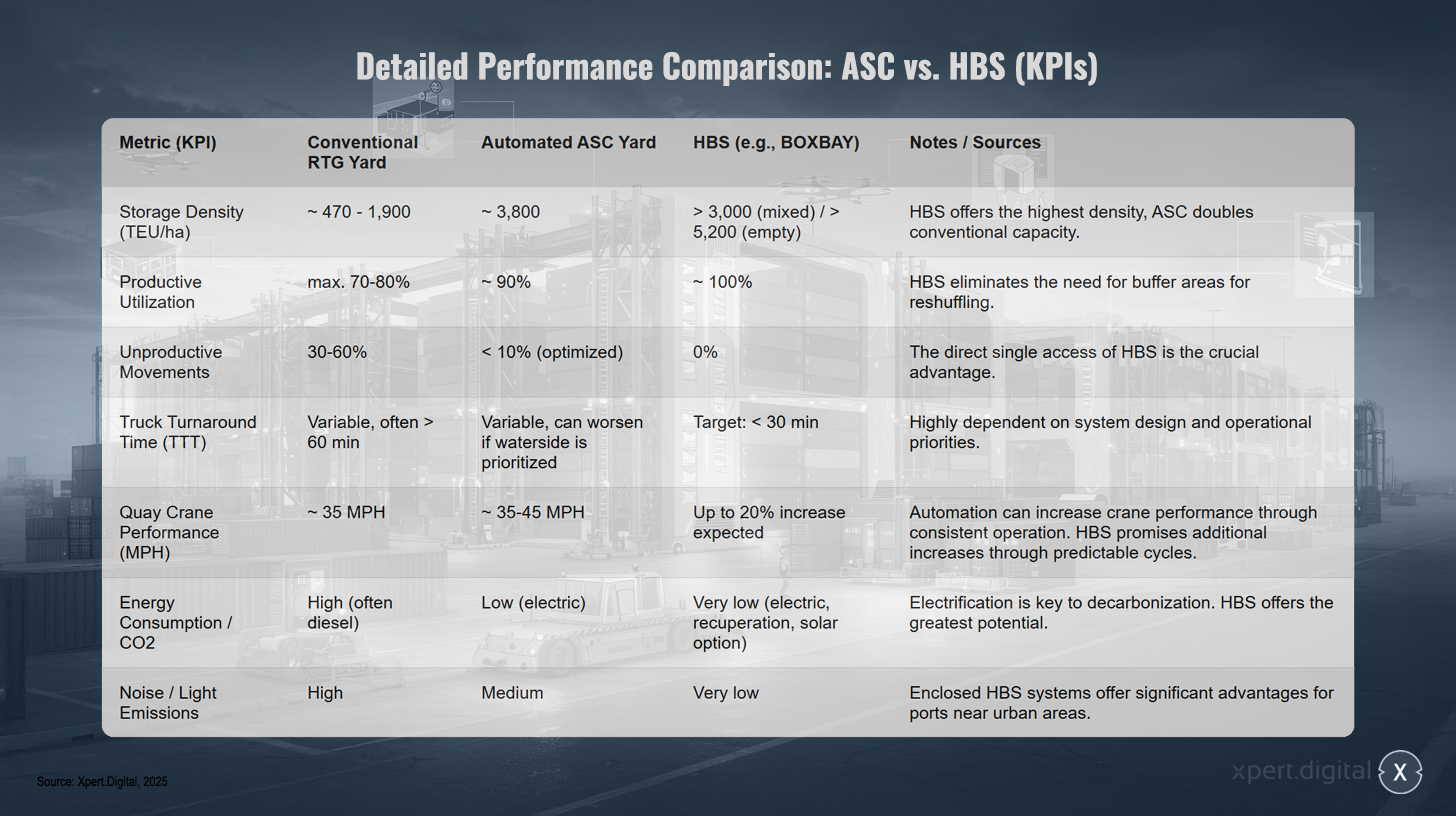
Detailed performance comparison ASC vs. HBS (KPIs)
Detailed performance comparison ASC vs. HBS (KPIs) – Image: Xpert.Digital
A comparison of performance indicators between conventional port handling systems, automated ASC yards and the High-Bay Storage System (HBS) reveals significant differences in various aspects of port logistics.
Storage density is a crucial factor: While conventional ports only achieve around 470 to 1,900 TEU per hectare, the automated ASC yard doubles this capacity to approximately 3,800 TEU. The HBS increases this even further, reaching over 3,000 TEU with mixed cargo and even more than 5,200 TEU with empty containers.
Productive utilization also improves significantly. Conventional systems achieve a maximum of 70-80%, automated systems increase this to about 90%, and the HBS can achieve almost 100% utilization because it eliminates the need for buffer areas for relocations.
Particularly impressive are the unproductive movements: While traditional ports have 30-60% unproductive movements, the ASC yard reduces this to below 10%. The HBS goes a step further and enables virtually 0% unproductive movements through direct individual access.
Further advantages are evident in energy efficiency and environmental aspects. Electric systems, and in particular the HBS with recuperation capabilities and solar options, offer significant improvements over conventional, often diesel-powered systems. The HBS also performs considerably better in terms of noise and light emissions, making it particularly attractive for ports near cities.
Quay crane performance can be increased by up to 20% through automation, with the HBS promising further efficiency gains through predictable cycles. Ideally, truck handling times should be under 30 minutes, depending on system design and operational priorities.
16. What are the key differences and challenges in implementation in "greenfield" vs. "brownfield" projects?
Deciding to automate a terminal is only the first step. The type of implementation – whether greenfield or brownfield – has a fundamental impact on the project's costs, schedule, and complexity.
Greenfield projects
A greenfield project refers to the construction of a new terminal on a previously undeveloped site. This is the ideal scenario for implementing highly integrated automation solutions.
Advantages: The greatest strength lies in the design freedom. The entire terminal layout, infrastructure, processes, and technology selection can be optimally coordinated from the ground up, without having to make compromises due to existing structures. This generally leads to greater long-term efficiency and enables the integration of the latest technologies.
Challenges: Initial investments (CAPEX) are naturally very high, as the entire infrastructure has to be built from scratch. The planning and approval phases are often lengthy. The BOXBAY pilot project in Jebel Ali was implemented in the context of the construction of Terminal 4 and can therefore be considered a quasi-greenfield project that demonstrated technical feasibility under ideal conditions.
Brownfield projects
A brownfield project refers to the modernization or automation of an existing, operational terminal. Since most of the world's ports are brownfields, the ability to retrofit is a crucial factor for the widespread market acceptance of a new technology.
Advantages: The main advantage lies in the use of existing investments and land. Initial infrastructure costs can be lower than for a completely new building.
Challenges: The complexity is immense. The new technology must be integrated into ongoing, often 24/7 operations without unduly impacting capacity and customer service. This requires a phased implementation, where parts of the terminal are rebuilt while others continue to operate. This process can take many years and lead to unforeseen costs and disruptions. A cautionary example is the partial automation of HHLA's Burchardkai terminal in Hamburg, which proved to be far more protracted and expensive than originally planned.
In this context, BOXBAY's first commercial order in Busan is of paramount importance. It is a pure brownfield project, where HBS is being retrofitted into an existing, highly productive terminal area. The success or failure of this project is being closely watched by the entire industry. A successful completion would prove that HBS technology is not merely a "greenfield fantasy," but a viable solution to the real-world problems faced by the majority of ports worldwide. It could be the crucial signal that many other terminal operators have been waiting for to reassess the perceived risk of such an investment and embark on their own HBS projects.
17. What is the current state of the market for container handling equipment and which companies are the main players?
The development of new storage technologies does not take place in a vacuum, but is part of a large and dynamic global market for container handling equipment.
Market size and growth
The global market for container handling equipment is a significant economic driver, with an estimated volume of US$8 to US$10 billion in 2024. Analysts predict a solid compound annual growth rate (CAGR) of approximately 4% to 5.4% for the coming years. This growth is driven by increasing global trade, the growing size of container ships, and the ongoing trend toward modernization and efficiency improvements in ports.
Main players
The market for heavy container handling equipment is dominated by a few global players. Konecranes (Finland), Liebherr (Switzerland), and Cargotec (Finland, with its Kalmar brand) together hold a significant market share of over 45%. Other important international players include Chinese manufacturers such as Sany and ZPMC (Shanghai Zhenhua Heavy Industries), which are gaining global importance due to their strong position in the Asian market and competitive pricing, as well as established brands like Hyster-Yale (USA) and Toyota Industries (Japan).
Market trends
The dominant trends shaping the market are automation and electrification. Driven by pressure to reduce costs, increase safety, and meet stricter environmental regulations, the demand for automated and semi-automated systems (such as ASCs and AGVs) as well as electrically or hybrid-powered equipment (such as E-RTGs or electric reach stackers) is continuously rising. Companies offering innovative, sustainable, and highly automated solutions can secure decisive competitive advantages.
18. Which storage system is best suited under which conditions?
The analysis shows that there is no one-size-fits-all solution for container storage. The choice of the optimal technology depends on a variety of specific factors, including terminal size, throughput volume, available space, capital costs, labor costs, and the operator's long-term strategic orientation. Based on the collected data, the following decision framework can be derived:
- RTG (Rubber-Tired Gantry Crane): Remains the best choice for small to medium-sized terminals with moderate throughput, where layout flexibility is paramount and investments in rigid infrastructure (CAPEX) should be limited. E-RTGs can mitigate the environmental disadvantages of diesel-powered versions.
- ASC (Automated Stacking Crane): This is the suitable solution for large terminals with high and stable throughput that want to pursue an evolutionary automation path. It is an investment in optimizing the proven block storage model, enabling high density and predictable performance, but requires a significant capital commitment to a rigid infrastructure.
- HBS (High-Bay Storage, e.g., BOXBAY): Represents the premium solution for terminals suffering from extreme space constraints in urban centers, where land costs are exorbitant and maximum operational predictability, speed, and sustainability are crucial. It is the most disruptive technology, requiring the highest initial investments, but also offering the greatest potential to solve the core problems of conventional systems. Ideal for greenfield projects, with the success of the Pusan project significantly determining its suitability for brownfield applications.
- UCL (Underground Logistics Systems): This is not a direct alternative to warehousing, but rather a strategic, long-term transport solution for large port complexes with multiple, spatially separated terminals, high internal transfer volumes, and significant congestion problems. It is most effective when combined with high-density storage systems like HBS at key hubs.
19. What are the critical success factors for a port operator when deciding on and implementing a highly automated warehouse system?
The successful implementation of a highly automated technology like ASC or HBS is far more than a mere technology or construction project. It is a profound business transformation. The following factors are crucial for success:
- Holistic strategy and realistic expectations: Automation should not be viewed in isolation as a mere technical upgrade. It requires a holistic strategy encompassing processes, IT, organization, and personnel. Operators must recognize that the return on investment can be lengthy and that initial productivity may not match the glossy brochures of vendors. The primary benefit often lies not in immediate cost reduction, but in the long-term improvement of operational safety, predictability, and sustainability.
- Process standardization before automation: Attempting to automate complex, historically grown, and inefficient manual processes one-to-one is a recipe for failure. Processes must be radically simplified, standardized, and optimized for automated operation before the technology is implemented. The ability to handle exceptions is a critical point that is often underestimated.
- Data, IT integration, and cybersecurity: A highly automated system is only as good as its data and software. Early investment in a robust, redundant IT infrastructure, uniform data standards, and seamless interfaces between all subsystems (TOS, gate system, crane control, WMS) is essential. With increasing connectivity, the risk of cyberattacks also rises, necessitating a comprehensive security concept.
- Personnel development and training: Automation does not necessarily lead to mass layoffs, but it radically changes job requirements. Manual tasks (crane operators, truck drivers in the yard) are eliminated, while new, highly skilled jobs are created in monitoring, control, IT, and maintenance of complex systems. A proactive approach to retraining and further qualifying the existing workforce is not only socially responsible but also economically necessary to compensate for the shortage of externally available skilled workers.
- Social partnership and communication: Resistance from employee representatives and trade unions is one of the biggest obstacles to automation projects. Early, transparent, and honest dialogue about the goals, impacts, and opportunities of the change is essential. Developing joint solutions for mitigating the social impact of the transition, sharing productivity gains, and shaping the new jobs can transform resistance into a constructive partnership and is a crucial factor for successful and smooth implementation.

Xpert.Plus Warehouse Optimization - High-bay warehouses and pallet warehouses: Consulting and planning
We are here for you - Consulting - Planning - Implementation - Project Management
☑️ Our business language is English or German
☑️ NEW: Correspondence in your native language!

Konrad Wolfenstein
I and my team are happy to be available to you as your personal advisor.
You can contact me by filling out the contact form here wolfenstein@xpert.digital:or simply call me at +49 7348 4088 965. My email address is
I'm looking forward to our joint project.