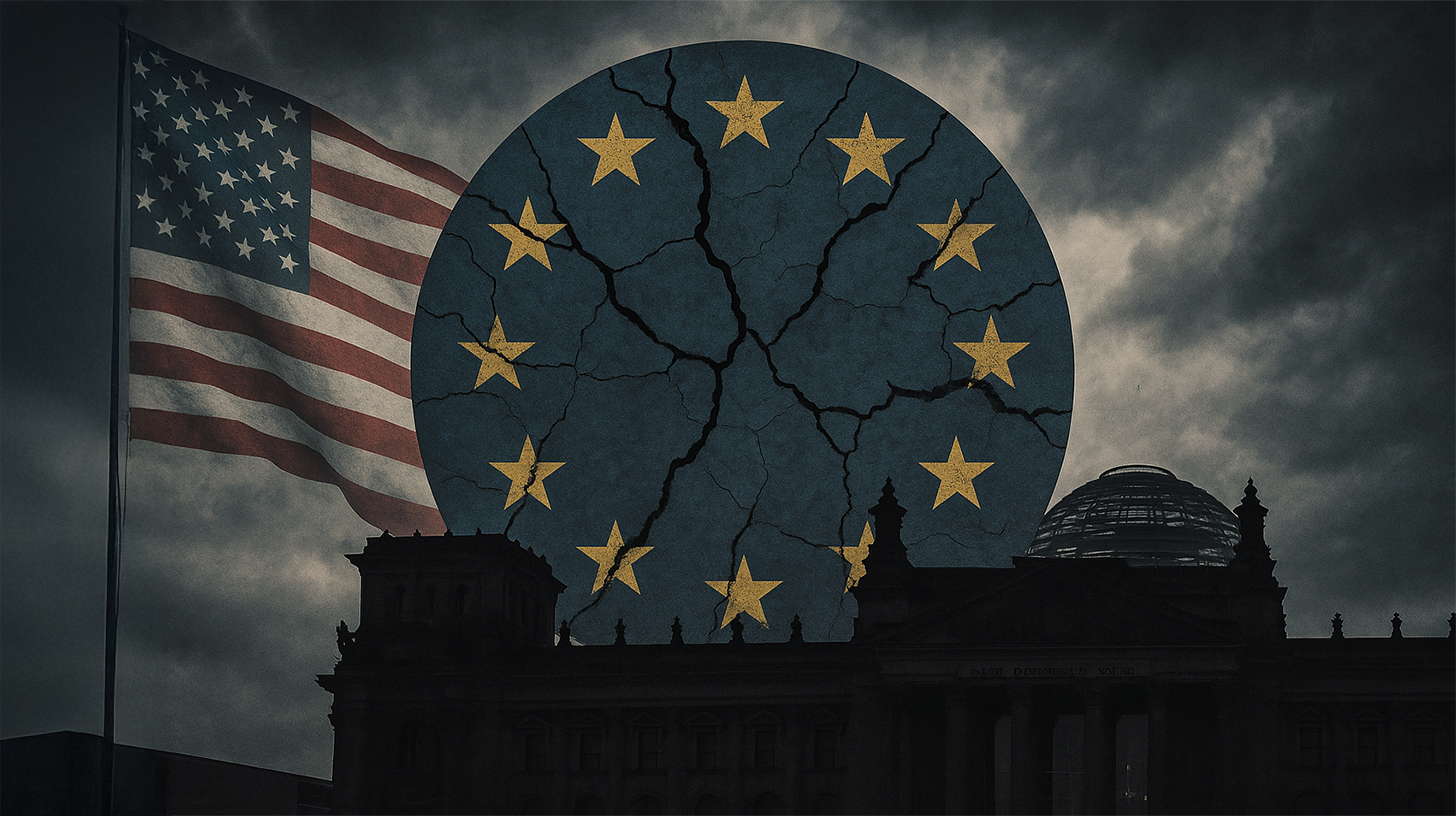
Consequences for Europe and Germany: The end of the comfort zone – Image: Xpert.Digital
US strategy targets “unstable governments” in Europe
The end of illusions: Why Germany is facing the toughest reality check in its history
A storm is brewing over the Atlantic that could shake the political and economic foundations of Germany to their core. The "National Security Strategy 2025" presents a scenario that signifies nothing less than the end of the current comfort zone for Europe – and especially for Germany. The era in which the transatlantic relationship was based on a romantic "community of values" appears to be irrevocably over. In its place is a hard, purely transactional alliance of interests, in which military protection is no longer a given, but a purchasable option.
The strategy paper outlines a double bind that poses an existential threat to the German business model: On the one hand, there is the demand for a massive increase in defense spending to 5 percent of gross domestic product – otherwise, a security vacuum looms due to a US withdrawal. On the other hand, Germany's export strength is no longer admired, but rather denounced as a "mercantilist threat" to American workers.
But the strategy goes even further: It deeply intervenes in European domestic politics, calls the welfare state into question, and demands an aggressive decoupling from China, our most important trading partner. Germany is thus faced with a choice between deindustrialization or total subordination. The following analysis unflinchingly reveals what awaits us, why moral appeals will fall on deaf ears in Washington, and what radical means of realpolitik Germany would have to employ to assert itself in this new, harsh world order.
Related to this:


The end of free security: The US demands 5% of GDP – or withdraws.
The "National Security Strategy 2025" is nothing less than a strategic shock for Europe, and especially for Germany. It heralds the end of the transatlantic partnership as a "community of values" and replaces it with a hard alliance of interests in which protection is a commodity. The consequences are existential and strike at the very core of the German business and security model.
1. The double pincer grip: loss of safety and economic pressure
For Europe, this strategy means the end of the free security guarantee. The demand for an increase in defense spending to 5% of GDP (referred to in the document as the "Hague Commitment") is hardly feasible for most European budgets, especially Germany's, under current political conditions without drastically cutting back the welfare state.
Safety vacuum
Should Europe fail to pay, the US risks withdrawing. Since the strategy aims for a swift end to the Ukraine war through a deal with Russia, Europe could be forced to either accept Russian territorial gains or continue the conflict without US support – an impossible undertaking.
Economic warfare
The US views the German trade surplus not as a sign of competitiveness, but as "mercantilist overcapacity" that harms US workers. The consequence is punitive tariffs and the obligation to buy US products (especially LNG and defense) to balance the trade deficit.
2. Germany in the crosshairs: The end of the “German business model”
The document explicitly and sharply criticizes Germany. It diagnoses German chemical companies as shifting production to China to utilize Russian gas, which they can no longer obtain domestically. This is portrayed as a strategic betrayal of Western interests.
Ultimatum for industry: Germany must choose between the Chinese and US markets
Germany faces a choice: either it severs its deep economic ties with China (its most important trading partner) and loses huge export markets, or it risks losing access to the US financial market and technology transfers. This strategy effectively requires the deindustrialization of Germany in favor of the re-industrialization of the USA.
Political destabilization
The strategy openly announces support for "patriotic parties" in Europe and aims to work against "unstable minority governments" portrayed as democratically questionable. For Germany's traffic light coalition (or similar constellations), this means that Washington could actively work against them by strengthening opposition forces ideologically closer to the "America First" policy.
3. Ideological rollback
The strategy rejects the EU's core projects – climate protection ("Net Zero") and supranational governance. It calls for a "restoration of Europe's civilizational self-confidence" and warns that some NATO states could become "predominantly non-European" due to migration. This puts European governments under pressure: if they cooperate with the US, they betray their liberal values; if they do not, they risk their security.
Hub for Security and Defense - Advice and Information

Hub for Security and Defense - Image: Xpert.Digital
The Security and Defence Hub offers expert advice and up-to-date information to effectively support companies and organizations in strengthening their role in European security and defence policy. Working closely with the SME Connect Defence Working Group, it particularly promotes small and medium-sized enterprises (SMEs) that wish to further develop their innovative capacity and competitiveness in the defence sector. As a central point of contact, the Hub thus creates a crucial bridge between SMEs and European defence strategy.
Related to this:
Realpolitik with Washington: How Germany reaches Trump's USA with deals instead of morality
Ways to restore cooperation: Realpolitik instead of morality
A return to the old romanticism of the "Atlantic bridge" is out of the question. Cooperation with this US administration can only be salvaged through radical transactionalism and an adaptation of rhetoric.
Related to this:

1. Accept the "pay-to-play" principle
Germany must understand security as a service for which one pays.
Massive arms investments
Instead of discussing 2%, Germany should immediately put together massive arms packages – ideally by purchasing US systems (F-35, missile defense) – to satisfy Washington economically.
Energy deals
Long-term contracts for the purchase of US fracking gas (LNG) could serve as geopolitical protection money to avert tariffs on German cars.
2. Bilateralism instead of Brussels
The strategy emphasizes the "primacy of nations." Germany should not attempt to negotiate through the EU (which is despised in Washington as a bureaucratic monster), but rather seek direct, bilateral deals with the White House. A "US-German Partnership Deal" would have a better chance of success than an EU-US summit.
3. Selling strategic autonomy as "burden shifting".
Paradoxically, both sides want the same thing: for Europe to defend itself. Germany could frame the demand for "European sovereignty" in such a way that it is precisely the "burden shifting" that Trump wants. By assuming the lead in Europe's conventional defense, Germany would relieve the US of this burden in the Indo-Pacific conflict.
4. The China Compromise
Germany must credibly demonstrate that it will no longer supply critical technology to China. A strict export control regime, modeled on US regulations, is the price of remaining in the core Western technological sphere.
5. Rhetorical disarmament
German politicians need to stop lecturing the US on morality. In talks with Washington, terms like "international order" or "climate justice" should be avoided, and instead, vocabulary such as "national interests," "supply chain security," and "deal" should be used. One must speak the partner's language to be heard.
Consulting - Planning - Implementation

Markus Becker
I would be happy to serve as your personal advisor.
Head of Business Development
Chairman SME Connect Defense Working Group
Consulting - Planning - Implementation
Konrad Wolfenstein
I would be happy to serve as your personal advisor.
You can contact me at wolfenstein∂xpert.digital or
Just call me on +49 7348 4088 965 .
Your dual-use logistics experts

Dual-use logistics experts - Image: Xpert.Digital
The global economy is currently undergoing a fundamental transformation, a watershed moment that is shaking the foundations of global logistics. The era of hyper-globalization, characterized by the relentless pursuit of maximum efficiency and the "just-in-time" principle, is giving way to a new reality. This new reality is marked by profound structural breaks, geopolitical power shifts, and increasing fragmentation of economic policy. The once taken-for-granted predictability of international markets and supply chains is dissolving and being replaced by a period of growing uncertainty.
Related to this:
Our global industry and economic expertise in business development, sales and marketing

Our global industry and economic expertise in business development, sales and marketing - Image: Xpert.Digital
Industry focus areas: B2B, digitalization (from AI to XR), mechanical engineering, logistics, renewable energies and industry
More information here:
A thematic hub offering insights and expertise:
- Knowledge platform covering global and regional economies, innovation and industry-specific trends
- A collection of analyses, insights, and background information from our key areas of focus
- A place for expertise and information on current developments in business and technology
- A hub for companies seeking information on markets, digitalization, and industry innovations