Competition regulation in Europe: Who is affected by the Digital Markets Act? – Image: Xpert.Digital
🔒 The Digital Markets Act: Groundbreaking regulation for large online platforms
📜 Introduction to the Digital Markets Act (DMA)
In October 2022, the European Union adopted the Digital Markets Act (DMA), which primarily aims to regulate so-called "very large online platforms" and their potentially damaging practices. According to the DMA, dominant online companies such as Alphabet, Apple, Meta, and Microsoft, for example, will no longer be allowed to display their own products more prominently than those of competitors in search results and must allow users to access third-party services from their platforms. Furthermore, users must be given the option to use software other than the pre-installed software, such as specific browsers, and the ability to uninstall such programs.
⏳ Implementation of the requirements and initial investigations
The EU had granted companies a grace period to implement these regulations, which expired on March 7, 2024. Nevertheless, according to the EU, some of the "gatekeepers" still appear not to have sufficiently fulfilled their obligations. As Reuters reports, the EU launched investigations last Monday into Apple, Google's parent company Alphabet, and Meta to uncover potential violations.
📊 Statistical insights and market dominance
The extent to which our digital lives are dominated by these "very large online platforms" is illustrated by the graphic. According to the DMA, for example, the meta-products WhatsApp and Messenger are found in the messaging category, while Alphabet has virtually monopolized the search and video segment with Google Search and YouTube. Three of the six "gatekeepers" are represented in each of the social media and advertising segments.
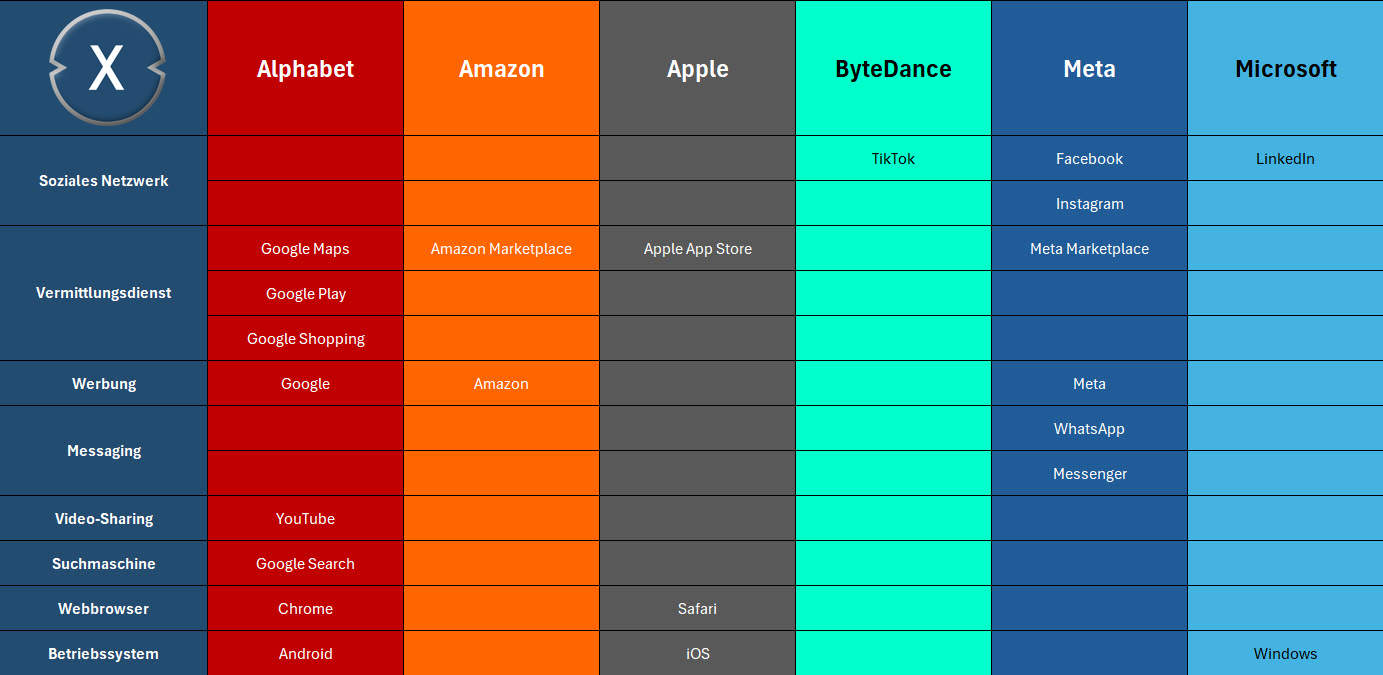
Gatekeeper overview according to the Digital Markets Act (DMA) – Image: Xpert.Digital
🌍 New EU laws for a fair digital market
The new laws for digital markets and digital services, the Digital Markets Act and the Digital Services Act, are the first of their kind to extend beyond national borders and apply EU-wide. While the latter is primarily aimed at the e-commerce sector and prescribes new due diligence obligations for large online platforms, the former aims to ensure fairer competition for services such as social media platforms, search engines, operating systems, and browsers.
🔊 Comments on the introduction of the new regulation
“Europe has agreed on the world’s strictest rules for greater competition and fairness among the major digital players,” commented Sven Giegold, State Secretary at the Federal Ministry for Economic Affairs and Climate Action, on the introduction of the new regulations. “The large platform companies will be subject to clear and tough rules and can no longer unilaterally dictate the rules of the game.”
🖥️ The digital landscape and the influence of online platforms
In the digital age, online platforms have become key players in our daily lives. They influence how we shop, communicate, search for information, and consume. The significant market shares and spheres of influence of tech giants like Alphabet (Google), Meta (formerly Facebook), Apple, and Amazon have attracted global regulatory attention due to their controversial market power and data practices. One concrete result of this process is the Digital Markets Act (DMA), adopted by the European Union in October 2022. The DMA aims to regulate the business practices of so-called "very large online platforms," often referred to simply as "gatekeepers.".
🏗️ Objectives and measures of the DMA
The Digital Market Act (DMA) was conceived out of the need to ensure a fair and competitive environment in the digital market. Its aim is to prevent dominant companies from abusing their market power to restrict the scope of action of smaller competitors and new market entrants. The Act includes a number of core commitments for gatekeepers, designed to promote a balance between large technology companies and consumers, small businesses and society as a whole. It affects corporations such as Alphabet, Meta, Apple, Amazon, Microsoft, Alibaba, ByteDance, eBay, and Netflix, which, due to their size and reach, occupy a key position in the digital economy.
👩💼👨💼 Consumer rights and competition promotion
The DMA regulations stipulate, for example, that online giants may not favor their own products in their search results and that consumers must have the freedom to access third-party offers through these platforms. This also means that users must be able to remove or modify pre-installed software—such as certain browsers or apps—in order to use alternatives. This is a step towards strengthening consumer rights and promoting innovation through competition.
🔍 Ongoing investigations and compliance
Companies were granted a transition period until March 7, 2024, to make the necessary adjustments. However, Reuters reported that some of the gatekeepers have not yet sufficiently complied with their obligations. Consequently, the EU launched investigations into companies such as Apple, Google's parent company Alphabet, and Meta to examine potential violations of the DMA's requirements.
📈 Dominant market position and Digital Services Act
The presence and dominance of these very large online platforms are reflected in numerous areas of everyday digital life. For example, the messaging segment is largely dominated by meta-products like WhatsApp and Messenger, while Alphabet, with Google Search and YouTube, holds significant shares in the search and video segments. In the social media and advertising segments, at least three of the six gatekeepers are often actively involved, underscoring their dominant market position.
💬 Reactions and future direction
The introduction of the DMA, together with the Digital Services Act (DSA), which focuses primarily on the e-commerce sector and establishes due diligence obligations for online platforms, marks a historic moment. Both laws are the first of their kind to apply across borders throughout the EU. They represent exemplary models for the regulation of digital markets and services at the international level.
🌐 Europe's efforts towards a transparent digital market
Sven Giegold, then State Secretary in the Federal Ministry for Economic Affairs and Climate Action, commented on the introduction of the new regulations as unprecedentedly strict and groundbreaking. Europe has agreed on the world's strictest rules for greater competition and fairness among the major digital players, he said. The large platform companies will be subject to clear and stringent rules and can no longer unilaterally dictate the rules of the game.
🔮 Future of the Digital Markets Act and digital challenges
In the spirit of these regulatory innovations, the DMA represents Europe's ambition to be at the forefront of a fair, transparent, and integrated digital market. These targeted regulatory measures are also intended to strengthen the European economy by creating a more level playing field where established companies and startups alike can thrive. This is crucial, as healthy competition fosters innovation, strengthens consumer protection, and ultimately contributes to the creation of high-quality jobs and services.
🧐 Observations and expectations regarding implementation
It remains to be seen how the implementation of the DMA will further shape the digital landscape in Europe and beyond. Critics call for transparency and consistent enforcement, while proponents welcome the reforms as a crucial step towards securing a digital era characterized by diversity, fairness, and equal opportunities. What is already becoming apparent, however, is a historic shift in how we understand and shape the digital superpowers and how we interact with them.
📣 Similar topics
- 📈 Challenges and opportunities of the Digital Markets Act (DMA)
- 🌐 EU regulation of online platform giants
- 👩💻 Promoting competition: Influence of the DMA and DSA
- 🔧 Strengthening consumer rights in the digital space
- 🛡️ EU-wide measures against the market power of tech giants
- 🏛️ New era of digital market regulation by the EU
- 📲 Revolution in dealing with pre-installed software and browsers
- 🔍 Promoting transparency and fairness in search engine optimization
- 🏅 Europe's push for a fair digital marketplace
- 🏢 Investigation of competition violations by EU bodies
#️⃣ Hashtags: #DigitalMarketsAct #EUDigitalRegulation #OnlinePlatforms #TechnologyGiants #DigitalFairness
🎯🎯🎯 Benefit from Xpert.Digital's extensive, five-fold expertise in one comprehensive service package | BD, R&D, XR, PR & Digital Visibility Optimization


Benefit from Xpert.Digital's extensive, five-fold expertise in a comprehensive service package | R&D, XR, PR & Digital Visibility Optimization - Image: Xpert.Digital
Xpert.Digital possesses in-depth knowledge across various industries. This allows us to develop tailored strategies precisely aligned with the requirements and challenges of your specific market segment. By continuously analyzing market trends and monitoring industry developments, we can act proactively and offer innovative solutions. The combination of experience and expertise generates added value and provides our clients with a decisive competitive advantage.
More information here:
💪 Ranking of the world's most valuable companies 2024
🌐📈 The global importance of company market capitalization
Market capitalization is an indicator that not only reflects a company's size and economic footprint but also reacts to global economic forces and investor sentiment. This metric, which measures the total value of a company's shares based on current stock prices, is subject to constant change, which becomes particularly evident during volatile market phases.
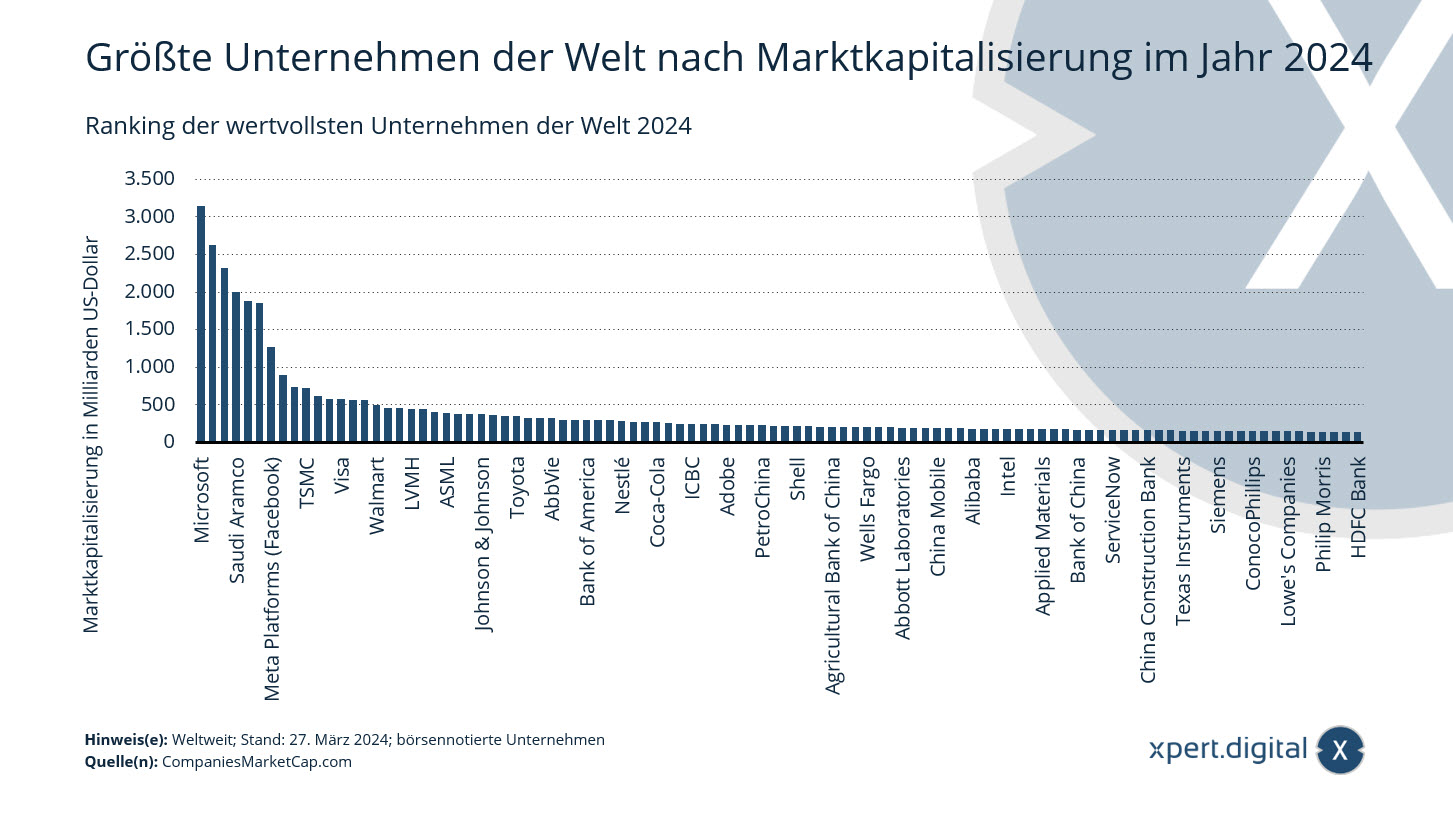
Ranking of the world's most valuable and largest companies by market capitalization in 2024 (in billion US dollars; as of March 2024) – Image: Xpert.Digital
🆙🏢 Microsoft's rise to become the world's most valuable company
At the epicenter of this economic dynamism is the US tech company Microsoft. At the beginning of 2024, it climbed to the top of the ranking of the world's most valuable companies, measured by their market capitalization. The pioneer and long-time leader Apple, which had topped the list for many years, had to relinquish its position to its competitor.
💻🚀 Microsoft's dominance thanks to innovations in AI
Microsoft, founded by technology icon Bill Gates, has established itself across a broad spectrum, particularly in the development of hardware and software, as well as in the provision of cloud services. As of March 27, 2024, the company's market capitalization reached the astronomical sum of approximately $3.1 trillion. Recent innovations in the field of artificial intelligence played a crucial role in this valuation. Such technologies are considered key drivers of future productivity gains and economic transformation.
🍎🧮 Apple and its strong competitive status
Not far behind these impressive figures is iPhone manufacturer Apple, whose headquarters are in Cupertino, California. With a market capitalization of approximately 2.62 trillion US dollars, Apple also demonstrates a high level of investor confidence and a strong market position.
🖥️🦾 NVIDIA and technological progress
The leading trio is completed by the US chip manufacturer NVIDIA, which, with a market value of around 2.31 trillion US dollars, has overtaken many traditional industrial giants as well as the previous oil industry behemoth, Saudi Aramco. This illustrates the powerful rise of the technology sector in the 21st century.
🚀📊 Dominance of tech giants in the economic rankings
Within the elite club of the world's 100 most valuable companies, other names from the technological elite can be found: Alphabet, the parent company of Google, occupies fifth place with approximately US$1.88 trillion, closely followed by Amazon, the online retail giant, in sixth place with approximately US$1.85 trillion. This underscores the dominance of the technology sector in the current economic landscape.
🇩🇪🏭 German companies and their positioning
The German economy, however, is rather modestly represented in this ranking of global heavyweights: only two companies – SAP and Siemens – made it into the top 100. Software manufacturer SAP, with a market capitalization of approximately US$229.5 billion, ranks 47th. Siemens, known for its electrical engineering and automation technologies, is also on this exclusive list, albeit further down the ranking.
🌟💡 The story behind the numbers
But behind the impressive market capitalization figures lie far more than just monetary valuations – they are stories of innovation, economic acumen and visionary leadership.
Microsoft's rise to the top is a direct result of its continuous adaptability and innovative strength. The development of its cloud business, Azure, and the ongoing success of the Windows operating system and the Office suite laid the foundation for its long-term success. At the same time, the exploration of new areas such as artificial intelligence, machine learning, and the development of edge computing solutions ensures a sustainable future. The company's vision of "empowering every person and every organization on Earth to achieve more" is supported by these strategic decisions.
Apple, Microsoft's direct competitor, has a similar story to tell. Famous for its innovative products and services, Apple revolutionized the global mobile technology market with the iPhone. Furthermore, the company has expanded its product lines to include the iPad, Mac, Apple Watch, and services such as the App Store and Apple Music. Given the digital transformation of our society, the ecosystem Apple has built will continue to be a fundamental part of our daily lives.
🔄🌌 NVIDIA's impetus for technological breakthroughs
NVIDIA's remarkable achievements in the world of technology have been attained through groundbreaking advances in graphics processors for gaming and professional markets, as well as through its role in the development of artificial intelligence and autonomous vehicles.
🌱📈 Economic growth and innovation
Despite all the fluctuations in market capitalization, it is the drive for innovation that not only keeps these companies afloat but propels them to the forefront. They reflect the central themes of our time: digitalization, artificial intelligence, and the relentless pursuit of forward-looking development that forms the basis of modern economic growth.
📣 Similar topics
- 🏦 The giants of the economy: Microsoft overtakes Apple
- 📈 Market capitalization: The ups and downs of stock market values
- 🌐 Artificial Intelligence – Driving Force in Company Valuations
- 🔝 Microsoft at the top: The most valuable companies in the world
- 🍏 Apple's position in global economic dynamics
- 🧠 NVIDIA: Technological rise and importance for the market
- 🌟 The German representatives in the global market: SAP and Siemens
- 🤖 Innovative technologies as the basis for economic success
- 💻 Microsoft's strategy: Adaptability and innovation
- 📱 Apple's ecosystem: The foundation of our digital everyday life
#️⃣ Hashtags: #MarketCapitalization #Microsoft #Apple #Technology #Innovation
📈 Here are the top 100 most valuable companies in the world - as of March 2024
Largest companies in the world by market capitalization in billions of US dollars in 2024
- Microsoft – 3,133
- Apple – 2,620
- NVIDIA – 2,314
- Saudi Aramco – 1,994
- Alphabet (Google) – 1,878
- Amazon – 1,852
- Meta Platforms (Facebook) – 1,264
- Berkshire Hathaway – 890.38
- Eli Lilly – 736.74
- TSMC – 720.16
- Broadcom – 617.04
- Novo Nordisk – 577.43
- Visa – 576.37
- Tesla – 565.84
- JPMorgan Chase – 563.77
- Walmart – 487.59
- UnitedHealth – 453.87
- Exxon Mobil – 451.50
- LVMH – 446.53
- Mastercard – 444.80
- Samsung – 393.83
- ASML – 391.27
- Procter & Gamble – 377.77
- Home Depot – 376.51
- Johnson & Johnson – 375.37
- Tencent – 359.88
- Oracle – 347.60
- Toyota – 342.77
- Costco – 324.19
- Merck – 317.89
- AbbVie – 317.28
- Salesforce – 296.65
- Kweichow Moutai – 295.61
- Bank of America – 292.66
- Chevron – 288.37
- AMD – 287.46
- Nestlé – 276.42
- Hermès – 272.51
- Netflix – 272.30
- Coca-Cola – 260.99
- L'Oréal – 252.13
- Reliance Industries – 242.73
- ICBC – 242.41
- International Holding Company – 238.64
- PepsiCo – 237.41
- Adobe – 229.71
- SAP – 229.54
- Linde – 225.16
- PetroChina – 222.83
- Walt Disney – 219.98
- Thermo Fisher Scientific – 216.89
- Shell – 214.89
- Accenture – 211.49
- AstraZeneca – 205.65
- Agricultural Bank of China – 202.16
- Roche – 201.53
- McDonald's – 201.17
- Wells Fargo – 200.66
- Cisco – 200.63
- Novartis – 195.74
- Abbott Laboratories – 193.47
- T-Mobile US – 191.20
- General Electric – 189.73
- China Mobile – 188.08
- QUALCOMM – 186.45
- Danaher – 183.78
- Alibaba – 179.75
- Intuit – 179.20
- Caterpillar – 177.97
- Intel – 177.53
- IBM – 172.80
- Verizon – 171.97
- Applied Materials – 171.72
- Comcast – 168.72
- Tata Consultancy Services – 167.91
- Bank of China – 166.08
- Uber – 161.78
- American Express – 161.61
- ServiceNow – 159.60
- Pinduoduo – 159.56
- Total Energies – 159.48
- China Construction Bank – 158.76
- Pfizer – 156.22
- Inditex – 155.09
- Texas Instruments – 152.80
- Amgen – 151
- HSBC – 150.74
- Siemens – 149.94
- Dior – 149.93
- Morgan Stanley – 149.26
- ConocoPhillips – 148.21
- Union Pacific Corporation – 146.76
- Airbus – 145.83
- Lowe's Companies – 143.85
- BHP Group – 143.09
- Intuitive Surgical – 140.93
- Philip Morris – 140.31
- Nike – 140.26
- Royal Bank Of Canada – 140.18
- HDFC Bank – 138.08
🌐📈 Global technology giants and their economic power
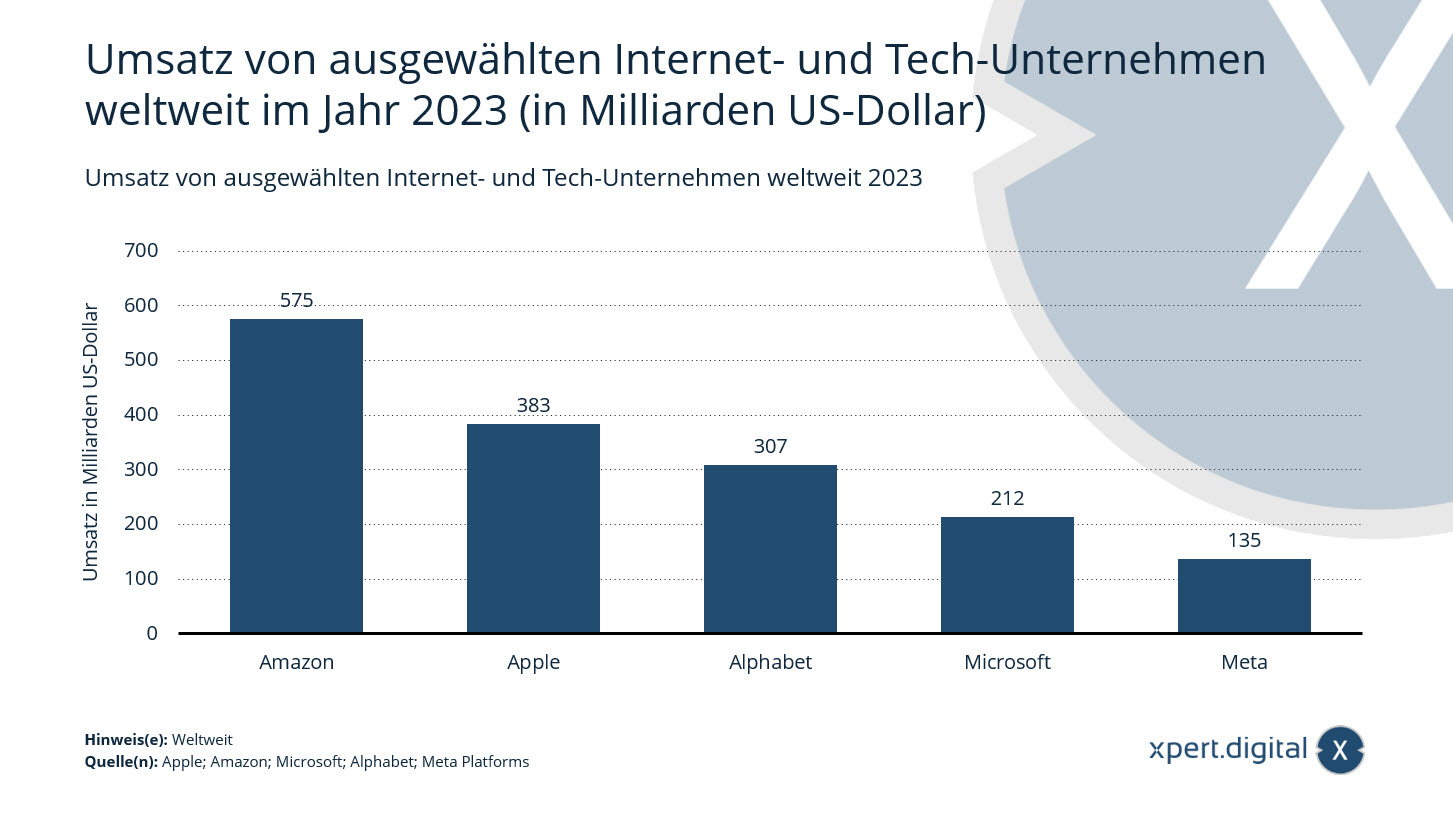
Revenue of selected internet and tech companies worldwide in 2023 – Image: Xpert.Digital
💰 Revenue of selected internet and tech companies worldwide in 2023
- Amazon – 575 billion US dollars
- Apple – 383 billion US dollars
- Alphabet – 307 billion US dollars
- Microsoft – 212 billion US dollars
- Meta – 135 billion US dollars
🚀 The innovative power of Apple
In 2023, major internet and technology companies worldwide recorded record revenues, impressively underscoring the dominance of these giants in the global economy. Despite economic uncertainty and fluctuations in global markets, their position as leading players in the digital space remains unchallenged.
Apple, one of the "Big Five" tech giants, experienced a slight revenue decline of approximately three percent, but the company remains a significant competitor with its innovative products and comprehensive service offerings. While the specific reasons for this revenue decline are not always obvious, some experts point to market saturation, intense competition, and the need for continuous innovation as possible explanations.
🌟 Amazon's market conquest through innovation
Amazon, on the other hand, has massively increased its revenues, with part of this success attributable to its strong business-to-business segment, particularly Amazon Web Services. This division offers cloud computing services that play a central role in managing and processing large amounts of data and in the operation of many businesses. The marketplace business, where Amazon serves as a platform for other sellers, has also contributed to this growth, bringing revenue to nearly $575 billion.
💻 AI Giants Battle
In the technology-driven era of artificial intelligence (AI), internet companies are engaged in intense competition, particularly regarding the development and implementation of AI applications. Companies like Microsoft, Amazon, Google, and Meta are deeply involved in a race for market share and innovation, in which the potential applications of AI play a central role. Microsoft, for example, has made a name for itself with the groundbreaking success of ChatGPT, an advanced natural language processing model. This involves not only the ability to understand and generate natural language, but also the development of systems that are capable of learning and improving over time.
🔮 Apple's secret about upcoming AI projects
Apple remained silent until recently, but CEO Tim Cook has announced an AI innovation for 2024 that has the potential to revolutionize the market. Although the details of Apple's AI push are still unknown, the tech world eagerly anticipates how the company will combine its traditional strengths in product design and user experience with the latest developments in AI.
📊 Meta's revenue jumps through advertising revenue
Meta, the company behind the powerful platforms Facebook and Instagram, also reported impressive revenue growth, primarily driven by advertising income. More than 90 percent of Meta's revenue is generated through ads on these platforms, underscoring their importance as key channels for online marketing. Meta is experiencing particularly strong advertising revenue in the US and Canada, but the company is also seeing robust growth in the Asia-Pacific region, where a growing number of businesses are recognizing and leveraging the potential of digital marketing.
💡 Importance of digital presence and e-commerce
A strong presence in digital media has proven crucial for the success of companies across all sectors. This is particularly evident in e-commerce, where a robust online presence is directly linked to sales. The online advertising market has evolved accordingly, with targeted advertising using data analytics and AI playing a key role.
📲 Mobile devices and social media as marketing innovators
The dynamics of the online advertising market also benefit from the increasing prevalence of mobile devices and the rising user numbers of social media platforms, which enable innovative forms of marketing such as influencer marketing and social shopping. Meta has positioned itself in this market through the continuous integration of advertising opportunities and commercial features into its platforms.
🔬 R&D as the key to technological advancement
Tech companies are also investing heavily in research and development to improve their products and services. These investments are essential, as they help drive technological growth and ensure that companies remain competitive. They also stimulate job creation and drive progress in other sectors such as healthcare, education, and transportation.
🌐 Next waves of innovation: AI, IoT and automation
Artificial intelligence, the Internet of Things (IoT), the automation of work processes, and the networking of data and machines are considered the next major fields of innovation. The "Big Five" and other tech companies are pioneers in the development and application of these technologies, which will have far-reaching effects on society and the economy.
Criticism and challenges for tech giants
The economic power and technological influence of large tech companies are not without challenges and criticism. Data privacy concerns, monopolistic tendencies, and the impact on the labor market are just some of the aspects that shape the debate about the role and responsibility of these companies in our modern world. Ultimately, the ability of these companies to commit to ethical standards and exert a positive influence on society will ensure not only short-term profits but also long-term, sustainable success.
📣 Similar topics
- 🌍 Global dominance of internet and technology companies
- 🍏 Apple's challenges and innovation potential
- 📊 Amazon's success story: AWS and marketplace dynamics
- 🤖 Artificial intelligence as a competitive factor in the tech sector
- 🚀 Microsoft and ChatGPT: Pioneers in speech processing
- 🧠 Apple's future AI innovations and their impact on the market
- 💡 Advertising revenue as the driving force behind Meta's revenue growth
- 📢 The importance of online marketing and targeted advertising
- 📱 The influence of mobile and social media on modern marketing strategies
- 🔬 Investments in research and development as a key to technological progress
#️⃣ Hashtags: #TechnologyGiants #ArtificialIntelligence #DigitalEconomy #Innovations #OnlineMarketing
🏭🌍 Future of Export – Digital Platforms for Mechanical Engineering – What has global sales been like so far and how can they be boosted?


Future of Export – Digital Platforms for Mechanical Engineering – Image: Xpert.Digital
One of the best-known examples of these platforms is Alibaba. As a global wholesale portal, it connects manufacturers, suppliers, and wholesalers with potential business partners around the world.
Other well-known platforms in the B2B sector include Amazon Business, which has established itself as a professional version of the popular B2C marketplace and offers a wide range of products and services. More specialized providers, such as ThomasNet, DirectIndustry, and Wer liefert was (WLW), also offer comprehensive catalogs and are tailored to the B2B market.
More information here:
📜 Example: B2B trading platform Alibaba: The Digital Markets Act (DMA) and its significance for gatekeeper platforms
🚀 The Digital Markets Act (DMA) is a regulatory framework of the European Union that aims to ensure fair and open digital markets. It targets so-called "gatekeeper" platforms, i.e., large online companies that play a key role in the digital economy and meet certain criteria, such as a strong market position, a large number of users, and a platform that serves as an important access point for businesses to customers.
🌐 Alibaba's presence in Europe
Although Alibaba is primarily based in China, it also operates in other countries and regions, including Europe. To the extent that Alibaba meets these gatekeeper criteria under the DMA, the law would also affect the company's business operations within the EU. The DMA requires gatekeepers to comply with certain obligations, such as prohibiting certain unfair business practices, and imposes certain restrictions on them to promote fairer competition.
🎯 Obligations and restrictions for gatekeepers
Examples of obligations and restrictions under the DMA are:
- Preventing the preferential treatment of one's own services or products over those of third parties on one's platform.
- Permission for users to uninstall pre-installed software or apps.
- Business users must have free access to their data generated on the platform.
- Restricting practices that make it difficult for users to switch between different services and platforms.
🛠 Alibaba's adaptation to the DMA
If Alibaba is considered a gatekeeper in the EU under the DMA, the company would have to ensure that its business practices and platform comply with the DMA's provisions. Non-compliance could result in substantial fines, potentially amounting to up to 10% of the company's global annual revenue.
🔍 Future influence of the DMA on Alibaba
However, it is important to note that the precise impact of the DMA on Alibaba depends on the extent to which Alibaba's specific business activities in the EU meet the gatekeeper criteria and how the DMA is specifically implemented and enforced. Companies like Alibaba, headquartered outside the EU, are nevertheless obligated to comply with the DMA rules if they conduct business in the EU and meet the gatekeeper criteria.
📣 Similar topics
- 🔒 The DMA and its impact on international tech giants
- 🌍 Alibaba in Europe: The DMA's influence on non-European companies
- ⚖️ Fair competition: The role of the DMA in the digital market economy
- 📱 Changes for users: How DMA affects the technology experience
- 💼 Business practices under the DMA: New rules for gatekeeper companies
- 🔑 Identifying Gatekeepers: Criteria and Consequences in the DMA
- 🚀 China's tech giants and European regulation: The Alibaba example
- ☝️ Platform restrictions: How the DMA is fighting market monopolies
- 📊 Access to data and DMA: What changes for business users?
- 🤝 User freedom and platform choice: The changes brought about by the DMA
#️⃣ Hashtags: #DigitalMarketsAct #GatekeeperPlatforms #DMAandAlibaba #PromotingFairCompetition #TechnologyRegulationEurope
We are here for you - Consulting - Planning - Implementation - Project Management
☑️ Industry expert, here with his own Xpert.Digital industry hub featuring over 2,500 specialist articles

Konrad Wolfenstein
I would be happy to serve as your personal advisor.
You can contact me by filling out the contact form below or simply call me on +49 7348 4088 965 .
I'm looking forward to our joint project.
Write to me


Xpert.Digital - Konrad Wolfenstein
Xpert.Digital is a hub for industry focusing on digitalization, mechanical engineering, logistics/intralogistics and photovoltaics.
With our 360° Business Development solution, we support renowned companies from new business to after-sales.
Market intelligence, smarketing, marketing automation, content development, PR, mail campaigns, personalized social media and lead nurturing are part of our digital tools.
You can find more information at: www.xpert.digital - www.xpert.solar - www.xpert.plus
Keep in touch

Industrial & B2B Business Metaverse: Reduce costs with XR technology for photorealistic product images (XR 3D rendering machine)

Lathe in photorealistic rendering (3D product presentation) - Image: Xpert.Digital
XR technology offers a superior solution for creating photorealistic images, allowing companies to avoid the expensive fees charged by external media agencies. It's well known that media agencies charge high prices for creating such images, as this requires expertise, specialized software, and collaboration with various specialists.
More information here: