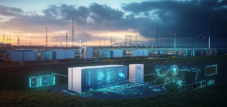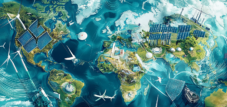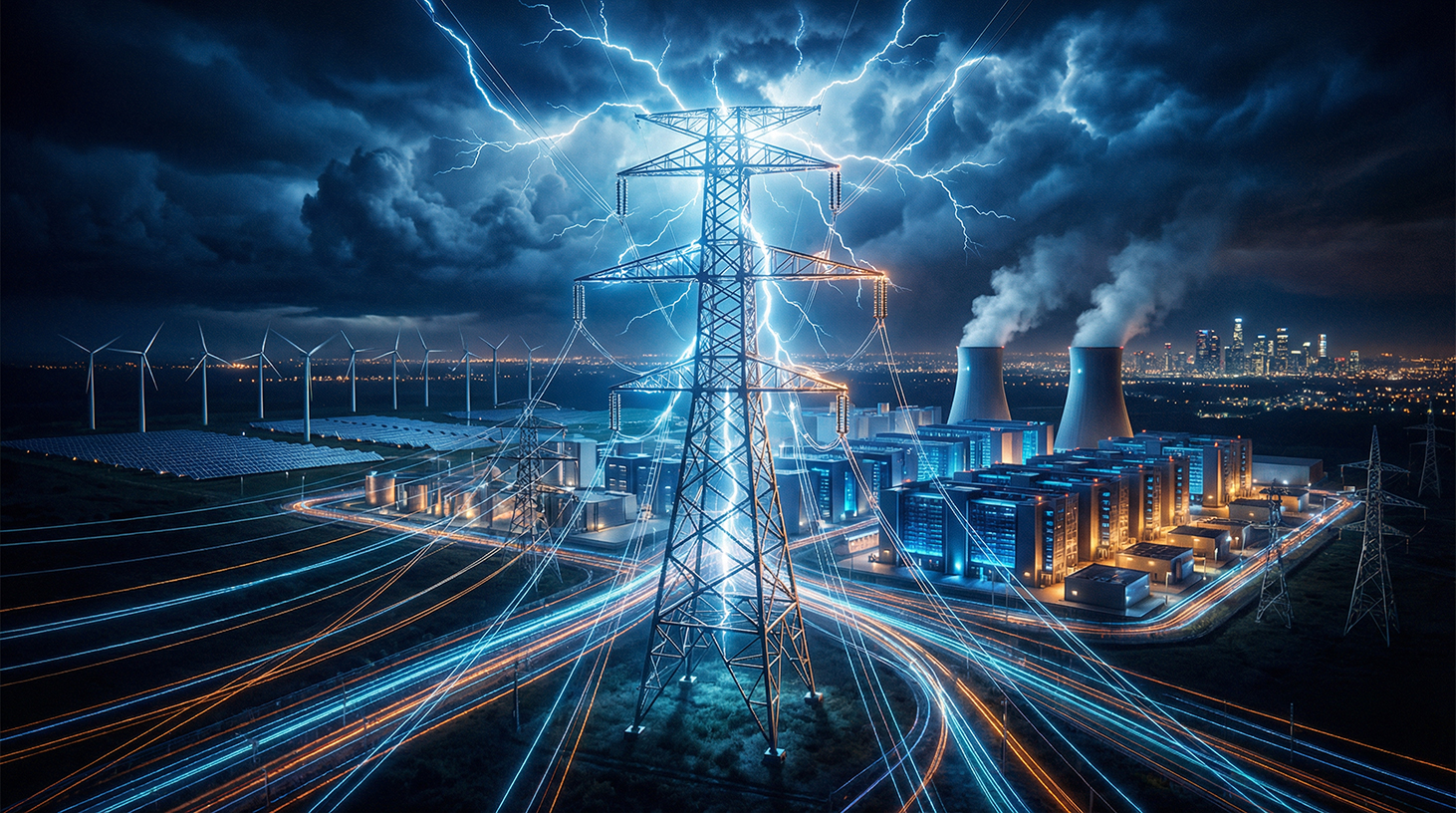
Comparison of electricity grid expansion: USA, China, EU, Japan, South Korea and Germany at a glance – Image: Xpert.Digital
Blackout warning: Why the AI boom is overwhelming our power grids
Billion-dollar shock for consumers: Who will pay for AI's insane electricity consumption?
The world is currently undergoing rapid technological change, but the biggest bottleneck for the future of artificial intelligence isn't a lack of high-performance chips—it's simply electricity. While tech giants are erecting ever more gigantic data centers, their exponential energy demands are colliding with infrastructures that were largely designed between the 1950s and 1980s. Power grids, once the invisible and reliable backbone of industrial society, are suddenly becoming a geopolitical matter of survival. Although record sums are flowing worldwide into the expansion of renewable energies, the transmission lines meant to transport this energy are hopelessly lagging behind demand. This in-depth report sheds light on the epochal race for energy supply in the AI age. It reveals why China is currently the only global power planning massively and agilely ahead of the curve, why the US and Europe are struggling with outdated grids and crippling permitting backlogs, and why tech metropolises like Frankfurt am Main are already effectively implementing moratoriums on new data centers. Ultimately, it all boils down to a highly explosive, global core question: Who will bear the trillions in costs for this digital energy transition – the highly profitable tech companies or, in the end, the average electricity customer?
Electricity grid atlas of the AI era: Who supplies the world with electricity – and who is left behind?
The world is facing a historic turning point in its energy history. Not wars, not oil crises, but artificial intelligence is forcing nations to radically transform their power supplies. Gigabit data centers, capable of running a single AI training run at up to 154 megawatts, are challenging infrastructures built for a completely different era. The crucial question, affecting governments, corporations, and consumers alike, is no longer whether the grids need modernization, but who will pay for it, who will act quickly enough – and who will be left behind.
The global power grid: A legacy of the 20th century
Power grids are the invisible foundation of modern civilization. They were predominantly built between the 1950s and 1980s – for a world in which large, centralized power plants channeled electricity in a single direction to passive consumers. This basic assumption is now obsolete. Decentralized generation from solar and wind power plants, bidirectional energy flows, volatile feed-in, and the exploding loads of data centers present the old architectures with challenges for which they were simply not designed.
Worldwide, around 400 billion US dollars are invested annually in electricity grids – while roughly one trillion dollars are invested in electricity generation. This structural investment gap between grids and generation is one of the key weaknesses of the global energy transition. The International Energy Agency estimates that Europe's annual grid investments would need to rise to over 70 billion US dollars by 2025 – twice as much as ten years ago – and yet they still lag behind the expansion of renewable energy.
The tectonic shifts in the energy sector, triggered by the AI boom, have dramatically widened this gap. A single AI training run consumes up to a thousand times more electricity than a simple internet search. A single AI query to a language model requires roughly ten times the energy of a classic Google search. High-quality training runs for frontier models like GPT-4 have consumed 20 megawatts or more in a single pass. It is this order of magnitude that is forcing grid operators worldwide to recalibrate their entire planning parameters.
The ailing superpower: The US power grid between patchwork and transformation
Infrastructure at its limit: Seven decades without major renovation
The American power grid is the oldest and most complex in the world. It comprises nearly one million kilometers of transmission lines, transporting one million megawatts from over 9,200 power generation units. However, large parts of this system are outdated: 70 percent of the infrastructure is nearing the end of its operational lifespan. What functioned for decades as the supply network for an industrial society is now being driven into an existential crisis by the age of artificial intelligence.
Schneider Electric predicts that US peak load power supply will fall short of demand as early as 2028. The gap is expected to widen to 175 gigawatts by 2033 – equivalent to the electricity needs of 130 million homes. In a single year, between 2023 and 2024, US energy providers' forecasts for five-year peak load growth jumped from 38 gigawatts to 128 gigawatts – an increase of 237 percent in just twelve months. This isn't a gradual adjustment; it's a planning shock.
The political contradiction: Renewables are growing despite Trump
Under the current administration of President Donald Trump, who promotes fossil fuels with a "drill, baby, drill" approach, the US energy market is paradoxically experiencing the strongest expansion of renewable energy capacity in its history. By 2026, almost all new net generation capacity will consist of solar, wind, and battery storage technologies. Market mechanisms are overriding government preference: wind and solar energy are simply the cheapest new investments.
In the current energy mix, natural gas will dominate in 2025 with approximately 40 percent, followed by nuclear power with 18 percent and coal with 15 percent. The share of renewable energies was around 23 percent in 2024 and is projected to rise to 26 percent by 2026. Wind and solar power together exceeded coal's share for the first time in 2024, reaching 17 percent. This trend is continuing: In the first half of 2025, more than 22 gigawatts of new large-scale solar power plants were added.
AI data centers as a tipping point for the network
US data centers consumed approximately 183 terawatt-hours of electricity in 2024 – more than four percent of the nation's electricity consumption, comparable to Pakistan's annual consumption. Deloitte estimates that electricity demand from AI data centers in the US could grow to 123 gigawatts by 2035 – thirty times the 2024 level. In the capacity market of the PJM interconnected grid, the largest in the US, data centers alone caused additional costs of $23.1 billion in three consecutive auctions.
The biggest structural problem is the interconnection queue – the waiting list for grid connections. Years-long permitting processes and a lack of grid capacity are slowing down new power plants and large consumers. In January 2026, the US Department of Energy announced plans to accelerate interconnection regulations and compress connection times from several years to just a few months. Forty-six data centers are already planning to build their own power plants – predominantly gas-fired – with a total capacity of 56 gigawatts. This would represent approximately 30 percent of planned US data center capacity.
The question of cost: Who pays for AI's energy consumption?
In the US, the debate over cost distribution is politically charged. Since 2020, household electricity prices have risen by over 36 percent. Regulators in California are demanding that data centers bear the full cost of grid expansion themselves, instead of passing it on to consumers. AI developer Anthropic was the first major company to announce that it would cover 100 percent of the grid expansion costs necessary for its data centers, including the portion of the costs that would otherwise be passed on to consumers. In his State of the Union address, US President Trump stated that technology companies have a duty to meet their own electricity needs and should build power plants as part of their data centers.
The Energy Empire: China's Strategic Lead in the Electricity Grid
Investment dimensions without a global counterpart
In less than two decades, China has become the dominant global power in electricity infrastructure. The State Grid Corp. of China, the world's largest grid operator, which supplies electricity to approximately 80 percent of China's territory and over one billion people, plans to invest 4 trillion yuan ($574 billion) in the national grid between 2026 and 2030 – a 40 percent increase compared to the previous five-year plan. Together with China Southern Power Grid, recent calculations indicate a total investment volume of up to 5 trillion yuan ($730 billion).
In 2025 alone, State Grid invested more than 650 billion yuan ($89 billion) – a new record. The two main grid operators issued a record 901 billion yuan in bonds in 2025 to finance the investments – at an average yield of 1.7 percent, the lowest ever. By the end of 2024, China had 38 ultra-high-voltage transmission lines, following the completion of three new lines that year.
The overarching strategic goal is west-east power transmission: high-voltage power lines are intended to transport inexpensive wind and solar energy from the sparsely populated western provinces of Xinjiang, Qinghai, and Inner Mongolia to the economic centers of eastern China. China plans to increase interprovincial transmission capacity by 30 percent by 2030 compared to the 2025 level.
The energy mix: Coal and renewables in a double pack
China's energy mix is a global paradox. The country is installing more renewable energy than anyone else worldwide – while simultaneously building more new coal-fired power plants than in any other country in nine years. Record levels of new coal-fired power plant capacity were commissioned in the first half of 2025. Nevertheless, the country plans to add enough renewable energy capacity in 2025 to meet the combined energy needs of Germany and the UK.
The current electricity mix for 2025 shows that coal dominates with 55 percent, followed by hydropower with 14 percent, and solar and wind power with 11 percent each. Nuclear power accounts for just under 5 percent, and biomass for around 2 percent. Low-carbon electricity generation reached a record high of 42 percent in 2025, even though fossil fuels still contribute around 58 percent. This dual strategy—maximizing the expansion of renewables while simultaneously relying on coal as a backup—reflects China's priority: security of supply takes absolute precedence over ideological stringency in climate policy.
China's AI data center strategy: Electricity as a competitive advantage
China is turning the growing energy demands of the AI boom into a strategic advantage. Data centers consumed around 140 billion kilowatt-hours (140 TWh) in 2024, representing 1.4 percent of national consumption – a 31 percent increase year-on-year, while total national consumption rose by only 6.8 percent. By 2035, data centers in China are projected to consume 400 billion kilowatt-hours annually – four times their current level.
Goldman Sachs estimates that by 2030, China will have reserve capacity more than three times the total global demand for data centers. As one consultant for The Lantau Group put it, grid connection for new data centers in China is virtually "no problem." This contrasts sharply with the years-long waiting lists in the US, Germany, or Japan. Nvidia CEO Jensen Huang has already warned that China could take the lead in AI because of its lower energy costs and less stringent infrastructure regulations. A new Chinese action plan integrates data center planning directly into energy infrastructure in renewable energy-rich regions like Qinghai, Xinjiang, and Heilongjiang.
Europe between aspiration and reality: The cumbersome continent
The investment backlog: €730 billion in catching up to do
The European Union has ambitious climate targets and an energy transition that is progressing faster than expected – but a chronically underinvested electricity grid. The European Commission estimates the investment required for electricity grids by 2040 at €730 billion, plus a further €240 billion for hydrogen pipelines. Overall, the Commission puts the total need for electricity grid investment at at least €2 trillion by 2050. That's a figure that is awe-inspiring even compared to China's impressive spending.
79 percent of the estimated investment needs are for electricity grids – including cross-border networks, offshore connections, and national transmission and distribution networks. The European Commission proposes accelerating permitting procedures, distributing the costs of cross-border projects more fairly, and introducing a common, Europe-wide grid planning system. EU Energy Commissioner Dan Jørgensen emphasized that a fully interconnected energy system is the foundation for a strong and independent Europe.
The industry association Eurelectric warns that many European distribution networks will be over 40 years old by 2030 and thus reach the end of their operational lifespan. Germany, France, and the Netherlands together already account for 53 percent of the total planned investments within the EU by 2040 – a sign of the significant unequal distribution of the modernization burden.
The energy mix: Europe's green success story with its downsides
The energy transition in the EU is progressing remarkably quickly. In 2024, 47.5 percent of the EU's electricity came from renewable energy sources – almost half and a historic record. Wind power contributed 17 percent, and solar power 11 percent. The share of coal-fired power generation fell below 10 percent for the first time, gas declined for the fifth consecutive year to just under 16 percent, and fossil fuels as a whole to 29 percent. Nuclear power maintains a stable share of almost 24 percent. In 2025, wind and solar power generated more electricity than all fossil fuels combined for the first time in EU history.
Since 2019, the transition has enabled Europe to avoid imports of fossil fuels for electricity generation worth €58.6 billion. Nevertheless, significant gaps remain: the grid lags behind generation capacity, long permitting processes slow the connection of new renewable energy projects, and the integration of decentralized sources poses systemic problems for the old one-way grid architectures.
New: Patent from the USA – install solar parks up to 30% cheaper and 40% faster and easier – with explanatory videos!

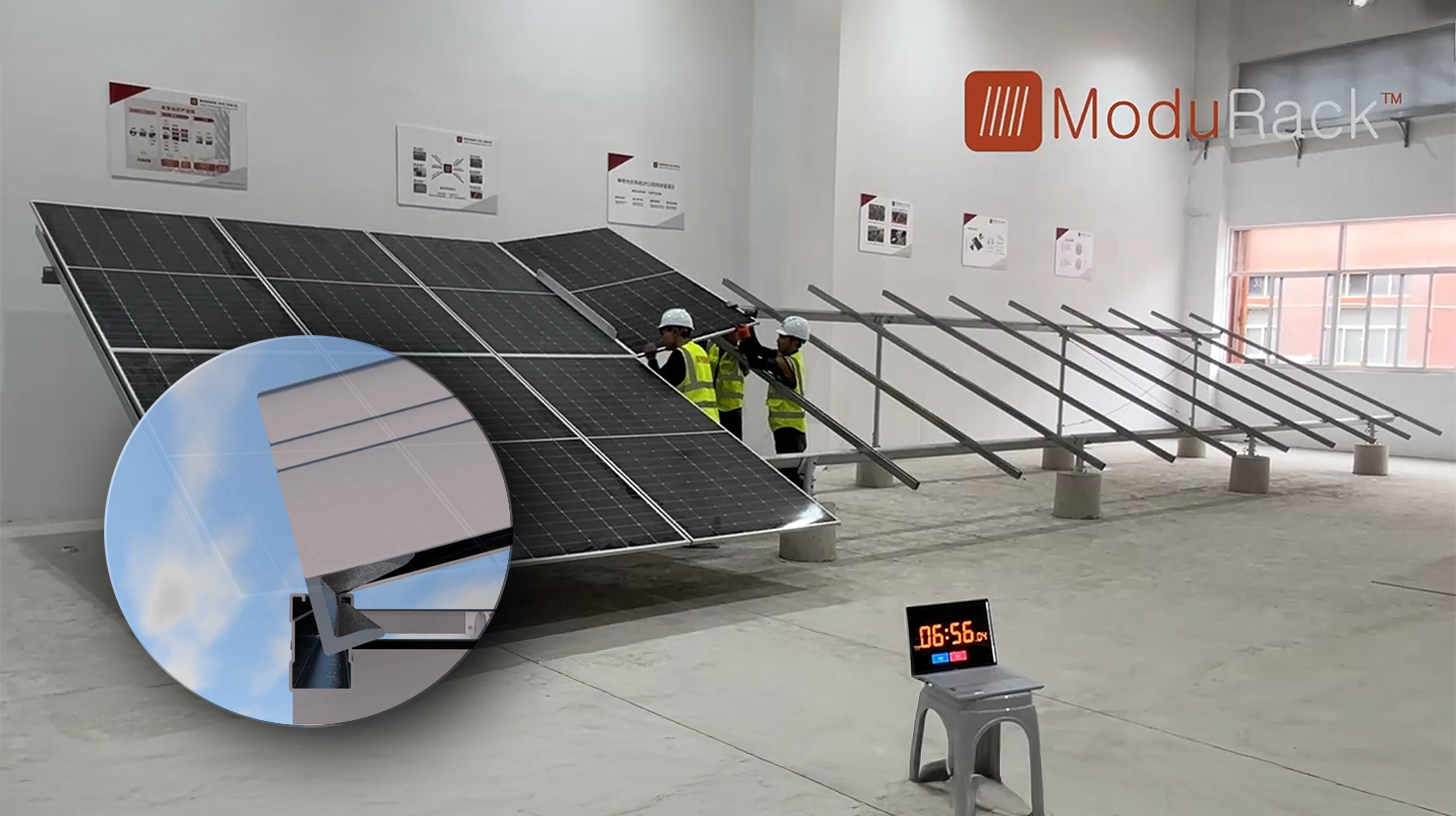
New: Patent from the USA – Install solar parks up to 30% cheaper and 40% faster and easier – with explanatory videos! - Image: Xpert.Digital
The core of this technological advancement is the deliberate departure from conventional clamp mounting, which has been the standard for decades. The new, more time- and cost-effective mounting system addresses this with a fundamentally different, more intelligent concept. Instead of clamping the modules at specific points, they are inserted into a continuous, specially shaped support rail and held securely in place. This design ensures that all forces – whether static loads from snow or dynamic loads from wind – are distributed evenly across the entire length of the module frame.
More information here:
Network expansion under time pressure: Billion-euro gap, lengthy approval processes, strategic risks
Germany: Model country of the energy transition with a structural infrastructure blockage
Record approvals and investment gap
Germany plays a key role within the EU – not only as the largest economy, but also as the country that has chosen the most challenging transformation path. Since the final nuclear phase-out in April 2023, there is no longer any nuclear power. The 2025 energy mix shows a renewables share of around 62 percent of public electricity generation – a historic high. Wind power is the strongest single producer, and photovoltaics overtook lignite for the first time in 2025.
The legally mandated grid expansion requirement currently stands at approximately 16,800 kilometers of new power lines. The Federal Network Agency is responsible for reviewing and approving 9,600 kilometers of these. In 2025, the agency approved around 2,000 kilometers – 45 percent more than the previous year (1,280 km). Overall, the approval processes for approximately 4,700 kilometers have now been fully completed. Federal Network Agency President Klaus Müller described 2025 as another record year for power grid approvals.
However, a worrying gap exists regarding investment needs: A study by the IMK, funded by the Hans Böckler Foundation, estimates the total costs for expanding and upgrading Germany's electricity grids by 2045 at €651 billion. Annual investments would have to rise to €34 billion – more than double the €15 billion invested in 2023. The German government plans to reduce grid fees by €6.5 billion annually through subsidies from the Climate and Transformation Fund (KTF).
AI data centers and the Frankfurt bottleneck
Germany is Europe's most central location for data centers. Frankfurt am Main alone is one of the world's largest data center clusters. But a structural crisis is looming right here. Due to a lack of network capacity, it is expected that no new AI data centers can be connected in Frankfurt until 2030. Waiting times for a power connection are up to 13 years. Billions of euros in investments from technology giants like Oracle and Amazon are therefore on hold.
The electricity consumption of German data centers was around 20 billion kilowatt-hours (20 TWh) in 2024 and rose to 21.3 TWh in 2025 – roughly 4 percent of Germany's gross electricity consumption. According to forecasts by the Öko-Institut (Institute for Applied Ecology), this figure will grow to 31 TWh by 2030. At the current rate of growth, it could reach around 80 TWh by 2045. AI data center capacity is also expected to increase from 530 megawatts to 2,020 megawatts by 2030 – representing 40 percent of total German data center capacity.
The question of costs is politically sensitive in Germany. Technically speaking, grid expansion costs are passed on to all electricity consumers via grid fees, which accounts for roughly a quarter of the electricity price. By 2045, the financing costs of grid expansion will rise from 35 to 80 percent of grid fees. Researchers at the Öko-Institut (Institute for Applied Ecology), such as Jens Gröger, warn: "This is simply the mechanism by which grid expansion is ultimately passed on to end customers." At the same time, industry associations like Bitkom are calling for special industrial tariffs and electricity tax exemptions for data centers – which, conversely, would mean that everyone else would have to pay for grid expansion.
Japan: Between Fukushima trauma and AI energy realism
The divided island nation: Structural network boundaries as an obstacle to growth
Japan has an electricity grid that, due to historical reasons, is fundamentally organized differently than in any other major industrialized country. The country is characterized by regionally separated grids built by nine traditionally vertically integrated regional utilities – each with its own technical standards, different grid frequencies (50 Hz in the east, 60 Hz in the west), and very limited interconnector capacities between regions. The Fukushima disaster in 2011 demonstrated how dangerous these isolated solutions are in the event of extreme weather events.
Starting in 2013, the Japanese government implemented a three-phase liberalization of the electricity sector, separating generation, transmission, and retail. The Organization of the Corporation for the Coordination of Electricity and Communications (OCCTO) now coordinates interregional grid operations. The 2023 National Grid Expansion Master Plan envisages investments of 6 to 7.9 trillion yen by 2050. Over the next ten years, 401 kilometers of new transmission lines are to be laid and 32,018 MVA of transformer capacity added.
TEPCO, Japan's largest utility company, is investing approximately 470 billion yen ($3.25 billion) in grid expansion by fiscal year 2027. Kansai EPCo is investing over 150 billion yen in four substations, which will be upgraded starting in 2026. TEPCO Power Grid is also investing an additional 200 billion yen by the early 2030s in Chiba Prefecture alone, where data centers are increasingly concentrated.
Energy mix: Fossil fuel regression after Fukushima and a laborious restart
Japan's energy mix for 2024/2025 reflects the legacy of Fukushima: Fossil fuels dominate generation, with natural gas accounting for around 31 percent and coal for 28 percent; together, fossil sources cover approximately 65 percent. Solar power contributes 11 percent and has developed rapidly since 2012, nuclear power has risen to around 10 percent after years of stagnation, hydropower contributes 8 percent, and wind power still plays a minor role at just over 1 percent.
The share of nuclear power in Japan's electricity generation was 8.5 percent in fiscal year 2023 – the highest level since 2012, but far from the pre-crisis level of 25 percent. Japan has 14 active reactors with a capacity of 13,253 MW; the new energy plan from the Ministry of Economy, Trade and Industry (METI) envisions a 20 percent share of nuclear power and a 40 to 50 percent share of renewables by 2040. Until then, Japan will remain exceptionally dependent on fossil fuels, which critics rightly describe as a structural security gap.
AI data centers as demand accelerators
Wood Mackenzie predicts that by 2034, Japan's data centers will consume as much electricity as 15 to 18 million households, driving 60 percent of Japan's total electricity demand growth this decade. Data center power consumption is expected to more than triple from 19 TWh in 2024 to between 57 and 66 TWh by 2034. TEPCO estimates that the Tokyo area alone will require 12 gigawatts of data center capacity, based on existing connection requests. Hyperscalers such as Oracle, Google, and Microsoft have been selected by the Japanese government as official cloud providers and are investing a combined 4 trillion yen ($28 billion).
According to the OCCTO, electricity demand from data centers and semiconductor factories will explode from an estimated 3.6 billion kilowatt-hours in fiscal year 2025 to 51.4 billion kilowatt-hours by fiscal year 2034 – an increase of approximately 14 times. Infrastructure bottlenecks are already delaying some projects until 2029. Japan is also investing heavily in battery storage: since December 2023, at least $2.6 billion has been invested in Japanese storage projects.
South Korea: Nuclear power comeback and AI ambitions amid network stress
A country without international connections – and with structural deficiencies in its network
South Korea is in a unique energy situation: The country is completely electrically isolated from its neighbors, with no international transmission lines. Every kilowatt-hour of electricity must be generated domestically. This makes security of supply an absolute national priority, explains the strong reliance on nuclear power, and simultaneously exposes the country's vulnerability during peak demand.
KEPCO (Korea Electric Power Corp.) plans to invest 72.8 trillion won ($53.5 billion) in grid expansion by 2038. This is 28.8 percent more than the previous estimate from two years ago. The plan calls for a 71.9 percent increase in transmission capacity compared to 2023 and the construction of nearly 400 new substations. National electricity demand is projected to rise from 106 gigawatts (2025) to 145.6 gigawatts by 2038 – an increase of 37.4 percent, driven by data centers, semiconductor clusters, and electric vehicles.
Despite these ambitious plans, the reality is sobering: Over 55 percent of transmission and substation projects were delayed in October 2025. Between 2013 and 2023, transmission capacity grew by only 14 percent, and distribution networks by 22 percent – despite significantly higher demand.
Energy mix: Nuclear power renaissance as a matter of national interest
South Korea is a prime example of a return to nuclear power after a brief political shift away from it. The current government has completely reversed the nuclear phase-out initiated by the previous administration. The country operates 26 large reactors and is building four more; nuclear power accounts for almost a third of its electricity generation. For the period up to 2038, the share of nuclear power is projected to increase from 30.7 percent (2023) to 35.2 percent, achieved by building two new large reactors and one small modular reactor (SMR) by 2035-2036.
Coal currently accounts for around 31 percent of South Korea's energy mix and is projected to fall drastically to 10.1 percent by 2038. Twenty-eight outdated coal-fired power plants are being converted to liquefied natural gas (LNG). Renewable energies currently account for 8.4 percent and are expected to grow to 29.2 percent by 2038 – more than fourfold. This would increase the carbon-free share to around 70 percent by 2038. South Korea imports approximately 98 percent of its fossil fuel needs – a strategic security risk that further legitimizes its reliance on nuclear power.
AI and the high-energy industry: The dilemma of high electricity prices
South Korea's AI data centers currently consume about 8 TWh annually—a figure that seems modest compared to China's 140 TWh and the US's 183 TWh. Total data center capacity is projected to grow from 1,960 megawatts (2025) to 6,320 megawatts by 2030. SK Telecom and AWS are jointly building Korea's largest AI data center, with 60,000 GPUs and 100 megawatts of capacity, for 7 trillion won. However, a fundamental obstacle is hindering this growth: the industrial electricity price of 172.99 won per kWh is more than double that of the United Arab Emirates or Malaysia and significantly higher than US and Chinese rates. This makes South Korea structurally unattractive as a location for energy-intensive AI training workloads.
The question of cost: Who pays for the digital energy transition?
A global distribution problem with no easy answer
The question of who bears the enormous costs of the network infrastructure transformation in the AI era is not a technical one, but a profoundly political one. It divides the global debate into two camps: on the one hand, technology companies and data center operators demanding favorable industrial tariffs and exemptions from network charges; on the other hand, regulatory authorities, household associations, and climate activists demanding that costs be distributed according to the polluter-pays principle.
In Germany, grid expansion costs are systematically passed on to all consumers via grid fees. These fees account for roughly a quarter of the electricity price. By 2045, the financing costs of grid expansion will rise from 35 to 80 percent of the grid fees. According to a study by the Hans Böckler Foundation, with public co-financing, average grid fees would increase only moderately by 1.7 cents per kilowatt-hour – a manageable figure, but one that adds up to billions for households and industry. The German government is taking initial steps toward public co-financing with the KTF subsidy of €6.5 billion per year.
In the US, the cost debate is intensifying: In Virginia's data center regions, Arizona's desert locations, and Texas' energy markets, municipalities are involuntarily becoming financiers of the AI boom. Political pressure is mounting: In California, regulators are recommending that data centers be classified into a special tariff category and required to prepay infrastructure costs. Anthropic has set a precedent by fully absorbing all network expansion costs itself—an approach that other hyperscalers are likely to increasingly adopt under political pressure.
The data center of the future: A power plant of its own?
In his State of the Union address, US President Trump marked a conceptual turning point when he called for technology companies to build power plants as part of their data centers. This is not merely a political opinion—it is the description of an emerging reality. Forty-six US data centers are already planning to build their own power plants, primarily fueled by natural gas, with a combined capacity of 56 gigawatts. Based on current estimates, this would represent approximately 30 percent of the planned US data center capacity. Hyperscalers like Microsoft are investing heavily in nuclear power plant reactivations (Three Mile Island) and in small modular reactors (SMRs) to establish 24/7 baseload power generation off the public grid.
For countries like Germany or Japan, with very high electricity prices and very long grid connection times, this path to off-grid or quasi-off-grid data centers is particularly attractive. In Germany, reactivated brownfield sites with existing high-performance connections could offer a niche solution to the structural bottlenecks. The trend shows that the line between energy suppliers and technology companies is becoming increasingly blurred.
Global comparison: Who is prepared for the AI era?
Infrastructure, energy mix and speed of adaptation at a glance
| Country/Region | Network investment (current/planned) | Renewable share | Fossil | atom | AI network readiness |
|---|---|---|---|---|---|
| USA | ~$2-3.5 billion/year (federal) private | ~26% (2026) | ~57% | ~18% | Critical: 70% infrastructure outdated, 175 GW gap by 2033 |
| China | $89 billion (2025), $574-730 billion (2026-30) | 36% (Solar, Wind, Water) | ~58% | ~5% | Stark: Excess capacities planned |
| EU | Approximately €70 billion per year, €730 billion by 2040 | 47,5% (2024) | ~29% | ~24% | Medium: Network outdated, expansion accelerated |
| Japan | ~$15.8 billion/year (2025) | ~22% | ~65% | ~10% | Tight: 14x data center demand by 2034 |
| South Korea | $53.5 billion by 2038 | ~8,4% | ~58% | ~30% | Challenging: >55% of projects are delayed |
| Germany | €34 billion needed per year, €15 billion invested | ~62% | ~27% | 0% | Critical: Frankfurt will have no new connections until 2030 |
The overview of infrastructure, energy mix, and adaptation speed for AI reveals significant regional differences. In the US, grid investments currently amount to approximately USD 2–3.5 billion per year at the federal level, in addition to private investment; the share of renewable energies is around 26% (2026), fossil fuels account for approximately 57%, and nuclear energy for about 18%. AI grid readiness is considered critical: around 70% of the infrastructure is outdated, and a gap of approximately 175 GW is projected by 2033. In China, grid investments of approximately USD 89 billion are planned for 2025, and a cumulative total of USD 574–730 billion for 2026–2030; the share of renewable energies (solar, wind, hydro) is around 36%, fossil fuels around 58%, and nuclear energy around 5%. China is considered strong in terms of AI grid readiness, as excess capacity is planned. The EU invests around €70 billion per year and plans to invest a cumulative total of approximately €730 billion by 2040; the share of renewable energy was 47.5% in 2024, fossil fuels accounted for about 29%, and nuclear energy for around 24%. AI grid readiness is rated as medium: parts of the grid are outdated, but expansion is being accelerated. In Japan, grid investments of approximately USD 15.8 billion are projected for 2025; the share of renewable energy is around 22%, fossil fuels around 65%, and nuclear energy around 10%. The situation regarding AI grid readiness is strained, as demand for data centers could increase fourteenfold by 2034. South Korea plans investments of USD 53.5 billion by 2038; the share of renewable energy is around 8.4%, fossil fuels around 58%, and nuclear energy around 30%. AI grid readiness is considered challenging, as more than 55% of projects are experiencing delays. Annual grid investment needs for Germany are estimated at €34 billion, with current investments of around €15 billion. The renewable energy share is approximately 62%, fossil fuels around 27%, and nuclear energy 0%. The situation regarding AI grid readiness is critical, as no new connections are expected in Frankfurt until 2030.
The crucial differences: speed, capital, political will
The most striking difference between China on the one hand and Western countries on the other is not just the money – it's the speed of approvals and the state's ability to control infrastructure. China's state-owned network operators can make decisions and build within months what takes years in Germany or the US. This institutional agility is not a mere detail – it's a strategic competitive advantage in an age of exponentially growing data center demands.
For Europe, and especially Germany, what critics have been warning for years holds true: the problem isn't a lack of a plan, but rather the speed of implementation. The Federal Network Agency approves record-breaking distances, but construction follows with considerable delays. The IMK study shows that Germany would have to invest more than twice as much annually as it does today – and even then, the gap between network expansion and the growth in demand driven by AI would remain, provided the construction of AI data centers continues at an exponential pace.
Japan finds itself in a particularly complex structural situation: a fragmented grid, high fossil fuel dependence following Fukushima, and an AI-driven demand boom with a 14-fold increase in data centers by 2034 – this combination necessitates simultaneous grid integration, a return to nuclear power, and a massive expansion of renewables. The clock is ticking, because TEPCO and Kansai EPCo are starting infrastructure projects with completion dates around 2029, which will hardly be able to withstand the surge in demand expected from 2030 onward.
South Korea stands out as the only country in the group that is strategically expanding its nuclear power capacity as a primary response to growing electricity demand and dependence on fossil fuel imports. This path is consistent and logically sound, but it does not address the structural investment backlog in the grid, which is manifested in the more than 55 percent of delayed infrastructure projects.
The internet as a geopolitical question of destiny
Global analysis of power grids reveals a clear pattern: no nation's infrastructure is currently fully ready for the AI era. However, the degrees of unreadiness, the speed of action, and the structural frameworks differ fundamentally. China combines state planning power, massive capital allocation, and industrial manufacturing capacity into a development program that Western democracies can scarcely replicate. The US grapples with the contradiction between outdated federal infrastructure and the world's largest private capital flows into new generation and data centers.
The EU and Germany boast high shares of renewables and clean energy mixes, but grid expansion cannot keep pace with the speed of AI-driven demand – neither in terms of permitting nor construction. Frankfurt, as the global data center hub of Europe, threatens to become a bottleneck that fundamentally limits European AI competitiveness. Japan and South Korea, in turn, are grappling with legacy grid infrastructure and political compromises regarding their energy mixes.
What all regions have in common is that the decisions made in the next five years will shape the geopolitical and economic landscape of the AI era for decades to come. The power grid is no longer simply an infrastructure problem – it has become a question of national sovereignty in the digital age.
Your partner for business development in the fields of photovoltaics and construction
From industrial rooftop PV to solar parks and larger solar parking lots
☑️ Our business language is English or German
☑️ NEW: Correspondence in your native language!

Konrad Wolfenstein
I and my team are happy to be available to you as your personal advisor.
You can contact me by filling out the contact form here wolfenstein@xpert.digital:or simply call me at +49 7348 4088 965. My email address is
I'm looking forward to our joint project.
☑️ EPC services (Engineering, Procurement and Construction)
☑️ Turnkey project development: Development of solar energy projects from start to finish
☑️ Site analysis, system design, installation, commissioning, maintenance and support
☑️ Project financier or intermediary of capital providers
Innovative photovoltaic solution for cost reduction (up to 30%) and time savings (up to 40%)
Innovative photovoltaic solution for cost reduction and time savings - Image: Xpert.Digital
More information here: