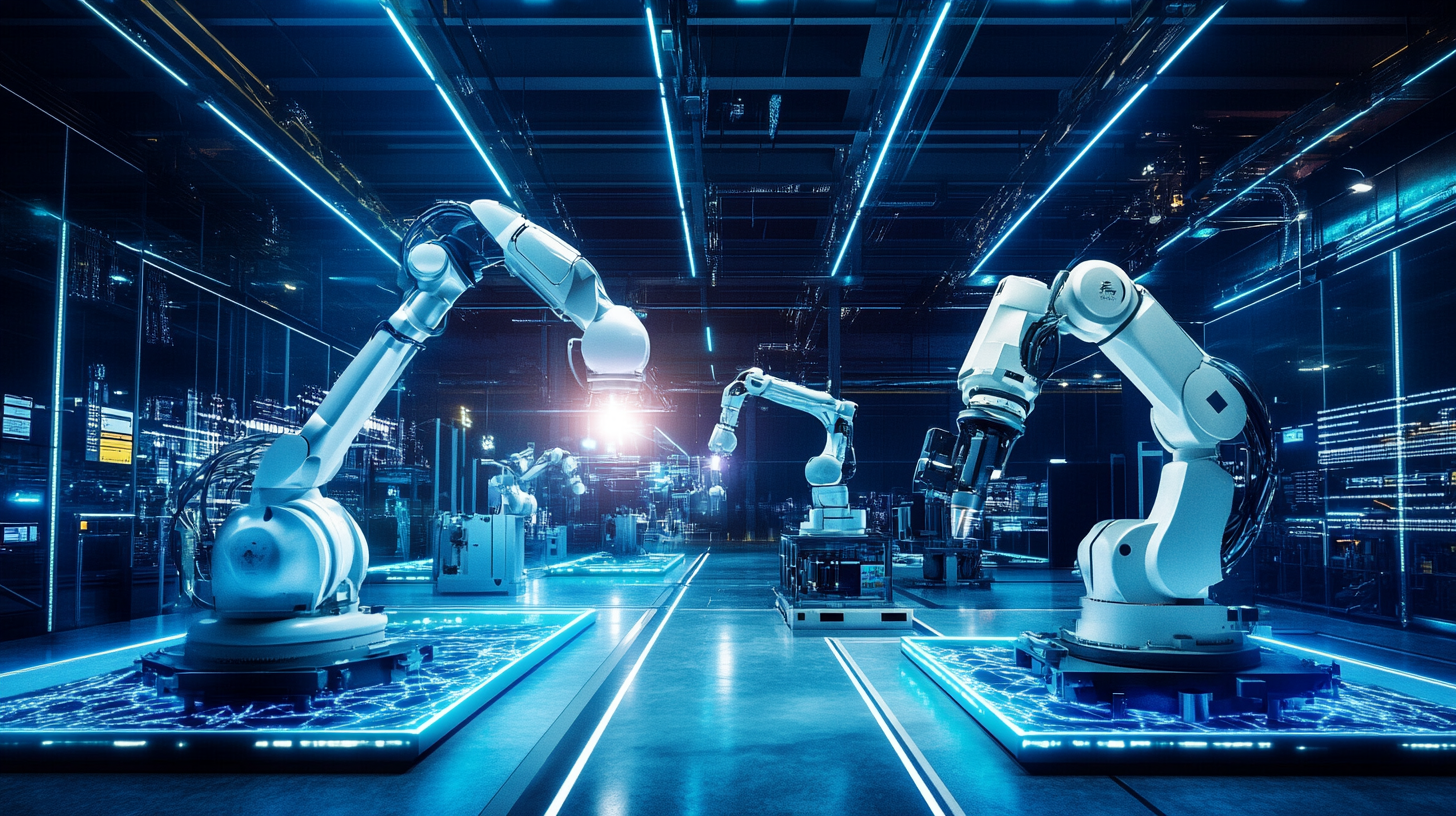
This is how Universal Robots, KUKA, FANUC, ABB and others are driving the robotics of collaborative robots (cobots) forward – Creative image: Xpert.Digital
💼🤝 Collaborative Robots: The Automation Revolution
⚙️🤖 Collaborative robots, or cobots for short, have revolutionized industrial automation in recent years. These robots are designed to work directly alongside humans without requiring complex safety devices. Cobots represent flexibility, safety, and efficiency, offering companies a way to increase productivity without compromising employee safety. In this article, we take an in-depth look at the leading companies in cobot development and how they are driving the industry forward.
⭐ Universal Robots: The pioneer of collaborative robotics
Universal Robots, a Danish company founded in 2005, is considered a pioneer in the field of collaborative robotics. With the aim of making robotics technology more accessible and user-friendly, Universal Robots has developed a platform that particularly appeals to small and medium-sized enterprises (SMEs). Thanks to its intuitive operation, even companies without extensive technical expertise can easily integrate cobots into their work processes.
Universal Robots' product range includes models capable of carrying payloads between 3 and 20 kilograms. The robots are characterized by quick installation, easy programming, and a high level of safety, enabling operation in close proximity to human colleagues. With over 50,000 cobots sold worldwide, Universal Robots has solidified its market leadership in the field of collaborative robots.
“Our vision has always been to make robotics accessible to everyone,” a company spokesperson describes Universal Robots’ mission. This philosophy is reflected in the user-friendliness of their products, which are often considered the benchmark in the industry.
🛠️ KUKA: German precision meets collaborative innovation
The German company KUKA is a major player in robotics and has also established itself strongly in the field of collaborative robots. With a long history in automation, KUKA is particularly active in industries such as automotive production, electronics manufacturing, and healthcare.
KUKA's cobots, such as the LBR iiwa series, are equipped with highly sensitive sensors that enable precise and safe collaboration with humans. Of particular note is the integration of human-robot interactions in complex production environments where flexibility and safety are equally important.
“Our collaborative robots are redefining automation and creating solutions suitable for both large and small businesses,” explains a KUKA representative. Their broad applicability and robust technology have made KUKA one of the leading providers in the field of collaborative robotics.
🔧 FANUC: Reliability and AI as trademarks
The Japanese company FANUC is one of the giants of the automation industry and has made a name for itself with its innovative cobots. FANUC offers a wide range of robot models known for their reliability and durability. Particularly noteworthy is the integration of artificial intelligence (AI) and machine learning, which enables the cobots to make work processes more efficient and adapt to changing tasks.
FANUC's cobots are widely used in the automotive and electronics industries, where precision and speed are essential. Their robots also stand out due to their ability to be seamlessly integrated into existing production lines, saving companies time and resources.
“Our cobots are designed to grow with the future,” is how FANUC describes its vision. Through its focus on innovation and adaptability, FANUC has established itself as one of the leading providers in the market.
🛡️ ABB: Advanced sensor technology for maximum safety
The Swiss company ABB is another major player in the automation industry and has secured its place among the market leaders with its expertise in sensor technology and electrification. ABB's collaborative robots are known for their advanced safety features, which enable their use in a wide range of industries, including food processing, logistics, and electronics manufacturing.
One of ABB's best-known product lines is the "YuMi," a cobot specifically designed for precise and delicate assembly work. Equipped with two arms, YuMi can simulate human movements and perform tasks such as assembling small parts. "YuMi is more than a robot – it's a partner in manufacturing," emphasizes ABB.
By combining high-tech sensors and intuitive programming, ABB enables companies to make their processes more efficient and secure, making the Swiss company a preferred partner for future-oriented businesses.
🌟 Why cobots are the future of automation
Collaborative robotics is more than just a technological trend – it is an essential component of the fourth industrial revolution, also known as Industry 4.0. Cobots offer companies the opportunity to make production processes more flexible and efficient, while simultaneously improving the safety and well-being of employees.
The main advantages of cobots are:
flexibility
Cobots can be programmed quickly and easily for different tasks, making them ideal for production environments where frequent changes are required.
Security
Thanks to advanced sensors and algorithms, cobots can work safely alongside humans without the need for elaborate protective devices.
Cost efficiency
Cobots are often cheaper than conventional industrial robots and allow even small companies to get started with automation.
📈 Market growth and outlook
The market for collaborative robots is growing rapidly. Forecasts predict that the industry will experience annual growth of over 15% until 2028. This development is driven by the increasing demand for flexible automation solutions in sectors such as electronics, healthcare, and logistics.
Another key factor is the increasing availability of AI technologies, which make cobots smarter and more adaptable. The integration of machine learning and data-driven optimization models will further strengthen the role of cobots in manufacturing and beyond.
🚧 Challenges and future developments
Despite their numerous advantages, cobots face several challenges. Integrating them into existing production lines can be complex, especially for companies with limited automation experience. Furthermore, there is a need for more advanced safety standards and legal frameworks to facilitate the global deployment of cobots.
Future developments could focus on the following areas:
- Enhanced AI functionalities: AI makes cobots even better at independently handling complex tasks.
- Improved mobility: Mobile use of cobots could open up new areas of application, for example in logistics or construction.
- Sustainability: Cobots could help make production processes more environmentally friendly by using energy more efficiently.
Collaborative robotics is only just beginning to evolve. Thanks to innovations from companies like Universal Robots, KUKA, FANUC, and ABB, cobots are becoming increasingly intelligent, flexible, and safe. They are not just tools, but partners in the modern workplace – and will fundamentally change the way we manufacture.
📣 Similar topics
- 🤖 Collaborative robots: A revolution in automation
- 🚀 Universal Robots: Pioneers in the field of cobots
- 🇩🇪 KUKA: German precision in collaborative robotics
- 🔍 FANUC: A combination of reliability and AI
- 🔐 ABB: Maximum safety through advanced sensor technology
- 🌐 Cobots and Industry 4.0: The Future of Automation
- 📈 Market Trends: The Growth of the Cobot Industry
- 📉 Challenges and opportunities in cobot development
- 💡 Future visions for collaborative robotics
- ⚙️ Productivity and safety: The advantages of cobots
#️⃣ Hashtags: #CollaborativeRobotics #IndustrialAutomation #ArtificialIntelligence #Industry4.0 #Flexibility
Our recommendation: 🌍 Limitless reach 🔗 Connected 🌐 Multilingual 💪 Sales power: 💡 Authentic with strategy 🚀 Innovation meets 🧠 Intuition


From local to global: SMEs conquer the world market with a clever strategy - Image: Xpert.Digital
In an era where a company's digital presence determines its success, the challenge lies in creating an authentic, personalized, and far-reaching presence. Xpert.Digital offers an innovative solution that positions itself as the intersection of an industry hub, a blog, and a brand ambassador. It combines the advantages of communication and sales channels in a single platform and enables publication in 18 different languages. Cooperation with partner portals and the ability to publish articles on Google News and a press distribution list with approximately 8,000 journalists and readers maximize the reach and visibility of the content. This represents a crucial factor in external sales and marketing (SMarketing).
More information here:
We are here for you - Consulting - Planning - Implementation - Project Management
☑️ SME support in strategy, consulting, planning and implementation
☑️ Creation or realignment of the digital strategy and digitization
☑️ Expansion and optimization of international sales processes
☑️ Global & Digital B2B trading platforms
☑️ Pioneer Business Development

Konrad Wolfenstein
I would be happy to serve as your personal advisor.
You can contact me by filling out the contact form below or simply call me on +49 7348 4088 965 .
I'm looking forward to our joint project.
Write to me


Xpert.Digital - Konrad Wolfenstein
Xpert.Digital is a hub for industry focusing on digitalization, mechanical engineering, logistics/intralogistics and photovoltaics.
With our 360° Business Development solution, we support renowned companies from new business to after-sales.
Market intelligence, smarketing, marketing automation, content development, PR, mail campaigns, personalized social media and lead nurturing are part of our digital tools.
You can find more information at: www.xpert.digital - www.xpert.solar - www.xpert.plus
Keep in touch