
China's industrial offensive: How Europe can reduce its dependencies and why European industry now needs more than tariffs
Xpert Pre-Release

Available in 27 languages 📢
Prefer Xpert.Digital on GoogleⓘPublished on: October 25, 2026 / Updated on: October 25, 2026 – Author: Konrad Wolfenstein
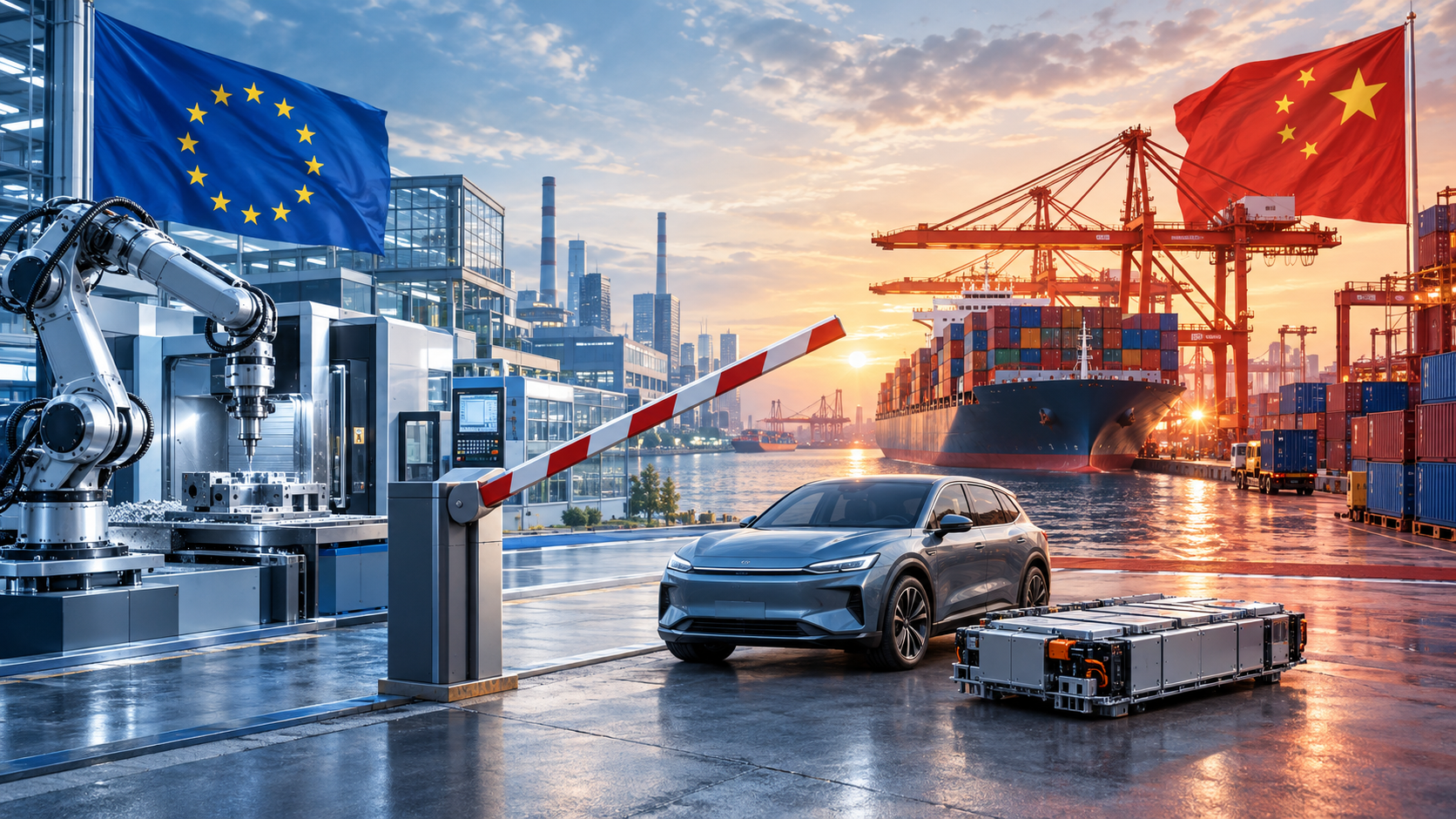
China's industrial offensive: How Europe can reduce its dependencies and why European industry needs more than tariffs now – Creative image on the topic, with AI: Xpert.Digital
Germany's trade deficit with China could exceed 100 billion euros
Cars, machinery, electrical engineering: Where China's industry is attacking Europe's lead
From customer to competitor: What China's rise means for German industry
China's rise is fundamentally changing the competitive landscape for European industry: What was once an important sales market and production partner has become a technologically powerful competitor in numerous key sectors. At the same time, Germany's trade deficit with China could exceed €100 billion for the first time in 2026. This figure is a projection based on data from the first half of the year, not a final annual result. However, it highlights a trend that particularly affects the automotive, mechanical engineering, and electrical engineering sectors. Blanket tariffs would not be a sufficient response: They can burden consumers and European companies without addressing the root causes of competitive pressure. A viable strategy must specifically counteract proven distortions of competition, reduce critical dependencies, and simultaneously improve Europe's own production conditions. The crucial factor is not to keep out as many Chinese goods as possible, but rather to secure Europe's technological capabilities, industrial value creation, and economic freedom of action in the long term.
China's industrial offensive and Europe's response: Those who only demand tariffs have already lost the competition
Europe needs a more decisive response to state-distorted competition from China. However, neither a blanket tariff barrier nor the hope for a self-correcting global trade system offers a viable strategy. The more convincing economic policy perspective combines targeted, evidence-based countermeasures with a fundamental improvement in European competitive conditions. The decisive factor is not how many Chinese goods Europe is deterred from entering the market, but whether competitive production, technological capabilities, and economic freedom of action can be maintained in the long term.
The urgency of this task is evident in German trade. According to data available up to October 25, 2026, the German trade deficit with China could exceed €100 billion for the first time in the entire year. This figure does not yet represent the final annual result, but rather a projection based on the first half of the year. Nevertheless, it points to a profound structural shift: China is no longer primarily a sales market and production partner for key German industrial sectors, but increasingly a technologically advanced competitor that is simultaneously expanding from its own domestic market and gaining market share in European and international markets.
The trade balance as a warning signal
In 2019, Germany's trade deficit with China amounted to €14.1 billion. By 2025, it was projected to reach approximately €89.3 billion. At that time, Germany imported goods worth €170.6 billion from China and exported goods worth €81.3 billion to the People's Republic. Compared to the previous year, imports increased by 8.8 percent, while exports declined by 9.7 percent. Not only is the size of the deficit remarkable, but above all, the opposing trends in these two trade flows.
If the trend from the first half of 2026 continues unchanged into the second half, the deficit would exceed €100 billion. That would be more than seven times the figure for 2019. In the first half of the year, imports were almost two and a half times greater than exports. In 2019, this ratio was only about 1.15. The earlier expectation of reciprocal demand deepening in line with China's increasing prosperity is therefore becoming less and less applicable to the German export model.
Methodological limitations are important here. Doubling half-year figures does not account for seasonal patterns or potential changes in demand, exchange rates, and trade policy. Furthermore, these are nominal commodity values, not a price-adjusted quantity analysis. Therefore, the finding of a structural shift is more reliable than any precise forecast of the final annual loss.
Why deficits are not losses
A trade deficit is not synonymous with an economic loss. For imported goods, businesses and consumers receive real benefits: machinery, electronics, intermediate products, or consumer goods. Low import prices can increase purchasing power and enable European companies to produce more cost-effectively. Furthermore, the bilateral balance does not capture all services or all cross-border income flows and, on its own, reveals little about how much added value actually remains in Germany.
Ownership details are also missing from traditional commodity statistics. A vehicle produced in China and delivered to Germany by a European corporation appears as an import from China. Conversely, the sale of a car manufactured in China by a German subsidiary to Chinese customers is not recorded as a German export. Company revenue, export volume, and domestic value added are therefore different metrics.
A deficit becomes particularly problematic when it occurs alongside technological displacement, persistently distorted prices, and growing dependencies. A specific tariff cannot be derived from the balance alone. It is a warning signal that justifies a closer examination of industries, prices, subsidies, and investment decisions. A policy that merely aims for balanced trade with each individual partner would misunderstand the international division of labor.
The transformation from customer to competitor
For many years, German industry benefited from China's expansion of its production capacities. German machine manufacturers supplied equipment, automotive companies served a growing middle class, and suppliers became part of new industrial networks. This division of labor was also based on a technological gap that enabled high margins and a strong market position for German suppliers in many products.
This gap has narrowed in key areas. Chinese companies possess their own development capabilities, large-scale production, specialized suppliers, and a market where products are rapidly developed under intense competitive pressure. Particularly in batteries and electric vehicles, Chinese competitiveness can no longer be convincingly explained solely as a result of low wages. Manufacturing expertise, automation, materials competence, and industrial networking are essential components of this lead.
This creates a twofold pressure for Germany to adapt. On the one hand, Chinese customers are increasingly buying locally developed products, which could reduce German export opportunities. On the other hand, Chinese suppliers are competing with the same German companies outside their domestic market. The challenge, therefore, is not only to maintain access to the Chinese market. It also lies in developing products and business models for which there is a viable willingness to pay, even under changed competitive conditions.
The automotive industry is losing its buffer
The shift is particularly evident in the motor vehicle and vehicle parts sector. In 2019, Germany still achieved a surplus of over €23 billion with China in this product group. By 2025, this surplus had shrunk to only around €6 billion. Extrapolating from the first half of 2026, only about €1 billion is expected for the entire year.
Compared to 2019, German exports of this product group could be approximately 54 percent lower in 2026. At the same time, the projection indicates an increase in imports from China of more than 475 percent. It's important to note the low starting point for this import figure: an exceptionally high percentage increase does not automatically mean that Chinese vehicles will dominate the entire European market. Nevertheless, Germany is losing a previously significant bilateral trade surplus.
This transformation has economic repercussions beyond the manufacturers themselves. Declining export volumes alter plant capacity utilization, the demand for supplier parts, and the distribution of development costs across the number of vehicles produced. If fewer units are manufactured, the cost per unit increases, even if fixed costs remain unchanged. Therefore, it is crucial for suppliers whether they gain access to the new drive, electronics, and software architectures or remain permanently tied to shrinking traditional product areas.
Mechanical engineering under new competitive pressure
Mechanical engineering is not just about selling individual machines. The sector supplies capital goods that enable other industries to improve their productivity. A downturn could therefore affect both export revenues and industrial problem-solving expertise. At the same time, the market remains highly heterogeneous: Standardized machines face competitive pressure from highly specialized systems with sophisticated process integration and comprehensive service.
In 2019, Germany's trade surplus in machinery with China was almost ten billion euros. Projections for the first half of 2026 show a slight deficit of just over one billion euros for the first time. The change in the balance thus amounts to approximately eleven billion euros. Exports could be around 26 percent lower than in 2019, while imports would have increased by about 65 percent.
The strategic implications are more complex than simply demanding higher prices for Chinese machinery. German suppliers must clarify where their differentiation actually generates added economic value. This includes aspects such as reliability, short commissioning times, energy efficiency, software integration, and robust maintenance services. If customers no longer adequately compensate for the high level of technical effort, simply pointing to quality is insufficient. In such cases, the cost structure and product concept must also be adjusted.
Electrical engineering exacerbates the shift
The electrical engineering industry deserves special attention because it is often overshadowed by the automotive and mechanical engineering sectors in public debate. Germany's trade deficit with China in electrical equipment amounted to €4.8 billion in 2019. Projections for the first half of the year indicate a deficit of more than €24 billion by 2026. This would represent a more than fivefold increase in the shortfall.
In 2019, there was already a significant deficit of over €26 billion in data processing equipment and electronic and optical products. This deficit is projected to reach almost €38 billion by 2026. Together, these two product groups have thus contributed approximately €30 billion to the deterioration of the German-Chinese trade balance since 2019. This magnitude clearly demonstrates that the trend extends far beyond the import of finished electric vehicles.
For an effective response, it is essential to differentiate between individual stages of the value chain. Affordable electrical components can strengthen European machine manufacturers and automation providers. However, if key components are sourced from only a few suppliers, technological and geopolitical dependencies increase. An economically sound strategy therefore examines which products are interchangeable, which are indispensable for entire production systems, and where an independent European supply can be developed economically.
Subsidies often operate behind the scenes
Government support consists not only of direct grants. Subsidized loans, guarantees, tax breaks, affordable land, or particularly favorable delivery terms can also provide economic benefits to companies. It is often difficult for competitors to discern the extent to which such measures affect actual capital costs or the ability to offer low prices over an extended period.
An international business analysis covering 15 industrial sectors shows that Chinese companies received, on average, three to eight times more government support between 2005 and 2024 than companies from OECD countries. The comparison is based on recorded support instruments and selected large industrial groups. It does not mean that every Chinese company in every sector receives the same benefit, nor that the results can be generalized to the entire Chinese economy.
The impact on investment decisions is particularly relevant. Cheaper financing can enable the development of additional capacity, even though the expected returns would be insufficient under normal market conditions. If economically weak producers remain in the market due to government support, the usual market correction is less pronounced. The resulting price pressure can also affect efficient foreign suppliers. However, for a legally sound compensation mechanism, this general approach must be broken down to specific companies, goods, and support measures.
Excess capacity is not an automatic violation of the law
Not every unused factory and not every aggressive price cut proves unfair competition. Industries invest based on uncertain expectations. New technologies can initially attract more production capacity than is needed in the short term. Falling prices can then be a reflection of technological progress, normal competition, or a temporary market correction.
A structural problem arises when political incentives permanently favor capacity expansion and losses do not lead to corresponding adjustments. At the same time, weak domestic demand can increase the pressure to sell additional quantities abroad. In the case of China, international discussions on industrial development are therefore linked to the question of how growth can be based more heavily on private consumption rather than on investment and net exports.
A European investigation should therefore not begin with the outcome, but with verifiable questions. How are production capacity, sales, and inventories developing? Which companies are generating sufficient returns without subsidies? What are the actual financing conditions? And is the harm to European suppliers caused by subsidized imports or by their own technological and organizational weaknesses? Only this distinction allows for appropriate measures. A blanket argument of overcapacity would also cast suspicion on legitimate competition.
The exchange rate increases price pressure
An undervalued currency can further alter a country's competitive position. The decisive factor is not solely the apparent exchange rate between the euro and the renminbi. The real exchange rate is crucial, as it also takes into account how prices and costs develop relative to trading partners. If inflation in China remains significantly lower than in Europe, Chinese goods can become relatively cheaper without requiring a dramatic nominal devaluation.
In October 2026, the then most recent international assessment of a real effective undervaluation of the renminbi, with a midpoint of approximately 21 percent, was explained. This figure is a model-based estimate, not a directly observable price discount for each individual export product. Furthermore, a real appreciation in the interim was noted. Therefore, this figure should not be interpreted as a fixed daily value or as a general customs formula.
Similarly, a genuine undervaluation does not automatically prove deliberate currency manipulation. Differing inflation trends, weak demand, and structural imbalances can significantly contribute to this. Stronger Chinese consumer demand, improved social security, and a more flexible exchange rate could support the adjustment process. Product-specific countervailing duties against proven subsidies remain legally and analytically distinct from this.
China's efficiency is also real
The debate would be incomplete if it attributed all of China's cost advantages to the state. For batteries, there are demonstrable advantages in manufacturing efficiency, automation, supply chain integration, and material availability. In 2025, average battery pack prices in China were around 35 percent lower than in Europe. This comparison includes different applications and battery chemistries; therefore, it is not a fully adjusted price comparison of identical products.
Nevertheless, it highlights the industrial gap. By the end of 2025, China accounted for more than 80 percent of the world's lithium-ion battery manufacturing capacity. Large production runs and a dense network of material manufacturers, equipment suppliers, and experienced specialists facilitate the resolution of production problems. New factories elsewhere must first go through these learning processes. A building with installed machinery is not yet a factory with high yields and competitive unit costs.
This leads to an uncomfortable realization: even perfectly calculated countervailing tariffs would not eliminate all of Europe's cost disadvantages. Anyone who confuses genuine Chinese productivity advantages with distorting subsidies is setting the wrong priorities. Europe must be able to do both simultaneously: limit unfair advantages and learn from efficient production methods. A manufacturer's origin is neither proof of its unfairness nor a guarantee of its economic superiority.
When countervailing duties are justified
Targeted countervailing duties can be economically sound and legally permissible if certain conditions are met. There must be a subsidy eligible for countervailing that provides the recipient with a specific advantage. Furthermore, there must be significant harm or a corresponding legally relevant threat to European industry, a causal link, and an assessment of the overall European interest.
The difference between countervailing tariffs and blanket protectionism lies not in the political terminology, but in their verification, limitation, and design. An instrument that neutralizes a specifically identified state advantage has a different justification than a tariff intended to shield against all cheaper foreign competition. However, even objectively justified countervailing tariffs remain market interventions with associated costs. They are not automatically welfare-neutral simply because their objective is legitimate.
The level of the regulation should be based on the legally established distortion and the relevant limitations, not on a desired market share for domestic manufacturers. Regular reviews are just as important as the possibility of adjustment or repeal. Otherwise, a justified correction could become a permanent protective rule that delays investment in better products and weakens competition within Europe.
Our global industry and economic expertise in business development, sales and marketing

Our global industry and economic expertise in business development, sales and marketing - Image: Xpert.Digital
Industry focus areas: B2B, digitalization (from AI to XR), mechanical engineering, logistics, renewable energies and industry
More information here:
A thematic hub offering insights and expertise:
- Knowledge platform covering global and regional economies, innovation and industry-specific trends
- A collection of analyses, insights, and background information from our key areas of focus
- A place for expertise and information on current developments in business and technology
- A hub for companies seeking information on markets, digitalization, and industry innovations
Electric vehicle tariffs as an example of differentiated trade strategies
Electric car tariffs demonstrate the possibilities
The European countervailing duties on new battery-electric vehicles from China, which have been in place since October 2024, illustrate a differentiated approach. The initially set additional rates were 17 percent for BYD, 18.8 percent for Geely, and 35.3 percent for SAIC. For Tesla vehicles produced in Shanghai, a rate of 7.8 percent was determined after individual assessment. For other cooperating manufacturers, the rate was 20.7 percent; for non-cooperating suppliers, a rate of 35.3 percent was generally applied. These countervailing duties were generally added to the regular import duty of ten percent.
The differing rates alone demonstrate why a blanket China surcharge would be economically unsound. The identified benefits vary between manufacturers. Furthermore, the measures are linked to the origin of the goods, not simply the nationality of the brand. Therefore, a European or American corporation can also be affected if the vehicle is manufactured in China.
One alternative is verifiable price commitments, where an exporter adheres to a minimum price. The requirements for this were further specified at the beginning of 2026; in February, such a commitment was accepted from a Chinese exporter. Here, too, conflicting objectives exist. A higher selling price can limit the distortion, but may leave the additional revenue with the manufacturer, whereas a tariff generates revenue for the government. Therefore, verifiable conditions are crucial, rather than mere political success stories.
The costs affect several parties
The person who formally pays a customs duty and the person who bears the economic burden are not the same. Typically, the importer pays the duty upon import. Subsequently, the burden is distributed among manufacturers, distributors, commercial customers, and private buyers, depending on market conditions. An exporter can reduce their profit margin; an importer can pass on part of the surcharge or switch to a different supplier.
A model calculation published in 2024 regarding the then-provisional European electric vehicle countervailing tariffs predicted a significant decline in imports from China, but in the long term only a comparatively limited average price increase for electric vehicles in the EU of approximately 0.3 to 0.9 percent. This was a model-based scenario calculation based on assumptions at the time, and not a measured effect of the tariffs that were later definitively set and varied in amount.
The economic policy lesson lies less in a single forecast figure than in the distributional effects. A European vehicle manufacturer might benefit, while a dealer or fleet operator faces higher costs. If intermediate goods become more expensive, even European exporters could be weakened. Therefore, every measure must consider the entire value chain. Protecting an upstream industry should not, without careful consideration, cause greater damage to downstream companies.
Climate goals require a second calculation
Trade policy is intertwined with the energy transition when it comes to electric cars, batteries, and solar technology. Affordable products can facilitate the adoption of low-emission technologies. If they become more expensive, the transition for households and businesses could be delayed. At the same time, it would be risky to rely almost exclusively on a single, concentrated supply network for key future technologies.
The real question, therefore, is not whether climate protection or industrial policy should take precedence. What needs to be examined is how short-term affordability, long-term security of supply, and technological development interact. A small price advantage can be less valuable if a subsequent supply disruption causes significant production losses. Conversely, the argument of resilience does not justify every arbitrarily expensive domestic manufacturing operation.
A balanced policy distinguishes between critical and readily interchangeable products, facilitates alternative imports, and improves European production conditions. Domestic model policy also plays a role: a predominant focus on high-priced vehicles limits affordability regardless of Chinese competition. Trade protection alone will not create an affordable European electric car or a reliable charging infrastructure. Such tasks remain the responsibility of companies, energy providers, and public infrastructure policy.
Europe's market power needs clear limits
The political discussion has now moved beyond individual countervailing tariffs. In October 2026, a new European instrument was announced that would allow faster access to the single market in the event of a threat to European interests. This is linked to the idea of potentially excluding companies or certain economic activities from the European market. At the time, however, this was an announced political and legislative initiative, not a new exclusionary power already generally available.
Furthermore, a legitimate European interest lies in more reliable and, where possible, equal conditions for market access. Reciprocity does not mean simply adopting every foreign restriction. Rather, it requires specifically identifying disadvantages and striving for verifiable improvements.
The economic rationale behind greater responsiveness is deterrence. A large market possesses bargaining power if access is valuable to foreign companies. A credible response capability could change the expectation that pressure on individual European industries or states will have no consequences. It can facilitate negotiations if its use is legally permissible and politically sustainable.
However, market power is not a free tool. Exclusion can affect European customers, employees, subsidiaries, and suppliers. Furthermore, dependencies vary considerably between products. An effective instrument therefore requires clearly defined triggers, proportionate responses, judicial review, and a transparent process for reversing the exclusion. Without these limitations, Europe would jeopardize the predictability that is one of its own economic strengths.
Existing instruments are not interchangeable
The EU already has various tools at its disposal. Anti-subsidy measures target certain subsidized imports of goods. The regulation on subsidies from third countries can address anti-competitive support for companies operating in the single market, for example, in connection with acquisitions. The instrument against economic coercion, which has been in force since the end of 2023, is designed to address attempts by third countries to influence political decisions through trade or investment pressure.
This distinction is practically important. A large import surplus does not necessarily constitute economic necessity. A technologically superior product is not automatically a subsidized import. And a questionable corporate takeover is not necessarily problematic through the same mechanism as an artificially cheapened flow of goods. Each problem requires a corresponding set of facts and appropriate evidence.
In addition, there are protective measures against harmful increases in imports. These are subject to different criteria than anti-subsidy measures and, in particular, require proof of serious harm or a corresponding threat. Those who lump all instruments together under the heading of punitive tariffs blur important distinctions. A European strategy gains credibility when it clearly explains which specific problem is to be addressed by which instrument and why a less intrusive approach is insufficient.
Retaliation begins at the bottlenecks
China's countermeasures lie not only in potential import tariffs. Restrictions can be particularly effective where alternative suppliers are lacking or can only be used after extensive technical qualification. For rare earth elements, crucial for high-performance magnets, China accounts for approximately 60 percent of global production and more than 90 percent of refining. In the production of permanent magnets, China's share of manufacturing is nearly 95 percent.
This concentration affects, among other things, electric motors, wind turbines, and industrial drives. The value of a missing magnet may be low, while the resulting production blockage is very expensive. Therefore, the monetary value of imports only inadequately reflects the strategic importance of a component. Crucial factors are its technical indispensability, the availability of substitutes, and the time it takes to establish alternative suppliers.
Experience with Chinese export controls since 2025 shows that such risks are not purely theoretical. For Europe, this leads to a concrete priority: negotiating power must be underpinned by robust procurement alternatives, stockpiles, and technical substitution. Anyone who wants to credibly threaten market restrictions must also be able to withstand the economic consequences of a countermeasure. Deterrence without preparation remains a risky gamble.
Solidarity decides over deterrence
A trade conflict does not distribute its costs evenly. A country with many exporting industrial companies can be more severely affected than a country whose economy primarily offers services. Within a country, a few regions or sectors may bear the immediate consequences. This asymmetry makes joint decision-making difficult and creates incentives to seek national solutions.
Therefore, European solidarity is essential for the economic viability of a decisive trade policy. If a single member state or a specific sector is deliberately subjected to pressure, a joint response must remain politically and financially sustainable. Support measures should, however, enable adjustments, not retrospectively cover every misguided business decision or every voluntarily assumed concentration risk.
Companies also bear responsibility. Those that generate exceptionally high returns from a concentrated market over many years should allocate a portion of these profits to risk management and diversification. Permanent, comprehensive insurance by the state would favor risky business models. A more sensible approach is limited coverage for exceptional political shocks, coupled with transparent requirements for alternative procurement, liquidity management, and the handling of critical knowledge.
High energy costs don't explain everything
Europe's location problems are real, but they don't automatically explain the specific shift in trade with China. In Germany's particularly energy-intensive industries, the bilateral trade balance in goods deteriorated by around four billion euros between 2019 and the projection for 2026. This is significantly less than the changes in automotive, electrical engineering, and mechanical engineering.
This suggests that direct energy costs alone do not convincingly explain the observed industry distribution. However, it would be going too far to deny their importance for industry as a whole. Energy also has an indirect impact through material prices, suppliers, grid costs, and the decision of where to build new plants. Furthermore, a descriptive breakdown of trade balances does not replace a causal analysis of all location factors.
The economic policy conclusion, therefore, is neither to blame China alone, nor to reduce international competition to German electricity prices. Distortions of competition and domestic cost problems can coexist. A company can suffer from subsidized imports while simultaneously being burdened by lengthy approval processes. Anyone who acknowledges only one of these causes unnecessarily restricts their own ability to act.
Productivity beats wage comparison
A simple comparison of hourly wages is insufficient when it comes to labor costs. The crucial factor is the amount of economically viable output generated per hour worked and how this translates into the cost per unit of product. High wages are sustainable if productivity, quality, and customer value are correspondingly high. Conversely, a low labor cost rate can be negated by low yields, long lead times, or quality issues.
For Europe, the leverage therefore lies not only in cost reductions, but also in improved processes. Automation, digital planning, predictive maintenance, and a reliable data foundation can reduce downtime and improve the utilization of existing equipment. However, the economic benefits depend on consistent implementation. A digital strategy that has been announced will not automatically change unit costs.
The same applies to regulation. Not every rule is an unnecessary burden; standards can build trust and foster competition. Problems arise from conflicting requirements, duplicate documentation, and unpredictable processing times. An effective reform approach reduces these inefficiencies without abandoning labor, environmental, and safety objectives across the board. Europe's ambition should be to combine high standards with rapid and predictable implementation.
Europe's single market remains unfinished
China possesses a large domestic demand and production area in many industries. Europe also has a large market, but does not fully exploit its potential everywhere. National differences in regulations, administration, and infrastructure can hinder the scaling of business models. A European trade strategy would be incomplete if it acted decisively at its external borders but tolerated avoidable fragmentation internally.
Capital, energy, and digital business processes are particularly important. New industrial companies need financing that also covers longer development and ramp-up phases. Power grids and cross-border connections must enable investment instead of creating bottlenecks. More standardized digital processes can prevent companies from having to submit the same information multiple times in different formats.
These reforms are not a replacement for trade protection, but rather a necessary complement to it. Even a successful correction of Chinese subsidies will not improve a poorly organized European factory. Likewise, more efficient administration cannot completely neutralize massive foreign subsidy distortions. Pitting these two objectives against each other would be just as economically unsound as expecting a single political measure to solve all competition problems.
European funding needs the same standards
Europe cannot convincingly criticize Chinese subsidies while simultaneously treating all its own aid as unproblematic. European funding can also create perverse incentives, maintain economically weak capacities, and trigger subsidy competition between locations. The political origin of a measure does not answer the question of its economic quality.
A better justification lies in clearly identifiable market problems. Research generates knowledge whose benefits do not remain entirely with individual companies. Critical supply security can have a societal value that the lowest procurement price alone cannot adequately reflect. In such cases, government support can be beneficial if it is targeted, time-limited, and verifiable.
Ongoing subsidies for businesses without productivity gains are difficult to justify. Successful support should be measured by whether costs decrease, private investment is mobilized, and sustainable demand is generated. Equally important is the ability to terminate unsuccessful programs. Industrial policy requires not only the courage to initiate programs but also the willingness to withdraw if economic assumptions prove false.
Diversification instead of complete decoupling
A complete economic separation from China would be neither realistic for Europe in the short term nor fundamentally sensible. Trade enables specialization, competition, and access to technologies. The crucial task is to reduce critical dependencies without unnecessarily relinquishing the advantages of the international division of labor.
For this reason, the actual supply chain is more important than the address of the immediate seller. Sourcing via a third country offers little security if crucial materials, components, or production facilities continue to originate from the same Chinese source. Even a new European factory can remain entirely dependent on key intermediate products. Diversification must therefore encompass multiple stages of the value chain.
In practical terms, this includes second suppliers, alternative materials, additional processing capacities, recycling, and longer-term offtake agreements. Not every stage needs to be within the EU. Partnerships with other economically suitable locations can better distribute costs and risks. Resilience is not free: additional capacity and warehousing require capital. Its benefits should be measured by avoided failure risks, not by a blanket political self-sufficiency target.
Local production changes the conflict
Chinese investments in Europe can create jobs, additional capacity, and industrial expertise. However, they can also shift new dependencies if development, key components, and essential decisions remain outside Europe. Therefore, neither a blanket rejection nor an automatic welcome of such investments is appropriate.
What matters economically is the value added locally and how the investment is financed. Assembly using almost entirely imported components has different effects than a site with development, local sourcing, and independent production capabilities. At the same time, legitimate production in Europe should not be considered circumvention simply because the owner is from China. The decisive factors are the specific rules governing origin, subsidies, and competition.
German companies also face a conflict of objectives. Increased production in China can help them remain competitive there and secure customer proximity. However, this does not necessarily translate into higher exports or additional jobs for German companies. The success of an internationally operating corporation and the development of the domestic industrial base can diverge. Sound economic policy must highlight these differences instead of equating the two.
Three possible development paths
A cooperative adjustment path would link trade measures to verifiable changes. These could include reducing certain subsidy distortions, improving market conditions, and establishing more reliable supply relationships. At the same time, Europe would improve its production conditions. Such a path does not require complete harmonization of economic systems, but it does require concrete progress and a willingness to allow agreements to be monitored.
A second path would be a permanently managed conflict. Europe would employ limited measures, China would respond selectively, and companies would increasingly distribute production and procurement across different regions. This course of action would entail additional costs but could preserve a significant portion of trade. The prerequisite would be that both sides respect limits to escalation and do not completely abandon economic predictability.
The third path would be a broad escalation with extensive market and supply restrictions. In the short term, not only exporters would lose out, but also companies that depend on Chinese intermediate goods. These three paths are analytical scenarios, not reliable predictions. Their purpose is to assess political options according to their prerequisites and costs, rather than presenting a single future as inevitable.
The right benchmark for Europe's course
The success of European policy cannot be measured by whether the bilateral deficit with China decreases as quickly as possible. A smaller deficit could also result from a weakening European economy and reduced imports. Similarly, rising import values would not automatically be problematic if they stemmed from productive investments and broadly secured supply relationships.
More meaningful indicators are the development of industrial value creation, competitive product costs, private investment, and the ability to translate new technologies into commercially successful offerings. Added to this are the concentration of critical supply chains, available alternatives, and the speed with which companies can respond to disruptions. Such criteria combine competitiveness and security without treating trade as inherently a threat.
From this perspective, targeted countervailing tariffs are justified if concrete state advantages and their damaging effects can be demonstrated. A credible European response instrument can also be useful, provided it is legally limited and economically prepared. However, neither replaces domestic industrial renewal. Europe's strongest response to China's rise is not the abolition of competition, but the ability to withstand fair competition and effectively correct unfair competition.
🎯🎯🎯 Data-driven B2B industry hub as a quasi-in-house solution

The quasi-in-house solution: How Xpert.Digital closes operational gaps in B2B marketing and sales – Smart Content-Driven Business - Image: Xpert.Digital
Xpert.Digital is a data-driven B2B industry hub led by Konrad Wolfenstein . The company acts as an external, quasi-in-house solution for industrial partners, closing operational gaps in marketing, content, and sales – without requiring additional resources on the client side.
More information here:
Your global marketing and business development partner
☑️ Our business language is English or German
☑️ NEW: Correspondence in your native language!

Konrad Wolfenstein
I and my team are happy to be available to you as your personal advisor.
You can contact me by filling out the contact form here [email protected]:or simply call me at +49 7348 4088 965. My email address is
I'm looking forward to our joint project.