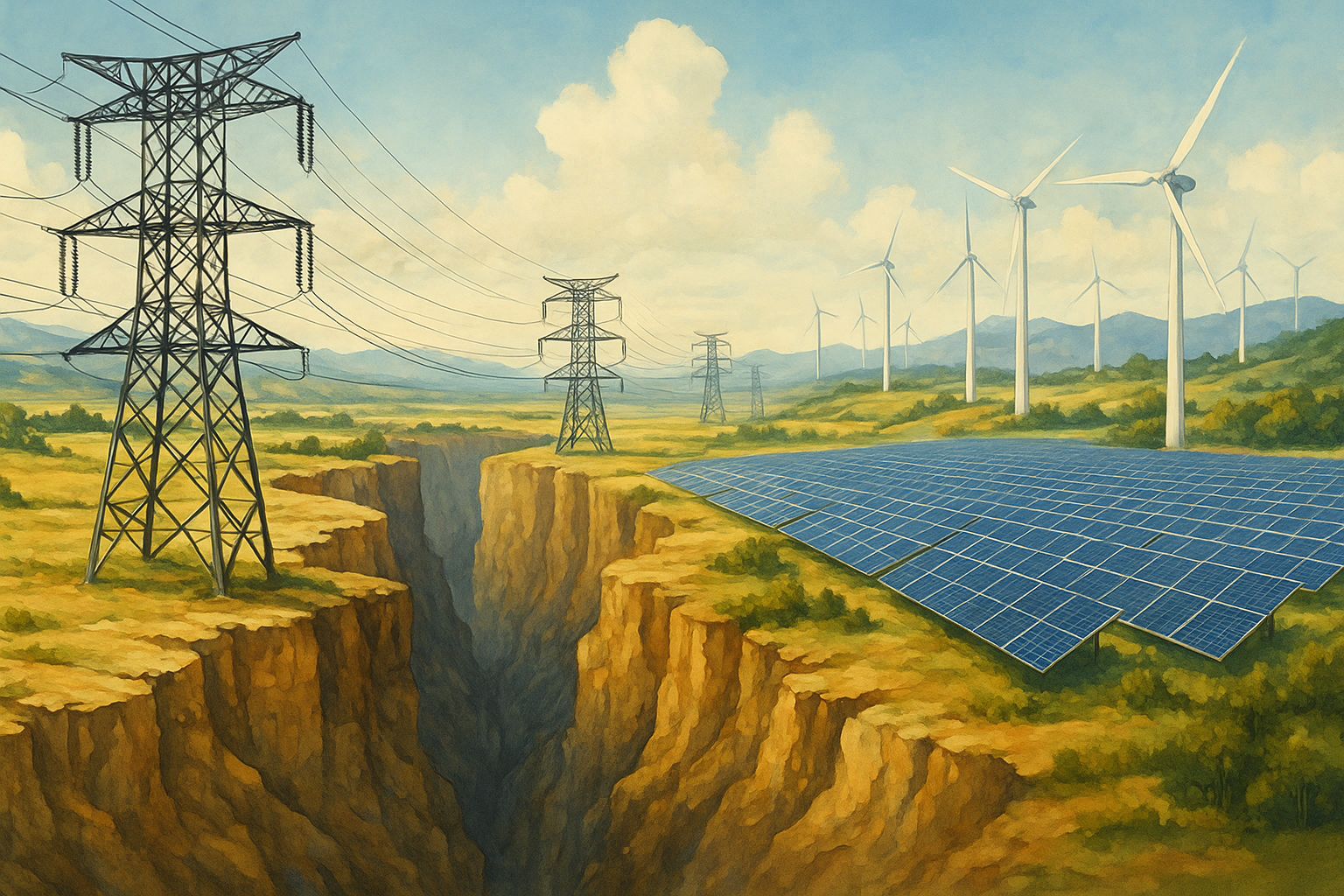
China's electricity grid: The gap between expansion and grid capacity – a challenge in integrating renewable energies into the grid – Image: Xpert.Digital
Power grid at its limit: The challenge of renewable energies in China
Energy waste despite records: China's expansion of solar and wind power
China has positioned itself as a global leader in the expansion of renewable energy, but faces significant challenges in integrating this capacity into its national power grid. Despite record-breaking installations of solar and wind power plants, a significant portion of the green electricity generated is curtailed—that is, not fed into the grid—because the grid infrastructure cannot keep pace with the rapid expansion. This discrepancy leads to considerable energy waste and hinders the effective transition to a more sustainable energy system. The Chinese government has recognized this problem and is developing various strategies to improve grid integration, including massive investments in ultra-high-voltage transmission lines, adjustments to curtailment quotas, and the promotion of energy storage technologies.
Related to this:

The unprecedented expansion of renewable energies in China
China has experienced an unprecedented expansion of its wind and solar energy capacity in recent years. The country is leading the global development, installing twice the capacity of the rest of the world combined. In the first seven months of 2023 alone, China installed almost 100 gigawatts of new solar capacity, already surpassing the record for the entire year of 2022. By the end of 2023, installed photovoltaic capacity reached nearly 610 gigawatts, with more than a third of that added in that year alone.
The growth momentum continued into 2024. In the first nine months of the year, 200 gigawatts of wind and solar power capacity were already installed, with a forecast of 250 to 300 gigawatts for the entire year. This explosive growth significantly exceeds the previous average figures of 100 to 130 gigawatts per year between 2020 and 2022. Global Energy Monitor estimates that China could easily reach an installed wind and solar capacity of 1,200 gigawatts by the end of 2024 – six years ahead of the target set by President Xi Jinping.
China's ambitions in the renewable energy sector are particularly evident in its planned "mega wind and solar power plants." The first wave of these large-scale projects, with a total capacity of 97 gigawatts, was announced in 2021 and largely went online as planned in 2023. A further 503 gigawatts are planned for the second and third waves, which are scheduled to be connected to the grid between 2025 and 2030.
The problem of curtailment: waste of renewable energy
Despite these impressive figures, China faces a fundamental problem: a significant portion of the renewable energy it generates goes unused. This phenomenon is known as curtailment – a process in which electricity producers are prevented from feeding their generated power into the distribution grid.
The history of curtailment in China dates back to the mid-2010s. At that time, curtailment rates in some provinces reached alarming levels of 40 to 50 percent, meaning that almost half of the potentially generated renewable energy remained unused. To address this problem, the National Development and Reform Commission (NDRC) and the National Energy Administration (NEA) introduced a 5 percent curtailment cap in 2018. This regulation stipulated that the utilization rates of solar and wind power projects in certain Chinese provinces could not fall below 95 percent.
However, the implementation of this policy had unintended consequences: it led to strict restrictions on the scale of renewable energy projects, particularly in regions with high curtailment rates. The approval and development of new projects was severely hampered, as many projects struggled to obtain planning permission.
A significant change in this policy is emerging in 2024. The NEA and the State Grid Corporation of China (SGCC) are considering increasing the permissible curtailment rate from 5 to 10 percent. This doubling of the allowed curtailment rate is an admission that the grid integration problem persists and cannot be fully resolved in the short term.
Reasons for the lack of network integration
The main reason for the lack of integration of renewable energies in China lies in the geographical mismatch between generation and consumption. The best conditions for wind and solar energy are found in the northwestern and northern provinces of China, where large solar and wind power plants dominate. However, the majority of electricity demand is concentrated in the industrialized metropolitan areas and industrial centers on the east coast – approximately 70 percent of China's electricity is consumed in the southeast.
This situation presents an enormous challenge, as the production facilities are located up to 3,000 kilometers from the main consumption centers. Over such long distances, electricity transmission is inefficient without specialized infrastructure, as losses are too high. A striking example of this problem is the world's largest wind farm in Ulanqab (Inner Mongolia). Although parts of this power plant, with a capacity of six gigawatts, were completed as early as 2020, only a single wind turbine was connected to the grid in the spring of 2023.
Another structural problem is the imbalance between investments in renewable energy generation and grid expansion. While China is investing record sums in expanding renewable energy, investments in the electricity grid remain comparatively low. Grid investments in China were largely stable between 2021 and 2023 compared to the period from 2018 to 2020 – despite the exponential growth in renewable energy.
Furthermore, the Chinese electricity market remains highly inflexible. Electricity trading across provincial borders is hampered by political interests and bureaucratic hurdles, further complicating the efficient distribution of renewable energy.
Plan your solar system for the most common applications conveniently online with our solar system planner!
With our user-friendly solar system planner, you can design your individual solar system online. Whether you need a solar system for your home, your business, or for agricultural purposes, our planner allows you to consider your specific requirements and develop a customized solution.
The planning process is simple and intuitive. You simply enter the relevant information. Our planner takes this information into account and creates a customized solar system that meets your needs. You can try out different options and configurations to find the optimal solar system for your application.
Furthermore, you can save your plan to review it later or share it with others. Our customer service team is also available to answer any questions and provide support to ensure your solar system is optimally planned.
Use our solar system planner to design your individual solar system for the most common applications and accelerate the transition to clean energy. Get started now and take an important step towards sustainability and energy independence!

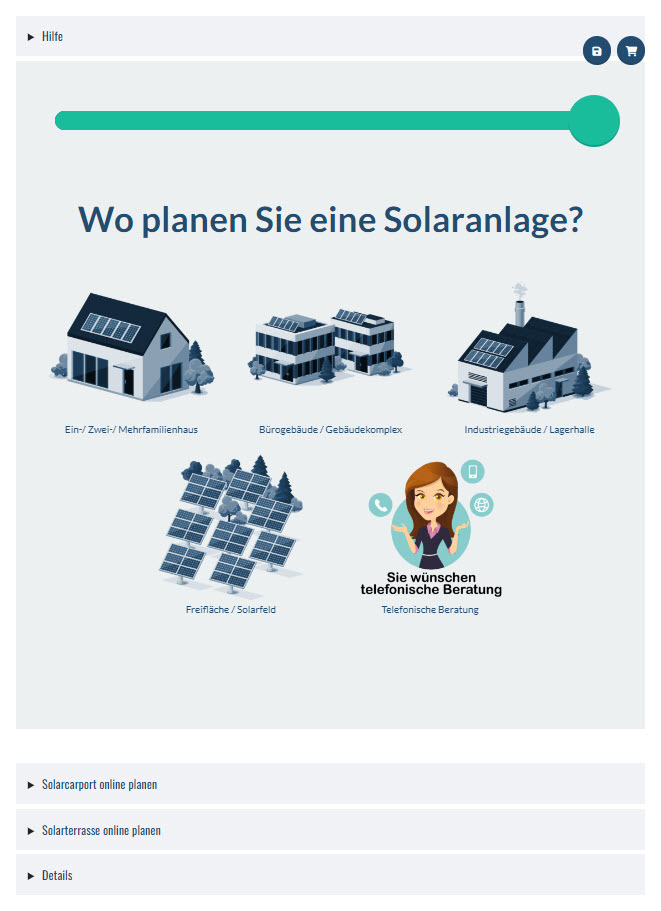
The solar system planner for the most common applications: Plan your solar system online here - Image: Xpert.Digital
More information here:
A balancing act in the energy sector: Coal and renewables in China compared
Political measures and investments to solve the problem
The Chinese government has recognized the problem and is working on various solutions. A key element is the expansion of the ultra-high voltage (UHV) grid, which enables the efficient transmission of electricity over long distances. China is a world leader in this field and is investing heavily in this technology.
The first pilot projects for large-scale wind and solar power plants in China's western regions were initiated in the early 2000s. These were intended, on the one hand, to electrify local regions where many households still lacked electricity, and on the other hand, to supply the industrialized southeast with power.
The two state-owned grid operators, State Grid and China Southern Grid, have announced record-breaking multi-billion-dollar investment targets to improve the grid infrastructure. Construction of the first high-voltage power line, running from a renewable energy project in northern Ningxia to Hunan province in the southeast, began in June 2023. Experts estimate that construction of this line could be completed as early as 2025.
In 2024, China is estimated to invest more than €80 billion in expanding its electricity grid. While this is a considerable sum, it is insufficient to keep pace with the rapid expansion of renewable energy. Experts from Agora Energiewende recommend that investments in the electricity grid should be aligned with the record-high investments in renewable energy generation.
Innovative approaches to improved network integration
In addition to expanding its power grid, China is also pursuing innovative approaches to better integrate renewable energies. One notable approach is the integration of electric vehicles into the grid. In January 2024, the Chinese government published implementation guidelines to improve the interaction of electric cars and plug-in hybrids with the power grid.
The program aims to establish a national technical standard system for vehicle-grid interaction and a tariff mechanism for bidirectional charging by 2025. By 2030, managed bidirectional charging is to be rolled out on a large scale, with the goal that electric vehicles will "provide tens of millions of kilowatts of bidirectional flexibility for the regulation capacity of the electricity system.".
Battery swapping stations, which are widespread in China, are also intended to contribute to grid stability. For example, the electric car manufacturer Nio began testing battery swapping stations capable of feeding electricity back into the grid as early as 2022.
Related to this:

The dual strategy: coal and renewable energies
A remarkable aspect of China's energy policy is that, despite the massive expansion of renewable energies, coal-fired power generation continues to grow. In 2024, construction activity for coal-fired power plants rose to 94.5 gigawatts – the highest level since 2015. Furthermore, the country approved 66.7 gigawatts of new coal-fired power plant capacity, with approvals increasing particularly in the second half of the year.
This parallel strategy raises questions about China's long-term energy transformation. Instead of replacing coal, clean energy is being added to an existing fossil fuel-based system, hindering the intended transition to a renewable energy-based power sector. More than 75 percent of the newly approved coal-fired power plant capacity in 2024 was financed by coal mining companies or energy corporations with coal operations, reinforcing coal's dominance even when market fundamentals do not justify expansion.
Nevertheless, positive developments are also evident: The expansion of renewable energies has helped to reduce the share of coal-fired power generation in China to a record low of 53 percent in May 2024. This suggests that, despite the parallel strategies being pursued, renewable energies are slowly gaining in importance.
China's balancing act: Network integration and the path to a green future
The challenges of grid integration will not deter China from continuing its massive investments in renewable energy. According to S&P Global Ratings, the expansion of renewable energy in China will continue despite projected increases in curtailment rates. Analysts expect operators to "have to ride out the pain until the knots in the transition process are smoothed out.".
Solutions to the curtailment problem are being developed, including further investments in transmission technology and storage solutions, but implementation will take time. For operators, this means they must become more selective and prioritize investments in regions with more favorable local electricity policies and better supply-demand ratios.
China's experience with integrating renewable energy into the grid has global significance. As the world's largest emitter of greenhouse gases and simultaneously a leading country in the expansion of renewable energy, China's success or failure in integrating these energies could have a decisive impact on global climate protection efforts.
Bridging the gap
The lack of grid integration of renewable energies in China poses a significant challenge to the country's energy transition. Despite impressive progress in expanding wind and solar capacity, the problem of curtailment persists, leading to considerable energy waste. The geographical mismatch between energy generation and consumption, insufficient investment in the electricity grid, and an inflexible electricity market are the main causes of this challenge.
The Chinese government recognizes this problem and is taking various measures, including massive investments in the ultra-high-voltage grid, adjustments to curtailment quotas, and innovative approaches such as integrating electric vehicles into the grid. At the same time, it continues its parallel strategy of expanding coal-fired power plants, raising questions about the long-term transformation.
Competition between coal and renewable energies is intensifying, with wind and solar power generation being increasingly restricted, particularly in the fourth quarter of 2024. To ensure a successful energy transition, China will need to significantly increase investment in its electricity grid and make the market more flexible. Only then can the country fully exploit the potential of its impressive renewable energy capacities and make an effective contribution to global climate protection.
Innovative photovoltaic solution for cost reduction (up to 30%) and time savings (up to 40%)

Innovative photovoltaic solution for cost reduction and time savings - Image: Xpert.Digital
More information here:
Your partner for business development in the fields of photovoltaics and construction
From industrial rooftop PV to solar parks and larger solar parking lots
☑️ Our business language is English or German
☑️ NEW: Correspondence in your native language!

Konrad Wolfenstein
I and my team are happy to be available to you as your personal advisor.
You can contact me by filling out the contact form here wolfenstein@xpert.digital:or simply call me at +49 7348 4088 965. My email address is
I'm looking forward to our joint project.