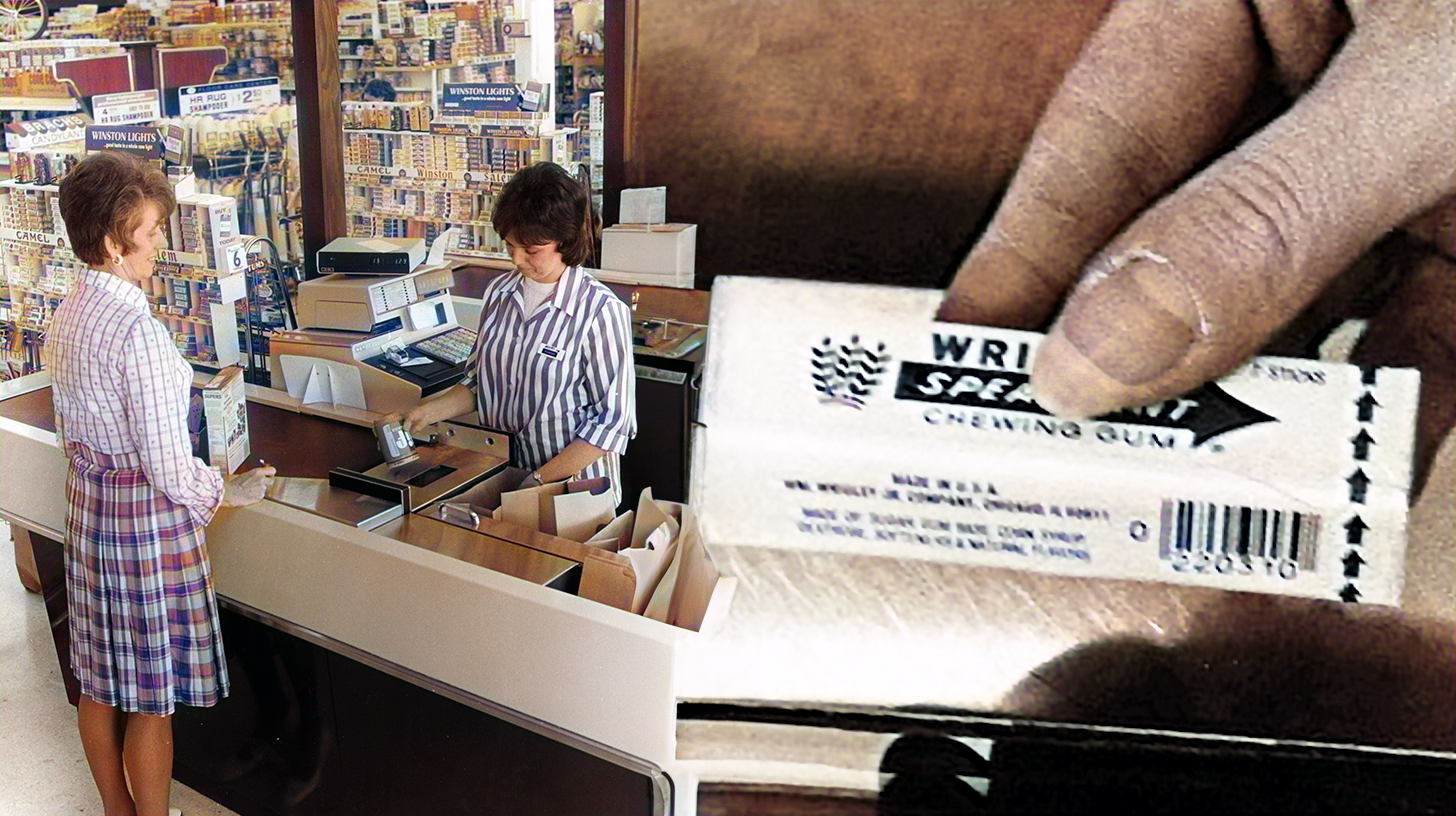
On June 26, 1974, the barcode on a Wrigley's Juicy Fruit chewing gum was scanned for the first time in a Marsh supermarket in Ohio, USA – Image: Wrigley/GS1 / Color adjusted: Xpert.Digital
Farewell to the beep? Why the barcode is facing a major transformation
A future without lines: How the DataMatrix code is changing our economy
The ubiquitous "beep" that has echoed through supermarket checkouts and warehouses for decades signifies more than just the completion of a purchase or the registration of an item. It is the acoustic echo of a revolution in the global economy, a symbol of efficiency and automation inextricably linked to the barcode. But after an impressive success story, with ten billion scans performed daily worldwide, the barcode stands at a turning point. A new generation of codes is poised to fundamentally change the way we identify products and exchange information.
This transformation takes us from the one-dimensional barcode to the two-dimensional matrix code, in particular the GS1 DataMatrix code. After more than 50 years of the barcode's undisputed triumph, a global shift is now imminent that will have profound effects on businesses, consumers, and the entire value chain.
1974: The beginning of an era
The year 1974 marks a milestone in the history of commerce. In an Ohio supermarket, the first barcode was scanned – an event that heralded the beginning of automated checkout and, simultaneously, the start of an unprecedented success story for the GS1 organization. The machine-readable GS1 barcode, containing the Global Trade Item Number (GTIN), formerly known as the European Article Number (EAN), quickly became the universal standard in global trade. It became the key to efficient and secure business processes, valid across company boundaries and continents, and scanned ten billion times daily on products worldwide.
Related to this:
GS1 standards act as the global language of business. They enable companies to optimize their processes, ensure product traceability, and increase security in their supply chains. GS1 sees itself as a global network that, together with customers and partners, develops market-driven and future-oriented solutions that directly contribute to business success. Today, two million companies from 25 industries worldwide use this common "language" to uniquely identify products, locations, and assets, collect relevant data, and seamlessly share it with business partners within their value networks. GS1's motto – "The Global Language of Business" – underscores this central role.
50 years of barcode scanning: A still-present sound
The characteristic beep when scanning a barcode has become an integral part of our modern lives. Fifty years ago, on June 26, 1974, this sound was heard for the first time when a pack of chewing gum was scanned in a grocery store in Ohio. This event marked the beginning of an era in which technology revolutionized the efficiency and speed of commerce. Even as a new generation of barcodes is poised to meet the growing information needs of businesses and consumers, this familiar sound will continue to accompany us as we shop.
Digital transformation is accompanied by a multitude of iconic acoustic signals. Consider the memorable Windows startup chime, the activation tones of voice assistants like Siri and Alexa, or the ubiquitous ringing and vibrating of our smartphones. But the absolute classic, the "beep" when scanning a barcode, is emblematic of the progress in data capture and processing. Today, we encounter this sequence of black lines on a light background almost everywhere – in retail, logistics, healthcare, and many other industries. Worldwide, this sound is heard over ten billion times a day.
Thomas Fell, CEO of GS1 Germany, aptly summarizes the significance of the barcode: “For 50 years, the barcode has stood for process reliability and increased efficiency. As one of the pioneers of digital transformation, it has significantly changed the way data is captured and processed, thus enabling further technological innovations, such as self-checkout in supermarkets.” The barcode has not only increased speed at the checkout, but has also laid the foundation for more precise inventory management, optimized supply chains, and improved product tracking.
From the first "beep" onwards, in the service of the German economy
The 50th anniversary of the barcode is being celebrated in conjunction with GS1 Germany. This non-profit organization is the central point of contact for companies in Germany that want to use barcodes or other GS1 standards for their products, shipments, documents, or machinery. To use these standards, companies need a GTIN, which they can also obtain from GS1 Germany. The GTIN, associated with the most well-known barcode, the EAN-13, is an indispensable component of global trade.
The Cologne-based company's portfolio now comprises around two dozen such "global standards," all aimed at enabling smart and efficient business processes. These include two-dimensional barcodes like the GS1 DataMatrix code and QR codes, which bridge the gap between the physical and digital worlds. A global network of 116 GS1 organizations continuously develops these solutions to actively address the challenges facing industry and commerce in 150 countries and 25 sectors. GS1 Germany is an integral part of this network and has supported the German economy since its founding in 1974 – from the very first "beep" and in close collaboration with its customers, including numerous major players in industry and commerce.
Digital solutions for greater efficiency
Thomas Fell emphasizes the practical relevance of GS1 standards for the business value creation process: “With our universal standards, we make a practical contribution to the business value creation process. We develop them side by side with users and see ourselves as a driving force in digitalization and as a neutral platform for cross-company collaboration.” This cooperative approach ensures that GS1 solutions are always market-oriented and future-proof, supporting companies in successfully asserting themselves in a dynamic market environment. An important aspect of this is simplifying e-commerce and meeting the growing information needs of consumers – tasks that the new generation of barcodes is designed to fulfill even better in the future.
Although it is difficult to quantify the exact economic contribution of GS1 standards, Thomas Fell is convinced: "It cannot be precisely quantified, of course, but our standards undoubtedly contribute to the profitability of companies, which is always a great motivation for us." The efficiency gains made possible by the use of barcodes and other GS1 standards have a positive impact on the entire value chain, from production and logistics to sales.
Into the future with multifunctional 2D codes
The next generation of barcodes, based on more powerful 2D codes, will play a role as significant as that of linear barcodes over the past 50 years. Two-dimensional barcodes offer crucial advantages, especially when it comes to storing and transmitting large amounts of information. While one-dimensional barcodes are limited by their linear structure, 2D codes allow for the combination of more than 7,000 numeric characters. This capability is essential in a world where the need for detailed product information is constantly growing.
Related to this:
Direct internet connection
Another crucial advantage of 2D codes is their ability to connect users directly to the internet. By scanning such a code, consumers and business partners can access a wealth of information in seconds. The relevance of this information is further enhanced by the new data exchange standard "GS1 Digital Link." This standard acts like a "switch," enabling the delivery of different information depending on the context.
Information diversity
Consumers are interested in information about allergens, ingredients, recipe ideas, or customer reviews. Business partners, on the other hand, need access to economic or technical data relevant to their specific processes. The key advantage is that the code on the product remains the same, while the information content changes depending on the time, location, and device used for the barcode scan—a single code for diverse applications. This flexibility and expanded information content make 2D codes a powerful tool for greater transparency and efficiency across the entire value chain.
Resistance to damage
The resistance of 2D codes to damage is another important advantage. Even if parts of the code are illegible, modern scanners can usually still reliably capture the information they contain. This is particularly important in demanding environments such as warehouses or production facilities.
Future readability
From 2028, 2D codes are expected to be readable at supermarket checkouts across the board. This marks an important step in replacing traditional barcodes. Despite all the innovations and the impending changes, however, things will by no means become quieter in the world of goods and digital business processes. The familiar "beep" will continue to accompany us, albeit perhaps in a new, more diverse soundscape of data capture.
Paradigm shift
The introduction of 2D codes is more than just a technical upgrade. It's a paradigm shift with the potential to redefine the interaction between products, businesses, and consumers. The ability to store and retrieve vast amounts of data in context opens up entirely new possibilities for personalized offers, improved traceability, and more efficient supply chains.
Advantages for companies
For companies, this means they will be able to label their products in more detail and provide consumers with more comprehensive information. This can lead to greater customer satisfaction and stronger customer loyalty. At the same time, the improved data foundation enables more precise inventory management, a reduction in waste, and the optimization of logistics processes.
Sustainability opportunities
2D codes also offer new opportunities in the area of sustainability. By integrating information about the origin of raw materials, the production process, and the recyclability of products, consumers can make more informed decisions, and companies can transparently communicate their efforts toward greater sustainability.
Challenges for companies
However, switching to 2D codes also requires investment and adjustments on the part of companies. Scanner systems need to be updated and internal processes adapted accordingly. GS1 supports companies during this transition with comprehensive information and training programs.
The future of global trade is digital and interconnected. The transition from barcodes to 2D codes is a crucial step in this direction. It enables us to fully leverage the benefits of digitalization and further enhance the efficiency, transparency, and sustainability of the global economy. While the sound at the checkout may change, the fundamental importance of automatic identification and data capture for modern commerce and logistics remains. The "beep" may evolve, but its message—progress and efficiency—continues.
Our recommendation: 🌍 Limitless reach 🔗 Connected 🌐 Multilingual 💪 Sales power: 💡 Authentic with strategy 🚀 Innovation meets 🧠 Intuition


From local to global: SMEs conquer the world market with a clever strategy - Image: Xpert.Digital
In an era where a company's digital presence determines its success, the challenge lies in creating an authentic, personalized, and far-reaching presence. Xpert.Digital offers an innovative solution that positions itself as the intersection of an industry hub, a blog, and a brand ambassador. It combines the advantages of communication and sales channels in a single platform and enables publication in 18 different languages. Cooperation with partner portals and the ability to publish articles on Google News and a press distribution list with approximately 8,000 journalists and readers maximize the reach and visibility of the content. This represents a crucial factor in external sales and marketing (SMarketing).
More information here:
We are here for you - Consulting - Planning - Implementation - Project Management
☑️ SME support in strategy, consulting, planning and implementation
☑️ Creation or realignment of the digital strategy and digitization
☑️ Expansion and optimization of international sales processes
☑️ Global & Digital B2B trading platforms
☑️ Pioneer Business Development

Konrad Wolfenstein
I would be happy to serve as your personal advisor.
You can contact me by filling out the contact form below or simply call me on +49 7348 4088 965 .
I'm looking forward to our joint project.
Write to me



Xpert.Digital - Konrad Wolfenstein
Xpert.Digital is a hub for industry focusing on digitalization, mechanical engineering, logistics/intralogistics and photovoltaics.
With our 360° Business Development solution, we support renowned companies from new business to after-sales.
Market intelligence, smarketing, marketing automation, content development, PR, mail campaigns, personalized social media and lead nurturing are part of our digital tools.
You can find more information at: www.xpert.digital - www.xpert.solar - www.xpert.plus
Keep in touch