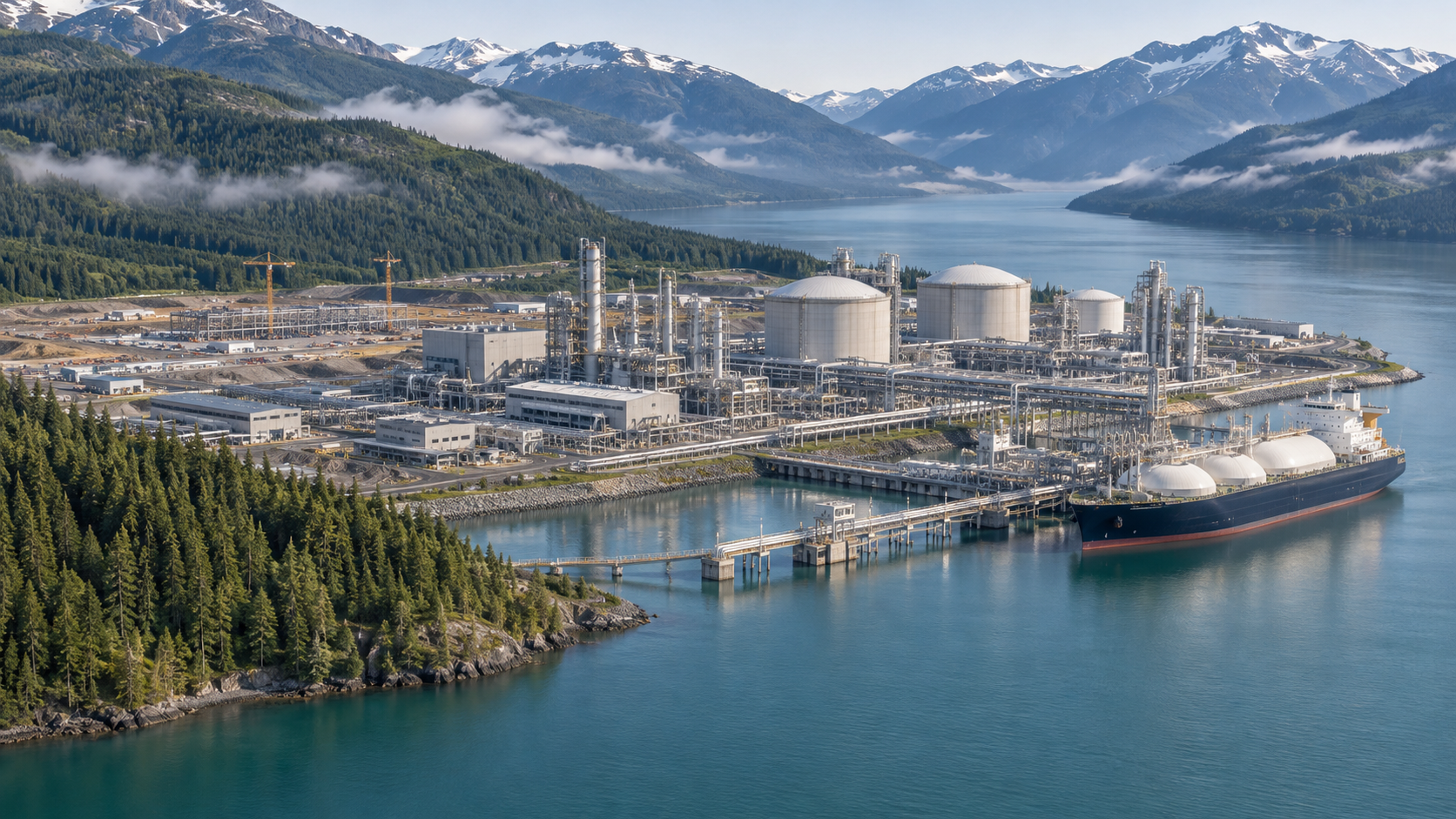
Canada aims to become an LNG giant: Up to $888 billion – What Canada's gas offensive could really achieve – Creative image on the topic, created with AI: Xpert.Digital
Global demand for safe gas is rising – can Canada seize the opportunity?
LNG from Canada for Germany? What's behind the multi-billion-euro export offensive?
Canada's LNG boom: How the energy crisis could become a billion-dollar market – but the biggest hurdles lie within the country itself
Canada could become one of the world's leading suppliers of liquefied natural gas (LNG). Large natural gas reserves, political stability, and access to the Pacific Ocean provide favorable conditions for this. The disruptions in energy markets caused by the Iran-Iraq War further increase the value of supplies that do not need to be transported through the Strait of Hormuz. In an ambitious expansion scenario, investments of nearly one trillion Canadian dollars could be mobilized along the gas and LNG value chain by 2050.
But abundant natural resources alone do not guarantee economic success. Canada must coordinate its extraction facilities, pipelines, export terminals, and reliable electricity supply in a timely manner. At the same time, it needs skilled workers, long-term customers, and viable agreements with the affected regions and Indigenous communities. The plan must also work out even when the currently high energy prices fall and other countries expand their LNG capacities.
The central question, therefore, is not only how much gas Canada can export, but also at what total cost and with what long-term consequences. Forecasts range from limited expansion to the rise of Canada as an LNG superpower. A closer look at Canada's plans reveals what these large sums of money actually mean, which companies and regions could benefit, and why infrastructure could become the crucial bottleneck.
The world is searching for safe gas – but Canada's biggest adversary is not in the Persian Gulf, but in its own country
Canada has the potential to become one of the world's leading suppliers of liquefied natural gas (LNG). Vast natural gas reserves, political stability, high-performing companies, and access to two oceans provide an exceptionally strong foundation. The disruptions in international energy markets exacerbated by the Iran-Iraq War further enhance the value of a supply whose transport is not dependent on the Strait of Hormuz. This long-underestimated resource potential could thus generate a significant boost in industrial growth. In an ambitious expansion scenario, this could amount to nearly one trillion Canadian dollars in investments along the gas and LNG value chain by 2050.
Between a large natural resource deposit and an economically successful export model lies a demanding industrial challenge. Natural gas must be extracted, processed, transported via pipelines, liquefied, and shipped. At the same time, the facilities require electricity, skilled workers, capital, long-term customer relationships, and public acceptance. Canada must therefore not only export more gas but also expand several interconnected infrastructure systems simultaneously.
The central economic question, therefore, is not whether the country possesses sufficient natural gas. The crucial question is whether it can bring its resources to international markets in time and at competitive overall costs. This is precisely the tension surrounding Canada's LNG offensive: the geopolitical opportunity is significant, but the window of opportunity for profitable investment could be smaller than current crisis prices suggest.
Security of supply becomes an economic location advantage
The Iran-Iraq War has once again highlighted that energy markets are not solely determined by production costs and consumption volumes. The geographical concentration of export facilities, the security of sea lanes, and the political relationships between suppliers and consumers also influence the economic value of an energy source. When transport through the Strait of Hormuz is restricted, this not only affects immediate disruptions in deliveries. Insurance premiums, freight rates, and the expectations of market participants also change.
This creates a twofold problem for importing countries. They must procure sufficient energy while simultaneously preventing several seemingly separate supply contracts from becoming dependent on the same bottleneck in a crisis. Different producers offer only limited diversification if their tankers all have to navigate the same vulnerable strait.
Canada can leverage a structural advantage here. LNG from its Pacific coast does not need to be transported through the Strait of Hormuz on its way to Northeast Asia. A Canadian shipment is therefore not merely an additional quantity of gas, but potentially also a differently distributed geopolitical risk exposure. The combination of large resources, comparatively stable institutions, and alternative transport routes makes the country attractive to energy consumers planning for the long term.
However, this does not automatically lead to a permanently enforceable price increase. Customers may be willing to pay more for security. How much, however, depends on their financial resources and the available alternatives. Security of supply is an economic advantage, but not a license for arbitrarily high production and construction costs.
Two coastlines offer opportunities, but they don't replace infrastructure
Canada's access to both the Atlantic and Pacific Oceans might initially give the impression that the country could supply Europe and Asia directly. However, this view is economically oversimplified. The most significant current LNG developments are concentrated along the Pacific coast of British Columbia. The particularly important Montney Basin is also located in the west of the country, in the border region between British Columbia and Alberta.
For the Asian market, this results in a logical industrial process: gas from western Canada is transported to the Pacific coast, liquefied there, and then shipped across the ocean to Asian customers. Existing and planned projects in western Canada follow this pattern. Direct deliveries from the Atlantic coast to Europe, however, would require correspondingly efficient transport links, liquefaction plants, and economically viable projects. A coastal access point on the map does not automatically constitute a fully operational export chain.
Canadian LNG remains relevant for Germany. Firstly, European companies can contractually purchase gas from Canadian projects. Secondly, additional production also has an indirect effect: if Canadian deliveries cover part of the Asian demand, other quantities of LNG can become available for Europe.
This distinction is important. The European benefit of a Canadian LNG initiative is not solely measured by the number of tankers sailing directly from Canada to Germany. Crucially, it also depends on how much global competition for available supplies eases. A larger global market with multiple independent supply centers can improve security of supply without requiring every importer to maintain a direct transport relationship with every producer.
The country is rich in raw materials, but its economic value remains limited
The Montney Basin is a key component of Canada's gas strategy. The region combines extensive resources with an existing production industry. In the ambitious expansion scenario, it could supply a large portion of the additional gas volume required to achieve a national LNG export level of 100 million tons annually. The additional use of natural gas in liquefaction plants is estimated at approximately nine billion cubic feet per day.
Canada's economically viable resource base is estimated at approximately 375 trillion cubic feet, assuming a price level of less than three US dollars per million British heat units. Under the relevant model assumptions, this base is sufficient to meet domestic demand and substantial LNG exports for more than half a century. This contradicts the notion that Canada would be unable to continue its export strategy after a short period due to insufficient resources.
However, such a range estimate is no guarantee of permanently cheap gas. Economically viable resources depend on technology, costs, prices, and regulatory conditions. If, for example, the costs for drilling, water treatment, emission reduction, or connecting new production areas increase, the economic limits of extraction will also change.
Furthermore, there is a fundamental difference between an existing gas reserve and a reliably available annual production. New wells, pipelines, and processing plants must be ready in a timely manner. Existing production sites do not deliver the same quantity indefinitely. A growing LNG sector therefore requires not only one-off investments but also continuous industrial modernization.
Canada's wealth of resources thus provides a solid foundation. However, it does not relieve companies and policymakers of the task of transforming underground potential into a reliable and cost-effective long-term supply capability.
Between political ambition and realistic export development
Several expansion targets are mentioned simultaneously in the public debate: around 50 million tons of LNG annually as a medium-term goal, 100 million tons as a long-term ambition, and a potential position as the world's third-largest LNG exporter. However, these figures describe different stages of development and should not be treated as a guaranteed future.
The accelerated expansion scenario examined projects up to 100 million tons of annual export capacity by 2050. Politically, this figure has also been linked to an earlier timeframe. This contrasts with a significantly more conservative development path: without a substantial acceleration, approximately 36 million tons annually are expected by 2050. The difference between the two scenarios is therefore 64 million tons per year.
This gap is more economically significant than the impressive target figure itself. It demonstrates that becoming a major LNG producer would not simply be a continuation of already approved projects. It would require an additional surge in investment encompassing new production capacities, pipelines, power supply, and export facilities simultaneously.
Even a potential export level of around 50 million tons in the early 2030s must therefore be understood as an ambitious expansion path. What matters is not the sum of all project announcements, but rather the actual financed, approved, and subsequently operational facilities. Several economically distinct risk levels lie between a project idea and a reliably operating export facility.
An objective assessment therefore distinguishes between political objectives, planned capacity, final investment decisions, and the actual exported volume. Anyone who conflates these categories quickly overestimates the speed of Canada's rise.
Kitimat turns an export vision into an industrial business
With LNG Canada in Kitimat, Canada has had large-scale access to the international LNG market since 2025. The first expansion phase is designed for an annual capacity of 14 million tons. At the end of September 2026, the participating companies made the final investment decision for the second expansion phase, which is expected to increase capacity to 28 million tons annually. The consortium includes Shell, Petronas, PetroChina, Mitsubishi, and Korea Gas.
The economic significance of this decision extends beyond the additional export volume. An existing location offers infrastructure, operational experience, and established relationships with customers, service providers, and authorities. An expansion can leverage these foundations, whereas a completely new location must create numerous prerequisites from scratch.
However, doubling an existing major project is not merely a technical upgrade. Plans include two additional liquefaction units, extra storage capacity, another berth, and expanded supply facilities. The connected Coastal GasLink pipeline will also need to be upgraded. The entire project involves approximately 33 billion Canadian dollars in private investment.
The participation model facilitates marketing: The five partners each assume their corresponding share of LNG production. This means the project is backed not only by investors, but also by companies with their own sales channels and long-term energy interests. This reduces certain marketing risks, but does not eliminate construction cost risks or the dependence on the future profitability of deliveries.
Kitimat thus provides practical evidence of Canada's ability to implement large LNG projects. However, it would be premature to conclude that the success of one site will lead to a smooth replication of such projects across the entire country.
What the $888 billion actually means economically
The prospect of 888 billion Canadian dollars sounds like a massive influx of money. However, to put it into perspective, it's essential to clarify what this figure measures. It refers to the cumulative contribution to the gross domestic product (GDP) up to 2050 in the accelerated development scenario of the gas, LNG, and associated liquid hydrocarbon value chain. It is neither an annual return nor a corporate profit, nor is it a readily available source of government revenue.
Nor can this figure simply be added to the nearly one trillion Canadian dollars in expected investments. Investments, sales, income, and value added describe different economic processes. An investment, for example, creates demand for construction services and machinery. The resulting domestic value added can then be a component of the gross domestic product.
The figure of 888 billion Canadian dollars, which translates to approximately 564 billion euros, remains remarkable. However, for international comparison, the euro amount is less reliable than the original figure because it depends on the exchange rate used. More meaningful is the realization that the economic potential would unfold over a period of more than two decades.
Furthermore, the relevant comparison is not a future with LNG versus a future without any gas industry. Even the more conservative development path includes investments of approximately 389 billion Canadian dollars and roughly 100,000 supported jobs on average per year by 2050. The additional benefits of accelerating development must therefore be assessed against this baseline, not against a zero economic scenario.
Why high export revenues do not automatically mean high profits
In the ambitious scenario, Canadian business revenues along the considered value chain are projected to reach approximately $1.6 trillion, labor income of around $405 billion, and tax revenues of about $151 billion by 2050. These figures illustrate the broad economic impact such expansion could have. However, they should not be added together because their contents partially overlap.
For individual companies, revenue alone is not the deciding factor. An LNG project can generate high revenues and still produce an insufficient return on investment if construction costs, financing costs, or ongoing operating expenses are too high. Especially with capital-intensive projects, the timing of cash flows is of great importance.
Initially, substantial sums are invested in planning, construction, and infrastructure over several years. Revenue is only generated after commissioning. If this is delayed, the period without corresponding export earnings is extended. At the same time, interest payments, personnel costs, and contractual obligations can continue.
For the economy, another point comes into play: not all investment expenditure stays in the country. While imported machinery and foreign services increase the project value, they do not generate a corresponding amount of Canadian added value. Conversely, domestic suppliers, engineering firms, and maintenance companies can build long-term industrial capabilities.
The quality of a boom is therefore not solely determined by the amount of investment. Equally important are the depth of domestic value creation, the productivity of the developing infrastructure, and the distribution of economic risks.
The underestimated leverage lies in the by-products of gas production
The economic importance of the Canadian gas industry extends beyond methane itself. Extraction often produces other hydrocarbons such as ethane, propane, butane, and condensate. These substances, known as natural gas liquids, can significantly impact the profitability of a production project.
For typical gas wells, their share of production is estimated at around 24 percent, while they can account for up to half of the economic value. This explains why a production project cannot be judged solely on the basis of the natural gas price. The prices and sales opportunities of the associated products can significantly alter its competitiveness.
Ethane, propane, and butane open up additional markets, including the chemical industry, heating, and exports. Condensate also plays a special role as a diluent for heavy Canadian crude oil. Expanding gas production can therefore strengthen links to other sectors of the energy industry.
This presents an industrial opportunity, but also a conflict of objectives. Additional raw materials can enable petrochemical value creation and export revenues. At the same time, a closer connection to the oil sands industry could complicate climate policy assessments. It would therefore be an oversimplification to attribute the entire economic potential solely to LNG liquefaction or to consider all accompanying effects as inherently positive.
This leads to a broader perspective for location policy: success would not only come from building individual export terminals, but also from developing competitive industrial links between extraction, processing, chemicals, transport and energy supply.
Our EU and German expertise in business development, sales and marketing


Our EU and German expertise in business development, sales and marketing - Image: Xpert.Digital
Industry focus areas: B2B, digitalization (from AI to XR), mechanical engineering, logistics, renewable energies and industry
More information here:
A thematic hub offering insights and expertise:
- Knowledge platform covering global and regional economies, innovation and industry-specific trends
- A collection of analyses, insights, and background information from our key areas of focus
- A place for expertise and information on current developments in business and technology
- A hub for companies seeking information on markets, digitalization, and industry innovations
Approval certainty is more valuable than mere political rhetoric about acceleration
An employment boom needs precise classification
The prospect of nearly 250,000 jobs annually is among the most impressive figures in the accelerated expansion scenario. However, this refers to an average annual employment effect along a comprehensive value chain. It does not imply that a quarter of a million additional permanent jobs would be created every year.
Equally important is the distinction between construction and operation. Large-scale projects generate high demand for construction workers, welders, engineers, logistics personnel, and technical service providers during the construction phase. After completion, the immediate need for personnel decreases considerably because modern LNG plants are capital-intensive and highly automated.
The second phase of LNG Canada's expansion illustrates this difference. During the construction phase, up to 4,000 new jobs are expected at the site, and approximately 2,100 jobs are anticipated for additional compressor stations along the pipeline. In contrast, later operations are projected to create around 90 additional full-time positions and about 150 contractor jobs. These figures do not reflect all indirect employment effects, but they demonstrate the significant difference between the construction ramp-up and sustained plant operation.
Even temporary construction phases can have a significant impact on income in affected regions. However, they can also strain housing markets, municipal infrastructure, and local services. Furthermore, if several large-scale projects are seeking skilled workers simultaneously, costs for other sectors increase.
A forward-looking economic policy must therefore consider skills development, regional infrastructure, and the future use of industrial capabilities. Lasting prosperity is not achieved solely through as many construction sites as possible, but through productive employment throughout the entire investment cycle.
The real competition takes place in the total costs
Canadian natural gas may be readily available at low prices, but this doesn't automatically mean Canadian LNG will arrive cheaply at the target market. Numerous cost components lie between the production site and the consumer: processing, pipeline fees, liquefaction, financing, storage, and maritime transport. The total of these costs is crucial.
The high costs for new infrastructure are particularly problematic. For the pipeline projects studied, permits in Canada take an average of 27 months longer compared to Texas. Construction costs are quoted with a markup of 160 percent. This markup, not just 1.6 times the base cost, is mathematically equivalent to 2.6 times the base cost.
These figures, however, do not describe a universally applicable characteristic of every Canadian project. Terrain, climate, project size, route alignment, and legal requirements can cause significant differences. The comparison serves as a warning signal for competitiveness but does not replace a project-specific cost analysis.
Especially for Western Canada, the combination of inexpensive extraction and expensive transport can become a crucial point of tension. A low price at the extraction site is of little use if new pipelines are so expensive that they negate the cost advantage. Conversely, an existing and well-utilized infrastructure can significantly improve economic viability.
This also explains why expanding existing sites often appears more attractive than entirely new projects. The economic value of existing pipelines, ports, and supply facilities lies not only in saved construction costs but also in less uncertainty regarding scheduling and technical integration.
Approval certainty is more valuable than mere political rhetoric about acceleration
Lengthy approval processes increase project costs, but speed alone is not a sufficient indicator of quality. A procedure that initially appears fast but is subsequently legally vulnerable can delay later implementation more than a thorough and reliable review.
For investors, predictability is paramount. Responsibilities must be clear, requirements defined early on, and decisions legally sound. For projects spanning decades, stable tax and regulatory frameworks are also crucial. Repeated changes increase uncertainty about future cash flows and can raise the required return on investment.
Another factor is coordination within the value chain. A terminal needs sufficient gas. A pipeline needs committed transport customers. Gas producers are more likely to invest if they have long-term access to attractive sales markets. If these decisions are made in isolation, each party involved has to wait for the commitment of the others.
Integrated participation models and coordinated contracts can reduce such obstacles. Government support can also resolve coordination problems in certain cases. However, it should not lead to economically weak projects being realized solely through the permanent shifting of their risks onto the general public.
The sensible political task is to enable reliable framework conditions and shared infrastructure. It is not to declare every announced LNG plant a national success story, regardless of costs and sales prospects.
Indigenous partnerships determine the viability of the expansion
The rights and economic interests of Indigenous communities are a central component of Canadian infrastructure development. To view them merely as an obstacle or as a tool for acceleration would be factually inappropriate and economically short-sighted.
Pipelines, extraction facilities, and export terminals alter landscapes and can impact traditional land uses and local livelihoods. Therefore, viable projects require early public participation, transparent environmental protection plans, and fair economic agreements. While ownership participation can better align competing interests, it does not replace environmental impact assessments or independent decision-making by the affected communities.
LNG Canada offers five neighboring First Nations the opportunity to invest up to one billion Canadian dollars in a company that will acquire the future LNG storage tank of the second expansion phase. This example demonstrates how economic participation can extend beyond short-term construction contracts.
From an economic perspective, risk distribution is just as important as the potential return. An investment creates wealth potential, but can also entail debt and long-term dependencies. Good models must therefore guarantee transparency, adequate financing, and independent decision-making capacity.
Long-term partnerships are not only a societal requirement. They can also improve the economic stability of a project because they make conflicts visible earlier and increase the quality of long-term agreements.
Clean electricity is becoming the limiting production factor
A key potential competitive advantage of Canadian LNG projects lies in their lower emission intensity. Electrically driven compressors and a comparatively low-emission power supply can reduce emissions during production, processing, and liquefaction. Canadian projects are projected to have a 55 percent lower greenhouse gas intensity compared to similar, yet-to-be-finalized international projects. This figure describes a specific comparison group and should not be generalized to all natural gas emissions.
However, this very advantage creates additional infrastructure dependencies. A comprehensive electrification of LNG development is projected to require an additional power output of approximately 3.1 gigawatts by 2050. This will also necessitate new transmission lines and improved access to electricity for extraction and processing plants.
Low-emission electricity is therefore not an unlimited byproduct, but a scarce production factor. LNG projects potentially compete with other industrial investments and with the growing electricity demand of buildings and transportation. Crucially, therefore, it is not only the installed capacity that matters, but also when and where additional electrical energy is reliably available.
For project planning, this means that an electrified LNG facility cannot be considered in isolation. If the terminal is completed before the power connection is available, a new operational risk arises. Conversely, if power grids are expanded too generously for projects that are later not realized, unused costs can result.
The competitiveness of gas exports is therefore surprisingly heavily dependent on a successful electricity and grid policy.
The climate impact is determined by the entire supply chain
Lower emission intensity during production does not make LNG climate-neutral. Even with highly efficient extraction and liquefaction, carbon dioxide emissions are still produced during subsequent combustion. Furthermore, there are potential methane losses along the extraction, transport, and utilization chain.
For a reliable assessment, it is therefore essential to distinguish which emissions are actually being measured. A comparison of liquefaction plants answers a different question than a complete analysis from the wellhead to the end user. Equally important is the case study: Does Canadian LNG replace more emission-intensive gas, coal, or oil, or does it crowd out investments in lower-emission alternatives?
Under certain assumptions, an accelerated Canadian expansion of LNG infrastructure is projected to have a global emissions reduction potential of up to 44 million tons of carbon dioxide equivalents annually. This result depends, among other things, on the actual replacement of more emissions-intensive production processes or other fossil fuels. It is not an automatic effect of every additional LNG shipment.
A balanced perspective therefore acknowledges both sides: Gas produced with lower emissions can have advantages over less favorable fossil alternatives. At the same time, very long-lasting gas infrastructures can create economic ties that may later clash with declining fossil fuel demand.
Canada's most credible position would therefore not be to claim a fundamentally climate-friendly fossil fuel boom. A more convincing approach would be a verifiable strategy with low methane losses, transparent emissions measurement, and a careful examination of the actual displacement effects.
The global market isn't waiting for Canadian projects
The biggest threat to Canada's expansion plans may be that the current energy crisis leads to a miscalculation of long-term shortages. High prices and supply concerns are increasing interest in additional deliveries. At the same time, however, other producers are also responding with investments.
Worldwide, LNG projects with a combined planned capacity of more than 600 million tons are competing for an additional market opportunity, which is projected to reach approximately 176 million tons by 2050. Not all projects will be realized. Furthermore, a global supply increase of roughly 50 percent is expected over the next five years.
This could shift market power once again. In an acute supply crisis, sellers have the advantage. Conversely, with a sharp increase in supply, buyers can demand lower prices, more flexible contract terms, and shorter commitment periods. Projects planned during a period of scarcity may not reach the market until a phase of significantly more intense competition.
Canada must therefore avoid basing its economic viability calculations on permanently inflated crisis prices. The crucial factor is whether projects can generate sufficient returns even under less favorable market conditions. This applies particularly to projects with high initial investments and expensive transportation links.
Speed has real economic value in this environment. However, it should not be confused with haste. A project completed early but structurally too expensive may perform worse in the long run than a slightly later project with reliable costs and guaranteed sales.
Who could benefit from the expansion – and who bears which risks
A Canadian LNG boom would affect various business groups. Gas producers such as Tourmaline Oil, Canadian Natural Resources, ARC Resources, and Ovintiv could potentially benefit from additional sales opportunities. Pipeline and infrastructure companies like TC Energy and Enbridge, as well as companies with LNG holdings like Pembina Pipeline, occupy different positions in the value chain. However, their involvement in the sector does not automatically translate into equally high economic benefits.
For mining companies, it is important whether additional export demand improves achievable prices and whether they can expand their production at competitive costs. Higher sales may be unattractive if it requires developing particularly expensive new mining areas.
Pipeline operators need sufficient long-term booked capacity. Their risks include construction costs, utilization, contract terms, and the creditworthiness of their customers. LNG facilities, in turn, must ensure that gas supply, liquefaction, and marketing are economically coordinated.
Pembina, for example, is involved in the Cedar LNG project together with Haisla Nation. Such investments differ significantly in their risk profile from a broadly diversified pipeline business or pure gas production.
For an economic evaluation, a blanket list of winners would therefore be misleading. What matters are specific projects, financing structures, and the question of which stakeholders have to bear the brunt of cost increases or weaker market prices. A growing sector can create value overall, while individual companies may still achieve unsatisfactory results.
Canada can reduce its dependence on the US, but not eliminate it
Expanding international LNG exports also serves a trade policy objective. Canada aims to broaden its sales opportunities and reduce its heavy reliance on the US market. Direct access to Asian and potentially European customers can increase the number of potential buyers and strengthen the negotiating position of Canadian producers.
Economically, this diversification makes sense as long as it is achieved at sustainable costs. An additional sales market has option value: producers are less dependent on a single neighboring country accepting their growing quantities under attractive conditions.
Complete independence, however, would be neither realistic nor necessarily desirable. North American energy markets remain closely interconnected through existing pipelines, trade relationships, and investments. LNG complements these connections rather than replacing them entirely.
Furthermore, new dependencies arise. Long-term contracts with Asian buyers, international financing partners, and global shipping bring their own economic and political risks. Diversification therefore does not mean risk-free operation, but rather a broader and, ideally, less correlated distribution of risks.
For Canada, the greatest progress would therefore not be a demonstrative break from the US. It would be the ability to choose between several attractive sales channels without having to permanently subsidize the infrastructure created for them.
Germany gains options, but no substitute for its own energy strategy
For Germany, additional Canadian LNG can contribute to a more resilient gas supply. A concrete example is the agreed long-term purchase of one million tons of LNG annually from the planned Ksi-Lisims project by the German energy company SEFE. The project's status and eventual commissioning remain dependent on further development steps.
Such relationships broaden the range of suppliers. However, they do not eliminate the fundamental question of how much natural gas Germany will need in the long term. Industrial demand, building heating, electricity generation, efficiency improvements, and electrification can develop differently. A robust procurement strategy must therefore consider multiple demand paths.
This creates a conflict of interest between sellers and buyers. New LNG plants often require long-term purchase commitments to ensure their financing is viable. European companies, on the other hand, want flexibility in case their gas demand falls more sharply than expected.
A contract with a politically stable supplier country is therefore not automatically the most economically optimal option. Pricing, contract duration, volume flexibility, and remarketing opportunities are also crucial. Security of supply is achieved through a well-balanced portfolio, not simply by replacing one dominant supplier with another.
Canadian LNG can increase Germany's room for maneuver. However, it should be seen as a complement to efficiency, diversified procurement, and a robust domestic energy infrastructure, not as a replacement for them.
Three development paths illustrate the range of the potential boom
A first plausible path is a limited but successful expansion. Projects already well advanced and selected expansions are implemented, while expensive or insufficiently secured projects are abandoned. Canada gains export revenue and additional sales opportunities, but remains significantly below its long-term ambition of 100 million tons annually. This path would be less spectacular, but could be economically disciplined.
A second path would be coordinated industrial acceleration. Production capacity, pipelines, power grids, and terminals would grow in a coordinated manner. Long-term customer contracts and viable equity participation models would facilitate financing. In this case, Canada would come closer to the ambitious scenario that describes nearly one trillion Canadian dollars in investments and a cumulative contribution of 888 billion dollars to the gross domestic product.
A third path would be a delayed and overpriced expansion. Several projects would be started in parallel while skilled workers are scarce, power connections are lacking, and international competitors are bringing additional quantities to market. The plants might then only reach full production during a period of lower prices.
These scenarios make it clear that more capacity does not always mean more prosperity. The best economic strategy is not necessarily to export every technically possible ton of LNG. It is to implement those projects whose long-term benefits justify the total costs and risks.
Success depends on productivity, not export records
Canada possesses a rare combination of abundant resources, political stability, and a favorable geographic location for additional LNG exports. Disruptions in global energy markets have increased the strategic value of this position. Furthermore, with LNG Canada and the approved expansion in Kitimat, an industrial foundation exists upon which further development can be built.
The potential multi-billion-dollar boom is not, however, guaranteed prosperity. These major economic figures describe conditional development paths spanning decades. They require investment, demand scarce skilled workers and low-emission electricity, and depend on a global market where numerous competitors recognize the same opportunity.
A convincing Canadian strategy would therefore have to combine four requirements: competitive total costs, reliable implementation, fair participation, and verifiable environmental performance. None of these goals can be permanently pitted against the others. Cheap subsidies are of little use without affordable infrastructure. Fast permits are useless without legal stability. Low production emissions are only convincing if their measurement is transparent.
Canada does not need to become the third-largest LNG exporter at any cost to be economically successful. Even a smaller, profitable, and well-integrated sector could generate significant income, trade, and industrial benefits. Conversely, a record export volume would not be a success if it were based on persistently high subsidies, insufficient capacity utilization, or excessive risk diversification.
The decisive factor, therefore, is not the scale of the announced gas expansion. It is the ability to transform a temporarily particularly valuable resource advantage into lasting productive capital. This is precisely what will show whether Canada uses the current energy crisis for structural advancement or merely formulates its next big resource hope.
🎯🎯🎯 Data-driven B2B industry hub as a quasi-in-house solution


The quasi-in-house solution: How Xpert.Digital closes operational gaps in B2B marketing and sales – Smart Content-Driven Business - Image: Xpert.Digital
Xpert.Digital is a data-driven B2B industry hub led by Konrad Wolfenstein . The company acts as an external, quasi-in-house solution for industrial partners, closing operational gaps in marketing, content, and sales – without requiring additional resources on the client side.
More information here:
Your global marketing and business development partner
☑️ Our business language is English or German
☑️ NEW: Correspondence in your native language!

Konrad Wolfenstein
I and my team are happy to be available to you as your personal advisor.
You can contact me by filling out the contact form here wolfenstein@xpert.digital:or simply call me at +49 7348 4088 965. My email address is
I'm looking forward to our joint project.