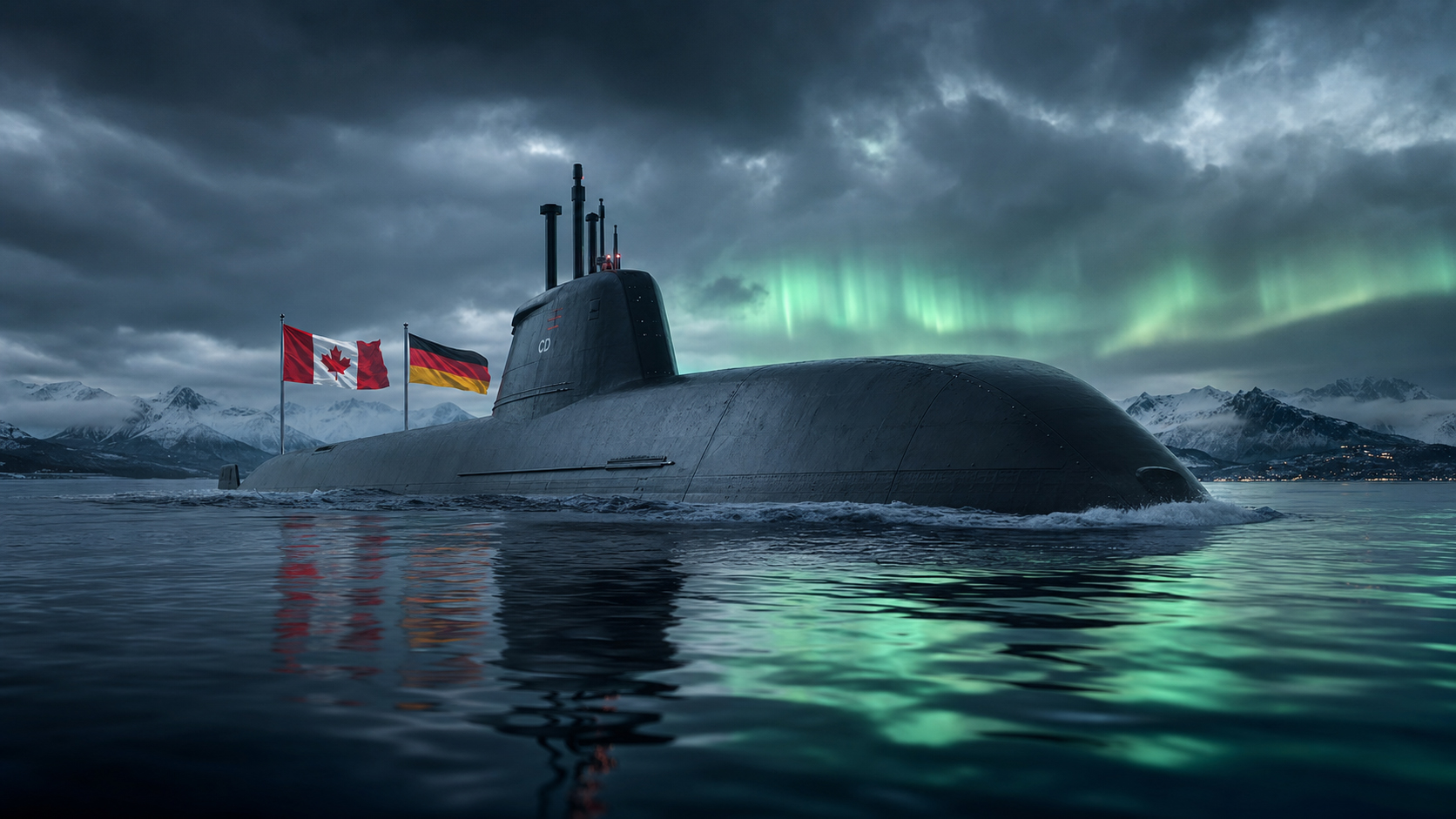
Canada buys German submarines for up to 61 billion euros: Turning away from the USA – Canada's historic mega-deal with German submarine shipyard – Creative image: Xpert.Digital
Mega-contract for TKMS: How a 61 billion euro deal will shape the German arms industry for decades to come
Historic arms deal: Canada bypasses the USA and buys submarines in Germany
Against Russia and China: Why Canada is reinventing its strategic soul – with German help
It is a historic turning point in global security policy that goes far beyond the mere procurement of major military equipment: Canada is undergoing an unprecedented strategic realignment and turning away from its traditional arms partner, the USA. For a total volume of up to 61 billion euros, the long-established German shipyard ThyssenKrupp Marine Systems (TKMS) is to build twelve state-of-the-art Type 212CD submarines for the Canadian Navy. This massive deal is Ottawa's direct response to the growing power ambitions of Russia and China in the increasingly ice-free Arctic – and at the same time, an unprecedented industrial stimulus package. While Canada is completely redefining its maritime sovereignty for the 21st century with this decision and forging closer ties with Europe, the German arms manufacturing sites in Kiel and Wismar are facing a massive capacity expansion that will secure thousands of jobs for decades to come. A look behind the scenes of a mega-deal in which arms purchases become a matter of major global politics.
When arms purchases become industrial policy – and a country reinvents its strategic soul
July 7, 2026, marks a turning point in Canadian security history. In Halifax, Nova Scotia, Prime Minister Mark Carney announces, before departing for the NATO summit in Ankara, that ThyssenKrupp Marine Systems (TKMS) has been selected as the preferred bidder for the construction of twelve new submarines. It is one of the largest defense contracts in the country's history—and it reveals far more about the state of global politics than tonnage and torpedo range.
A procurement project of historic proportions
The Canadian Patrol Submarine Project (CPSP) is no ordinary defense contract. The procurement of up to twelve diesel-electric submarines alone involves construction costs of 24 to 30 billion Canadian dollars. Adding in operation, maintenance, and modernization over their entire service life, the total cost reaches up to 100 billion Canadian dollars – roughly 61 to 65 billion euros. This is approximately equivalent to Canada's annual defense budget at the time the decision was made.
The urgency of the project is undeniable. Canada's current fleet consists of four Victoria-class submarines, originally built by Great Britain in the 1980s and purchased secondhand from Ottawa in 1998. Typically, only one of these is operational at the time of the tender process. The others are either cannibalized for spare parts or undergoing lengthy maintenance. A country with the world's longest coastline and strategically important Arctic territories defends its sea and underwater borders with a submarine force that is largely insignificant operationally. This is the stark reality that makes this contract politically unavoidable.
The military has clearly defined its needs: To maintain three submarines ready for deployment at all times – for the Atlantic, the Pacific, and the Arctic – Canada requires twelve boats, as experience has shown that only one out of four boats is available in a high-readiness state. The first delivery is expected in the mid-2030s.
The German-Norwegian offer – quality from the heart of NATO
ThyssenKrupp Marine Systems, headquartered in Kiel, is no newcomer to the world of conventional submarine construction. The company has supplied more than 70 percent of all conventional submarines in service with NATO members and has export experience with twenty navies worldwide. The model offered to Canada is the Type 212CD – where CD stands for "Common Design" – a joint project with Norway, based on the proven Type 212A, but surpassing it in almost every dimension.
The technical specifications are impressive. At approximately 73 meters long and with a submerged displacement of 2,500 tons, the 212CD is significantly larger than its predecessors. Its propulsion system combines two MTU 4000 diesel engines with hydrogen-based fuel cells (AIP – Air Independent Propulsion), enabling the submarine to remain submerged for weeks without surfacing to recharge batteries. Its maximum underwater speed exceeds 20 knots. The hull design is diamond-shaped – an innovation that effectively deflects the active sonar of enemy surveillance vessels, minimizing its acoustic signature. The submarine is equipped with modern 533 mm torpedo tubes and systems such as IDAS for vertical defense missiles and potentially sea-launched Naval Strike Missiles.
The decisive argument of the German consortium, however, lies not solely in the technology. Berlin and Oslo have emphasized from the outset that, by purchasing the submarines, Canada would be joining an existing trilateral partnership: Germany is ordering six submarines, Norway six as well, and the two countries operate, maintain, and modernize their fleets in close coordination. Canada would be entering a system that already exists and has been proven – including joint training, joint logistics, and joint monitoring of Russian submarine movements in the North Sea and the Atlantic. This argument – “proven, not promised” – has been repeatedly emphasized by TKMS CEO Oliver Burkhard. It directly addresses Canada’s legitimate concern about ending up with a supplier who makes grand promises in theory but cannot deliver on them operationally.
On the industrial policy front, TKMS has put together a comprehensive package. The company promises a GDP contribution of 86 billion Canadian dollars over the project's lifetime, as well as more than 650,000 work-years in Canada. Total economic activity, including indirect effects, is estimated at 160 billion Canadian dollars. Partnerships have been established with, among others, CAE (simulation technology and training), Seaspan Shipyards (maintenance), the AI company Cohere, and several Indigenous economic organizations. In a gesture unusual for the industry, TKMS has also announced a partnership with BlackBerry subsidiary QNX for the submarines' real-time operating system – a signal of technological depth and local engagement.
The competitor from Seoul and the art of public speaking
Hanwha Ocean from South Korea was the only remaining competitor and waged this competition with an aggression and visibility unusual in the discreet world of defense procurement. Posters around Parliament, TV spots featuring prominent Canadian voices, a submarine that sailed 14,000 kilometers across the Pacific to British Columbia – Hanwha spared no expense to make its name known in Canada.
The offered boat, the KSS-III Batch-II, is a modern, export-proven model with air-independent propulsion, a range of over 7,000 nautical miles, and an endurance of more than three weeks underwater. Hanwha also promised a faster delivery pace: four boats by 2034 and one per year thereafter. The economic figures for the Korean offer were comparable to those of TKMS – a GDP impact of 70 to 94 billion Canadian dollars, 22,500 jobs annually until 2044, and a binding investment of 345 million Canadian dollars in Algoma Steel, as well as liabilities in the automotive, LNG, and rare earth sectors.
Had it been a purely commercial competition, the decision would have been a very close race. But the CPSP was, from the outset, more than just a technical tender.
Arms procurement as a geopolitical instrument
Perhaps the most significant dimension of this deal is not its sheer size, but what it reveals about Canada's security policy realignment. Prime Minister Carney has repeatedly and unequivocally stated: "We will no longer be dependent on a single nation." He is referring to the United States. The tensions between Ottawa and Washington—triggered by the Trump administration's aggressive tariff policies, public threats of annexation against Canada, and a demonstrative disdain for its northern neighbor—have fundamentally altered Ottawa's security calculations.
For decades, it was standard practice in Canadian defense planning to procure major weapons systems from the United States. Three-quarters of Canada's defense spending on large-scale projects traditionally flowed south. With the CPSP contract, Ottawa is effecting a paradigm shift of immense symbolic and strategic significance: Canada will henceforth purchase its most important underwater weapons not from the superpower with which it had the closest security ties, but from its European allies. The fact that the US – having largely withdrawn from conventional submarine construction since the end of the Cold War – would not have been able to submit a competitive offer anyway makes the message to Washington no less clear.
The NATO dimension is equally relevant. Carney has committed Canada to NATO's new target of five percent of GDP for defense by 2035 – an increase that completely recalibrates procurement for the decade. Canada's defense spending is projected to rise to four percent of GDP by 2030, representing an annual increase of approximately 34 billion Canadian dollars compared to previous plans. In this context, the submarine order is not only a military necessity but also a political signal: Canada is fulfilling its alliance obligations – and doing so with its European partners.
The competition for Arctic sovereignty as a core motive
Behind the figures and diplomatic phrasing lies a fundamental security policy reality: the Arctic is no longer a dormant hinterland. In recent years, Russia has systematically expanded its military bases, radar installations, and icebreaker fleets in the High North. China describes itself as an "Arctic state" and is pursuing a long-term Arctic strategy with investments in Svalbard and the "Polar Silk Road" concept. The increasingly ice-free sea routes due to climate change—the Northwest Passage and the Northern Sea Route—are gaining immense importance as shipping lanes and as access points to previously inaccessible raw material reserves. It is estimated that approximately 30 percent of the world's undiscovered natural gas reserves and up to 13 percent of its oil reserves lie in the Arctic.
Canada controls the Northwest Passage and claims it as its internal territorial waters—a position disputed by the US and one that carries far more than academic weight in a future world of increasing resource and trade interests. Without a capable submarine fleet, this sovereignty argument cannot be credibly defended. The Type 212CD is specifically designed for operations under ice and in Arctic waters—a set of requirements that limits the capabilities of the Korean KSS-III, whose strengths lie more in open ocean areas.
The 35 billion Canadian dollar Arctic investment package announced in March 2026 – for airfields, logistics centers, and surveillance systems in the High North – provides the architectural framework for the twelve new submarines. These projects are complementary: ground infrastructure, air surveillance, and underwater capability together form an integrated deterrent system, which Ottawa considers the foundation of genuine Arctic sovereignty.
Hub for Security and Defense - Advice and Information

Hub for Security and Defense - Image: Xpert.Digital
The Security and Defence Hub offers expert advice and up-to-date information to effectively support companies and organizations in strengthening their role in European security and defence policy. Working closely with the SME Connect Defence Working Group, it particularly promotes small and medium-sized enterprises (SMEs) that wish to further develop their innovative capacity and competitiveness in the defence sector. As a central point of contact, the Hub thus creates a crucial bridge between SMEs and European defence strategy.
Related to this:
From steel to AI: How Canada is turning procurement into industrial policy
The industrial policy logic behind the award decision
Ottawa chose an unusual evaluation scheme for this procurement. Fifty percent of the total score was based on sustainability and maintenance concepts, twenty percent on the actual submarine capabilities, fifteen percent on price, and another fifteen percent on economic benefits and strategic value. This explicitly and transparently explained what is usually only implicit: military equipment is a condition of competition, but not its primary criterion. Procurement is industrial policy.
This approach is not an anomaly, but rather the expression of a deliberate economic policy strategy under Carney. At a time when Trump's tariffs and economic threats are putting pressure on Canadian export industries, Ottawa is using the submarine contract as leverage to build domestic capacity in steel, artificial intelligence, shipbuilding, education technology, and mineral processing. Both bidders were pressured to pledge investments in tariff-affected sectors such as steel and automotive—one of the most unusual aspects of the competition, which resembled an investor conference more than a traditional tender.
The TKMS offer ultimately proved convincing in its industrial policy depth. The partnerships with established and systemically important Canadian companies – CAE is the world's largest provider of flight simulation technology and brings similar core competencies to the training of submarine crews – underscored the value of the German offer. Berlin's message was clear: less quantity in letters of intent, more substance in strategic partnerships.
What the contract means for TKMS and the German defense industry
For ThyssenKrupp Marine Systems, the Canada deal is far more than just a single order. The company, which became independent from the ThyssenKrupp Group in October 2024, already had an order backlog exceeding €20 billion in the spring of 2026, reaching historic highs. Six Type 212CD submarines for Germany, six more for Norway, a multi-billion euro torpedo order from the German Armed Forces, frigates for Brazil, and the ongoing competition for the F127 frigates for the German Navy – the Kiel shipyard is operating at a capacity not seen in decades.
The Canadian order is taking capacity planning to a new level. TKMS has announced that it will begin series production of the 212CD class as early as September 2026 and is investing €100 million in a new hull production line. The Wismar site – once a bankruptcy case as MV Werften – is being systematically expanded into TKMS' second major production facility. Over €200 million is being invested in new production halls and a dedicated submarine production line, with the potential to create around 1,500 new jobs by the end of the decade. Wismar is thus not only being industrially rehabilitated but also strategically integrated into the backbone of German naval defense.
At full capacity with the German, Norwegian, and potentially Canadian orders, TKMS would build up to 24 submarines of the same type over a period of 15 years. This enables scaling of production and procurement, reducing unit costs, stabilizing supply chains, and accumulating expertise. This is industrial policy logic in its purest form: same platform, multiple customers, common design – hence the letters CD.
For Germany's defense sector as a whole, this sends a significant signal. TKMS claims to be the world's largest manufacturer of non-nuclear submarines and has delivered submarines to twenty navies worldwide. An order of this magnitude from a NATO partner like Canada not only confirms the export capabilities of the German defense industry but also strengthens the case for further investment in shipbuilding expertise and naval armaments – in a world where Europe's defense increasingly needs to become self-sufficient.
Procurement speed and negotiation reality – what the contract award really means
One important caveat accompanies the celebratory announcement from Halifax: The designation of TKMS as the preferred bidder does not legally or financially equate to a signed contract. In the logic of large defense procurements, this step marks the beginning of intensive renegotiations regarding prices, delivery deadlines, warranty conditions, technical specifications, and industrial participation quotas. The final contract could be years in the making, and the actual terms may differ significantly from the publicly communicated promises.
The procurement process itself was exceptionally fast by all defense industry standards. From the initial Request for Information in September 2024 to the selection of the preferred bidder in July 2026, just under two years passed – a remarkable achievement for a procurement project of this scale on an international scale. Defense projects for large naval combat ships typically take five years or more in the bidding phase alone. Canada has sent a clear signal: In a rapidly changing security environment, the ability to act also means speed of processes.
The economic promises of both bidders should also be viewed with appropriate skepticism. Figures such as "86 billion Canadian dollars contribution to GDP" or "650,000 working years" are based on models spanning thirty years or more, which rely on numerous assumptions about exchange rates, multiplier effects, interest rates, and technological developments. They are indications of the magnitude of potential impacts, not reliable predictions. Experts such as the Deloitte analysts have assessed the value creation promises of both bidders as fundamentally plausible, but highly dependent on the final contract terms.
The strategic outlook – a deal with long-term impact
If the treaty is finalized, it will bind Canada and Germany – as well as Norway as a third alliance partner – to a security partnership for fifty to seventy years. This is the true depth of the deal. Training, maintenance, upgrades, spare parts, simulation – all of this will be tied to the same supplier for decades. The trilateral submarine alliance of Canada, Germany, and Norway would become a permanent cooperative structure that extends far beyond weapons systems: joint training, joint monitoring, and shared strategic interests in the Atlantic and the Arctic.
For Germany, this is a geopolitical dividend of the first order. At a time when Berlin is struggling to redefine its foreign policy role and its contribution to the European security architecture, such a long-term security agreement with one of NATO's most loyal allies is an anchor. The Foreign Office and the Ministry of Defense accompanied this deal with rare diplomatic intensity: Pistorius traveled to Ottawa several times, Chancellor Merz personally lobbied Carney, and a double-digit number of TKMS employees were deployed on-site for months.
For Canada itself, the symbolic dimension cannot be underestimated. For the first time in the history of the Royal Canadian Navy, the country will possess a scalable, self-deterrent underwater component. Three submarines ready for immediate deployment, capable of patrolling undetected – this represents a qualitative transformation of Canada's defense posture, surpassing all previous considerations of national defense. It marks the end of sixty years of complacency and the beginning of a new era in which Canada will defend its three coasts in the Atlantic, Pacific, and Arctic with the means truly suited to the task.
More than the purchase of twelve ships
The submarine deal between Canada and TKMS is, in its entirety, a textbook example of how security policy, industrial policy, and geopolitics have become intertwined and mutually reinforcing in the second quarter of the 21st century. It is both a military necessity and an economic investment program. It is a response to Russian and Chinese Arctic ambitions and, at the same time, an expression of a conscious distancing from the former protecting power, the USA. It is a commitment to NATO and to European partners who, under the current political circumstances, consider Canada more reliable than its southern neighbor.
For TKMS, it represents what is likely the greatest single opportunity in the company's history and a doubling of production capacity in Germany. For Kiel and Wismar, for thousands of skilled workers in the maritime industry, for suppliers, universities, and research institutions, it is a wave of transformation with a multi-generational impact. And for the global defense architecture, it sends a clear signal: anyone looking to buy conventional submarines—from Canada to India, from Singapore to potential future NATO partners—is looking to Kiel.
Negotiations are starting now. The really significant deal is still ahead of us. But the direction has been set, and it is historic.
Consulting - Planning - Implementation

Markus Becker
I would be happy to serve as your personal advisor.
Head of Business Development
Chairman SME Connect Defense Working Group
Consulting - Planning - Implementation
Konrad Wolfenstein
I would be happy to serve as your personal advisor.
You can contact me at wolfenstein∂xpert.digital or
Just call me on +49 7348 4088 965 .