
GPT-6 Luna or GPT-6.1 Terra? Luna for routine tasks, Terra for complex tasks – ten times cheaper, but not always better
Xpert Pre-Release

Available in 27 languages 📢
Prefer Xpert.Digital on GoogleⓘPublished on: October 29, 2026 / Updated on: October 29, 2026 – Author: Konrad Wolfenstein
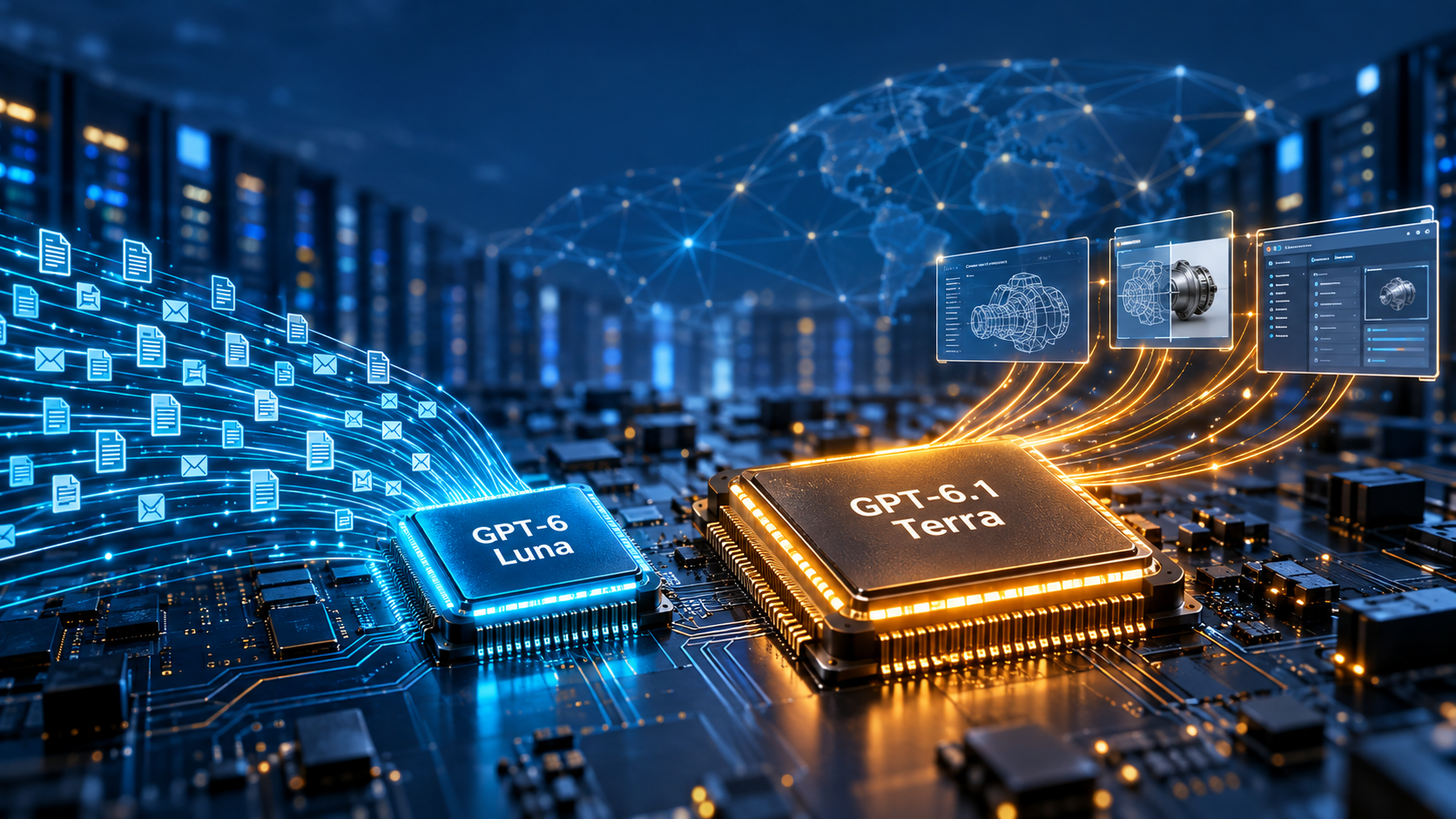
GPT-6 Luna or GPT-6.1 Terra? Luna for routine tasks, Terra for complex ones – ten times cheaper, but not always better – Creative image on the topic, with AI: Xpert.Digital
Calculating AI costs correctly: When OpenAI's more expensive model pays off
Affordable AI versus DeepSeek: OpenAI attacks the price competition with Luna
OpenAI offers two models with different price and performance profiles: GPT-6 Luna and GPT-6.1 Terra. Luna is primarily aimed at clearly defined tasks that occur in large numbers. Terra is designed to excel in visual analysis, more demanding computer operations, and versatile knowledge work. The price difference is significant: Terra costs ten times as much as Luna for both regular input and output tokens.
For companies, the crucial question is therefore not simply which model is more efficient or cheaper. It's about when additional capabilities justify their higher price – and when a more expensive model merely performs basic tasks. Because what matters is not the cost per token, but the total cost per accepted outcome: including tool usage, iterations, human review, and potential errors.
The comparison also touches on competition in the AI market. With Luna, OpenAI also challenges the notion that particularly inexpensive models must necessarily come from Chinese providers or from the open model market. However, low prices alone do not create a productivity advantage. For that, companies must use the models in a way that suits their processes, monitor their results, and keep an eye on the costs of the entire process.
Cheap intelligence, expensive bad decisions: Why the cheapest token doesn't create a competitive advantage
GPT-6 Luna is particularly interesting for clearly defined tasks with high production volumes, while GPT-6.1 Terra is designed to excel in visual analysis, more demanding computer operation, and versatile knowledge work. Both models thus belong to the more commercially oriented side of the OpenAI portfolio, but occupy different performance and price points: Terra costs ten times as much as Luna with regular input and output tokens.
The crucial question, therefore, is not which model is fundamentally better or cheaper. The decisive factor is in which tasks the additional performance justifies its higher price and where it merely leads to unnecessarily expensive processing of simple tasks. At the same time, OpenAI's pricing challenges the widespread notion that cost-effective AI must necessarily come from Chinese developers or from the open-source market.
From an economic perspective, a two-pronged competition arises. On the one hand, model providers compete on performance, speed, and usage prices. On the other hand, user companies compete to meaningfully integrate these models into their processes. The second competition is likely to be at least as important as the first for actual productivity gains.
Two models, different production roles
Luna is positioned as a particularly efficient model for focused tasks and large processing volumes; Terra, on the other hand, is designed to combine visual reasoning, precise computer operation, and natural written communication. This results in different operational roles, even though the technically supported functions partially overlap.
Luna is particularly well-suited to processes whose goal can be clearly defined. These include assigning a query to a category, extracting specific information from a document, summarizing a known issue, or creating standardized text modules. Such a model becomes economically attractive when the effort is determined not by the exceptional difficulty of a single case, but by the large number of similar cases.
Terra becomes more interesting when different types of information are combined or several work steps need to be meaningfully coordinated. OpenAI cites, for example, the comparison of product photos with catalog entries, the interpretation of technical drawings, and the operation of application interfaces. The potential added value here lies less in simply generating text than in the connection between perception, interpretation, and subsequent action.
The practical dividing line thus lies between standardized mass processing and more demanding process handling. However, it is not a rigid line. A well-prepared process can become simple for Luna, even if the original business problem appears complex. Conversely, a seemingly harmless request can become challenging due to conflicting documents, unclear responsibilities, or unusual exceptions.
The price difference is significant
The regular API prices demonstrate how clearly OpenAI differentiates between the two models. New inputs, reused inputs from the cache, and generated outputs must be considered separately.
| Price per Million Tokens | GPT-6 Luna | GPT-6.1 Terra |
|—|—:|—:|
| New Input | $0.10 | $1.00 |
| Read Cached Input | $0.01 | $0.05 |
| Output | $0.50 | $5.00 |
| Cache Write, Regular Short Retention | $0.125 | $1.25 |
With the same number of new input and output tokens, the price difference is therefore a factor of ten; with only read cache tokens, it is a factor of five. The actual difference thus depends, even at the pure token level, on the composition of the workload.
For business calculations, it is also important to note that these prices do not represent the full application costs. Tool usage can be charged separately, and both models differentiate between various processing methods and specific pricing conditions.
The list price therefore provides a starting point, but not yet an investment decision. It describes the purchase of a technical input. Whether this results in a favorable business outcome is only determined in the complete workflow.
The correct cost unit is often missing
A million tokens is a useful unit of account for developers, but of limited significance for management. Companies don't typically sell tokens, nor do they organize their value creation around model calls. They process invoices, answer customer inquiries, create quotes, review technical documentation, or modify software.
The economically relevant key performance indicator is therefore cost per accepted result. Acceptable means that the result is technically sufficient, available on time, can be processed correctly, and does not cause disproportionate rework. This definition necessitates considering model costs and process quality together.
A cheap initial run is of little value if an employee then has to reread documents and correct all the information. Similarly, a more expensive model can be more cost-effective if it resolves difficult cases without multiple repetitions. However, this should not lead to the blanket assumption that higher model prices automatically result in lower overall costs.
The comparison must be based on the same process. This includes identical input data, comparable tools, and a predefined quality target. Only then can it be determined whether Terra justifies its higher price or whether Luna already operates reliably enough.
What independent performance tests reveal
An independent evaluation from October 26, 2026, ranks Terra ten points higher than Luna in the Artificial Analysis Intelligence Index at maximum cognitive intensity; in the Coding Agent Index, Terra achieves 48 points compared to 31 points for Luna and 54 points for GPT-6.1 Sol. This suggests a substantial performance difference, especially in more demanding agent-based programming tasks.
These values should not be interpreted as a universal quality ranking. The publication in question uses the Intelligence Index version 4.3.2 for its breakdown; a new index generation with additional and revised tests was announced on October 27th. Therefore, scores from different index versions should not be indiscriminately combined.
A closer look puts simple narratives of victory into perspective. Vals AI rates Terra at 60.17 percent in its own index and gives DeepSeek V4.1 Flash 1017 a slightly higher overall score of 61.26 percent. This differing ranking alone demonstrates how strongly results depend on the mix of tasks and the evaluation methodology.
This has a clear consequence for business decisions: Public tests are suitable for pre-selection. However, they must prove their economic viability in concrete business applications.
Why Terra becomes interesting in visual work
Terra's profile is particularly relevant where information is not already clearly structured. A product photo, a technical drawing, or a screen contains relationships, spatial arrangements, and visual cues that can be lost through pure text extraction. OpenAI explicitly positions Terra for such visual and screen-based tasks.
In industry and logistics, this can lead to useful assistance applications. These include preparing comparisons between different drawing versions, assigning photographed components to existing product master data, or supporting the transfer of information between applications. The economic benefit depends on whether the system actually recognizes relevant differences and handles its uncertainty appropriately.
OpenAI reports a 15 percentage point improvement for Terra compared to GPT-5.6 Terra in Agents' Last Exam at medium thinking intensity, at approximately one-third of the cost; compared to Astra and GPT-6.1 Sol, the tasks in question were completed more than three times faster. However, this does not translate into a corresponding speed advantage over Luna.
Nor does this imply authorization for safety-critical decisions. Interpreting a technical drawing to prepare for an inspection is different from the binding approval of a component. There must be a clear organizational boundary between assistance and responsibility.
Luna makes the routine scalable
Luna's economic strength lies in its ability to perform many small processing steps very cost-effectively. In addition to text, the model also supports image input, structured output, function calls, and various tools. It is therefore not limited to simple chat replies.
Tasks whose results can be automatically checked are particularly useful. For example, if a system extracts an article number, date, or amount from a document, formatting rules and comparisons against master data can be added. Such checks can handle part of the quality assurance process without requiring every result to be fully re-evaluated by a more robust model.
This division of labor is also plausible in B2B marketing. Classifying incoming contacts, standardizing product data, or preparing standardized communication drafts often doesn't require maximum model intelligence. However, sophisticated market positioning or evaluating conflicting competitive information places different demands on the system.
The most common business mistake would be to run all processes through the more powerful model out of convenience. The opposite mistake would be to shift tasks to Luna, even those where misinterpretations have significant consequences, simply because of lower prices. Efficiency arises from appropriate allocation, not from a blanket cost-cutting target.
Document processes require several stages
Invoice processing illustrates why a multi-stage architecture is often more sensible than choosing a single model. A complete process involves more than just reading a document. It can also include supplier reconciliation, order reference, verification of mandatory information, and handling of discrepancies.
Luna is suitable for a standardized initial run. Once the required fields are clearly defined, processing can be tailored to a limited results format. Subsequently, predefined rules check for missing information, matching totals, and discrepancies between known supplier data and the data.
Terra becomes interesting where the document structure is unusual, visual relationships are crucial, or interaction with existing software interfaces is required. OpenAI explicitly mentions reading incoming invoices and transferring their data into accounting software as a possible application.
The economic benefit arises from combining these stages. Unobtrusive, standard cases remain cost-effective. Exceptions receive additional computing power or human attention. Particularly sensitive actions, such as changing bank details or authorizing payments, should not be automated simply because the model can operate the interface.
Programming requires more than code production
Even in software development, the distinction between simple and complex tasks is crucial. Small, clearly specified changes with thorough testing have a different risk profile than comprehensive architectural decisions or interventions in safety-relevant components.
OpenAI reports a value of 66.6 percent for Luna in the older DeepSWE v1.1 comparison at maximum thinking intensity. According to the manufacturer, Terra reaches a maximum of 50.3 percent in the Terminal Bench 4.0, while Vals AI reports 49.49 percent in its own test setup. These figures come from different tests and do not allow for a direct comparison of their percentages.
A more meaningful indicator for relative ranking is the joint Coding Agent Index, in which Terra clearly outperforms Luna. For more complex development tasks, this suggests Terra is the stronger candidate, while Luna can remain economically attractive for limited support tasks.
The measure of success should not be the amount of code generated. What matters are accepted changes that pass tests, comply with project rules, and can be integrated without disproportionate rework. More code can mean increased productivity, but it can also create additional bugs and technical debt.
Improved factual accuracy still requires explanation
Terra shows significant progress in preventing factual errors. In an internal OpenAI test with deliberately error-prone inputs, the error rate decreased from 53.6 to 16.7 percent at low cognitive intensity; at maximum cognitive intensity, OpenAI reports 4.3 percent. These figures refer to the specific test and do not represent a general error probability for any business task.
Artificial Analysis measures a different aspect: In its own knowledge test, Terra's hallucination rate compared to GPT-5.6 Terra dropped from 88 to 38 percent, with this metric describing guesswork in situations where the model does not know the answer. Therefore, the two sets of measurements should not be considered equivalent.
From an economic perspective, less unfounded guesswork is certainly valuable. A system that recognizes uncertainty and escalates a case can be more controllable than one that generates a convincingly worded but incorrect answer. At the same time, increased reluctance leads to more escalations.
The optimal course of action therefore depends on the cost of errors. For non-binding text preparation, cautious wording may suffice. For a binding professional decision, reliable evidence, data access, and, if necessary, human review are required.
A new dimension of digital transformation with 'Managed AI' (Artificial Intelligence) - Platform & B2B solution | Xpert Consulting

A new dimension of digital transformation with 'Managed AI' (Artificial Intelligence) – Platform & B2B solution | Xpert Consulting - Image: Xpert.Digital
Here you will learn how your company can implement customized AI solutions quickly, securely and without high entry barriers.
A managed AI platform is your all-inclusive, worry-free solution for artificial intelligence. Instead of dealing with complex technology, expensive infrastructure, and lengthy development processes, you receive a ready-made solution tailored to your needs from a specialized partner – often within just a few days.
The key advantages at a glance:
⚡ Rapid implementation: From idea to ready-to-use application in days, not months. We deliver practical solutions that create immediate added value.
🔒 Maximum data security: Your sensitive data stays with you. We guarantee secure and compliant processing without sharing data with third parties.
💸 No financial risk: You only pay for results. High upfront investments in hardware, software, or personnel are completely eliminated.
🎯 Focus on your core business: Concentrate on what you do best. We take care of the entire technical implementation, operation, and maintenance of your AI solution.
📈 Future-proof & scalable: Your AI grows with you. We ensure continuous optimization and scalability, and flexibly adapt the models to new requirements.
More information here:
Price-performance ratio of OpenAI's GPT-6 models
Expertise remains a separate category
A strong general model does not automatically make it a reliable legal, tax, or financial expert. Vals AI describes Terra as comparatively stronger at programming tasks and significantly weaker in several legal, tax, and financial-related tests.
For example, the analysis cites 25.96 percent in the Legal Research Bench and 15.17 percent in the Tax Agent Bench; at the same time, it points out that Terra sometimes omits conclusions that would have been required according to the respective evaluation rules. This illustrates an important conflict of objectives between caution and complete task resolution.
For practical application, this does not mean that Terra is fundamentally unsuitable for such areas. It means that the specific task must be precisely defined. Preparing documents, identifying potential inconsistencies, or creating an initial draft are different tasks than a final expert assessment.
Here, too, process design determines the benefit. Using models for preparation and then having their results professionally reviewed can lead to productivity gains. However, if general performance metrics are used as a substitute for specialized quality assurance, the risk of a seemingly inexpensive, but actually costly, error increases.
The buffer changes the calculation
Recurring input can account for a significant portion of processing. In Luna, reading cached input costs ten percent of the normal input price, while in Terra it costs five percent. This makes the design of the context itself an economic factor.
An agent may require the same behavioral rules, tool descriptions, and background information at every step. Effective reuse of these stable components reduces the proportion of newly processed input. Conversely, constant reordering or unnecessary modifications can negate the theoretical cache advantage.
OpenAI, within the GPT-6 family, allows changes to the complexity of reasoning and tool availability under certain conditions, without losing the previously established context for reuse. This is interesting for multi-stage applications because simple and complex sections can receive different amounts of computing power.
However, caching is not a free service. Write operations are priced separately, and with Terra, the costs also vary depending on the storage duration. A high hit rate is therefore only economically valuable if reuse, storage, and actual information needs are aligned.
Large contexts have hidden consequences
Both models support a context window of 1,050,000 tokens and a maximum of 128,000 output tokens. However, an equally sized context window does not imply identical capabilities or identical economic efficiency.
For requests exceeding 272,000 input tokens, the input and cache fees for the entire request double in both models, while the output price increases by one and a half times. Therefore, particularly long individual requests must be calculated differently than the same amount of tokens distributed across many smaller requests.
The technical capability to import vast amounts of material should not be confused with an economic recommendation. Often, it is more sensible to selectively choose relevant documents and provide the model with only the necessary excerpts. However, searching, document preparation, and additional infrastructure also incur costs.
Furthermore, there is a functional limitation: Both models process text and images as input, but according to the model description, they do not support native audio or video input. Applications involving video therefore require suitable additional processing, such as providing individual images and other information.
China is no longer automatically cheaper
The price offensive also challenges an established market narrative. If Chinese models are primarily associated with low costs, a Western provider can challenge this position simply by offering a lower regular price.
DeepSeek V4.1 Flash is quoted with off-peak costs of $0.15 per million new input tokens, $0.003 for cache hits, and $0.60 for output tokens; these values double during peak times. Luna's costs are lower, at $0.10 and $0.50 for new input and output tokens, respectively.
However, this statement does not apply to all cost components. DeepSeek's cache read price is lower than the corresponding Luna rate, and different prices may apply through external operators. Therefore, the claim of general cost leadership is too simplistic.
Furthermore, Terra doesn't occupy the same price position as Luna. Its higher price targets a different performance level. The strategic approach therefore consists of a tiered approach: Luna is intended to cover standardized mass tasks cost-effectively, while Terra offers additional capabilities at a still comparatively low price within the more powerful segment.
Where DeepSeek remains economically strong
DeepSeek's particularly low cache fee is relevant for applications with long, frequently repeated contexts. When an agent repeatedly uses the same codebase, the same rules, or the same large dataset, the composition of its inputs can become more important than the price of new tokens.
However, this advantage must actually be realized. A theoretically cheaper cache is of little use if inputs are constantly changing or the chosen provider has different terms and conditions. The time-dependent pricing of the direct DeepSeek API should also be considered.
The published peak windows are between 01:00 and 04:00 UTC on weekdays and between 06:00 and 10:00 UTC. This may be relevant for European real-time applications, while scalable background processing can more easily be scheduled for more favorable times.
Speed and execution time are further factors. The updated version 1017 is designed to complete tasks with shorter outputs and less processing time than the original V4.1 Flash version. Therefore, a lower token price does not automatically equate to a cheaper overall process. Especially in interactive workspaces, saved waiting time can be more economically valuable than a small difference on the API bill.
Open weights create an alternative option
A fundamental difference lies in the operating model. DeepSeek V4.1 Flash 1017 publishes its model weights under the MIT license, while Terra is offered as a model with private weights.
This allows DeepSeek to be provided by various operators or deployed in a company's own or contracted infrastructure. Its economic significance lies not only in potential cost advantages but also in the negotiating power it gains with individual service providers.
This remains a large and technically complex model. The architecture is described by 552 billion backbone parameters, of which eight billion are active per token during input processing and 16 billion during output; additional storage components supplement this structure. The smaller number of active parameters does not automatically make the model a straightforward local application.
Operating your own system requires a complete accounting of hardware, utilization, energy, monitoring, updates, and personnel. For fluctuating demand, an API can be more economical. Open weights are therefore primarily a strategic option. They offer flexibility but don't guarantee lower overall costs or automatically improved security.
A price offensive is not the same as price dumping
OpenAI has reduced the Luna entry price from $0.20 to $0.10 compared to GPT-5.6 Luna and the issue price from $1.20 to $0.50. Terra, in turn, has halved its entry price compared to GPT-5.6 Terra and lowered its issue price from $12 to $5 per million tokens.
This development can be interpreted as an aggressive competitive strategy. However, it does not prove that OpenAI is selling below its actual costs. Without reliable information on infrastructure contracts, utilization, and internal cost allocation, such a claim would be speculative.
Several mechanisms can operate simultaneously. Technological improvements can reduce costs. Increased utilization can better utilize existing capacities. Low entry prices can create additional demand and retain customers within the company's own ecosystem.
For the market, it is important that affordable basic models can also facilitate the marketing of complementary services. Once companies have built their applications on a platform, tools, operational functions, and higher-value model tiers become more important. The individual token then becomes just one component of a broader platform business.
Lower unit costs can increase expenses
A price reduction does not guarantee a lower overall bill. Companies can respond to more cost-effective processing by analyzing more documents, connecting larger user groups, or automating additional control steps.
This effect is amplified with agents. A business process can consist of planning, information retrieval, multiple tool calls, verification, and reprocessing. The number of model calls is then significantly greater than the number of visible user requests.
Economically, this is a potential rebound effect: efficiency makes additional use attractive. This is not necessarily problematic. If the additional consumption generates a correspondingly higher value, expenditures and productivity increase together.
The development becomes problematic when companies only monitor the unit price and fail to control the number of attempts, context lengths, or termination conditions. An agent that continues working without making clear progress can generate unnecessary costs even with very cheap tokens.
Therefore, every automated process needs a budget at the task level. In addition to a cost limit, maximum processing time, permissible repetitions, and clear escalation rules should be defined.
The economic logic of routing
Luna and Terra are particularly useful as coordinated processing stages. Simple cases start at a low cost. Additional processing power is only activated when the task is likely to require it.
The difficulty lies in deciding whether to forward the data. The model should not be allowed to judge its reliability solely based on its own convincing language. Verifiable signals such as missing information, inconsistencies, failed tests, or deviations from known rules are preferable.
Two types of errors are important for evaluating such an architecture. If difficult cases are forwarded too infrequently, quality suffers. If simple cases are escalated too often, the cost advantage disappears. Routing is therefore itself a measurable operational function.
For high case volumes, a cascade of Luna, Terra, and human review can become economically attractive. However, for small quantities of simple tasks, the additional development effort may outweigh the savings. The optimization architecture itself must also be cost-effective.
Security is not included in the price
A low model price does not automatically reduce the costs of organizational responsibility. Automating more processes also increases the scope of potential systematic errors.
Especially in computer-based systems, permissions must be limited. A model can read information, generate suggestions, or prepare input, but not simultaneously authorize payments, modify rights, or delete production data. The technical capability to perform an action is not a sufficient justification for its unsupervised execution.
Regional data processing also needs to be specifically examined. For Luna, OpenAI documents European data residency in several processing modes; regional processing can incur a price premium. However, such options do not replace an examination of the respective data flows, contracts, and organizational requirements.
The same principle applies to open models. The option of self-operation creates control, but only a truly secure and maintained infrastructure can translate this control into a security advantage. Neither a low tariff nor an open license absolves the operating company of responsibility.
This makes the model comparison reliable
A sound economic comparison begins with real-world processes from one's own company. Frequent standard cases, difficult exceptions, and situations with high potential error costs should be recorded separately.
Every process requires a verifiable success criterion. In document processing, this could be the correct transfer of defined fields. For software changes, successful testing and technical acceptance can be key. In customer communication, comprehensibility, completeness, and adherence to binding rules must also be evaluated.
Luna and Terra are then tested with suitable but comparable settings. Both support several levels of cognitive processing, from no additional cognitive processing to maximum intensity. The highest setting is not necessarily the most economical.
Token consumption, tool costs, processing time, repetitions, and human review minutes should be recorded. Equally important is how a model behaves under uncertainty. A controlled abort can be more valuable than a seemingly completely incorrect solution.
The introduction should be gradual. Initially, new models can run in parallel with the existing process without triggering any binding actions themselves. Only when quality and costs are convincing across the relevant case groups can the level of automation be increased.
The advantage lies in the interchangeability
The long-term economic viability of AI operations should not depend on a particular model maintaining its current market position. The differences between direct vendor pricing, third-party offerings, and open operating models alone demonstrate how dynamic this environment is.
Companies therefore need an architecture in which data preparation, business rules, quality assessment, and model access are separated as cleanly as possible. This allows a new model to be tested without rebuilding the entire application.
This interchangeability has its own economic value. It facilitates price negotiations, reduces the impact of capacity problems, and enables a differentiated model selection. However, a multi-vendor approach also entails effort. Different tools, output formats, and behaviors must be reliably mastered.
For standardized mass tasks, Luna is therefore an obvious starting point. For visual interpretation, more demanding computational work, and more versatile agent-based tasks, Terra is the stronger candidate for evaluation. DeepSeek remains particularly relevant where open weights, alternative operators, long-recurring contexts, or operational control are highly valued.
The viable decision is therefore not based on a brand name. It is based on where a company can demonstrate which model handles a specific process with sufficient quality, acceptable risk, and the lowest total cost.
Note regarding the desired header image
I cannot provide a header image generated with Gemini 3.1 Pro here, as I currently do not have direct access to this image model. Furthermore, the specified 1456 × 816 pixels only approximate the 16:9 aspect ratio; the explicitly requested pixel dimensions should be used for implementation.
A suitable visual template is a factual, high-quality technology illustration featuring two differently sized AI processors in the foreground: on the left, a compact, coolly lit processing unit symbolizing cost-effective mass processing; on the right, a more powerful unit that connects technical drawings, documents, and application windows. In the background, a restrained global data center landscape suggests the competition between closed platforms and open AI infrastructures. The design should be free of flags, victory imagery, fabricated performance charts, and illegible labels.
🎯🎯🎯 Data-driven B2B industry hub as a quasi-in-house solution

The quasi-in-house solution: How Xpert.Digital closes operational gaps in B2B marketing and sales – Smart Content-Driven Business - Image: Xpert.Digital
Xpert.Digital is a data-driven B2B industry hub led by Konrad Wolfenstein . The company acts as an external, quasi-in-house solution for industrial partners, closing operational gaps in marketing, content, and sales – without requiring additional resources on the client side.
More information here:
Your global marketing and business development partner
☑️ Our business language is English or German
☑️ NEW: Correspondence in your native language!

Konrad Wolfenstein
I and my team are happy to be available to you as your personal advisor.
You can contact me by filling out the contact form here [email protected]:or simply call me at +49 7348 4088 965. My email address is
I'm looking forward to our joint project.









