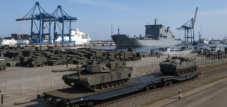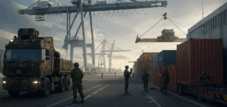
German Armed Forces procurement and municipal responsibility: The new role of municipalities – bureaucracy and building law in focus – Image: Xpert.Digital
The head of the German armed forces is holding German cities accountable – bureaucracy is slowing down rearmament
### Tanks instead of species protection? Why your mayor now has to make way for the German Armed Forces ### "War-ready by 2029": What the new German Armed Forces doctrine means for your city ### New law overturns everything: Why tank factories now have priority in your municipality ### How a lizard can stop tank production – and what is now radically changing ###
The demand for municipal support: National security becomes more important than local building regulations
What does the statement by the BAAINBw president regarding the responsibility of municipalities mean?
Annette Lehnigk-Emden, President of the Federal Office of Bundeswehr Equipment, Information Technology and In-Service Support, has taken a clear stance: "Local authorities have a duty to minimize bureaucratic obstacles to this new era." This demand should not be understood as an isolated expression of opinion, but rather as part of a systematic realignment of German security and defense policy following Russia's war of aggression against Ukraine.
The changing times have brought about a fundamental shift in priorities. Where previously only civilian interests were at the heart of municipal planning, national security interests must now be given greater consideration. Lehnigk-Emden notes that arms manufacturers face the same challenges as other construction projects – particularly delays caused by building permit procedures and species protection regulations.
Related to this:


Why is an acceleration of arms production necessary?
What threat scenarios justify this urgency?
The changed security situation necessitates a rapid modernization of the German armed forces. Experts and intelligence agencies warn that Russia could be capable of a major war and an attack on NATO territory as early as 2029. General Carsten Breuer, the Inspector General of the German Armed Forces, emphasizes: "We must be ready for war by 2029." This assessment is based on Russia's systematic rearmament and the numerous hybrid attacks on critical infrastructure.
The German armed forces (Bundeswehr) have a backlog of needs in almost every area. They lack classic equipment such as tanks and aircraft, but above all, ammunition. To make Germany and Europe less dependent on the US, they also need to acquire military capabilities that the US has previously provided within NATO. These include satellite reconnaissance, long-range missiles, and air defense.
The German arms industry faces enormous challenges. Three decades of disarmament have led to a significant reduction in production capacity. Doubling defense efforts now cannot be achieved overnight. End-user manufacturers like Rheinmetall, KNDS, TKMS, and Diehl employ only around 60,000 people in Germany; including suppliers, the number rises to approximately 150,000.
The Procurement Acceleration Act as an answer
What specific changes will the new law bring?
The Planning and Procurement Acceleration Act, which was adopted by the Cabinet on July 23, 2025, and is scheduled to come into force at the beginning of 2026, represents a fundamental shift in policy. Lehnigk-Emden particularly welcomes the new weighting of interests: "It states that the interests of the Federal Republic take precedence in such a balancing of interests. What was previously equal has now been re-evaluated.".
The law significantly expands the scope of application. In the future, all "contracts to meet the needs of the German Armed Forces" will fall under the accelerated procedures. This includes not only military equipment but also civilian procurement such as medical supplies, medical devices, bandages, and medications. Likewise, all construction projects and planning services for the German Armed Forces are covered by the law, regardless of whether they are defense- or security-related.
The law's term will be extended until December 31, 2035, providing planning certainty for long-term projects. Exceptions to procurement law will facilitate and accelerate the awarding of public contracts to meet the needs of the German Armed Forces. Direct awards of contracts should be possible more quickly and frequently in the future.
Bureaucratic obstacles and their effects
What specific problems arise from lengthy approval processes?
Since 2010, species protection assessments according to Section 44 of the Federal Nature Conservation Act have been mandatory for all construction projects. These assessments can cause significant delays, as they comprise a three-stage process. The first stage clarifies whether any protected species are present in the project area. If the findings are positive, more in-depth assessments follow, which can lead to advance compensatory measures, specific risk management, or even the project being deemed inadmissible.
Lehnigk-Emden specifically cites delays in building permits due to species protection regulations as an example of obstacles that Germany can no longer afford "given the global situation." This assessment reflects a fundamental shift in priorities. Where species protection previously had absolute priority, it must now be balanced against security interests.
The new law aims to ensure that, in military construction projects, the federal government's security interests take precedence over municipal planning regulations. This does not mean that environmental and species protection are completely disregarded, but the balancing of interests is now weighted more heavily in favor of defense interests.
The role of municipalities in the field of tension
How can the building planning rights of municipalities and the security interests of the federal government be reconciled?
According to the Basic Law, municipalities have planning authority over their territory. This includes the creation of land-use plans and development plans. Public building law is divided into building planning law, which is regulated by the federal government, and building regulations, which fall under the jurisdiction of the states. However, the enforcement of public building law is carried out by the municipal building authorities.
Lehnigk-Emden emphasizes that municipal planning rights and the federal government's security interests must "always be weighed against each other." The trained lawyer refers to the new Procurement Acceleration Act, which recalibrates this balancing of interests. While previously both interests were considered equally important, the interests of the Federal Republic now take precedence.
This rebalancing is also evident in other areas. For example, in the case of wind energy, the interests of civil and military air traffic are being reassessed. While the expansion of renewable energies does not automatically take precedence over national and collective defense interests according to Section 2 of the Renewable Energy Sources Act (EEG 2023), the aim is to create the possibility of achieving a reasonable balance between the affected interests through reasonable adjustments.
Production capacities and industrial challenges
What efforts are needed to increase arms production?
The German defense industry faces enormous challenges in building new production capacities. Rheinmetall CEO Armin Papperger reported that his company began doubling its capacity as early as March 2022. This demonstrates how quickly the industry has reacted to the changing threat landscape.
Nevertheless, current capacities are far from sufficient. Klaus-Heiner Röhl from the German Economic Institute emphasizes: "Capacities must be expanded here by incorporating existing civilian industrial plants or by constructing new production facilities." Industry needs long-term prospects backed by concrete orders.
A key problem is the medium-sized structure of the German defense industry. The structural forms existing in Germany represent an exotic exception compared to international defense industries. The small and medium-sized defense technology companies, traditionally geared towards small batch sizes, lack sufficient expansion potential in terms of their production capacity to adapt to the current market dynamics driven by defense policy.
Hub for Security and Defense - Advice and Information

Hub for Security and Defense - Image: Xpert.Digital
The Security and Defence Hub offers expert advice and up-to-date information to effectively support companies and organizations in strengthening their role in European security and defence policy. Working closely with the SME Connect Defence Working Group, it particularly promotes small and medium-sized enterprises (SMEs) that wish to further develop their innovative capacity and competitiveness in the defence sector. As a central point of contact, the Hub thus creates a crucial bridge between SMEs and European defence strategy.
Related to this:
Strategic Transformation: When Urban Planning Becomes a Military Priority
Time pressure and strategic necessities – Between efficiency and democracy: Municipalities as security architects
Why is time such a crucial factor?
Defense Minister Boris Pistorius has declared speed the top priority in procurement. "The time factor is paramount," he repeatedly emphasizes. The Bundeswehr (German Armed Forces) is to be combat-ready by 2029 at the latest. Given the threat analyses, which do not rule out a possible Russian attack on NATO territory as early as 2027 to 2030, the time pressure is understandable.
The problem, however, is that modern arms production takes time. Tank steel has to be ordered at least a year in advance. Personnel is a huge bottleneck, not only in the German Armed Forces and defense technology. Rheinmetall alone is reportedly looking to hire more than 3,500 new employees. This requires setting up additional production lines and ordering and installing machinery. None of this can happen overnight.
At the same time, many companies are waiting for orders to be received before taking these steps, as profitability remains the top priority. Hans Christoph Atzpodien, Managing Director of the German Security and Defense Industry Association, therefore demands "clear communication" for the sector: "The industry can supply almost everything if it is clearly told what is needed, in what quantities, and within what timeframe.".
Related to this:

The rebalancing of interests
How is the relationship between civilian and military priorities changing?
This turning point in history brings with it a fundamental rebalancing of priorities. While in the past three decades of disarmament, civilian interests had almost absolute priority, security interests must now be given greater consideration. This is evident not only in armaments projects, but also in other infrastructure projects.
The new procurement acceleration law allows, for example, the German Armed Forces to block civilian construction projects if they could interfere with military operations. Wind power projects that might interfere with air defense radar are cited as an example. In such cases, the law can prevent the realization of such projects because they could jeopardize the country's defense capabilities.
This development is also reflected in spatial planning and regional development. The requirements of defense and civil protection are to be given greater weight without compromising their character as a principle that can be weighed against other interests. This ability to weigh other interests must be maintained in order to achieve practical harmony between defense concerns and other interests. However, this increased weighting makes it clear that spatial planning and regional development must support the country's defense capabilities more strongly than before.
Municipal scope for action and limitations
What specific measures can municipalities take?
Municipalities have various options for supporting arms production without relinquishing their fundamental planning authority. In the area of building permit procedures, they can contribute to this changing era by expediting processing and pragmatically interpreting regulations.
For species protection assessments, it is already possible to refer to the species protection assessment conducted during the development plan's creation for projects within the area covered by development plans that are no more than seven years old. For projects within built-up areas, presumptions can be applied that no species protection concerns are affected.
Municipalities can also contribute to arms production by actively providing land. Designating industrial areas for defense companies and their suppliers can support the necessary capacity expansion. It is important to consider that not only traditional defense companies, but also suppliers from other sectors, such as the automotive industry, should be working for the defense industry.
Legal framework and limits
What are the legal limits of municipal support?
Despite the new priorities, the fundamental legal structures remain in place. Planning law will continue to be regulated by the federal government, while building regulations will remain under the jurisdiction of the individual states. Municipalities retain their planning authority but must consider the altered weightings when balancing the various interests.
The substantive legal situation remains unchanged by the acceleration of procedures. Even in accelerated procedures, the substantive requirements of building law must be met. This means that safety standards, environmental protection regulations, and other mandatory provisions continue to apply, even if the procedures are processed more quickly.
An important aspect is the consideration of security interests. Military installations are subject to special security requirements that must be taken into account during the planning and approval process. This can lead to restrictions on the usual participation procedures if reasons of secrecy or the urgency of the project preclude the implementation of normal approval procedures.
Challenges for the administration
How can local authorities cope with the new requirements?
Local authorities face the challenge of adapting traditional planning and approval processes to new priorities. This requires not only legal expertise but also a shift in administrative culture. Where previously only civilian interests were the focus, security interests must now also be considered.
Cooperation between different levels of government will need to be intensified. For security-relevant projects, close coordination between municipal, state, and federal authorities is required. This may lead to more complex procedures, even though the overall goal is to accelerate them.
Another aspect is the staffing levels of the administrations. The accelerated processing of applications requires sufficient and qualified personnel. At the same time, employees must be made aware of the new legal framework and the changed priorities.
Impacts on urban development
What are the long-term consequences of prioritizing arms production?
The increased consideration of defense interests will have long-term effects on urban development. Municipalities will have to take military requirements into greater account in their land-use planning than before. This can lead to conflicts of use if civilian development plans clash with security interests.
The establishment of defense companies also presents opportunities. The industry is growing rapidly and can become a significant economic pillar. Highly skilled jobs in the defense industry can strengthen the local economy. At the same time, municipalities must address the challenges associated with defense production, such as increased security requirements and potentially limited public participation in sensitive projects.
Integrating defense sites into urban development requires careful planning. Security zones, transport routes for military equipment, and connections to supra-regional infrastructure must be taken into account.
The balance between efficiency and democracy
How can acceleration be reconciled with democratic principles?
The acceleration of planning and approval processes must not lead to an erosion of democratic participation rights. Even in priority security projects, the fundamental principles of citizen participation and due process must be upheld.
The new Procurement Acceleration Act stipulates that special procedures can be applied in cases of confidentiality or urgency. However, this must not become the norm, but must remain limited to truly security-critical exceptional cases.
Municipalities face the challenge of developing transparent and comprehensible criteria for determining when security interests take precedence and when standard procedures apply. This requires careful case-by-case assessment and the development of appropriate guidelines for administrative practice.
A turning point: Municipalities as key players in German security policy
What developments can be expected in the coming years?
The realignment of German security policy will have a lasting impact on the work of local authorities. The Procurement Acceleration Act is only the first step in a longer process of adapting to the changed security situation. Further legislative changes and adjustments to administrative practices are to be expected.
The defense industry will grow significantly in the coming years. This will lead to increased demand for commercial space, infrastructure, and skilled labor. Municipalities that initiate appropriate planning early on can benefit from this development.
At the same time, the societal debate about the right balance between security interests and other concerns will continue. Local authorities will have to play an important role as mediators between these different interests.
The coming years leading up to 2029, the target year for the Bundeswehr's combat readiness, will be crucial. During this period, it must become clear whether the new prioritization of interests will actually lead to an acceleration of arms production without jeopardizing other important societal goals. Local authorities, as partners of the federal government, will have to play a key role in implementing this paradigm shift.
Consulting - Planning - Implementation

Markus Becker
I would be happy to serve as your personal advisor.
Head of Business Development
Chairman SME Connect Defense Working Group
Consulting - Planning - Implementation
Konrad Wolfenstein
I would be happy to serve as your personal advisor.
You can contact me at wolfenstein∂xpert.digital or
Just call me on +49 7348 4088 965 .