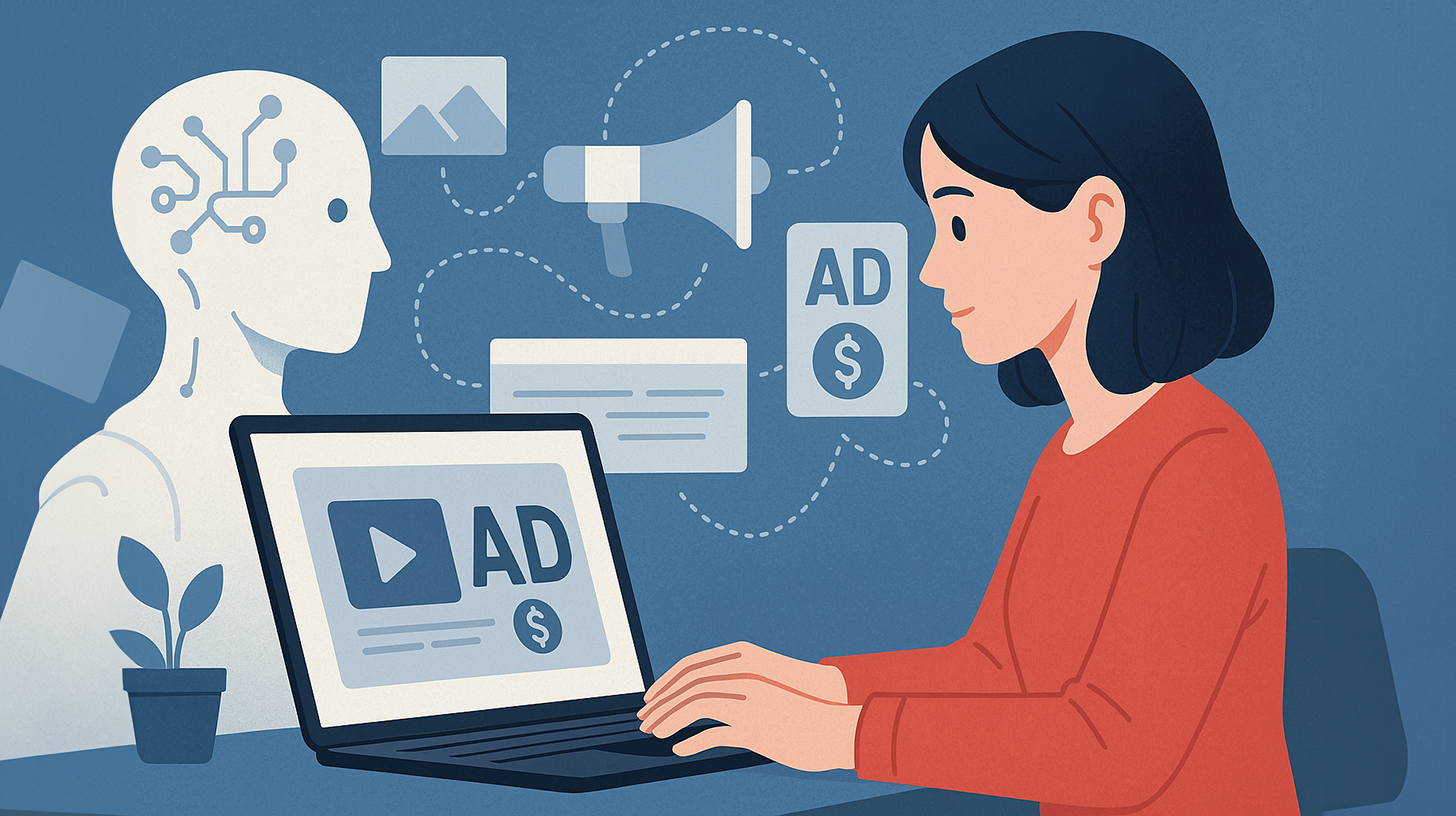
Shock for the advertising industry: Zuckerberg wants to completely automate advertising with AI using META – $72 billion investment – Image: Xpert.Digital
Will Mark Zuckerberg make advertising agencies obsolete? The 'black box' of advertising: How Meta plans to revolutionize the market with AI
No copywriter, no strategist: Zuckerberg outlines the future of advertising – entirely without agencies
In a sensational interview with tech strategist Ben Thompson, Mark Zuckerberg outlined a vision that could shake the advertising industry to its core. The Meta CEO plans nothing less than to take over the entire advertising value chain – from creation and targeting to performance measurement – through massive use of AI. This development could render traditional agencies, creative service providers, and many other industry players obsolete. With an enormous AI budget of up to $72 billion by 2025, Meta underscores the seriousness of these intentions and is preparing for a fundamental upheaval of the advertising market.
Related to this:

Zuckerberg's ultimate advertising vision
„We’re going to get to a point where you’re a business, you come to us, you tell us what your objective is, you connect to your bank account, you don’t need any creative, you don’t need any targeting demographic, you don’t need any measurement, except to be able to read the results that we spit out. I think that’s going to be huge, I think it is a redefinition of the category of advertising.“
With these words, Zuckerberg describes his vision of the future of advertising in an interview with Stratechery. The vision is as simple as it is radical: Companies name their business objective "Meta," connect their bank account, and AI does the rest. No creative department, no demographic targeting, no complex performance measurement – the AI-powered platform handles all these tasks.
This "ultimate business agent" strategy goes far beyond previous automation approaches. Zuckerberg speaks of a complete redefinition of advertising as a category. He is convinced that the share of advertising spending in GDP could grow significantly as a result of this transformation, since advertising becomes more efficient and accessible.
The fully automated advertising approach
Meta is already using AI-driven advertising through its "Advantage+" system. Advertisers simply define their business objective, target country, budget, and basic ad design – "Our AI systems then take care of the rest," explains Meta's global advertising chief, Nicola Mendelsohn.
The initial results appear to confirm Zuckerberg's vision: Return on ad spend (ROAS) is expected to increase by an average of 32 percent for such AI-driven campaigns, while the cost per acquisition decreases by 17 percent. These efficiency gains could be compelling for many companies, even if they partially relinquish control over their advertising strategy.
Massive AI investments as a foundation
To realize its vision, Meta is investing in AI infrastructure on an unprecedented scale. The company recently increased its capital expenditure (CapEx) budget for 2025 from $60-65 billion to $64-72 billion. These enormous sums are primarily being invested in expanding its AI capabilities.
Zuckerberg plans to build a data center with over 2 gigawatts of power—a facility that would “cover a significant portion of Manhattan.” By the end of 2025, Meta is expected to have more than 1.3 million graphics processing units (GPUs) at its disposal. This massive computing power forms the technological foundation for the AI revolution in advertising.
The focus of investments has shifted significantly. While Zuckerberg concentrated heavily on the Metaverse in 2021/2022, Meta is now clearly concentrating on AI as a key growth driver. This strategic realignment demonstrates how serious the company is about the AI-driven transformation of the advertising business.
Four pillars of the AI strategy
In an interview with Stratechery, Zuckerberg outlines four key business opportunities for Meta's AI initiative:
- Optimizing the advertising business: AI-supported ad generation, targeting and performance measurement should enable companies to achieve maximum results with minimal effort.
- Increasing user engagement: AI should not only provide better content recommendations, but increasingly also help in the creation of content or generate it completely.
- Business Messaging: AI agents are intended to take over customer support and sales for companies, thus creating new monetization opportunities for Meta's messaging platforms.
- AI-native offerings: These include Meta AI, which is already used by one billion people monthly and is also to be monetized in the future through premium subscriptions.
The AI revolution in advertising production
The AI models developed by Meta are already fundamentally transforming advertising production. With its "Generative Ads Recommendation Model" (GEM), Meta analyzes enormous amounts of data in a very short time to tailor ads more precisely to individual users. Initial tests showed that GEM increased ad conversions by up to 5%.
The influence of AI is also noticeable in creative production. The "Advantage+ Creative Suite" in Ads Manager includes tools that can generate variations of existing images, change backgrounds, and adjust image dimensions for different formats. These technologies can drastically reduce production costs and accelerate campaign scaling.
Meta AI as a data collector
A key element of Meta's AI strategy is Meta AI, which is now available as a standalone app. Through conversations with users, it gathers valuable data that can be used for even better targeting. Meta plans to monetize these AI services through a paid subscription – offering exclusive features, faster processing, and improved personalization.
It is noteworthy that Meta also plans to use publicly available user content in the EU to train its AI. From May 27, 2025, publicly accessible user data is to be used in Meta products for AI development – a step that raises data privacy concerns.
Impact on the advertising industry
The consequences of Meta's AI offensive for the advertising industry could be severe. Matthias Schrader, CEO of OH-SO Digital, describes Zuckerberg's vision as "brutal" in a LinkedIn post and warns: "Mark Zuckerberg wants to replace agencies with AI. We should take him seriously."
Friedrich Tromm, founder of Try No Agency, even predicts: "By 2028, classic advertising agencies as we know them will no longer exist." He refers to statements such as that of Sam Altman (OpenAI), according to which "up to 95% of today's agency tasks will be replaced by AI – faster, cheaper, better."
The new agency landscape could look significantly leaner: "It doesn't need junior copywriters, art directors, strategists, producers, or consultants. What remains are top creatives at the CD and/or management level who orchestrate the work. The rest? Redundant."
Related to this:

The black box effect
A major drawback of full automation is the "black box effect": advertisers no longer know exactly which criteria and prices the algorithms use to manage their campaigns. Media experts therefore advise continuing to run manually booked ads alongside automated campaigns in order to compare the results.
This loss of control could be problematic, as a LinkedIn comment on Zuckerberg's vision illustrates: "AI is brilliant at pattern recognition, but has no concept of brand legacy, market positioning, or ethical nuances." The vision of a completely AI-driven advertising machine is therefore met with skepticism.
Autonomous ad delivery: How much control do companies retain?
Despite the technological possibilities, it remains questionable whether companies are willing to completely outsource their advertising strategy to Meta. As heise.de notes: "Agencies and companies usually have concrete ideas about their products, target groups, and what they stand for (or want to stand for). Outsourcing everything to Meta may be easy, perhaps even successful, but not necessarily a sustainable strategy."
Data privacy concerns could also slow down Meta's plans. The EU has already expressed concerns about Meta's "pay or consent" model, and the use of user data for AI training is under scrutiny by European data protection authorities.
Furthermore, the question of the system's transparency arises. While Meta is increasingly taking control of ad delivery, it remains unclear how transparent the processes and costs will be for advertisers. Zuckerberg speaks of providing reports, but what these will include and what advertisers are ultimately paying for remains to be seen.
A new era of advertising?
Meta's AI initiative under Mark Zuckerberg has the potential to fundamentally transform the advertising industry. With enormous investments in AI infrastructure and the vision of a fully automated advertising machine, the company could challenge traditional industry structures.
While the efficiency gains and simplified processes may be tempting for many advertisers, questions remain about control, transparency, and data privacy. The industry faces the challenge of adapting to this new reality or finding niches where human creativity and strategic thinking continue to add value.
Whether Zuckerberg's vision of "redefining advertising" becomes reality depends not only on technological development but also on whether companies are willing to entrust their advertising strategy to an algorithm. However, one thing seems certain: the AI revolution in advertising has only just begun, and Meta is positioning itself at the forefront of this movement.
Related to this:
Your global marketing and business development partner
☑️ Our business language is English or German
☑️ NEW: Correspondence in your native language!

Konrad Wolfenstein
I and my team are happy to be available to you as your personal advisor.
You can contact me by filling out the contact form here wolfenstein@xpert.digital:or simply call me at +49 7348 4088 965. My email address is
I'm looking forward to our joint project.