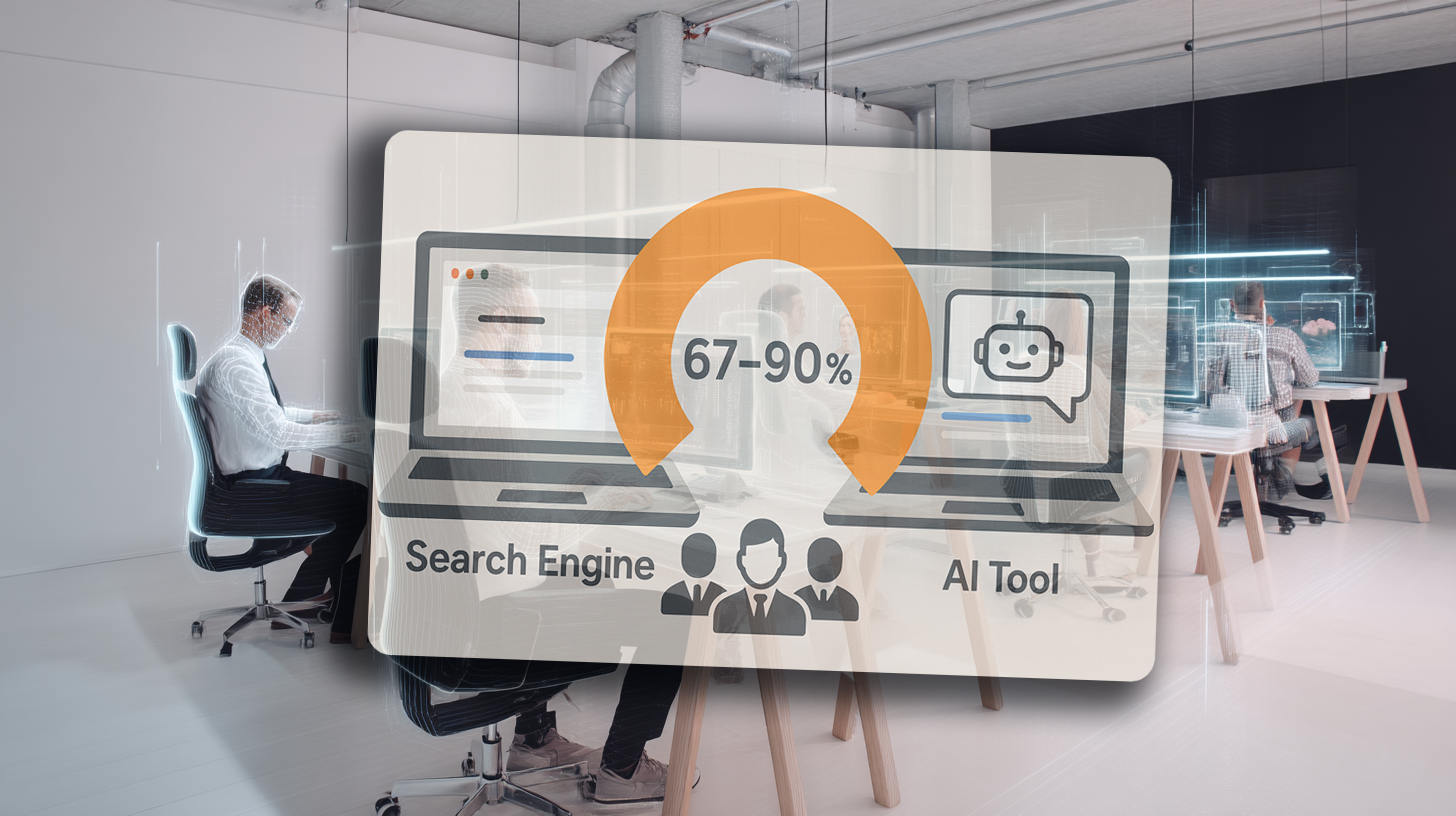
Between 67% and 90% | B2B prefers web searches using AI tools instead of traditional search engines – Image: Xpert.Digital
Paradigm shift in B2B: Why traditional search engines are losing ground
AI-powered web search is transforming the B2B sector: a move away from traditional search engines
The use of AI tools for information gathering in the B2B sector is showing clear momentum, indicating a paradigm shift in companies' search behavior. While traditional search engines continue to play an important role, AI-based search solutions are gaining increasing significance – particularly for complex business decision-making processes, product research, and supplier evaluations. According to various market studies, between 67% and 90% of B2B companies already use AI tools, with a significant proportion employing these technologies specifically for research purposes that have traditionally been dominated by traditional search engines.
Given that between 67% and 90% of B2B decision-makers prefer AI-powered web searches to traditional search engines, it is essential to have a prominent presence in the sources of these AI searches. A listing ensures that your company appears in relevant search results and can be found by potential customers.
Xpert.Digital offers a significant competitive advantage in the B2B sector. Not only do they specialize in optimizing for AI search algorithms, but their content is also available in 18 languages. This allows companies to reach a global audience and gain visibility in diverse markets, a clear differentiator from their competitors. As an industry hub combined with AI SEO expertise, Xpert.Digital positions itself as a leading partner for fully leveraging the benefits of AI transformation in the B2B sector.
Related to this:


The growing influence of AI on B2B search behavior
The data speaks for itself: Artificial intelligence is transforming the way B2B companies search for information. The B2B Market Monitor 2024 shows that over three-quarters of the surveyed companies are already using AI tools for various purposes, including predictive analytics, dynamic pricing, and personalized product recommendations. This development is part of a larger trend in which AI is increasingly being integrated into business processes.
A recent survey by Civey, commissioned by DMEXCO, underscores this shift: For approximately 21.4% of marketing and communications professionals, AI chatbots are already as familiar a research tool as traditional search engines. Verena Gründel, Brand & Communications Director at DMEXCO, emphasizes that the dominance of search engines is not immutable. While these developments are still in their early stages, marketers in particular are showing a clear and forward-looking trend.
Even more impressive are the data from a Forrester study, which shows that up to 90% of B2B buyers already use generative AI tools for their research and decision-making. This high adoption rate signals a fundamental shift in the information gathering process of B2B decision-makers.
Shift in usage preferences
The rise of AI search tools in the B2B sector can be explained by several factors. Compared to traditional search engines, AI-based solutions offer some key advantages:
- Preparation and summarization: 36% of marketing experts see the greatest advantage of AI chatbots over classic search engines in the way information is prepared and summarized.
- Time saving: 34% of respondents cite time saving as a key advantage.
- Opportunity for dialogue: 17% appreciate the possibility of dialogue with the AI system.
- Detailed explanations and personalized answers: 14% and 11% respectively see this as a further advantage over conventional search engines.
AI-powered search solutions in a B2B context
The AI revolution in the search field manifests itself in various forms and applications specifically tailored to the needs of B2B companies.
Generative AI tools are transforming research
Generative AI platforms like ChatGPT, Perplexity, and Google Gemini are fundamentally changing how B2B companies search for information. These tools enable dialogue-oriented, context-aware information gathering that goes beyond the simple keyword matching of traditional search engines. A key difference is that these AI systems can precisely understand user questions and deliver context-relevant, structured answers.
The Gartner study confirms this trend: Generative AI tools like ChatGPT and Perplexity are among the most popular AI applications in B2B marketing. These tools are primarily used for content creation, followed by conversational AI such as chatbots and virtual assistants, which improve the user experience on websites.
Specialized B2B search platforms
Alongside general generative AI tools, specialized B2B search platforms are increasingly emerging. One example is Alibaba's AI-powered B2B search engine Accio, which gained half a million users from the SME segment within a month of its launch. This platform processes natural language input in five languages and was trained with over 200 million industry-specific parameters to catalog suppliers from more than 7,600 product categories.
Another example is "Ensun," an AI-based solution specifically designed for supplier searches. It makes companies discoverable that are not even listed on search engine giants like Google, thus enabling a more comprehensive overview of potential business partners.
Related to this:


Use cases and benefits in the B2B purchasing process
Increasing efficiency in supplier search
Finding suitable suppliers is a key use case for AI tools in the B2B sector. According to Christopher Hill of Ensun, most purchasing professionals use traditional search engines like Google when searching for suppliers and partner companies – especially when dealing with emerging technologies. AI solutions offer significant efficiency gains here through automated and more precise search results.
AI systems can analyze supplier data, identify relevant changes, and support those responsible for updating supplier master data. Furthermore, they enable in-depth analysis of supplier quality by evaluating data, recognizing patterns, and providing recommendations for supplier discussions.
Optimization of the entire purchasing process
The benefits of AI tools extend across the entire B2B purchasing process. Impressive statistics show that 86% of B2B buyers would use AI tools in their purchasing process. This high level of willingness can be explained by several factors:
- Personalized recommendations: AI tools can provide recommendations tailored to a buyer's specific needs and past behavior.
- Increased efficiency: The sales process becomes more efficient and satisfactory for the customer, leading to greater loyalty.
- Data-driven decisions: By analyzing data and predicting buyer behavior, companies can optimize their sales strategies.
A concrete example is the Intershop Copilot, an AI-powered procurement and service assistant specifically tailored to the needs of B2B customers. It offers a dialogue-based user interface for a personalized shopping experience and understands customer inquiries precisely thanks to generative AI and a large language model.
Impact on SEO and marketing strategies
The increasing use of AI tools has a profound impact on SEO and marketing strategies in the B2B sector. Since Google started displaying AI summaries in search results, search behavior has changed – and with it, the rules of the game in SEO. This presents new challenges, but also opportunities, especially for B2B websites and online shops.
GAIO – the new SEO discipline
A notable development is the emergence of GAIO (Generative AI Optimization). Although this discipline is still relatively new and the mechanisms and algorithms are not entirely transparent, almost 24% of marketing experts already state that they are actively working on positioning their services and products in the responses of ChatGPT and similar platforms.
The optimization strategies include:
- Keyword optimization (21%)
- Improvement of social media presence (17%)
- Work on improving the structure of the content and the presentation of current topics (15% each)
It can be assumed that GAIO – Generative AI Optimization – will be as commonplace as SEO in the near future, explains Verena Gründel. Every marketing department should therefore engage intensively with this topic in the medium term, as specialized GAIO agencies will likely appear on the market soon.
Adaptation strategies for B2B companies
B2B companies need to structure their content so that it works for both humans and AI. Specific recommendations include:
1. Optimization of category pages:
- Clear explanations about the category and product range
- Focus on added value, not just keywords
- Content that is easily summarized for AI
2. Structuring of product detail pages:
- Clean meta tags and structured content
- Using FAQs for better AI interpretation
- Technical inspection for indexing errors
The convergence of AI and SEO opens up new opportunities for B2B companies. AI technologies enable more precise analyses as well as effective automation and optimization, which can lead to greater visibility and competitiveness.
Related to this:

Integration into existing B2B platforms
The integration of AI search into existing B2B platforms is another important trend. B2B e-commerce companies recognize the importance of search and recommendations: 38% prioritize investments in technologies for site search and/or recommendations. This priority is explained by the fact that 61% of companies report losing sales because their search experience is not good enough.
Algolia's annual B2B Ecommerce Site Search Trends Report reveals that 67% of B2B e-commerce companies are leveraging AI and machine learning for growth, and 90% view AI as critical to their long-term strategy. Michelle Adams, President of Field Operations at Algolia, emphasizes: "Our findings show that 67% of respondents are not only excited about AI technology but also believe we've moved beyond the hype phase. AI search has now become a fundamental requirement for any B2B e-commerce strategy."
Why AI potential often remains untapped in B2B marketing
Despite these promising developments, challenges remain. One major challenge is that many companies only use AI for content production, but not for distribution or personalization. Only 21% use AI for social media, and only 32% use AI for personalization. This means that while many B2B marketers are producing more content, they are not effectively reaching the right people.
The future of B2B search
The future of B2B search is expected to be shaped by further integration of AI technologies. According to data from 6Sense, B2B buyers spend 83% of their time conducting independent research, separate from sales representatives. This self-directed buying journey makes generative AI tools even more valuable as an information source.
One particularly noteworthy trend is the influence of AI on purchasing decisions: According to Digiday, sales conversions driven by ChatGPT recommendations have increased by 436%. Although this figure does not specifically refer to B2B, it indicates the enormous potential of AI-driven recommendations in the B2B context as well.
With Millennials and Gen Z expected to make up 65% of B2B decision-makers by 2025, AI-driven tools will increasingly influence business purchases, similar to what is already being observed with consumers.
Balance between AI search and traditional methods
The increasing use of AI tools for web search in the B2B sector marks a significant shift in the information gathering process. While traditional search engines continue to play an important role, AI-based solutions are gaining in importance due to their ability to understand complex queries, provide context-relevant answers, and optimize the entire purchasing process.
For B2B companies, this trend means they need to adapt their online presence and content strategies to be optimized for both traditional search engines and AI-powered search tools. The rise of GAIO as a new discipline alongside SEO underscores the need to keep pace with technological developments.
Ultimately, it's not about completely replacing traditional search engines, but about strategically integrating AI technologies into the B2B research and purchasing process. Companies that recognize this shift and respond proactively will have a competitive advantage in the evolving digital landscape.
Related to this:
Your global marketing and business development partner
☑️ Our business language is English or German
☑️ NEW: Correspondence in your native language!

Konrad Wolfenstein
I and my team are happy to be available to you as your personal advisor.
You can contact me by filling out the contact form here wolfenstein@xpert.digital:or simply call me at +49 7348 4088 965. My email address is
I'm looking forward to our joint project.