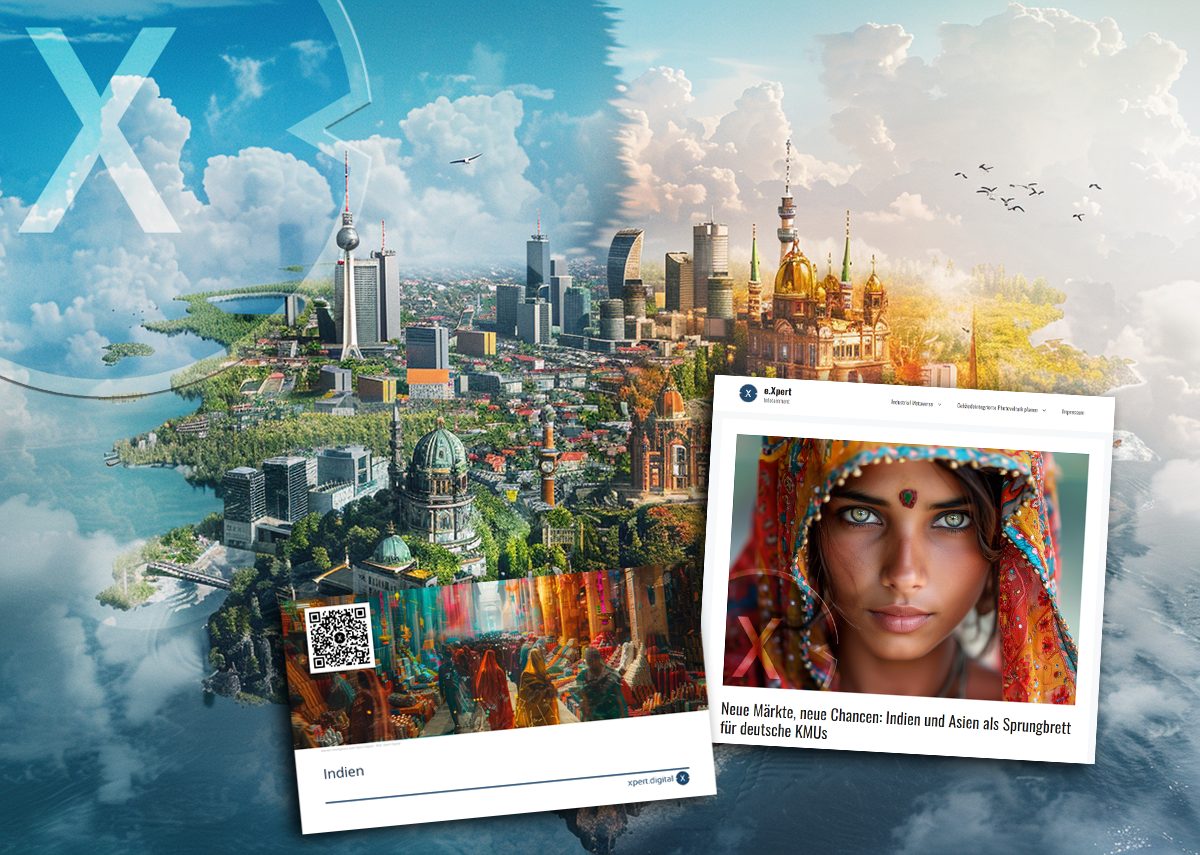
Growth without limits: Strategies for German SMEs entering India and the Asian market – Image: Xpert.Digital
💼🌏 The economic relations between Germany and India
📈 Trading volume and positions
The economic relations between Germany and India, two countries playing an increasingly important role on the global stage, are multifaceted and complex. While Germany is known as one of the world's largest economies, India is characterized by its rapid growth and its position as one of the most populous nations. Trade relations between these two countries offer a fascinating range of opportunities, challenges, and development potential.
In 2023, Germany's export volume to India amounted to only €16.49 billion, placing India 22nd among Germany's most important trading partners. This figure may seem surprising at first glance, especially when compared to the export volumes of smaller countries like Switzerland (€66.58 billion) or Belgium (€62.41 billion). This discrepancy raises questions about the reasons for these relative positions and what this means for the future of trade relations between Germany and India.
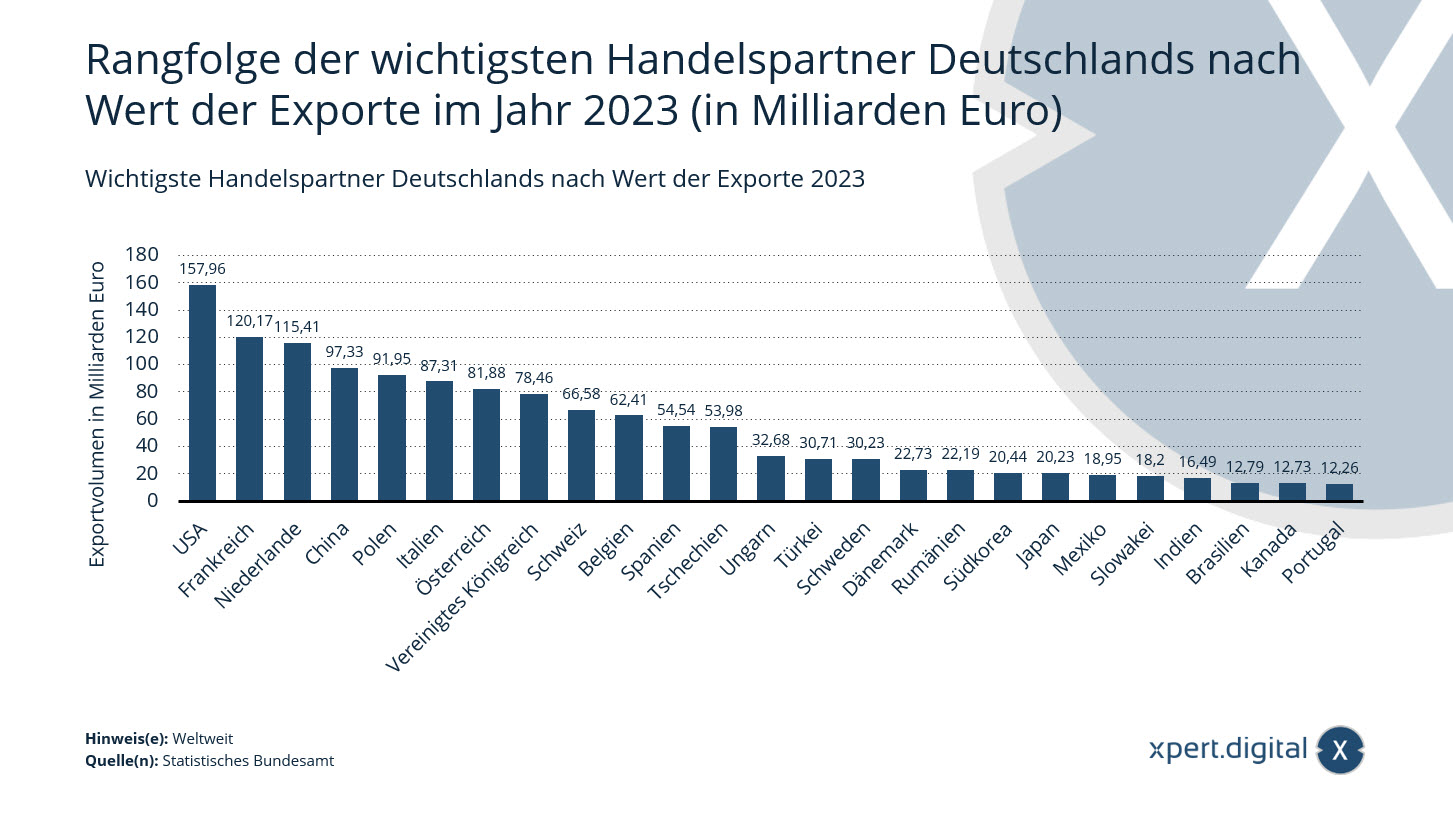
Ranking of Germany's most important trading partners by the value of exports in 2023 (in billion euros) – Xpert.Digital
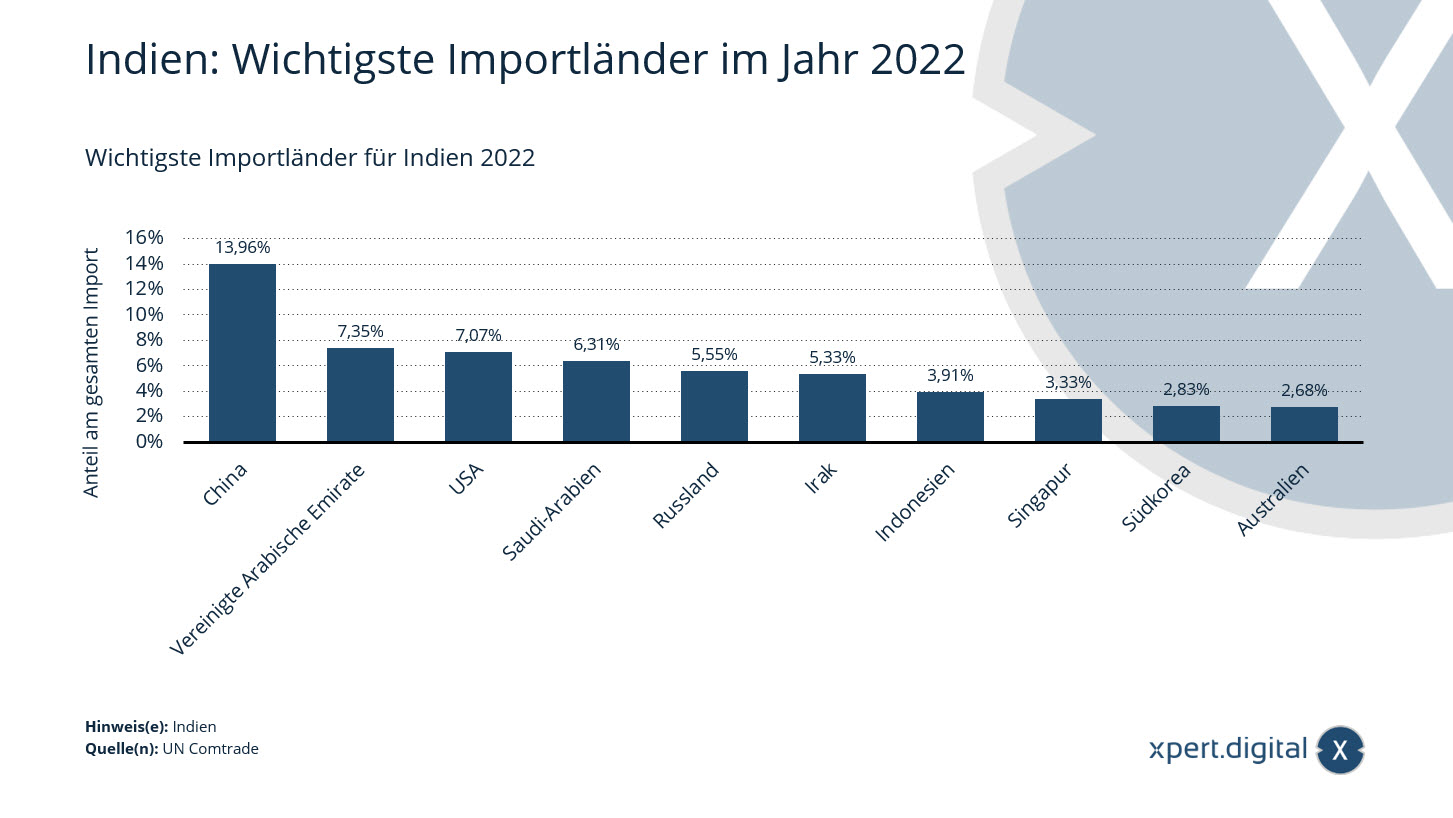
From India's perspective, goods worth approximately €14.32 billion were exported to Germany in the same year. This places India 24th in the ranking of Germany's most important import sources. In contrast, India's trade balance, with a deficit of €270.61 billion, is the second largest worldwide after the USA, where, for example, India's import share from China is 13.96%, while its export share to China is only 3.33%.
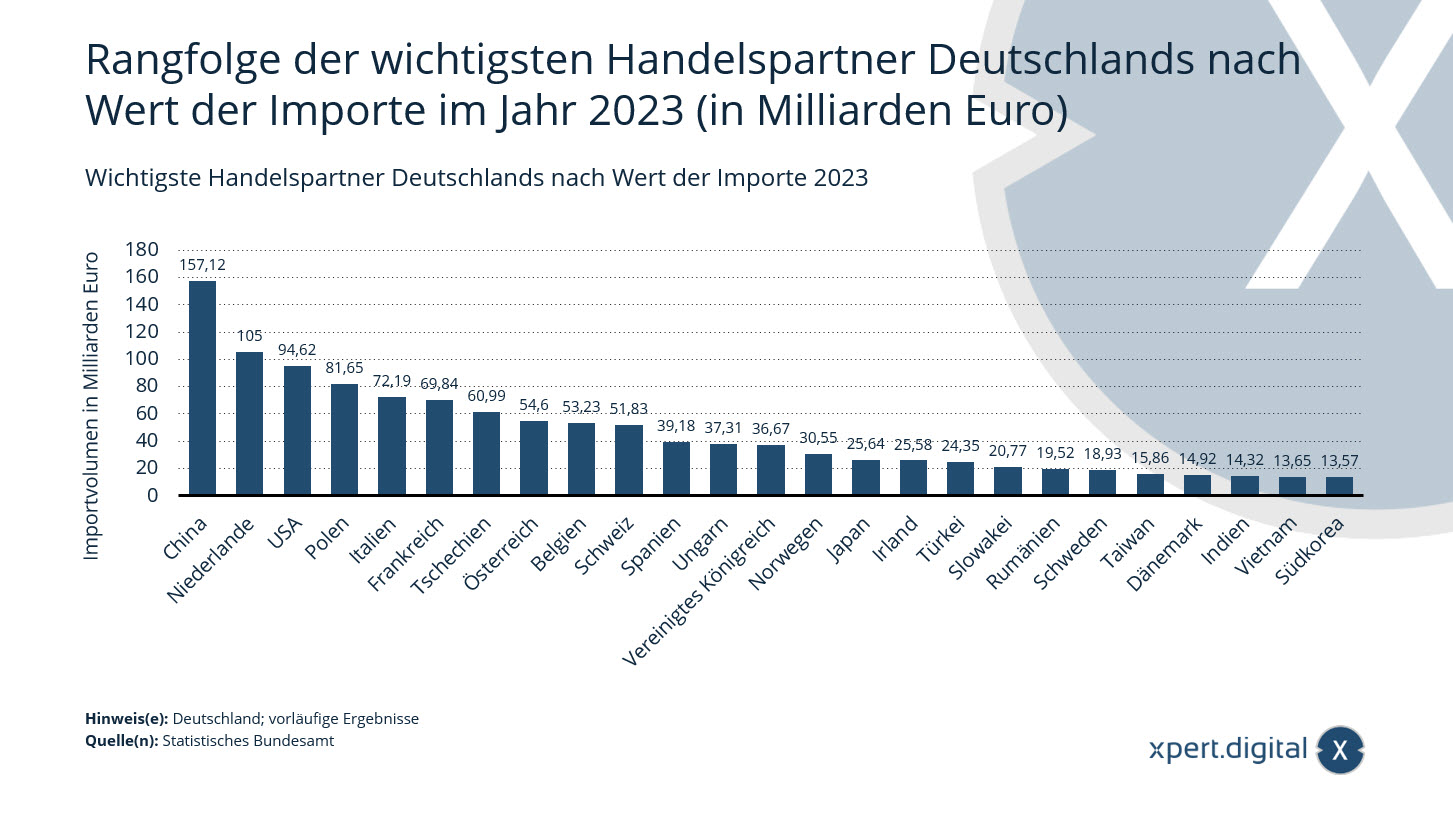
Ranking of Germany's most important trading partners by value of imports in 2023 (in billion euros) – Image: Xpert.Digital
A trade deficit occurs when the value of a country's imports exceeds the value of its exports. This means that the country in question buys more goods and services from other countries than it sells to other countries. The trade balance is an important part of a country's balance of payments and refers specifically to trade in physical goods and, depending on the definition, sometimes also to services.
A trade deficit is not inherently negative. It can have various causes and effects, depending on a country's economic situation, its industrial structure, and its role in the global trading system. Some possible reasons for a trade deficit include:
- A high level of domestic consumption and investment leads to increased demand for imported goods.
- A strong currency that makes imports cheaper and exports more expensive.
- Structural changes in the economy or in specific sectors that affect competitiveness.
- Lower production costs abroad, leading to a relocation of production.
In the long term, however, persistent trade deficits can lead to foreign debt, as they are often financed through foreign borrowing or the sale of domestic assets. This, in turn, can impair a country's macroeconomic stability, particularly if the debt is unsustainable or not invested in productive assets.
Countries respond to trade deficits in various ways, including adjusting their monetary policy, promoting exports, restricting imports, or implementing structural reforms to increase their competitiveness. The appropriate response depends on the specific causes and circumstances of the deficit.
🌐 Significance for the trade landscape: India is currently not a primary trading partner for Germany – but vice versa
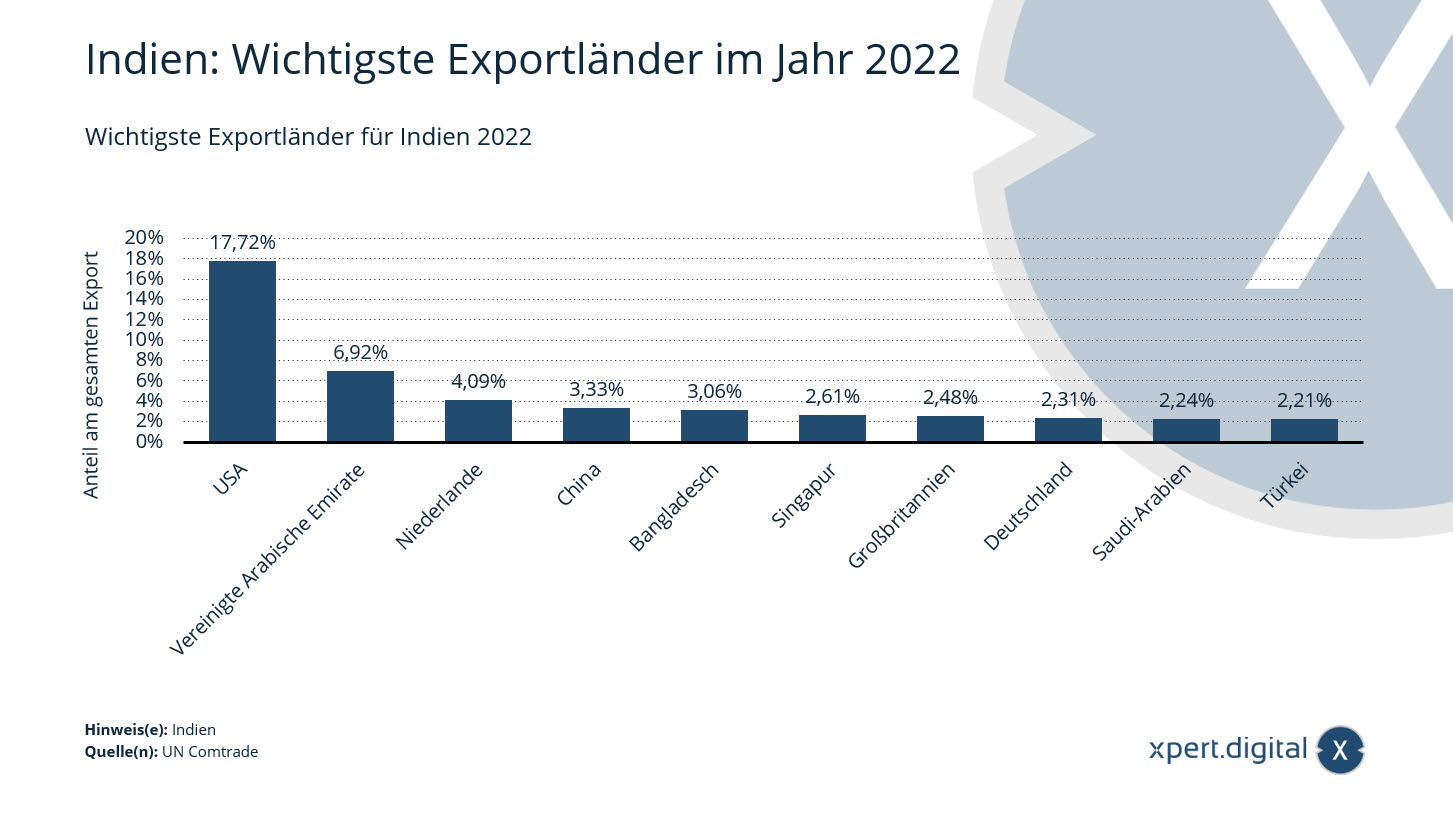
These figures might initially suggest that India is not currently a particularly important trading partner for Germany. However, the picture is somewhat different on the Indian side. In the ranking of export destinations for Indian goods, Germany occupies eighth place with a share of 2.31% of India's total export volume. The USA leads this list with a substantial share of 17.72%, followed by the United Arab Emirates with 6.92%. Other countries such as the Netherlands, China, Bangladesh, Singapore, and the UK are similarly grouped around Germany's share, making Germany a significant buyer of Indian goods.
These seemingly dry statistics conceal a vast ocean of untapped potential and dynamic interactions. Germany, a leading power in technology, engineering, the automotive industry, and renewable energy, offers India not only a market for its goods but also a source of technological know-how and investment. At the same time, India's young, rapidly growing, and increasingly consumer-driven population offers the German market both export opportunities and strategic partnerships in areas such as digital technologies, energy, environmental protection, and education.
🔮 Future Perspectives
Looking to the future, trade relations between these two countries are constantly evolving. Future agreements could intensify trade ties, particularly in areas such as the digital economy and sustainable development, which both countries prioritize. Various factors, including political changes, the global economic situation, and technological breakthroughs, will further influence the development of these relations.
💰 Foreign direct investment
In addition to trade dynamics, foreign direct investment (FDI) plays a significant role in the integration of the two economies. Germany is among the largest foreign investors in India, with a strong focus on the manufacturing sector, the automotive industry, and technology projects. These investments not only strengthen India's economy but also contribute to job creation and technology transfer.
🤝 Cultural and scientific exchange
Cultural and scientific exchanges between Germany and India offer another dimension to bilateral relations. German universities and research institutes attract thousands of Indian students and researchers every year. At the same time, interest in Indian culture, language, and knowledge is growing in Germany. These connections foster better mutual understanding and form a solid foundation for a strong and lasting partnership.
🌱 Growth potential and challenges
While trade relations between Germany and India may currently appear limited in certain aspects, they possess enormous potential for growth and deepening. Both countries face the challenge of actively seizing these opportunities and investing in a shared future that not only serves their own interests but also makes a positive contribution to the global economy and stability. The key to successfully expanding these relations lies in identifying existing obstacles and overcoming them through joint efforts, visionary policymaking, and the utilization of technological innovations.
📣 Similar topics
- 🌍 Growing economic partnership between Germany and India
- 📊 Germany's trade relations with India: An analysis of the latest figures
- 🤝 India and Germany: A comparison of their trade positions
- 💡 The untapped potential of German-Indian economic relations
- 🏭 Key sectors in German-Indian trade dynamics
- 🌱 Sustainable Development and the Digital Economy: Future Perspectives
- 💼 The importance of foreign direct investment in the relationship between Germany and India
- 🎓 Cultural and scientific exchanges as the basis of bilateral relations
- 🚀 Technology sector as a bridge between German and Indian markets
- 🌟 The role of Germany and India in a globalized world economy
#️⃣ Hashtags: #GermanyIndiaTrade #EconomicRelations #ForeignTradeDynamics #TechnologyPartnership #BilateralInvestments
📊🔍 Data and figures for the charts and statistics
Measurement of foreign trade
The exchange of goods and services across national borders defines a country's foreign trade. This exchange is divided into exports (goods exported) and imports (goods imported). The difference between the value of a country's exports and imports constitutes its trade balance. A country that exports more than it imports has a positive trade balance, also known as a trade surplus.
Germany's role in foreign trade
Due to its persistent export surpluses, the Federal Republic of Germany is often referred to as an export nation or even an export world champion. Germany's three leading import categories recently included vehicles and vehicle parts, data processing equipment, and electrical equipment.
Germany's most important trading partners by value of imports in 2023
In 2023, the preliminary value of goods imported from China to Germany amounted to approximately €157.1 billion, making China Germany's most important import partner. The Netherlands, with imports worth €105 billion, and the United States, with imports worth €94.6 billion, followed in second and third place, respectively. Further information on Germany's main export partners in 2023, based on their export value, is also available.
- China – 157.12 billion euros
- Netherlands – 105 billion euros
- USA – 94.62 billion euros
- Poland – 81.65 billion euros
- Italy – 72.19 billion euros
- France – 69.84 billion euros
- Czech Republic – 60.99 billion euros
- Austria – 54.60 billion euros
- Belgium – 53.23 billion euros
- Switzerland – 51.83 billion euros
- Spain – 39.18 billion euros
- Hungary – 37.31 billion euros
- United Kingdom – 36.67 billion euros
- Norway – 30.55 billion euros
- Japan – 25.64 billion euros
- Ireland – 25.58 billion euros
- Türkiye – 24.35 billion euros
- Slovakia – 20.77 billion euros
- Romania – 19.52 billion euros
- Sweden – 18.93 billion euros
- Taiwan – 15.86 billion euros
- Denmark – 14.92 billion euros
- India – 14.32 billion euros
- Vietnam – 13.65 billion euros
- South Korea – 13.57 billion euros
Germany's most important trading partners by value of exports in 2023
- USA – 157.96 billion euros
- France – 120.17 billion euros
- Netherlands – 115.41 billion euros
- China – 97.33 billion euros
- Poland – 91.95 billion euros
- Italy – 87.31 billion euros
- Austria – 81.88 billion euros
- United Kingdom – 78.46 billion euros
- Switzerland – 66.58 billion euros
- Belgium – 62.41 billion euros
- Spain – 54.54 billion euros
- Czech Republic – 53.98 billion euros
- Hungary – 32.68 billion euros
- Türkiye – 30.71 billion euros
- Sweden – 30.23 billion euros
- Denmark – 22.73 billion euros
- Romania – 22.19 billion euros
- South Korea – 20.44 billion euros
- Japan – 20.23 billion euros
- Mexico – 18.95 billion euros
- Slovakia – 18.20 billion euros
- India – 16.49 billion euros
- Brazil – 12.79 billion euros
- Canada – 12.73 billion euros
- Portugal – 12.26 billion euros
India: Key export markets in 2022
India's most important export market in 2022 was the USA, accounting for approximately 17.7 percent of exports. The United Arab Emirates was India's second most important trading partner, with an export share of around 6.9 percent in 2022.
- USA – 17.72%
- United Arab Emirates – 6.92%
- Netherlands – 4.09 in %
- China – 3.33%
- Bangladesh – 3.06%
- Singapore – 2.61%
- Great Britain – 2.48%
- Germany – 2.31 in %
- Saudi Arabia – 2.24%
- Türkiye – 2.21 in %
India: Main import countries in 2022
India's most important import partner in 2022 was China, accounting for approximately 14 percent of imports. The United Arab Emirates was the second most important import partner, with an import share of about 7.35 percent of India's total imports.
- China – 13.96%
- United Arab Emirates – 7.35%
- USA – 7.07%
- Saudi Arabia – 6.31%
- Russia – 5.55%
- Iraq – 5.33 in %
- Indonesia – 3.91%
- Singapore – 3.33 in %
- South Korea – 2.83 in %
- Australia – 2.68%
📊📈ℹ️ Figures - Data - Facts - Background: India and Asia in Focus: Growth Paths for German SMEs

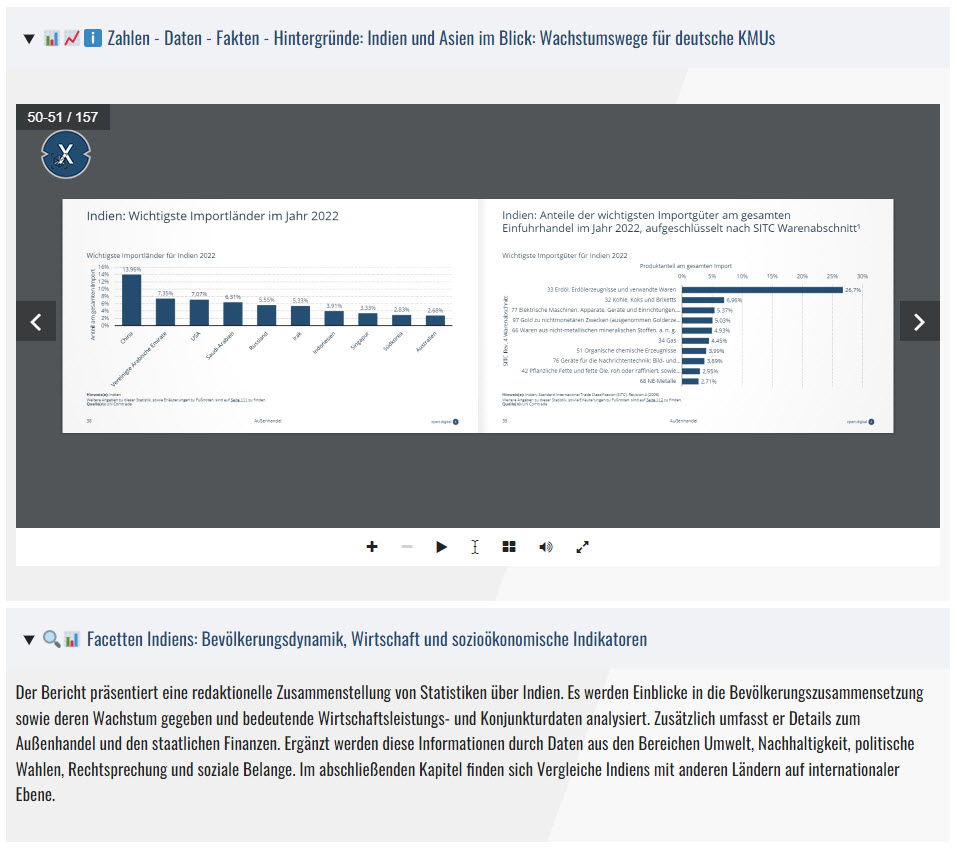
Figures – Data – Facts – Background: India and Asia in focus: Growth paths for German SMEs – Image: Xpert.Digital
We currently no longer offer our newer PDFs for download. These are only available upon direct request.
However, you can find the PDF "India" (157 pages) in our
📜🗺️ Infotainment portal 🌟 (e.xpert.digital)
under
https://e.xpert.digital/indien/
with the password: xindia
view.

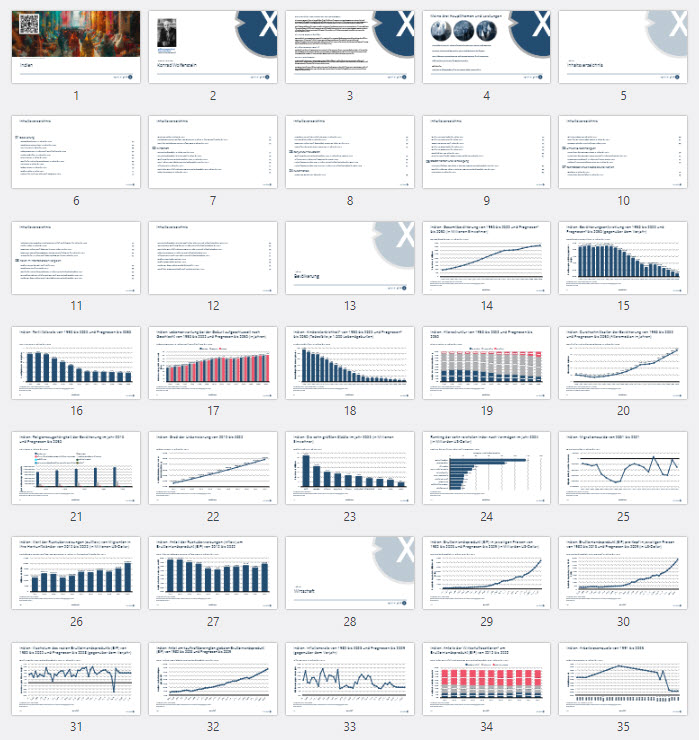
Facets of India: Population dynamics, economy and socioeconomic indicators – Image: Xpert.Digital
📊🔗 Linked Future: Understanding and Utilizing Challenges and Opportunities in German-Indian Trade
🌏🤝 The path that Germany and India can take in their bilateral trade relations is largely determined by various factors. It is essential to recognize the current challenges and opportunities in order to develop a strategy for a sustainable and growth-oriented future.
📊🔑 Addressing trade challenges
Trade barriers
Trade barriers, whether tariff or non-tariff, often hinder more interconnected trade. Eliminating or reducing tariffs, simplifying customs procedures, and removing bureaucratic obstacles could have far-reaching positive effects on bilateral trade. A first step could be exploring a free trade agreement or a preferential trade agreement specifically tailored to the needs and capabilities of both countries.
Market access
For German companies looking to enter the Indian market in particular, easier market access conditions could make a significant difference. Likewise, India could benefit if its exports were boosted through simplified approval processes or greater integration into German supply chains.
💡🌱 Unlocking potential
Technology and Innovation
Germany, as one of the leading nations in technology and innovation, can rely on a partnership with India to collaborate in areas such as digitalization, renewable energies, and sustainable agriculture. Projects focusing on the development and implementation of green technologies, digital education solutions, or smart city initiatives offer valuable opportunities for close cooperation.
Promote investment
Foreign direct investment (FDI) represents another area of action. Promoting German investment in India, as well as encouraging Indian companies to invest in Germany, could deepen the economic ties between the two nations. This also includes investing in education and training to ensure that the population can meet the changing demands of the labor market.
📘🌐 Cultural and scientific cooperation
Educational and research collaborations
Deepening scientific and academic cooperation between Germany and India can serve as the foundation for a lasting partnership. Promoting academic exchange and joint research projects in key areas could help strengthen ties and foster innovative thinking.
Cultural exchange
Culture is a powerful bond between nations. Promoting cultural exchange and mutual understanding through art, music, literature, and film can elevate relationships to a more personal level and lay the foundation for a long-term partnership.
🚀🔮 Potential for a more intensive and beneficial trade relationship
The potential for a more intensive and beneficial trade relationship between Germany and India is enormous. Both countries possess unique strengths that they can contribute to a partnership, as well as shared interests that should be pursued. However, the future of these bilateral relations depends on the ability of both nations to address common challenges, foster mutual respect, and cooperate in a sustainable and inclusive manner.
In a world characterized by rapid technological advances, global challenges, and shifting geopolitical landscapes, Germany and India could serve as an example of a successful, forward-looking partnership that benefits not only their own peoples but also the global community. Through joint efforts and a shared vision for the future, both countries can usher in a new era of cooperation marked by innovation, growth, and mutual understanding.
📣 Similar topics
- 🌍 Future prospects of German-Indian trade relations
- 💡 Innovation and technology as a bridge between Germany and India
- 🤝 The role of cultural and scientific exchange in the German-Indian partnership
- 💼 Strategies for overcoming trade barriers between Germany and India
- 📈 Promoting investment as a key to deepening German-Indian economic relations
- 🌱 Green technologies and sustainable agriculture: Opportunities for Germany and India
- 🎓 Education and research: Cornerstones for a strong German-Indian future
- 🔄 The importance of mutual cultural exchange for close relationships
- 🚀 Potential of a German-Indian partnership in the field of digital innovation
- 🌟 Germany and India: Pioneers of future-oriented global cooperation
#️⃣ Hashtags: #GermanIndianRelations #TradeAndInnovation #CulturalExchange #TechnologyPartnership #SustainableDevelopment
🔄📈 B2B trading platform support – Strategic planning and support for export and the global economy with Xpert.Digital 💡


B2B trading platforms – Strategic planning and support with Xpert.Digital – Image: Xpert.Digital
Business-to-business (B2B) trading platforms have become a critical component of global trade dynamics and thus a driving force for exports and global economic development. These platforms offer significant advantages to companies of all sizes, especially SMEs—small and medium-sized enterprises—which are often considered the backbone of the German economy. In a world where digital technologies are increasingly prominent, the ability to adapt and integrate is crucial for success in global competition.
More information here:
🌐 Potential opportunities for German SMEs in India, regardless of the political situation. For example, via B2B trading platforms
🔍📈 India is experiencing not only continuous economic growth but also increasing digitalization in all areas of life. With over 560 million internet users in 2023, the subcontinent is the world's second-largest online market. This digital boom is paving new paths in the business world for German SMEs, particularly through expansion via digital platforms.
💼 Potential of B2B trading platforms
🌍 Access to a broad market
India's enormous population and growing middle class represent a vast customer base. B2B platforms enable German SMEs to reach a wide range of business customers in India, from startups to established companies. The diversity of industries, from technology to agriculture, offers German SMEs a broad foundation for business opportunities.
🚀 Reduced market entry barriers
Traditionally, international business relationships require significant upfront investments, such as establishing a physical presence or adapting to local regulations. B2B trading platforms significantly minimize these barriers by providing the infrastructure for transnational trade. They offer a simplified way for German SMEs to conduct business in India without having to make large upfront investments.
🔄 Efficient business processes
By leveraging technology, B2B platforms offer efficient solutions for establishing contact, negotiating, and processing transactions. They improve business processes through automated payment systems, logistics solutions, and customer support. These platforms thus not only facilitate international trade but also optimize operational workflows.
✔️ Personalized and scalable options
B2B platforms offer customized solutions tailored to the specific needs and budget of each company. German SMEs can adapt their presence and offerings on these platforms according to their capacities and strategic goals. This creates an environment in which businesses can be scaled gradually and expansion steps can be implemented predictably.
🚧 Challenges and solutions
⚖️ Cultural sensitivity
Doing business in India requires a deep understanding and respect for the local culture. It is advisable to invest in intercultural training or to collaborate with local partners to ensure cultural sensitivity.
🗣️ Language and Communication
English is widely spoken as a business language in India; however, using regional languages can facilitate access to certain market segments. German SMEs should invest in multilingual platforms or services to overcome communication barriers.
🤝 Build a local network
The importance of personal relationships in India cannot be overstated. A strong local network can open doors and facilitate business transactions. German SMEs should consider strategic partnerships and alliances to gain a foothold and grow.
###🏁 Expansion of German SMEs into India
The expansion of German SMEs into India, particularly through the use of B2B trading platforms, promises significant business opportunities. The combination of a vast market, technological advancements, and reduced barriers to entry creates a favorable environment for German companies. By overcoming the challenges and adapting to local conditions, German SMEs can operate successfully in one of the world's most dynamic markets.
This overview illustrates that, despite various challenges, the opportunities in India are enormous for German SMEs that are willing to adapt and commit. With the right strategy, the necessary dedication, and a deep understanding of the Indian market, German SMEs can benefit from the diverse opportunities and expand successfully.

🎯🎯🎯 Benefit from Xpert.Digital's extensive, five-fold expertise in one comprehensive service package | BD, R&D, XR, PR & Digital Visibility Optimization

Benefit from Xpert.Digital's extensive, five-fold expertise in a comprehensive service package | R&D, XR, PR & Digital Visibility Optimization - Image: Xpert.Digital
Xpert.Digital possesses in-depth knowledge across various industries. This allows us to develop tailored strategies precisely aligned with the requirements and challenges of your specific market segment. By continuously analyzing market trends and monitoring industry developments, we can act proactively and offer innovative solutions. The combination of experience and expertise generates added value and provides our clients with a decisive competitive advantage.
More information here:
We are here for you - Consulting - Planning - Implementation - Project Management
☑️ SME support in strategy, consulting, planning and implementation
☑️ Creation or realignment of the digital strategy and digitization
☑️ Expansion and optimization of international sales processes
☑️ Global & Digital B2B trading platforms
☑️ Pioneer Business Development

Konrad Wolfenstein
I would be happy to serve as your personal advisor.
You can contact me by filling out the contact form below or simply call me on +49 7348 4088 965 .
I'm looking forward to our joint project.
Write to me


Xpert.Digital - Konrad Wolfenstein
Xpert.Digital is a hub for industry focusing on digitalization, mechanical engineering, logistics/intralogistics and photovoltaics.
With our 360° Business Development solution, we support renowned companies from new business to after-sales.
Market intelligence, smarketing, marketing automation, content development, PR, mail campaigns, personalized social media and lead nurturing are part of our digital tools.
You can find more information at: www.xpert.digital - www.xpert.solar - www.xpert.plus
Keep in touch