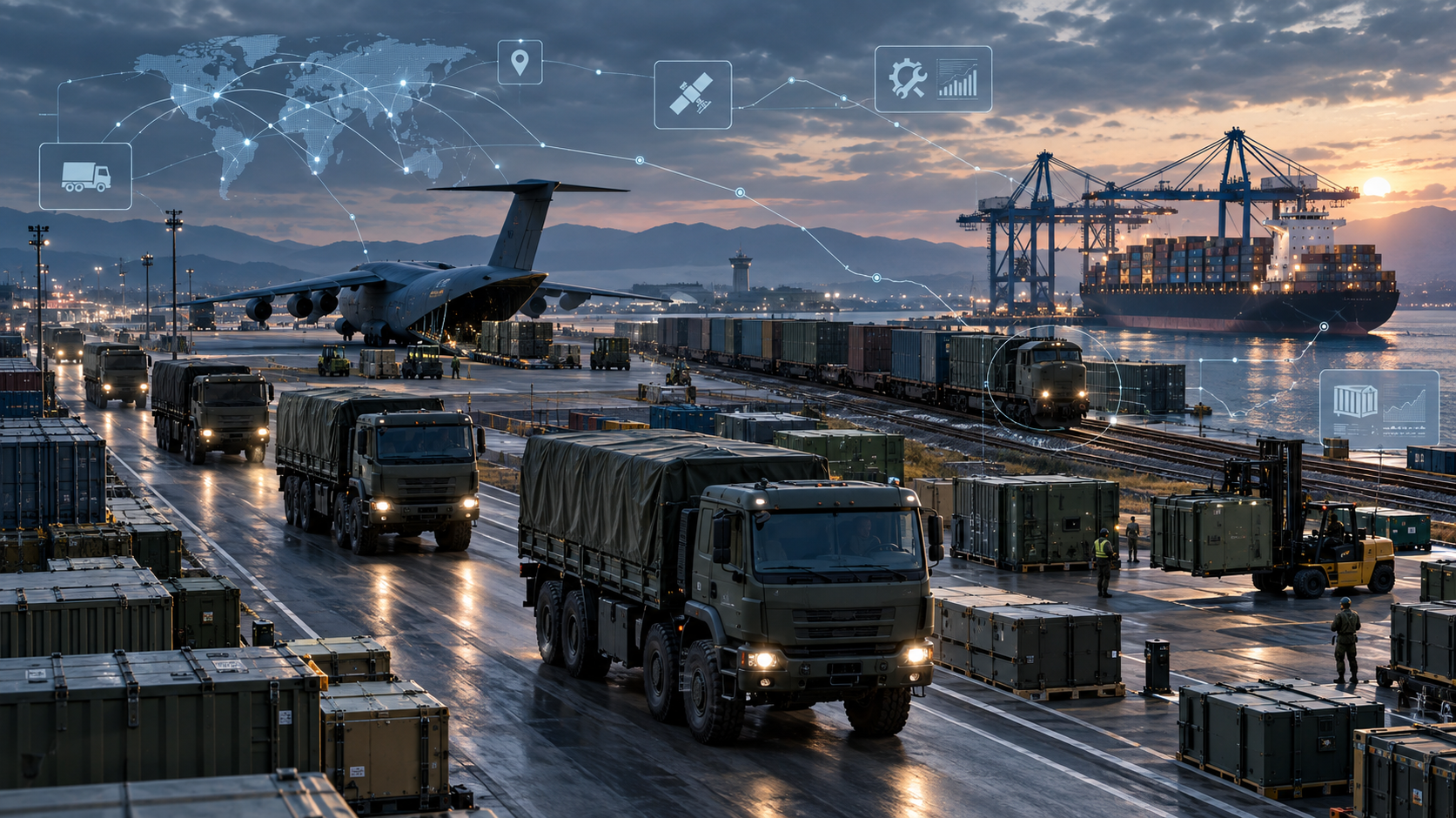
Technologies of the future: Autonomy and digitalization in defense logistics – creative image on the topic, with AI: Xpert.Digital
From cost center to strategic power factor: The role of defense logistics
How fuel and spare parts determine the outcome of wars
$344 billion: The future of military logistics – Why availability is the new gold
Defense logistics is an often overlooked yet crucial area that significantly determines a country's military power. In a global market whose volume could reach an impressive $344.35 billion by 2034, the importance of fuel, spare parts, and modern data management systems is becoming increasingly clear. In times of rising geopolitical tensions and complex military operations, the ability to overcome logistical challenges is becoming a strategic advantage. This development underscores that military readiness depends not only on the number of weapon systems but, above all, on the availability and effectiveness of the supporting infrastructure. The coming years will reveal how this market evolves and which technologies and strategies will be crucial in meeting its growing demands.
Defense logistics: The $344 billion market behind military power
Tanks win battles – but fuel, spare parts, and data decide wars
The global defense logistics market is poised for a period of exceptionally strong growth. Its volume is projected to reach $182.50 billion in 2025. $195.90 billion is expected for 2026, and by 2034 it could reach $344.35 billion. This equates to an average annual growth rate of 7.3 percent from 2026 to 2034. Behind these figures lies far more than simply an increase in transportation volume. Defense logistics is evolving from a supporting administrative and supply function into a strategic capability that determines whether modern armed forces can sustainably operate their expensive platforms.
This development follows a simple economic logic: A weapons system generates its military benefit not through purchase, but through available operational hours. Aircraft require spare parts, qualified maintenance, and secure airfields; land systems need fuel, ammunition, and mobile repair capabilities; ships depend on ports, depots, and long supply chains. The more complex and software-intensive the platforms become, the greater the effort required to ensure their operational readiness over decades. For this reason, a growing portion of the value chain is shifting from the one-time sale of a platform toward lifecycle support, data management, maintenance, training, and supply.
The market is growing not only because defense budgets are increasing, but also because the logistical target system is becoming more sophisticated. Cost efficiency remains important, but it is no longer sufficient. Simultaneously, speed, redundancy, security, interoperability, and the ability to continue operating under attack are required. This is creating a market in which physical infrastructure, industrial capacity, digital systems, and geopolitical risk mitigation are becoming increasingly intertwined.
From cost center to strategic power factor
Defense logistics encompasses the planning, movement, storage, maintenance, and delivery of personnel, equipment, ammunition, fuel, spare parts, medical supplies, and services. This includes road, rail, air, and sea transport, as well as depots, field camps, workshops, bases, IT systems, and the management of international supply chains. Its economic core lies in making the right capability available at the right time and in the right place. In a commercial network, a delayed delivery can cost revenue. In a military operation, it can mean the loss of an operational option.
This difference alters the optimal design of the system. Civilian logistics has spent decades reducing inventory, consolidating networks, and optimizing processes for high utilization. Military resilience, on the other hand, demands reserves, alternative routes, additional means of transport, and distributed storage locations. Such redundancies appear as inefficient costs in normal times. In a crisis, they become an insurance premium against the failure of the entire system. The market is therefore growing even where the focus is not on moving more goods, but rather on organizing the same supply service more robustly.
Added to this is the long service life of military platforms. Fighter jets, ships, and armored vehicles often remain in service for several decades and are modernized during this time. The supply of spare parts must cope with technical changes, aging components, discontinued supplier products, and changing security requirements. This creates a continuous demand that is less dependent on economic cycles than many civilian logistics markets. However, it is heavily dependent on political priorities, budgetary decisions, and security situations.
A market on its way to doubling in size
Between 2025 and 2034, the projected market volume will increase by US$161.85 billion, or approximately 88.7 percent. From 2025 to 2026 alone, this represents an increase of US$13.40 billion, or about 7.3 percent. This magnitude demonstrates that this is not a narrow niche market, but rather a significant portion of the global defense economy. However, this forecast should not be interpreted as a guarantee of revenue. It describes a scenario contingent upon sustained high defense spending, continued modernization, and an increasing outsourcing of logistics services.
The macroeconomic tailwind is considerable. Global military spending reached approximately US$2.887 trillion in 2025. Europe, Asia, and Oceania saw particularly strong increases. At the same time, NATO member states have committed to spending a total of five percent of their annual economic output on nuclear defense and defense and security-related sectors until 2035. Of this, 3.5 percent is earmarked for nuclear defense and up to 1.5 percent for related areas such as infrastructure, resilience, and industrial prerequisites. The latter, in particular, can significantly increase the demand for military mobility, ports, railways, fuel systems, communications, and secure supply chains.
Growth is occurring in several areas simultaneously. New platforms require integrated support packages. Increased readiness demands larger inventories and more maintenance. Distributed operations concepts increase the number of locations that need to be served. Digitalization creates demand for data platforms, sensors, and cybersecurity. Regionalization and strategic warehousing tie up additional capital. The market is thus growing both quantitatively, through higher volumes, and qualitatively, through more sophisticated services.
Wartime capability trumps peacetime efficiency
The war against Ukraine has fundamentally changed the economic assessment of military logistics. At the beginning of the conflict, the consequences of inadequate maintenance, fuel shortages, poorly protected supply lines, and inflexible supply structures became apparent. Long convoys, a heavy reliance on a few transport routes, and insufficient field repair capabilities hampered operations. At the same time, it became clear that even large stockpiles of supplies are of little use if goods do not reach their point of need in a timely manner.
On the other hand, a distributed and adaptable supply chain gained importance. Small mobile repair teams, pre-positioned stockpiles, decentralized warehouses, and the use of civilian support networks increased responsiveness. However, the conflict also demonstrated that both sides adapt. Logistics hubs were redistributed, repairs were moved closer to the front lines, civilian vehicles were used more extensively, and new sources of supply were developed. The most important lesson, therefore, is not that one particular model is permanently superior, but rather that the ability to learn and adapt is itself becoming a core logistical competency.
For market economics, this means a shift from maximum efficiency to resilient performance. A single large depot is cheaper in peacetime than several smaller ones. However, under the threat of drones and precision weapons, it can become a dangerous point of failure. A centralized IT platform offers transparency and economies of scale, but if inadequately secured, it increases the potential damage from a cyberattack. Therefore, demand is increasingly focused on systems that combine centralized control with decentralized execution.
Roads remain the backbone
Road transport is projected to reach the largest share of all modes of transport in 2026, at 53.49 percent. This equates to a market volume of approximately US$104.8 billion. This dominance is plausible because roads provide the final link between ports, railway stations, airports, depots, and deployment locations. Military trucks, armored transport vehicles, tankers, and mobile workshops offer a level of flexibility unmatched by any other mode of transport.
The strength of the road is also its vulnerability. Convoys require personnel, fuel, security, and functioning roads. Bridge loads, tunnel profiles, construction sites, border procedures, and damaged infrastructure can all slow progress. In conflict zones, vehicles are at risk from drone reconnaissance, mines, sabotage, and long-range weapons. The economic solution is not simply to buy more trucks. What's needed are intelligent route planning, flexible transshipment points, camouflage, secure communication, technical standardization, and the ability to quickly transfer goods between different modes of transport.
Air transport is projected to grow by an average of 7.4 percent annually over the forecast period. While expensive and limited in volume, it offers speed and range. Sea transport remains indispensable for heavy equipment and large volumes, but requires secure ports and long lead times. Rail efficiently moves large quantities over long distances, but is dependent on fixed routes, compatible networks, and suitable terminals. Successful defense logistics, therefore, is not about choosing a single mode of transport, but rather about the ability to manage road, rail, air, and sea as a robust overall network.
Ammunition dominates, availability decides
The arms, ammunition, and explosives segment is expected to reach a market share of 52.86 percent in 2026. Based on market forecasts, this corresponds to approximately US$103.6 billion. This high share is due to the specific requirements for security, storage, documentation, handling, and on-time distribution. Unlike many civilian goods, these products must be transported and monitored under strict regulations and protected against theft, tampering, and damage.
High intensity also alters the logic of consumption. Ammunition requirements in protracted conflicts can far exceed peacetime assumptions. This turns production capacities, raw materials, intermediate products, stockpiles, and transport routes into interconnected bottlenecks. An additional production line is useless if explosives, propellant charges, electronic components, or qualified personnel are lacking. Conversely, a large stockpile is insufficient if storage sites are vulnerable or distribution to troops is disrupted.
Technical support and maintenance form the second strategic core. Modern systems consist of complex electronics, software, sensors, and specialized mechanical components. Their availability depends on diagnostic capabilities, spare parts, documentation, tools, and trained technicians. Medical logistics, in turn, requires temperature-controlled supply chains, secure inventory, and rapid distribution. The combined segment of other services is expected to grow particularly dynamically, at 8.5 percent annually. This reflects the increasing trend of supply chain management through integrated services, data, training, and flexible support packages.
The army generates the greatest continuous load
In terms of end users, the military is expected to dominate with 52.51 percent by 2026. This equates to approximately US$102.9 billion. Due to their personnel strength, geographical distribution, and the wide variety of vehicles they use, land forces generate a particularly broad supply demand. Fuel, ammunition, rations, spare parts, medical services, and maintenance must be provided across widely varying distances and terrain.
The air force is expected to grow faster than the overall market, at an estimated 8.0 percent per year. This is due to its high technical complexity and the high costs of unplanned downtime. A missing component can ground a very expensive aircraft. Therefore, condition monitoring, predictive maintenance, digital configuration control, and precise spare parts forecasting are becoming increasingly important. At the same time, airfields themselves are evolving into logistical systems requiring fuel, ammunition, ground support equipment, IT, security, and repair capabilities.
For naval forces, distances, deployment durations, and port dependencies are particularly relevant. Ships can carry large quantities but remain reliant on scheduled resupplies, shipyards, and specialized spare parts. The three end-user segments should not be added together with the segments based on transport type or service area. They describe different dimensions of the same market. For example, an ammunition convoy for the army simultaneously falls under road logistics, the defense sector, and army supplies.
North America sets the standard
North America was the largest regional market in 2025, accounting for 33.19 percent of total US revenue at $60.57 billion. This figure is projected to reach $64.53 billion in 2026, representing an increase of approximately 6.5 percent. The region benefits primarily from the global US military presence, large strategic transport fleets, a dense network of military installations, and a highly developed private defense industry.
The US market is projected to reach approximately $52.95 billion in 2026. This means the United States will account for roughly 82 percent of the North American market and about 27 percent of the global market. The claim that the US represents nearly half of global demand would be untenable given these figures. Nevertheless, its significance remains exceptional because American requirements often shape technical standards, data architectures, and business models that also influence allies and international suppliers.
Of particular relevance is the interplay between military depots, commercial contractors, global transportation capabilities, and digital control. An AI-enabled commercial cloud for U.S. defense logistics exemplifies the attempt to more closely integrate large datasets, demand forecasts, and operational decisions. Long-term interagency cooperation in the healthcare sector demonstrates how pooling demand and supply can generate economies of scale. Canada complements the region with its NATO responsibilities and the unique challenges of the Arctic, where vast distances, sparse infrastructure, and extreme environmental conditions increase the costs of logistical preparedness.
Asia-Pacific narrows the gap
The Asia-Pacific region reached a volume of US$53.34 billion in 2025, representing a share of 29.23 percent. US$57.95 billion is expected for 2026. The short-term increase of approximately 8.6 percent exceeds the corresponding growth rates of the other major regions identified. This brings the region closer to North America.
China is projected to reach approximately US$19.26 billion in 2026, Japan US$14.34 billion, and India US$9.87 billion. Together, these three countries account for US$43.47 billion, representing roughly three-quarters of the regional market. Their motivations differ, but they all point in the same direction: China is expanding its maritime and technological capabilities, Japan is strengthening its readiness and reach, and India is combining modernization with the goal of increasing domestic production. South Korea and Australia are additionally increasing demand for maintenance, munitions supply, maritime logistics, and cooperation with partners.
Geography makes the Indo-Pacific a particularly challenging logistical environment. Vast distances, island chains, maritime bottlenecks, and dependence on ports and airfields increase the need for pre-positioned assets and distributed bases. At the same time, widespread distribution can increase costs and coordination efforts. Therefore, it will be crucial which states not only procure platforms but also finance tankers, transport vessels, airlift, depots, repair facilities, and secure data links. The region clearly demonstrates that military reach without logistical depth quickly becomes a theoretical concept.
Hub for Security and Defense - Advice and Information


Hub for Security and Defense - Image: Xpert.Digital
The Security and Defence Hub offers expert advice and up-to-date information to effectively support companies and organizations in strengthening their role in European security and defence policy. Working closely with the SME Connect Defence Working Group, it particularly promotes small and medium-sized enterprises (SMEs) that wish to further develop their innovative capacity and competitiveness in the defence sector. As a central point of contact, the Hub thus creates a crucial bridge between SMEs and European defence strategy.
Related to this:
Innovative solutions for defense logistics
Europe's bottleneck is mobility
Europe reached US$39.37 billion in 2025, representing a global market share of 21.57 percent. US$42.29 billion is projected for 2026, corresponding to growth of approximately 7.4 percent. The British market is expected to reach US$9.99 billion, and the German market US$8.32 billion. Together, these two countries account for just over 43 percent of the European market volume.
The central European challenge is not only the availability of equipment, but its rapid movement across borders. Differing procedures, national responsibilities, limited terminal capacities, unsuitable bridges, a lack of rail connections, and non-harmonized digital systems can delay deployments. Military mobility is therefore increasingly understood as a European infrastructure issue. Investments in roads, railways, ports, airports, fuel networks, and cross-border permitting processes have both military and civilian benefits.
Reliable corridors are particularly important for the eastern and southeastern flanks. Poland, Romania, and Bulgaria are gaining importance as transit, reception, and support areas. Black Sea ports, Danube connections, railway lines, and road networks must be considered as an interconnected system. The economic benefits of such investments can extend beyond the defense sector, provided that infrastructure is planned for dual use. At the same time, there is a risk that numerous individual national projects will be developed without consistently addressing cross-border bottlenecks.
Europe's rising budgets will therefore not automatically solve the problem. Common standards, predictable demand, and interoperable maintenance and supply systems are at least as important as additional funding. Without this coordination, more money can lead to higher prices and parallel, incompatible structures. With such coordination, the region can strengthen its industrial base while simultaneously retaining a larger share of the logistics value chain within Europe.
The remaining regions will be more differentiated
The rest of the world reached a total of US$29.22 billion, or 16.01 percent of the market, in 2025. Of this, US$13.93 billion was attributable to Latin America and US$15.29 billion to the Middle East and Africa. A total of US$31.13 billion is expected for 2026. This aggregated category has limited analytical value because it combines very different security situations, infrastructure levels, and procurement models.
In the Middle East, sophisticated imported platforms, regional tensions, and the desire for greater national self-reliance are driving demand. Saudi Arabia and the United Arab Emirates require high-performance maintenance, training, and support systems to keep their complex air, land, and naval forces operational. This creates opportunities for local partnerships, technology transfer, and the development of national maintenance capabilities. Long-term value creation lies less in the transportation of individual shipments than in the development of lasting technical expertise.
In Africa, vast distances, limited infrastructure, and challenging environmental conditions increase the operational importance of robust vehicles, mobile maintenance, and simple, repairable systems. In Latin America, border security, maritime surveillance, disaster relief, and peacekeeping missions are often paramount. Brazil, due to its size and industrial base, occupies a special position. For suppliers in these markets, highly complex solutions are not automatically superior. Systems must be affordable, maintainable under local conditions, and compatible with existing infrastructure.
From warehouse to digital battle network
Digitalization is transforming the market along the entire value chain. Real-time tracking improves the visibility of material movements. Condition data enables maintenance to be more closely aligned with actual wear and tear. Integrated platforms connect inventory, transport capacities, demand forecasts, and deployment planning. Digital twins can virtually map plants, vehicles, or supply networks and test scenarios before physical resources are moved.
The economic benefits arise primarily from increased availability and reduced uncertainty. Knowing the actual condition of a component allows for the avoidance of unnecessary maintenance and the earlier detection of critical failures. When inventory levels are visible across organizations, the risk of simultaneously creating overstocks and local shortages decreases. Artificial intelligence can improve demand forecasting, route planning, and fault diagnosis. However, it does not replace reliable master data or robust processes. Poor data does not automatically improve with a more powerful algorithm.
Blockchain is also being discussed as a tool for tamper-proof supply chains. Its usefulness depends on whether multiple organizations actually need a shared, trustworthy transaction history. For many applications, traditional, well-secured databases can be more efficient. Furthermore, every digital ledger remains dependent on accurate input. An immutable, incorrect data record is not progress. Therefore, the market will not be decided by buzzwords, but by solutions that demonstrably increase uptime and function even when communication is disrupted.
Autonomy and 3D printing are changing the edge of the chain
Unmanned aerial and ground vehicles are increasingly being tested for supply missions. Their greatest advantage lies not in completely replacing heavy main transport, but in taking over risky or time-critical segments. Small drones can transport medical supplies, batteries, or selected spare parts. Unmanned ground vehicles can relieve personnel on dangerous last-mile deliveries. In both cases, range, payload, interference immunity, maintenance, and costs must be realistically assessed.
Additive manufacturing promises to produce certain spare parts closer to the point of use. This can shorten delivery times and reduce dependence on rarely needed stock parts. Simple components, tools, brackets, or parts whose original supply chain no longer exists are particularly interesting. For safety-critical parts, however, material quality, certification, intellectual property, and documented process control remain significant hurdles. Therefore, 3D printing does not replace an industrial base. It complements it where small production runs, long delivery times, or interrupted transport routes represent the biggest bottlenecks.
Autonomy and additive manufacturing are also shifting qualification requirements. Fewer drivers or warehouse staff don't automatically mean less employment. What's needed is software expertise, system integration, cybersecurity, materials testing, and technical certification. Companies that offer hardware without training, data connectivity, and maintenance will only capture a portion of the value chain. The most attractive business models combine product, digital control, and long-term service.
Private providers are moving into core functions
Armed forces are increasingly outsourcing basic operations, maintenance, secure transport, training, and parts of supply chain management to private companies. This model is often described as Logistics-as-a-Service. It can transform fixed costs into more predictable performance payments, provide access to specialized knowledge, and accelerate modernization. At the same time, it creates a greater reliance on private capacity, personnel, and data platforms.
The central question, therefore, is not whether outsourcing will occur, but rather which functions can be outsourced and under what conditions. In peacetime, a commercial network can be highly efficient. In a crisis, however, it must be contractually, technically, and in terms of personnel that services continue to operate despite increased risks, border closures, cyberattacks, or staff shortages. The state must not completely lose its ability to manage and control services. Data ownership rights, software access, and the continuity of services during a change of provider must also be taken into account.
Commercial logistics companies like DHL and Kühne+Nagel contribute global networks, customs expertise, and experience with complex supply chains. Large defense corporations, on the other hand, possess in-depth platform knowledge and access to technical data. Specialized service providers handle basic operations, technical support, and mission logistics. This creates partnerships that combine civilian economies of scale with military security requirements. The ability to integrate these diverse competencies into a reliable overall model will be crucial for competitiveness.
The competition takes place across life cycles
Lockheed Martin, Boeing, RTX, Northrop Grumman, General Dynamics, and BAE Systems are shaping the integrated lifecycle support of complex platforms. Their strength lies in technical data, systems knowledge, maintenance procedures, and long-standing customer relationships. KBR, Amentum, Leidos, and Fluor excel in outsourced services, basic operations, technical support, and large-scale program implementation. Global logistics providers complement the field with their expertise in transportation, freight forwarding, and supply chain management.
This market is characterized by high barriers to entry. Security checks, export controls, approvals, confidential data, and long-standing relationships of trust limit access. New providers can nevertheless succeed if they fill a clearly defined gap. These gaps include cybersecurity, sensor technology, AI-supported forecasting, digital twins, mobile energy supply, autonomous systems, or certified additive manufacturing. They usually don't become general contractors immediately, but rather part of a larger ecosystem.
The dominant position of platform manufacturers poses a lock-in risk for customers. If maintenance data, spare parts, and software are only available from a single source, costs and dependency increase in the long run. Open interfaces and clearly defined data rights can promote competition, but must be compatible with security and liability issues. From an economic perspective, competition is therefore shifting from the cheapest individual product to a credible commitment to a certain level of availability over many years.
Personnel and infrastructure impose severe limitations
Rising budgets can generate more demand in the short term, but not automatically more qualified personnel. Maintenance technicians, drivers, IT security specialists, engineers, and hazardous materials experts are not readily available. Training takes time, security clearances require time, and many civilian industries compete for the same skills. This labor shortage can therefore become a limiting factor for growth.
The same applies to infrastructure. An additional train is of little use if terminals are lacking. More heavy vehicles don't solve a problem if bridges can't bear their load. Larger fleets require suitable, secure storage areas. Additional aircraft need maintenance hangars, fuel, ground support equipment, and personnel. Building these infrastructures is capital-intensive and often takes longer than purchasing a platform.
The most economically sound modernization therefore begins with a bottleneck analysis. Not every point in the system needs to be expanded to its maximum capacity simultaneously. The crucial factor is identifying which single failure would have the greatest impact on the overall network. Such weak points could be a port, a spare part, a permit, a data connection, or a specific professional group. Investments in seemingly unspectacular components can generate more willingness to invest than prestigious new acquisitions.
Cybersecurity becomes essential for delivery capability
The more digital logistics become, the larger its attack surface. Inventory levels, routes, maintenance statuses, and priorities are valuable information. Manipulated data can trigger incorrect deliveries, delay maintenance, or reveal the location of critical inventory. An attack doesn't have to destroy the entire network. Even targeted disruptions at transfer points or identification systems can cause significant delays.
Cybersecurity should therefore not be treated as an add-on. Encrypted communication, strong identity controls, segmented networks, tamper-proof protocols, and robust recovery procedures are essential for operational capability. Analog or local fallback options are equally important. A system that only functions with a permanent cloud connection may be unsuitable in unstable environments.
This increases development and verification costs for providers. At the same time, an attractive market is emerging for secure cloud infrastructures, data integration, threat analysis, and continuous monitoring. The crucial factor remains the connection between IT security and physical logistics. Those who only protect the software but overlook sensors, terminals, or suppliers leave significant vulnerabilities open. The supply chain must be secured as a whole system.
Sustainability becomes a question of reach
Sustainability is becoming increasingly important in defense logistics for two reasons. First, fuel consumption and energy-intensive bases increase operating costs. Second, every fuel delivery saved is also a vulnerable transport movement avoided. Energy efficiency therefore has direct military value. Hybrid propulsion systems, more efficient generators, local power generation, and intelligent energy management can increase range and endurance.
Alternative fuels and lower-emission systems will only be widely adopted if security of supply, performance, and compatibility are guaranteed. An environmentally friendly fuel is of little use if it is not available in sufficient quantities during a crisis. Conversely, local renewable energy sources can reduce dependence on long supply routes. Therefore, the evaluation must integrate life-cycle costs, military benefits, and security of supply.
Robust, repairable, and longer-lasting systems are also part of sustainable logistics. A longer lifespan reduces material consumption and lessens the pressure on spare parts supply chains. In this market, sustainability is therefore less a matter of image than an optimization of energy, materials, and movements. It will progress most rapidly where ecological and operational advantages coincide.
High budgets don't solve every problem
Despite the strong outlook, the market remains subject to significant constraints. Defense budgets are politically driven and can change with shifts in government, economic downturns, or new priorities. Logistics often competes with visible platform acquisitions. The political benefit of a new aircraft is easier to communicate than that of a spare parts depot or digital inventory management, even though the latter can improve availability in the short term.
Regulation, export controls, and national security interests increase costs and lengthen decision-making processes. They are not merely bureaucracy, but are intended to protect sensitive technologies and supply chains. Problems arise when differing rules unnecessarily hinder cooperation or stifle innovation. Particularly in Europe, there is a tension between national control and the need for common standards.
Further risks arise from supplier concentration and critical raw materials. Electronics, rare materials, specialty chemicals, and certain mechanical components are sometimes sourced from just a few suppliers. A formally broad supplier list can therefore mask a deep dependence on the same intermediate products. Resilience requires transparency across multiple stages of the supply chain. This increases the effort, but prevents a single, inconspicuous component from shutting down a multi-billion-dollar system.
Where providers can find the best opportunities
The most attractive growth areas lie at the interface between physical and digital logistics. Mobile depots, rapidly deployable storage systems, modular workshops, and unmanned replenishment solutions cater to the trend toward distributed operations. Predictive maintenance, digital twins, and secure data platforms increase the availability of existing systems. Additive manufacturing creates opportunities for hard-to-find parts and small batch sizes.
Traditional infrastructure is also becoming a growth market. Ports, rail terminals, roads, bridges, fuel networks, and military airfields all require modernization. Dual-use concepts can increase public acceptance and economic benefits because these same facilities also strengthen civilian supply chains. This opens up access for construction, energy, telecommunications, and logistics companies to a market that was previously dominated by traditional defense contractors.
Companies that combine regulatory expertise, cybersecurity, and operational reliability have good market opportunities. A technically superior product is insufficient if it is not certifiable, integrable, or maintainable in the field. Solutions that work with existing legacy systems and can be implemented gradually are particularly in demand. Most armed forces modernize their logistics not from scratch, but during ongoing operations.
What the forecast doesn't say
Market forecasts convey a sense of precision, but they rely on assumptions about prices, exchange rates, definitions, and political developments. A nominally increasing volume can partially reflect inflation. Different studies may define maintenance, infrastructure, transportation, or internal military services differently. The figure of US$344.35 billion should therefore be understood as a plausible market scenario and not as an exact prediction.
Regional growth also says little about the profitability of individual providers. Large programs can involve low margins, high upfront financing, and significant liability risks. Security requirements and long payment cycles increase capital needs. At the same time, small, specialized segments with high barriers to entry can be more attractive than high-volume transport services.
Another blind spot is actual operational readiness. Higher expenditures and more contracts don't guarantee better results. Crucial factors are delivery times, technical availability, repair duration, range, inventory accuracy, and the ability to continue operating during disruptions. Therefore, anyone assessing the market should consider not only revenue and growth rates, but also key operational performance indicators.
Readiness is the new currency
The defense logistics market is growing because governments are recognizing that military capabilities have limited value without reliable support. The projected expansion to $344.35 billion by 2034 reflects rising budgets, but also a structural reassessment of maintenance, mobility, data, inventory, and industrial capacity. Road and army operations remain the largest segments, with weapons and ammunition dominating the service areas, while air force logistics, digital solutions, and other integrated services are experiencing above-average growth.
The clear economic perspective is this: the greatest benefit does not necessarily come from more material, but from the increased availability of existing material. An additional weapon system increases theoretical capacity. Improved spare parts supply, faster repairs, or a secure transport route, on the other hand, can increase the actually usable capacity of an entire fleet. This logic argues for a shift from pure procurement to lifecycle management and measurable readiness outcomes.
For states, the ability to combine civilian and military resources without relinquishing critical control will be crucial. For companies, the opportunity lies in integrated solutions that combine hardware, data, security, and services. For Europe, the greatest challenge is translating increased spending into shared mobility, industrial depth, and resilient cross-border networks. The competition of the coming years will therefore not be decided solely on the battlefield, but also in workshops, ports, data centers, depots, and along the transport corridors that make military power mobile.
Consulting - Planning - Implementation

Markus Becker
I would be happy to serve as your personal advisor.
Head of Business Development
Chairman SME Connect Defense Working Group
Consulting - Planning - Implementation
Konrad Wolfenstein
I would be happy to serve as your personal advisor.
You can contact me at wolfenstein∂xpert.digital or
Just call me on +49 7348 4088 965 .