No longer science fiction: Autonomous drones handle warehouse jobs at Hyundai: Drones reduce inventory time by 90 percent – Creative image: Xpert.Digital
This drone technology is 6 times more accurate: A look inside Hyundai's super warehouse
Only 30 minutes instead of 5 hours: Hyundai revolutionizes inventory with drones
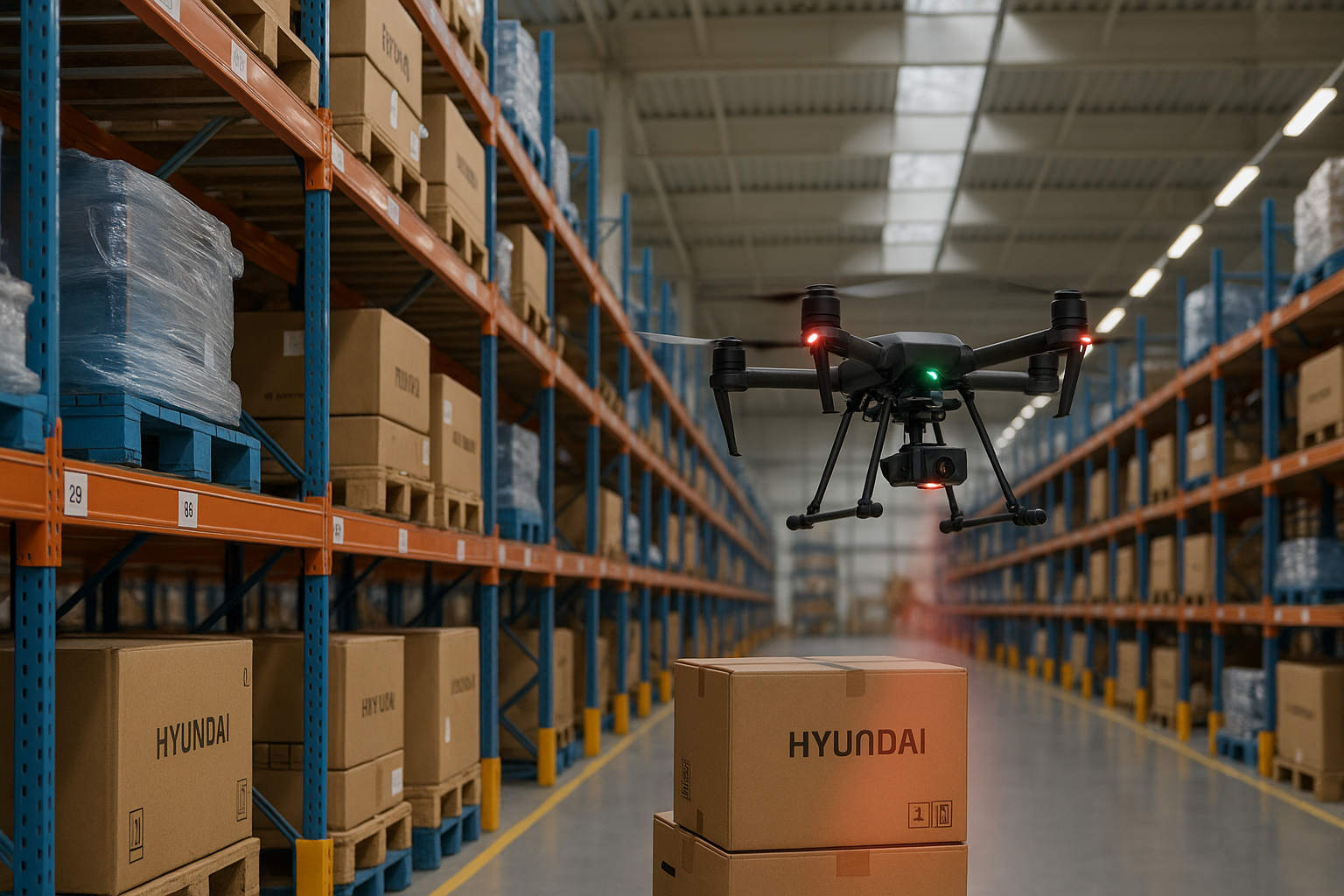
Automation in warehousing has reached a new milestone. South Korean automaker Hyundai has implemented a groundbreaking solution at its innovative logistics center in Georgia, USA, reducing inventory time from five hours to just 30 minutes. This dramatic improvement was achieved through the use of two autonomous drones, representing a completely new approach to inventory management.
Related to this:

The technological revolution of drone inventory
The drones used by Hyundai represent a highly advanced technology specifically designed for use in enclosed storage areas. These autonomous aircraft operate according to predefined flight patterns, systematically capturing images and location data of the unassembled vehicle parts within the warehouse.
At the heart of the technology is a sophisticated sensor system that integrates various components. Fisheye cameras, also known as wide-angle lenses, extract specific visual features such as angles and surface textures of the stored components. These cameras offer a 360-degree field of view, enabling the monitoring of large areas from a single vantage point. Fisheye technology has proven particularly effective because it operates without blind spots, thus ensuring comprehensive inventory tracking.
The camera system is complemented by an integrated accelerometer and a gyroscope, which continuously track the drones' movement and spatial orientation. These sensors enable the drones to precisely determine their position in space and perform stable flight maneuvers, which is crucial for accurate data acquisition.
Navigation is achieved using camera-based imaging technology instead of GPS signals, which is essential for indoor use. This technology, known as Visual Simultaneous Localization and Mapping (VSLAM), allows the drones to orient themselves indoors and create precise maps of their surroundings.
Automated data processing and system integration
The efficiency of drone inventory lies not only in data collection but also in the intelligent processing of the gathered information. The combined sensor data enables precise location mapping, which is synchronized in real time with the facility's warehouse management system.
A particular advantage is the complete automation of the process. The drones transmit the analyzed results directly to the logistics management system without requiring any human intervention. This seamless integration eliminates potential sources of error that can occur with manual data transfer.
Battery management is also automated at dedicated base stations and requires no manual charging or replacement procedures. This automation ensures continuous drone operation and minimizes downtime.
Advantages of drone inventory
The implementation of drone technology offers numerous advantages that extend far beyond mere time savings. Traditional inventory methods are often associated with significant challenges, particularly in high-bay warehouses where employees have to work with forklifts or aerial work platforms.
The drone solution offers a significant improvement in workplace safety. Employees no longer need to work at dangerous heights or operate heavy machinery to reach hard-to-access storage areas. This considerably reduces the risk of workplace accidents and contributes to a safer working environment.
Cost efficiency is another crucial advantage. Projections show that switching to drone inventory can result in time savings of up to 80 percent and cost reductions of up to 90 percent. These savings are achieved through reduced personnel requirements, minimized machine usage, and an accelerated overall inventory process.
Another important aspect is the accuracy of data collection. Drones can continuously collect information with the highest precision, leading to improved inventory accuracy. Reports show that companies have been able to improve their inventory accuracy sixfold by using drones.
Practical application and experiences
The practical implementation of drone inventory is showing impressive results. A single employee can use a drone to regularly scan the entire warehouse stock, aisle by aisle, even during normal business hours. This represents a significant improvement over traditional methods, where inventories often had to be carried out outside of business hours.
The drones are able to reliably detect barcodes of storage locations and inventory, comparing the target situation with the actual situation. A detailed image is created for each storage location, which can later be used for analysis and tracking. The average time to check a single storage location is only five seconds or less.
The drones' flexibility is also evident in their ability to read various types of codes. They can capture and process both barcodes and QR codes, enabling comprehensive inventory tracking. Features such as continuous scanning and multi-barcode capture allow for the uninterrupted scanning of up to 30 barcodes simultaneously.
Groundbreaking automation strategy: Hyundai integrates drone inventory and Atlas robots
Hyundai views the successful implementation of drone inventory as part of a broader automation strategy. The company plans to deploy additional drones at its Georgia site and potentially expand the technology to other Hyundai logistics centers.
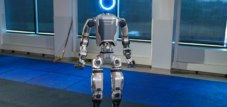
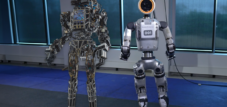
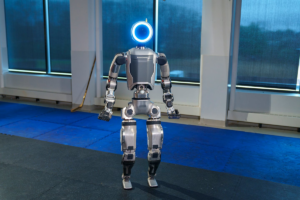
This strategy aligns with Hyundai's comprehensive automation plans. By the end of 2025, the humanoid robot Atlas from Boston Dynamics is slated for deployment at Hyundai Motor Group's Metaplant America. These robots are designed to perform tasks considered simple but potentially dangerous for human workers in automotive manufacturing.
The combination of drone technology and humanoid robots demonstrates the potential for a fully automated warehouse environment. While drones handle inventory tracking and monitoring, humanoid robots can perform physical tasks such as transporting heavy parts or assembling components.
Related to this:
Technological developments in drone warehousing
The development of drone technology for warehousing is a continuous process characterized by various innovations. Modern drones utilize advanced AI algorithms and machine learning to continuously improve their performance.
One particularly innovative approach is the use of multi-channel radar sensors, which allow drones to see through opaque packaging. This technology, based on terahertz spectroscopy, can enable precise inventory tracking and counting at the item level.
The integration of time-of-flight (ToF) sensors represents another important development. These sensors measure the time difference of light pulses reflected by target objects and enable precise distance measurement. ToF sensors allow drones to create 3D models of shelves and capture information such as the height and distance of goods in real time.
Safety and occupational health
The implementation of drones in warehousing brings significant improvements in safety and occupational health. Traditional inventory methods in high-bay warehouses often require employees to work at dangerous heights, which involves considerable risks.
Drones eliminate these risks by conducting inspections and inventories in hazardous areas without human intervention. They can operate at altitudes of up to 44 meters without requiring employees to put themselves at risk.
Reducing workplace accidents is a key aspect of drone implementation. Statistics show that falls from heights are among the most common fatal workplace accidents. Using drones can significantly reduce these risks, as employees no longer need to work at dangerous heights.
Economic impact and cost analysis
The economic impact of drone inventory is considerable. The drastic reduction in inventory time from five hours to 30 minutes represents a time saving of 90 percent. This increase in efficiency leads to direct cost savings through reduced personnel costs and shorter operational downtimes.
Automating the inventory process allows companies to conduct more frequent stocktaking without disrupting operations. This leads to improved inventory accuracy and can reduce losses due to stockouts.
In the long term, investments in drone technology can be recouped through savings in personnel costs, reduced errors, and improved operational efficiency. The environmental impact is also positive, as battery-powered drones do not require fossil fuels and are significantly quieter than conventional warehouse vehicles.
Integration into Industry 4.0
Hyundai's drone inventory system is an example of the practical implementation of Industry 4.0 concepts in warehousing. The technology embodies the principles of digital transformation by combining autonomous systems, real-time data processing, and intelligent networking.
The integration into existing warehouse management systems demonstrates how modern technologies can be seamlessly incorporated into established infrastructures. The drones do not operate in isolation, but as part of a networked system that exchanges data in real time and optimizes processes.
This interconnectedness enables companies to optimize their supply chains and react more quickly to changes in demand. Continuous inventory monitoring by drones provides precise data that can be used for planning and controlling the entire supply chain.
Challenges and solutions
Despite the impressive successes, there are also challenges in implementing drone inventory systems. One of the biggest challenges is navigation in complex warehouse environments with many obstacles and narrow aisles.
Modern solutions combine drones with other autonomous systems, such as automated guided vehicles (AGVs), to overcome these challenges. These hybrid solutions make it possible to access each shelf area horizontally using the AGV and vertically using the drone.
The battery capacity and flight time of drones present further practical challenges. Modern systems address these problems through automated charging stations and optimized flight patterns that minimize energy consumption.
The future of automated warehousing
Hyundai's success with drone inventory demonstrates the enormous potential of this technology for the future of warehousing. The combination of drones, artificial intelligence, and automated systems will fundamentally change the way warehouses are operated.
Future developments could include multi-drone systems that work collaboratively and can cover larger warehouses even more efficiently. The integration of advanced sensor technologies will further improve the accuracy and versatility of the drones.
Hyundai Motor Group's Metaplant America in Georgia, with its more than 950 robots and approximately 880 human workers, exemplifies the future of automation. This factory demonstrates how drones, humanoid robots, and other autonomous systems can work together to create highly efficient and safe production and storage environments.
Hyundai's drone inventory marks a significant milestone in the evolution of warehousing, demonstrating how innovative technologies can revolutionize traditional processes. With a 90 percent time saving and substantial improvements in safety and accuracy, this technology sets new industry standards and paves the way for a fully automated future of warehousing.
Related to this:
Your global marketing and business development partner
☑️ Our business language is English or German
☑️ NEW: Correspondence in your native language!

Konrad Wolfenstein
I and my team are happy to be available to you as your personal advisor.
You can contact me by filling out the contact form here wolfenstein@xpert.digital:or simply call me at +49 7348 4088 965. My email address is
I'm looking forward to our joint project.