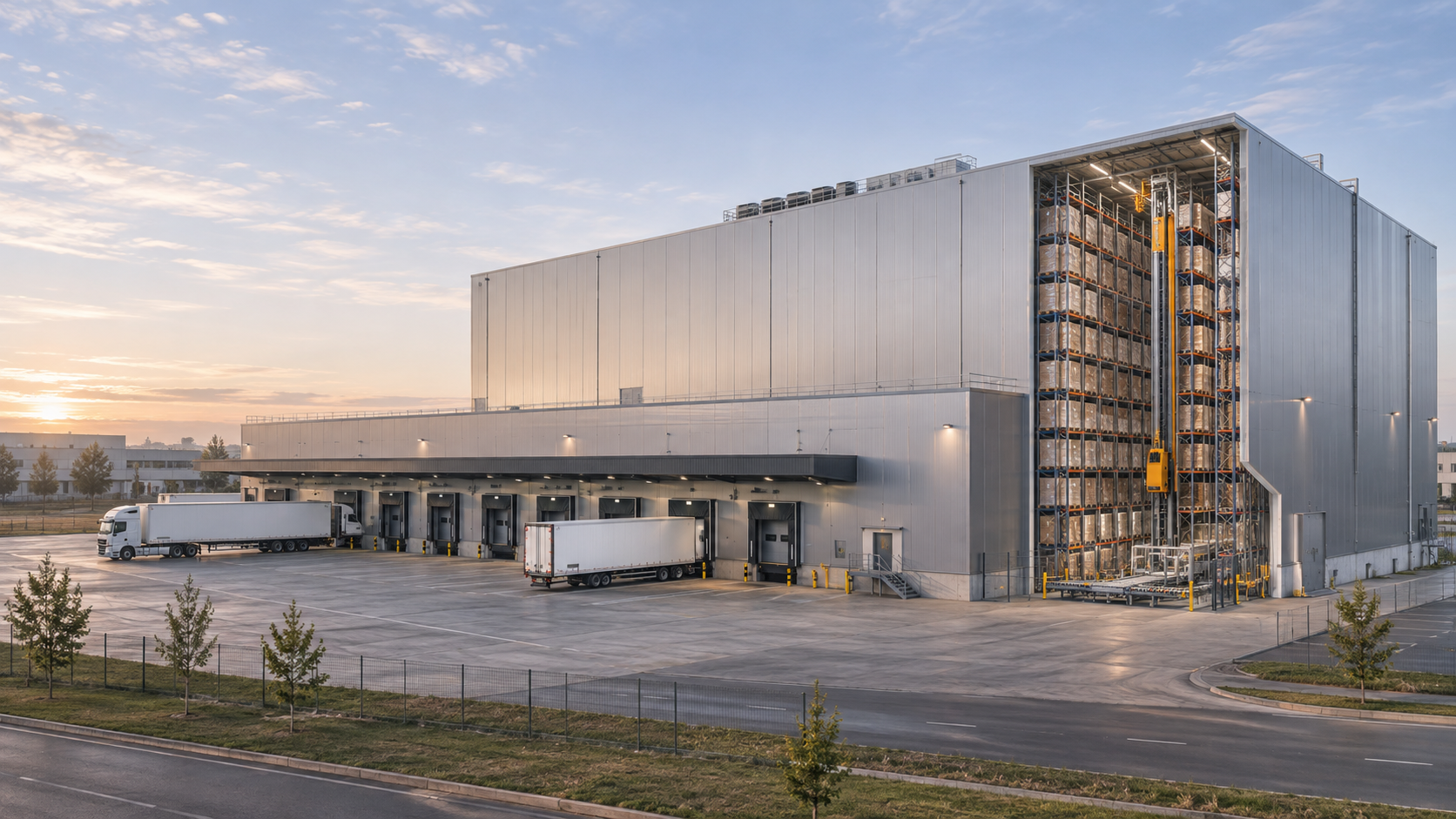
NewCold is building a warehouse for 75,000 pallets in Bucharest: What's behind the mega-project in Romania – start planned for 2027 – Creative image on the topic, with AI: Xpert.Digital
Almost twelve times larger: NewCold's automated warehouse aims to transform food logistics
New high-bay warehouse in Romania: This is how NewCold plans to automate logistics
Planned to launch in 2027: NewCold's multi-million dollar project: Can an automated cold storage facility make food supply more efficient?
NewCold is planning a fully automated high-bay warehouse with 75,000 pallet spaces in Bucharest. The expansion, scheduled for completion in early 2027, would be almost twelve times the size of the existing, manually operated logistics center with 6,400 spaces. The project aims to serve food producers, processors, retailers, and distributors in Romania and Southeast Europe – not only with storage space, but also with services such as order picking, labeling, additional packaging, and cross-docking.
However, the impressive capacity alone says little about whether the investment will pay off. Crucial factors will be utilization, throughput, the reliability of the automated processes, and the actual benefit of the complementary services. The energy efficiency improvements expected from the project also need to prove themselves in operation. This expansion demonstrates the significant transformation underway in food logistics: competitive advantages increasingly arise from automation, digital control, and the ability to consolidate goods flows economically.
NewCold's automation offensive in Bucharest: How 75,000 pallet spaces could change food logistics
A warehouse becomes eleven times larger – but size alone doesn't earn money
A logistics project is underway in Bucharest, with economic significance extending beyond simply providing additional storage capacity. NewCold plans to expand its site with a fully automated high-bay warehouse offering 75,000 pallet spaces. Commissioning is scheduled for early 2027. The existing, manually operated logistics center currently has 6,400 pallet spaces. The new warehouse will serve food producers, processors, retailers, and distributors in Romania and Southeast Europe. In addition to storage, the planned services will include labeling, additional packaging, order picking, and cross-docking.
The scale of the project makes it clear that this is not simply an expansion of an existing operation. NewCold is fundamentally changing the technical and organizational foundation of its site. A manageable, manual warehouse operation is to be transformed into an industrially organized, digitally controlled logistics center with significantly greater capacity.
The crucial economic question is therefore not how many pallets will fit into the building in the future. The crucial question is whether NewCold can consolidate a sufficient number of suitable goods flows, reliably utilize the facility, and justify the higher capital and technology costs through productivity, energy efficiency, and additional services.
The project thus exemplifies a structural change: logistics no longer competes solely on the basis of available space and cheap labor, but increasingly on the basis of process quality, data integration and the ability to manage complex supply chains economically.
The increase in capacity requires a precise classification
Comparing 75,000 pallet spaces with 6,400 yields a factor of approximately 11.7. The planned automated storage capacity is therefore nearly twelve times greater than the previous manual capacity. The calculated difference is 68,600 pallet spaces. Compared to the previous figure, this represents an increase of approximately 1,072 percent.
These figures initially describe a size comparison between the planned new building and the existing warehouse. They do not definitively answer the question of what the total, permanently operated capacity of the site will be. If all existing pallet spaces were to be retained and used in parallel, this would theoretically result in 81,400 pallet spaces. However, without a clear confirmation of the future operating concept, it would be imprecise to present this figure as the guaranteed site capacity.
Similarly, the number of storage spaces does not directly indicate future goods throughput. A warehouse can hold a large volume of goods and yet have relatively few daily movements if the inventory remains in storage for extended periods. Conversely, a smaller facility with short storage times can achieve high throughput.
The figure of 75,000 pallet spaces is therefore a meaningful indicator of the scale of the investment, but not yet proof of productivity, revenue, or profitability. These depend on how intensively and with what performance the capacity is utilized.
A warehouse is being transformed into an industrial operating system
The transition from manual warehousing to full automation changes the economic logic of the operation. In a manual warehouse, performance depends heavily on how many employees and material handling equipment can be used simultaneously, how long the distances are, and how well the individual tasks are coordinated.
An automated high-bay warehouse shifts a significant portion of this work to technical systems. Warehouse movements are organized based on digital orders, storage locations are systematically assigned, and the flow of goods is linked to operational control. For Bucharest, the plans include proprietary warehouse management systems and end-to-end visibility of goods movements.
Economically, this means a shift from variable to more fixed costs. A larger portion of the output is made possible by existing equipment and software. Additional volumes can often be handled within technical limits without proportionally increasing personnel and resources.
This advantage, however, is subject to certain conditions. The delivered goods must meet the technical requirements, data must be accurate, and processes must not be constantly interrupted by exceptional circumstances. A damaged pallet or an incorrect item master record can have different consequences in an automated process than in a flexible, improvisational manual operation.
Automation therefore does not replace organization. It makes a robust organization a prerequisite for its economic viability.
Why the food industry needs more than just free parking spaces
Food producers, processors, retailers, and distributors have different requirements for the same logistics center. A manufacturer might need predictable deliveries of large production batches. A retailer, on the other hand, expects short-term delivery capabilities, customized product combinations, and reliable delivery windows.
For temperature-controlled food products, storage, handling, and transport cannot be considered in isolation. The quality of the entire process chain determines whether goods retain their intended product characteristics and can be sold on time.
NewCold positions the expansion in Bucharest as a response to growing demand from Romania and Southeast Europe. However, this does not imply a specific growth rate for the regional cold storage market. Nor does the project, in itself, prove a widespread capacity shortage. A single large-scale project could be aimed at either increasing overall demand or at shifting existing goods flows to a more efficient provider.
For customers, modernization can still be economically relevant. If deliveries become more predictable, coordination efforts and disruption costs decrease under suitable conditions. If inventory is recorded more accurately, the prerequisites for replenishment planning and inventory control improve.
The real market for the new warehouse, therefore, is not just pallets that need to be stored. It consists of companies that want to organize their supply chains more reliably and control their overall logistics costs.
Bucharest's importance arises from the linking of trade flows
A logistics location does not derive its value solely from its position on a map. What is crucial is which production facilities, sales markets, and transport connections it can economically link together.
For NewCold, Bucharest is part of a broader European network strategy. The Romanian location is intended not only to offer local warehousing services but also to be integrated into supra-regional supply chains. The focus on customers in Romania and Southeast Europe underscores this ambition.
The economic strength of such a hub lies in its consolidation. When goods from different customers are brought together at one location, transport capacity can be better utilized, inventory can be centrally managed, and services can be jointly organized. However, this only works if delivery destinations, time windows, and temperature requirements are sufficiently aligned.
A greater geographical reach is therefore not automatically advantageous. The further away a customer is located, the more important transport costs, transit times, and connection reliability become. A cost-effective warehousing process can be made more expensive again by additional road miles or inefficient delivery structures.
Bucharest, therefore, does not need to replace every regional location to be strategically important. A more economically plausible approach is a network based on the division of labor: large, standardized volumes are concentrated at high-performance hubs, while other facilities operate close to customers, in specialized areas, or with exceptional flexibility. The benefit arises from collaboration, not from centralization at any cost.
The financing shows the scale – not the final return
Additional information regarding financing underscores the capital-intensive nature of the project. The European Bank for Reconstruction and Development is providing NewCold Romania with a loan of up to 182.8 million Romanian lei, equivalent to approximately 36 million euros. Simultaneously, Banca Comercială Română is expected to provide the same amount. Together, this initially amounts to up to 365.6 million lei. For the broader project, a financing framework from the two banks totaling up to 695.6 million lei is cited.
These amounts should not be equated with the final, fixed construction costs of the 75,000-pallet warehouse. Financing commitments, loans actually drawn down, investment expenditures, and the total volume of multi-phase projects are all different factors.
Therefore, simply dividing the total financing framework by 75,000 pallet spaces would be misleading if it were used to derive supposedly precise investment costs per pallet space. For that, it would be necessary to know which buildings, project phases, technical systems, and supplementary facilities are included in the respective amounts.
The involvement of large banks is still relevant. It shows that the project requires structured, long-term financing. However, it does not mean that all economic risks disappear. Even a financed project must recoup its costs after commissioning.
The decisive factors remain the quality of customer contracts, the speed of ramp-up, and the ability to generate a stable cash flow from installed capacity.
Occupancy is more important than the maximum number of parking spaces
For a capital-intensive facility, capacity utilization is a key factor in determining how many units of output the fixed costs are spread across. A high-bay warehouse incurs financing costs, depreciation, technical maintenance, and a portion of its energy consumption even when numerous storage spaces remain empty.
A simple scenario analysis illustrates the scale of the issue. With an average occupancy rate of 70 percent, 52,500 of the 75,000 parking spaces would be used. At 85 percent, this figure rises to 63,750 spaces. The difference amounts to 11,250 average occupied parking spaces. These figures are not a forecast for Bucharest, but rather demonstrate the economic impact of varying occupancy levels.
However, this does not mean that maximum occupancy is always optimal. Suitable storage areas and sufficient space for movement must remain available for efficient operation. Different product groups, blocked stock, or customer-specific requirements can further influence the practically usable capacity.
Furthermore, not every pallet is equally profitable. A pallet with a long storage period has a different revenue profile than goods that are quickly turned over and require additional picking and labeling. The decisive factor is the contribution margin of the entire service package.
Economic management must therefore consider occupancy, storage duration, turnover, additional services, and technical load together. An impressive occupancy rate alone can mask an unfavorable customer mix.
Storage capacity and throughput must not be confused
The economic significance of storage duration can be illustrated with a further model calculation. If an average of 60,000 pallet spaces are occupied annually and goods remain in storage for an average of 30 days, this would correspond to approximately 730,000 pallets shipped per year under highly simplified, uniform conditions. With an average storage duration of 60 days, this figure would be approximately 365,000.
The calculation assumes a stable inventory and consistent inflows and outflows. It says nothing about the actual technical performance of the system. Nevertheless, it shows why the same storage capacity can be associated with very different quantities of goods.
Furthermore, a distinction must be made between delivered pallets and movements. A pallet that is stored and later retrieved results in at least one entry and one exit. Order picking, internal transfers, or additional processing steps can trigger further movements.
For real-world operations, peak loads are more important than annual averages. A facility may theoretically have sufficient capacity but still reach its limits if many trucks arrive simultaneously or numerous orders need to be processed within a short time.
The performance of the new site is therefore not solely determined by the high-bay racking. Goods receiving, inspection processes, staging areas, packaging areas, loading docks, and transport planning must also be compatible with the desired performance. The slowest relevant process limits the benefit of the rest of the investment.
Energy efficiency can become a lasting competitive advantage
The project is expected to achieve approximately 50 percent lower energy intensity compared to conventional cold storage facilities of similar size. This target figure is economically significant because energy consumption is not merely a minor factor in temperature-controlled storage operations. Furthermore, this represents an anticipated improvement compared to a benchmark, not a proven annual value for a fully operational site.
The crucial distinction is between energy intensity and absolute consumption. A more efficient system can require significantly less energy per stored or moved unit, yet still consume more overall if it is considerably larger or processes significantly more goods.
For a reliable comparison, it would therefore be necessary to clarify which reference metric efficiency refers to. Possible metrics include pallet days, goods volumes, or a combination of storage and handling. Furthermore, temperature requirements, ambient temperatures, and capacity utilization also influence the result.
The economic impact of lower energy intensity remains clear: all other things being equal, energy consumption per unit of output decreases. At the same time, sensitivity to rising electricity prices diminishes.
Halving energy consumption per unit does not, however, halve total operating costs. Financing, maintenance, personnel, software, and transportation remain separate cost components. The strength of a realistic analysis lies precisely in not equating one important efficiency lever with overall economic efficiency.
Your intralogistics experts

Consulting, planning and implementation of complete solutions for high-bay warehouses and automated storage systems - Image: Xpert.Digital
More information here:
Sustainability in food logistics: opportunities and challenges
A densely packed high-bay warehouse is not automatically a sustainable overall system
The combination of high storage density and energy efficiency opens up ecological and economic opportunities. When more goods are stored within a compact building, the ratio between usable storage volume and building envelope can improve. However, whether and to what extent this translates into an advantage depends on the specific construction method and operation.
For a comprehensive ecological assessment, looking at the building alone is insufficient. A centralized warehouse may operate very efficiently internally, but generate additional transport kilometers. Conversely, consolidated goods flows can improve vehicle utilization and reduce unnecessary journeys.
Therefore, storage and transport effects must be considered together. A saving per pallet day is not conclusive proof that the entire supply chain is becoming less polluting. This also includes the source of the electricity, the technical implementation of the refrigeration system, and the actual transport routes.
Another potential benefit lies in the reduction of product losses. More precise inventory management, controlled processes, and timely delivery can help reduce avoidable spoilage. However, there is no reliable data available for Bucharest regarding a concrete reduction in food losses.
The objectively justified perspective is therefore: The project possesses identifiable efficiency potential. Its actual environmental impact must be assessed later based on consistent operational data and clearly defined system boundaries.
Additional services transform storage space into a more comprehensive business model
The planned range of services shows that NewCold does not intend to solely market pallet spaces. Labeling, co-packing, order picking, and cross-docking expand the economic access to the supply chain.
Labeling may be necessary to prepare products for different customers or sales markets. Co-packing encompasses complementary packaging and assembly work, such as when goods are brought into saleable units or customer-specific combinations. Order picking involves assembling items according to specific orders. Cross-docking refers to the transfer of goods between inbound and outbound shipments with minimal intermediate storage.
For customers, consolidating such tasks can reduce handover and coordination efforts. When services are performed at a single location, goods may need to be transported less frequently between different service providers. At the same time, the importance of clear interfaces between warehousing, processing, and shipping increases.
NewCold has the opportunity to generate additional revenue and deepen customer relationships. However, the operational complexity also increases with the scope of services. Labor-intensive packaging work follows a different logic than the standardized movement of entire pallets in high-bay racking.
The economic viability of the model therefore depends on whether additional services actually generate an adequate contribution margin. Increased revenue does not automatically translate into increased profit if special processes hinder automated workflows or create additional sources of error.
The software determines how valuable the hardware becomes
NewCold plans to implement its own warehouse management systems and ensure complete transparency of goods flows. This places the software at the heart of the value chain. A storage space is only economically viable if the system reliably knows which goods are located there, which customer they belong to, and when they are needed for which order.
For food retailers, the link between physical inventory and digital information is particularly important. Batch numbers, expiration dates, and any restrictions must be integrated into the processes. Consistent processing of this information improves the basis for targeted deliveries and the handling of discrepancies.
However, end-to-end visibility isn't achieved simply by a warehouse having modern software. Customers and transport partners must also provide suitable data in a timely manner. Reliable internal inventory management doesn't automatically mean that all processes before and after the warehouse are fully recorded.
Proprietary software enables NewCold to closely align processes with its operating model and to deploy improvements across multiple locations. At the same time, the company bears responsibility for maintenance, further development, interfaces, and security.
The strategic advantage therefore does not lie in merely owning a proprietary application. It arises when the software demonstrably enables more stable operation and customers can derive practical benefit from the information provided.
Capital commitment doesn't disappear – it migrates between the parties involved
An outsourced logistics model can be attractive for food companies because they don't have to finance and operate their own high-bay warehouse. Capital that would otherwise flow into buildings and technology can remain available for production, product development, or market expansion.
From a macroeconomic perspective, however, the capital commitment does not disappear. It shifts to the specialized operator and their financing partners. The economic advantage only arises when this operator can use the plant more efficiently than individual customers with their own facilities could.
Pooling different customers can help achieve this. If their peak demand is staggered, a shared facility can be utilized more evenly. Conversely, if the peaks coincide, this same effect is limited.
A differentiated approach is also necessary when it comes to inventory levels. An efficient warehouse creates better conditions for precise control, but it doesn't automatically reduce inventory. Customers must adjust sales forecasts, production cycles, and safety stock levels accordingly.
The quality of a project is therefore also reflected in whether customers can reduce their overall costs. Lower storage fees are only one aspect of this. Equally important are tied-up capital in inventory, transportation costs, shortages, damages, and the internal effort required to coordinate the supply chain.
Automation changes work without making humans redundant
A fully automated high-bay warehouse reduces the need for certain manual tasks within the automated areas. However, this does not allow us to deduce the future number of employees or the number of potential job changes at the site. Concrete data for this is lacking.
At the same time, the planned capacity multiplies. Even if the personnel costs per pallet decrease significantly, a rapidly growing site may still require numerous employees. Therefore, the relationship between capacity and personnel is more important than considering individual tasks in isolation.
The most significant shift is likely to be in the required skill set. Technical maintenance, automation, IT support, quality control, and handling exceptions will become increasingly important. Additional services such as order picking and packing will also require dedicated personnel.
This creates a qualification challenge. A company that is less dependent on manual transport work also needs people who can identify technical malfunctions, solve data problems, and understand complex processes. Crucial factors include not only initial training and recruitment, but also ongoing professional development.
For economic evaluation, this means that automation is not a simple calculation where people are replaced by machines. It changes the composition of work, increases certain skill requirements, and can increase dependence on specialized professionals.
The competition is shifting from area to performance promise
A large, automated facility can increase competitive pressure on existing warehouse operators. This affects not only prices, but also customer expectations regarding inventory accuracy, digital connectivity, predictable processing, and complementary services.
However, this does not necessarily mean that smaller or manually operated warehouses will be displaced. Automation is particularly attractive when goods and processes are sufficiently standardized and the required quantities are consistently available.
Other operators may have advantages with small orders, unusual products, short-notice special services, or a particularly customer-friendly location. A less technically complex warehouse can also, under certain conditions, react more flexibly to changing requirements.
More likely than complete displacement is stronger segmentation. Standardized bulk products are likely to compete more intensely for highly productive nodes. Other market participants will need to more clearly explain what unique value they offer outside of this model.
Another effect can be rising barriers to market entry. A high-performing automated operation requires capital, technological expertise, qualified personnel, and suitable customer relationships. This combination is more difficult to establish than simply offering available warehouse space.
Whether this will lead to greater market concentration in the long term depends on demand, competitors, and customers' ability to switch providers. A single project is not enough to guarantee such a development.
A large knot creates efficiency – and bundles risks
Centralization presents a fundamental conflict of objectives. It can simplify processes, consolidate inventories, and improve the utilization of technological investments. At the same time, a disruption at a large location can affect multiple customers and numerous goods flows simultaneously.
For an automated cold storage facility, technical availability, power supply, IT security, and emergency response are therefore core economic factors. The specific redundancies that NewCold is implementing in Bucharest cannot be fully assessed based on the available data.
The assessment would depend on which components are particularly critical, how quickly replacements can be provided, and which processes can be maintained in the event of disruptions. Restart procedures and the possibility of involving other locations or external partners if necessary are equally important.
It is important to distinguish between different risks. A disruption in the flow of goods has different consequences than a malfunction in temperature control. Similarly, an interruption in the customer interface is different from a complete failure of the warehouse control system.
Resilience is therefore not a general quality criterion that can be derived solely from the modernity of a facility. It must be created through concrete technical and organizational measures. Especially at a large site, reliability becomes an integral part of customer benefits in exceptional circumstances.
The start-up phase determines the economic advantage
The planned commissioning in early 2027 is an important milestone, but does not automatically mean immediate full capacity utilization and stable target productivity. A challenging ramp-up phase lies between technical operational readiness and economically established regular operation.
In this phase, equipment, software, personnel, and customer processes must come together under real-world conditions. Product master data is transferred, interfaces are tested, and processes are adapted to actual order patterns. What works in testing must also prove itself with fluctuating quantities and incomplete information.
The ramp-up phase can be financially burdensome because costs are incurred while revenues and productivity only increase gradually. Therefore, the timing of customer onboarding and the availability of sufficient liquidity are essential.
A large plant needs not only many customers, but also suitable customers. High volumes are of little use if they result in inadequately calculated special services or exacerbate operational peaks in an unfavorable way.
The most compelling scenario, therefore, is not the fastest possible occupancy at any cost. It is a controlled build-up of profitable goods flows, where technical stability increases with business volume. A slower, well-organized ramp-up can be more economical in the long run than an early, forced utilization that constantly generates disruptions and additional costs.
Which key performance indicators (KPIs) reveal actual success
Once the project is launched, the number of available pallet spaces alone will hardly be sufficient to assess its success. A more meaningful picture will be one that considers usage, performance, quality, and costs.
Usage includes average occupancy and its fluctuations. Performance includes the quantities processed and the ability to reliably handle peak loads. Quality is determined by inventory accuracy, on-time delivery, damage, and error-free order processing.
On the cost side, energy, personnel, maintenance, and capital expenditures must be related to meaningful units of output. A distinction must be made between simple pallet movements and more complex services. An average across completely different processes can lead to incorrect conclusions.
Customer benefits should also be measurable. Are processing times shortened? Are transports easier to plan? Is coordination effort reduced? Can customers reduce inventory without impairing delivery capability? Such questions link the operator's internal productivity with the economic impact on the supply chain.
A reliable assessment also takes time. A single successful month proves no more a sustainable business model in the long term than a difficult start proves its failure. What matters is the development over several operational phases.
A signal of modernization for Romania with clear economic limits
For Romania, this project could mean more than just an additional logistics hub. Efficient warehouse infrastructure creates the conditions for food companies to better integrate production, distribution, and supra-regional supply.
Such an offering can be particularly relevant for companies that require sophisticated logistics but could not economically operate their own large-scale facility. Access to specialized infrastructure can expand their business options.
At the same time, it would be an oversimplification to conclude that a single high-bay warehouse will fundamentally change the entire regional food industry. The competitiveness of producers continues to depend on raw materials, energy, financing, processing capacities, sales channels, and transport connections.
The warehouse is therefore an important component, but no substitute for functioning framework conditions. Its regional economic benefits increase when it works in conjunction with efficient manufacturers, reliable transport connections, and qualified service providers.
European integration also requires a nuanced approach. An international operator can contribute standards, technology, and customer contacts. However, for this to translate into a broader locational advantage, local companies must actually be able to utilize these opportunities.
The economic value, therefore, does not lie solely in the installation of modern technology in Romania. It lies in whether this technology creates productive connections and improves the efficiency of real value chains.
The measure is not size, but economic superiority
NewCold's expansion in Bucharest represents a substantial step from manual warehousing to a highly automated, digitally integrated logistics model. The planned 75,000 pallet spaces, the focus on Romania and Southeast Europe, and the complementary service offerings give the project significance that extends beyond mere expansion of physical space.
The economic perspective is fundamentally plausible. A sufficiently utilized site can efficiently process standardized quantities, spread technical investments across large volumes, and offer customers additional services from a single source. The targeted reduction in energy intensity would support this approach.
The conditions are equally clear. The project requires suitable supply chains, reliable customer relationships, stable technical processes, and a controlled start-up phase. Added to this are the risks of high fixed costs, potential customer dependencies, and the concentration of numerous processes at a single location.
The objective assessment is therefore neither euphoric nor skeptical. The project has the potential to raise performance standards in parts of regional food logistics. However, whether this will translate into a lasting competitive advantage will only become clear during operation.
True success wouldn't be achieved simply by building 75,000 parking spaces. It would be achieved if the facility organized the flow of goods more reliably and economically than available alternatives – and if both NewCold and its customers derived measurable benefits from this.
Your global marketing and business development partner
☑️ Our business language is English or German
☑️ NEW: Correspondence in your native language!

Konrad Wolfenstein
I and my team are happy to be available to you as your personal advisor.
You can contact me by filling out the contact form here wolfenstein@xpert.digital:or simply call me at +49 7348 4088 965. My email address is
I'm looking forward to our joint project.