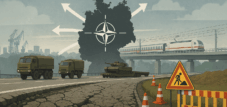
An attack on infrastructure? Why the freight train accident in the Ruhr region should alarm politicians, the military, and the economy – Image: Xpert.Digital
Sabotage on the railways? The Essen freight train accident as a stress test for Germany's infrastructure
Essen narrowly escaped disaster? Metal clamps in the track: 20 tank cars of hazardous material derailed – Germany's rail network as its Achilles' heel
An inconspicuous piece of metal, a derailed train, and the question of national security: Why the incident in Essen is far more than a local operational disruption
It was a Monday evening in Essen that could have ended in disaster. A freight train derailed, loaded with twenty tank cars full of hazardous materials. What initially appeared to be a routine accident on an overloaded rail network quickly developed into a thriller with geopolitical dimensions: Investigators found metal clamps on the tracks that didn't belong there – and just a few hours later, a US military train carrying ammunition was scheduled to pass at that exact spot.
Whether targeted sabotage, political extremism, or a hybrid attack: the incident exposes a raw nerve in the German economy. It demonstrates the fragile nature of an infrastructure that has long been operating at its limits and is simultaneously meant to be the backbone of industry, chemical logistics, and military alliance capability.
At a time when cable fires paralyze rail traffic and security authorities warn of attacks on critical infrastructure, the Essen incident is a wake-up call. It forces us to consider rail freight not only in terms of cost and climate impact, but as a core security policy issue. How resilient is Germany's supply chain really? What economic damage threatens if the railway, the lifeblood of the system, is deliberately targeted? And how will business and politics react to a threat situation in which logistics becomes the front line?
When a "near-chance" becomes an economic risk for an entire country
In Essen, a freight train derailed on a Monday evening; only one axle jumped the tracks, and no one was injured – at first glance, a local railway incident, the kind that can happen on the heavily used network. However, two details make the case significant: The train was carrying twenty tank cars, each with approximately 25 tons of hazardous materials, and just a few hours earlier, a US military train carrying ammunition and equipment was scheduled to pass by at that exact same spot. Investigators found metal clamps on the track that didn't belong there. Police have so far ruled out the possibility that they were placed there accidentally.
Whether the incident will ultimately be considered sabotage from a legal standpoint, or simply an unresolved technical or organizational error, remains to be seen. However, the case is already economically significant. It highlights an Achilles' heel of the German economy: the vulnerability of an overburdened and underinvested rail network, which simultaneously serves as a central hub for industrial production, energy and chemical logistics, international supply chains, and military mobility.
The Essen incident should therefore be viewed less as an isolated “criminal case” and more as a symptom of an increasingly complex risk situation: increasing acts of sabotage against railway infrastructure, geopolitical tensions, a railway system that has been “worn out” over decades, and the politically desired but infrastructurally unsupported expansion of rail freight transport.
The following section provides an economic analysis of this case: What direct and indirect costs do such events generate? What signals does the incident send to industry, logistics, and international partners? And what adjustments are necessary from a macroeconomic perspective when railway lines become not just transport routes, but increasingly strategic objectives?
The underestimated systemic importance of rail freight transport
Rail freight is already a significant component of the German economy in terms of volume. In 2023, railway companies in Germany transported approximately 337 million tons of goods; while this represents a decrease of just over six percent compared to 2022, the absolute scale remains considerable. In ton-kilometers, rail achieved a transport performance of around 125 billion ton-kilometers in 2023, thus accounting for almost one-fifth of total domestic freight transport performance.
In parallel, the network has shrunk over the decades in terms of length, while the load per kilometer has increased. Germany currently has around 39,000 kilometers of public rail network; the DB infrastructure portion alone comprises a good 33,400 kilometers. Since the 1990s, thousands of kilometers of track have been decommissioned on balance, while passenger and freight traffic have increased significantly. The result is bottlenecks: in 2008, only 187 kilometers of the federal rail network were considered overloaded, but by 2025 this figure had risen to over 1,300 kilometers.
From an economic perspective, this means that disruptions at just a few nodes can quickly trigger cascading effects. If a freight line in the Ruhr region – one of Europe's densest industrial and logistics corridors – experiences a temporary outage, it affects not only local traffic but potentially entire value chains in the chemical, steel, energy, automotive, and inland port sectors. Alternative routes are limited due to the high network load, timetables are tight, and construction work further restricts flexibility.
At the same time, policymakers are pursuing ambitious goals: By 2030, the share of rail in freight transport is to increase to at least 25 percent, from the current figure of just under 20 percent. With federal support, the railway is investing billions in a "high-performance network" of over 9,000 kilometers, which is intended to consolidate and upgrade particularly congested corridors by 2030. However, this not only increases the importance of these routes for the economy, but also their attractiveness as targets for politically motivated disruption.
Against this backdrop, the Essen incident is not a marginal issue, but a test case: How resilient is a system whose role in economic and climate policy is supposed to grow, but at the same time is caught in the intersection of extremism, geopolitical conflicts and aging infrastructure?
Dangerous goods and military logistics: When security risks overlap
The combination of hazardous materials transport and potential military traffic, as revealed by the incident in Essen, is particularly sensitive. According to the Federal Railway Authority, approximately 20 percent of the goods transported by rail are hazardous materials; the spectrum ranges from mineral oil and chemical products to gases and other dangerous substances. For years, the volume of hazardous materials transported by rail has been in the tens of billions of ton-kilometers.
While rail is considered a significantly safer mode of transport for hazardous goods compared to trucks – studies quantify the accident risk on the rails as up to 42 times lower than on the roads – from an economic perspective, this is a key argument for shifting to rail: accidents involving hazardous goods are rare, but extremely costly when they do occur. Every step towards a safer mode of transport reduces the expected volume of damage and thus also insurance and external costs.
However, sabotage or deliberate interventions alter the risk structure. While technical defects or human error are relatively easy to identify in probabilistic safety models and can be mitigated through standards, maintenance, and training, intentionally caused disruptions are significantly more difficult to predict. They tend to occur at critical points and combine with other high-risk traffic.
In the Essen incident, the freight train involved was carrying twenty tank cars containing hazardous materials. It came to a relatively minor stop because only one axle of the locomotive derailed while traveling slowly. Had a faster train been involved, perhaps with a more sensitive train composition or on a bridge or tunnel section, the extent of the damage would have been many times greater. Furthermore, the originally intended US military train would have been carrying ammunition and military equipment. A derailment involving explosives or sensitive materials would not only have caused significant property and environmental damage but would also have exacerbated security tensions.
From an economic perspective, three levels are intertwined here:
- Classic industrial and hazardous goods risk management (damage, liability, environment, insurance).
- The security of military logistics, which is also relevant for the credibility of alliance commitments and deterrence capability.
- The perception of international partners, especially the USA and NATO, regarding the reliability of German infrastructure in times of crisis and tension.
A single incident can thus influence, beyond its immediate costs, the assessment of German infrastructure as a reliable backbone of military and economic logistics – with possible consequences for stationing decisions, joint exercises or burden sharing.
Patterns of increasing sabotage: From cable fires to metal clamps
Taken on its own, the Essen case could still be considered an exceptional but isolated incident with an unclear cause. However, it is part of a series of interventions in the railway infrastructure.
As early as 2022, suspected acts of sabotage against Deutsche Bahn's communication cables in northern Germany led to a near-total shutdown of long-distance rail services. The cutting of fiber optic and control cables in signal boxes resulted in the failure of safety and communication systems, leading to widespread delays and train cancellations.
In North Rhine-Westphalia alone, security authorities have registered nine attacks on railway facilities since mid-2025, ranging from cut cables to arson attacks on infrastructure in cities such as Essen, Oberhausen, and Düsseldorf. The North Rhine-Westphalian Interior Minister cited both left-wing extremists and possible Russian influence operations ("pocket money agents") as potential masterminds; in some cases, freight lines or facilities with suspected military connections are specifically targeted.
At the same time, cases of sabotage against railway networks are increasing across Europe, with far-left groups openly referring to the role of the railways as the "backbone of the capitalist system and military infrastructure," for example in letters claiming responsibility after cable fires in Germany. The motives range from anti-war positions (blocking arms transports) to climate-politically motivated sabotage of transport protests and generally anti-systemic goals.
Against this backdrop, it is plausible that investigators in the Essen case categorize the deliberately placed metal clamps at least as a possible act of sabotage. Whether this was due to targeted geopolitical influence, left-wing extremist actions, or simply misconduct in the construction sector remains unclear. Economically, however, the exact group of perpetrators is less important than the overall picture: the railway is perceived as a lever that can generate high media visibility and noticeable disruptions with comparatively little effort.
Direct costs of a single incident – limited, but not trivial
The directly quantifiable costs of the Essen incident are relatively moderate compared to potential disaster scenarios: An axle derails, carriages come to a standstill, infrastructure and vehicles are damaged, lines have to be closed, and tracks have to be inspected and, if necessary, repaired. The railway incurs material and repair costs as well as additional operational costs due to diversions and delays. Shippers may experience delivery delays, contractual penalties, or production disruptions if just-in-time supply chains are interrupted.
In freight transport, margins are tightly calculated; even short-term diversions increase track access charges, energy consumption, and personnel costs. At the same time, opportunity costs arise: In an already congested network, diverted traffic displaces other trains, timetables are disrupted, and punctuality rates decline.
What was narrowly averted carries even greater economic weight. Had one of the hazardous materials tankers been severely damaged, depending on the class of substances involved, it could have led to regional environmental and health hazards, potentially even requiring evacuations. Experience with tanker derailments in other countries shows that damage can run into the millions or even tens of millions of euros if spilled substances contaminate soil and water or cause fires and explosions. The cost categories range from firefighting and disaster relief efforts to infrastructure repairs and soil remediation, as well as protracted liability and insurance claims.
The Essen incident derives its economic significance primarily from the fact that it occurred in a critical zone (Ruhr area, hazardous materials, potential military transport) and that the cause does not fit the pattern of an "ordinary accident." This not only alters the expected damage but also the risk awareness of stakeholders along the value chain.
Hub for Security and Defense - Advice and Information


Hub for Security and Defense - Image: Xpert.Digital
The Security and Defence Hub offers expert advice and up-to-date information to effectively support companies and organizations in strengthening their role in European security and defence policy. Working closely with the SME Connect Defence Working Group, it particularly promotes small and medium-sized enterprises (SMEs) that wish to further develop their innovative capacity and competitiveness in the defence sector. As a central point of contact, the Hub thus creates a crucial bridge between SMEs and European defence strategy.
Related to this:
When the railway becomes the front line: How safe is our economy really?
Indirect costs: damage to trust, risk premiums and location factors
The indirect economic consequences of such events are significantly more difficult to quantify than repair bills – but often more serious in the medium term. Three levels are particularly relevant:
First, the perceived safety and reliability of rail freight influences shippers' choice of transport mode. Federal policy strongly emphasizes shifting goods "from road to rail" to achieve climate and environmental goals. However, if industrial companies and logistics providers increasingly perceive that railway lines are targeted by sabotage or politically motivated actions, they rationally increase safety margins in their planning. This can lead to transports perceived as critical (such as chemicals, high-value goods, and defense logistics) remaining with trucks despite conflicting climate policy objectives. The consequences would be higher external costs (emissions, congestion, accidents) and a slowdown in the desired modal shift.
Secondly, risk premiums in insurance and financing models are changing. When waves of sabotage and critical incidents like the one in Essen increase the statistical expectation of targeted interventions, insurers adjust their premium structures. This can mean higher premiums for certain routes, materials, or types of transport, but also requirements for security measures along the transport chain. For railway companies with already strained business models – rail freight has been struggling with profitability pressures for years – additional insurance and security costs can jeopardize the economic viability of certain services.
Thirdly, the security of transport infrastructure is playing an increasingly important role in location decisions. Germany is positioning itself as Europe's logistics hub and as a reliable corridor for east-west and north-south freight flows. A large-scale disruption of the rail network due to sabotage – such as the collapse of large parts of northern rail traffic in 2022 following a cable cut – has demonstrated how quickly international traffic can be disrupted. If such incidents become more frequent or are not effectively prevented, this could weaken the long-term attractiveness of German corridors compared to alternative routes (such as via seaports in other countries or other land corridors).
The Essen incident is therefore less significant because of the actual extent of the damage, but rather because of the signal it sends: even centrally located, core industrial routes are vulnerable not only technically, but also in terms of security policy. At a time when Germany is vying for investment in energy-intensive industries, battery factories, and military logistics sites, this is a factor that should not be underestimated.
Hybrid conflicts and extremism: When logistics becomes the front line
The political dimension of such incidents cannot be separated from the economic one. Since the Russian attack on Ukraine, NATO and the EU have repeatedly warned of attacks on critical infrastructure, from the energy sector and data cables to transportation infrastructure. Within this context, the railway is an obvious target: it handles massive amounts of civilian and military traffic, its facilities extend across the entire territory, and many hubs are relatively easily accessible.
In past discussions surrounding acts of sabotage, various perpetrator profiles have been debated: left-wing extremist groups who view railways and logistics as the "backbone of capitalism" or as part of "war infrastructure" and want to disrupt arms shipments; right-wing actors who aim to destabilize and sow discord; and foreign actors who want to create significant disruption with limited resources. In the context of several incidents, the Interior Minister of North Rhine-Westphalia introduced the hypothesis of "Russian pocket money agents"—that is, locally recruited individuals paid for minor acts of sabotage.
Regardless of the specific perpetrator(s) in the Essen case – which remains unclear at the time of analysis – this shifts the railway's risk profile. From an economic perspective, it is relevant that not only abstract "disruptions" are a threat, but also intentionally distributed attacks that go beyond traditional security architectures. While prevention strategies in the technical field are highly centralized and standardized (maintenance, certifications, standards), the prevention and detection of sabotage require more decentralized, police/intelligence, and societal approaches.
Economically, this means that some security costs are shifting from the business logic of railway companies to the sphere of internal and external security. At the same time, coordination costs arise: railway companies, the Federal Police, the Federal Office for the Protection of the Constitution, the military, and regional security authorities must share information, coordinate early warning systems, and integrate measures. These additional governance and coordination costs are difficult to quantify in euros, but they are real and increase with every security-relevant incident.
Possible development paths: From individual case to structural burden
The future economic consequences of the Essen incident depend significantly on which scenario it falls into.
In the most optimistic scenario, it turns out that the metal clamps are the result of negligence or an error related to the construction work, coupled with a failure of control mechanisms. In this scenario, it is certainly a serious warning sign, but primarily a matter for quality assurance, construction supervision, and internal control systems. The consequences would be stricter requirements for site dismantling, additional inspections, and potentially liability issues between the railway, construction companies, and regulatory authorities.
In a second scenario, the incident exemplifies a growing series of "low-level" acts of sabotage, primarily perpetrated by domestic extremists with mixed motives: anti-war protests, anti-capitalism, and radical transportation reform. In this scenario, the economy would face regularly recurring, regionally limited disruptions—similar to cable fires, but with a potentially higher risk if hazardous materials or military logistics are also affected. The cost structure would change due to increased investment in surveillance, securing particularly sensitive sections, and more efficient disruption management.
The most pessimistic scenario would be to classify this as part of a hybrid conflict in which foreign actors are systematically attempting to undermine the functionality of the German rail network. In this case, not only would individual routes need to be better secured, but fundamental redundancy and resilience concepts would also need to be reconsidered. This could, in some respects, have parallels to the discussions following the Nord Stream sabotage: targeted diversification of corridors, protection of particularly critical nodes, and increased cooperation with NATO partners.
For all scenarios, the earlier and more clearly the causes are identified and communicated, the better the economic consequences can be limited. Uncertainty creates room for speculation, unsettles shippers, citizens, and international partners – and ultimately increases the implicit risk premiums that economic actors factor into their decisions.
Strategic response: How politics, railways and business can increase resilience
From an economic perspective, the key lies in a dual strategy: firstly, increasing the technical and organizational resilience of the rail system, and secondly, credibly communicating this resilience to market participants.
On a technical level, these incidents argue for a more risk-based approach to infrastructure security. While it's impossible to monitor every route completely, particularly critical sections – such as junctions in the Ruhr region, main lines with a high density of hazardous materials, and militarily relevant routes – can be prioritized and equipped with additional sensors, cameras, drone surveillance, or train tracking systems. Digital monitoring of track integrity, which could detect anomalies (e.g., unplanned track extensions), would also be a valuable component.
Financially, this initially means higher investment and operating costs. However, substantial public funds are already flowing into the modernization of the rail network: by 2030, an additional 30 billion euros are to be invested in the network, particularly in the planned high-speed rail network. It therefore makes sense to systematically integrate safety and resilience components into these programs from the outset, rather than adding them retroactively in individual measures.
At an organizational level, closer cooperation between railway companies, infrastructure operators, the Federal Police, the Federal Office for the Protection of the Constitution, and, where applicable, military authorities is required. For transport requiring special protection – such as military transports or certain hazardous materials routes – tiered security concepts could be developed, encompassing aspects such as route selection, travel times, speeds, escorts, and temporary security measures along the route.
Ultimately, the shippers' perspective is crucial. If industry and the logistics sector perceive that the railway systematically addresses and transparently communicates safety requirements, the need to unduly increase individual precautionary costs (e.g., in the form of redundant warehousing or alternative road transport) decreases. Transparent, data-driven communication regarding disruptions, root cause analysis, and implemented countermeasures can help to strengthen trust.
The Essen case as an economic wake-up call
The Essen freight train accident, in a strictly technical sense, was a fortunate event: no injuries, no hazardous materials released, and manageable local damage. However, from a broader economic and security policy perspective, it serves as a wake-up call.
It demonstrates how closely the German economy operates with potentially systemically relevant disruptions caused by targeted interventions in its infrastructure. A network that has shrunk in recent decades while simultaneously becoming increasingly strained, the growing role of rail in climate policy and freight logistics, increasing international tensions, and a noticeable rise in acts of sabotage combine to form a complex of risks that can no longer be treated as a mere footnote.
Economically, this is not just about the financial losses from individual incidents, but about the stability of expectations: companies, investors, citizens, and international partners must be able to trust that the central transport infrastructure will remain robust even under stress. If this fails, hidden costs increase in the form of risk premiums, alternative decisions, and lost competitive advantages.
Precisely because the Essen incident had a relatively mild outcome, it offers an opportunity to draw structural lessons without the immediate pressure of a disaster: adapting safety architectures, integrating resilience into investment programs, and rebalancing governance between the railway, the state, and the private sector. If this signal is ignored and treated merely as a criminal curiosity, the likelihood increases that the next incident will be significantly more costly, not only economically, but also in terms of human and political consequences.
Consulting - Planning - Implementation

Markus Becker
I would be happy to serve as your personal advisor.
Head of Business Development
Chairman SME Connect Defense Working Group
Consulting - Planning - Implementation
Konrad Wolfenstein
I would be happy to serve as your personal advisor.
You can contact me at wolfenstein∂xpert.digital or
Just call me on +49 7348 4088 965 .
Your dual-use logistics experts
Dual-use logistics experts - Image: Xpert.Digital
The global economy is currently undergoing a fundamental transformation, a watershed moment that is shaking the foundations of global logistics. The era of hyper-globalization, characterized by the relentless pursuit of maximum efficiency and the "just-in-time" principle, is giving way to a new reality. This new reality is marked by profound structural breaks, geopolitical power shifts, and increasing fragmentation of economic policy. The once taken-for-granted predictability of international markets and supply chains is dissolving and being replaced by a period of growing uncertainty.
Related to this:
Our EU and German expertise in business development, sales and marketing

Our EU and German expertise in business development, sales and marketing - Image: Xpert.Digital
Industry focus areas: B2B, digitalization (from AI to XR), mechanical engineering, logistics, renewable energies and industry
More information here:
A thematic hub offering insights and expertise:
- Knowledge platform covering global and regional economies, innovation and industry-specific trends
- A collection of analyses, insights, and background information from our key areas of focus
- A place for expertise and information on current developments in business and technology
- A hub for companies seeking information on markets, digitalization, and industry innovations