Artificial Intelligence – Learning and Problem Solving – @istockphot | PhonlamaiPhoto
Artificial intelligence – smart business thanks to big data
There are many indications that 2018 will be the year in which artificial intelligence (AI) finally receives the attention it deserves in business and society. It is already clear that the technology will disrupt entire industries and systems – including sectors that are not even remotely anticipating it. The opportunities offered by AI are revolutionary.
Many discuss it, but few truly understand what AI is and what impact it will have on us. Bill Gates, Microsoft founder and IT visionary, predicts an AI revolution within the next 20 years that will completely transform the job market. Tasks currently performed by humans could then be taken over by robots or software systems. Transportation logistics with its self-driving trucks or taxis autonomously navigating the city are just one example among many.
One of the pioneers in this development was IBM with its Watson. Originally designed for speech recognition, the system is now successfully used by countless users worldwide for communication, analysis, and diagnostics. Meanwhile, numerous small startups as well as the big players from Silicon Valley are working intensively on AI development. But AI is not only being driven forward by companies like IBM and Google. OpenAI, a non-profit organization supported by Elon Musk (Tesla, SpaceX) and endowed with a billion dollars in donations, aims to research artificial intelligence. The goal is to develop an open-source AI to grant everyone access to the technology and allow society as a whole to benefit.
AI – the big data technology
People often jump to conclusions about Big Data, even when it's not applicable in specific cases. AI, however, truly is a technology that devours gigantic amounts of data. Due to the sheer endless amount of available information, high-performance software systems are essential for a smooth workflow.
The operating principle of AI
- All information and current states are recorded in the AI database.
- Integrated filters provide extremely fast access to unimaginable amounts of real-time information.
- These are categorized according to their own (programmed) criteria.
- Information is no longer recognized and analyzed based on its content, but rather on its patterns.
- Based on the data, AI organizes responses and decides on actions.
- The more new data is fed in, the more the system "learns" (deep learning).
AI increases business productivity
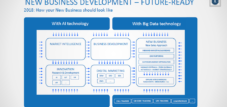
Currently, even in automated production systems, processes are still relatively rigidly defined despite the extensive use of software. While the number of autonomously operating devices in manufacturing is constantly increasing, the use of AI could revolutionize the entire process chain. This is essential, as the ever-growing e-commerce sector, among other things, demands increasingly flexible and faster systems to meet growing challenges. But AI promises groundbreaking changes not only in industry. Artificial intelligence will also set new standards in the digital services sector. The principle of intelligent data analysis is ideally suited for business intelligence in companies. The software can access a large pool of internal and external data, for example, via Google or from provided databases. With such advanced capabilities, Business Intelligence@AI is perfectly suited for:
- Market and competitive analyses
- Online Marketing Optimization
Anyone who thinks this technological revolution is solely driven by California is mistaken. Germany also has innovative IT service providers developing AI-based marketing solutions for clients.


It's no wonder, then, that the system can make extremely precise predictions for improvements in online marketing. For example, by analyzing users' online activity, it can predict the ideal content and timing for its clients' social media posts. The software also knows the answer to the question of optimal target group filtering across various channels. With these capabilities, the AI takes over a function that agencies currently charge their clients dearly for – another industry that risks disappearing from the market due to AI if it doesn't adapt.
Keep in touch