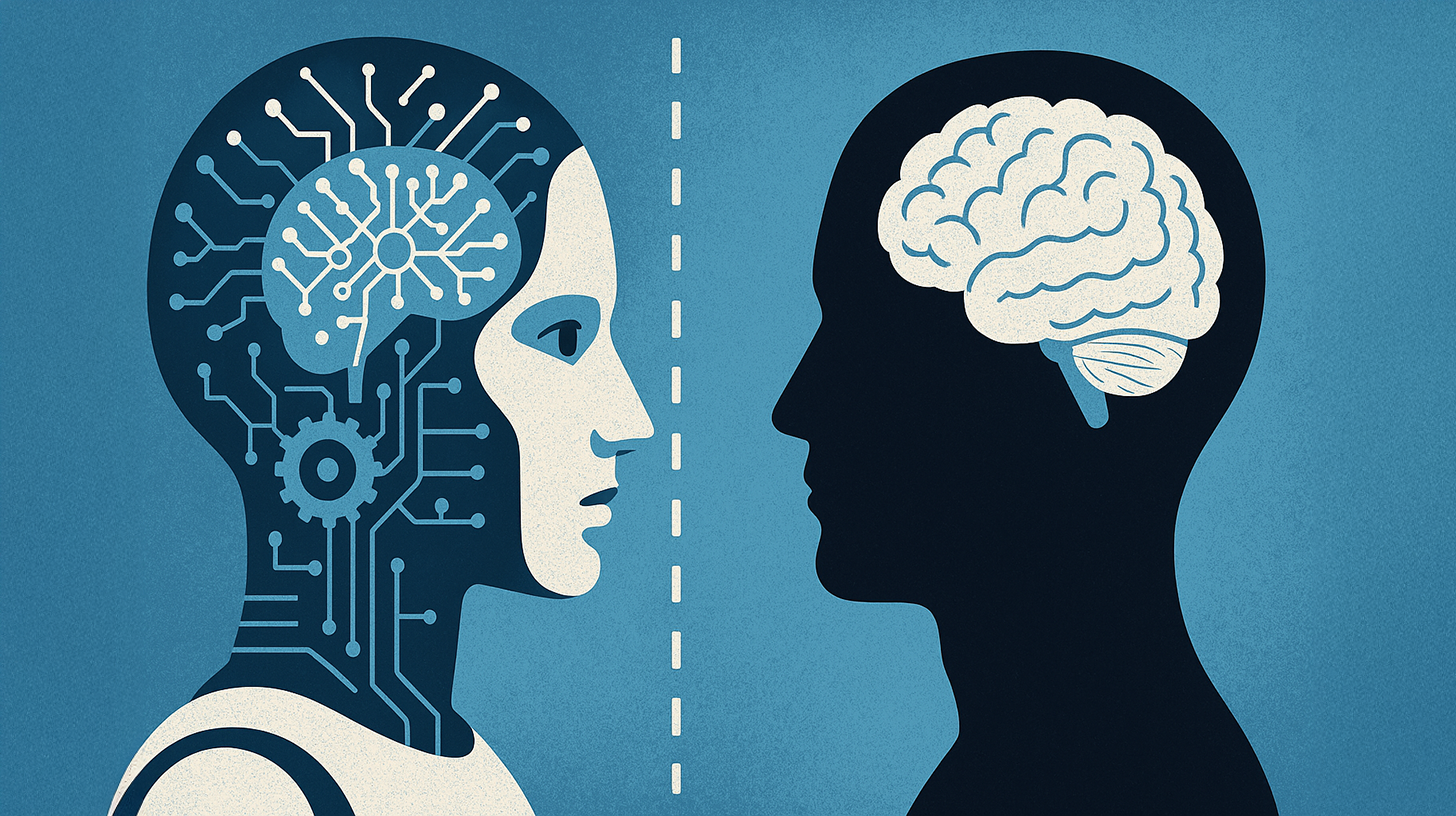
Why artificial intelligence models cannot have consciousness – Image: Xpert.Digital
Why AI models cannot develop consciousness – Mathematical processing instead of subjective experience
The basic architecture of Transformer models
Current artificial intelligence systems, especially large language models like GPT and ChatGPT, are based on the so-called Transformer architecture. This is a specialized form of mathematical data processing developed by researchers at Google in 2017. This architecture operates entirely on the basis of numerical calculations and statistical patterns, without developing a deeper understanding of the processed content.
A transformer model consists of stacked encoder and decoder layers that work together to process input data. The encoder transforms the input data into mathematical representations, while the decoder converts this information into the desired output. Both components use complex mathematical operations such as matrix multiplications and nonlinear activation functions to perform their tasks.
How self-attention mechanisms work
The core of the Transformer architecture is the Self-Attention Mechanism. This allows the model to weight different parts of an input sequence differently. The mechanism calculates scalar products between vectors to model dependency structures within a sequence. However, these weights are purely numerical coefficients that capture statistical regularities in the training data.
The term "attention" in this context is purely metaphorical. It does not refer to conscious attention in the human sense, but rather to mathematical calculations that determine which parts of the input should be given greater weight when generating the output. These calculations follow deterministic rules and are based on learned weight matrices.
Token processing and embedding spaces
The processing begins with the conversion of text into so-called tokens, which function as numerical units. These tokens are then embedded in high-dimensional vector spaces called embeddings. An embedding is a mathematical representation that depicts each word or text segment as a point in a multidimensional space.
The position of a token in this embedding space is determined by optimization processes aimed at improving the model's predictive accuracy. Proximity in the embedding space reflects statistical similarities in the training corpus, but not semantic meanings in the strict sense. These embeddings are simply coordinates in a mathematical space whose values are optimized through machine learning.
The mathematical foundations of AI processing
Parameters and optimization
Modern language models contain billions of parameters. These parameters are numerical values that are fitted using gradient descent to minimize a loss function. Gradient descent is a mathematical optimization technique that systematically changes the parameters of a model to improve its performance.
The process works similarly to hiking in a mountain in dense fog. The model gradually approaches the optimal point by calculating the slope of the loss function and moving in the opposite direction. These parameters serve solely as optimization coefficients for mathematical functions and have no conscious meaning or intention.
Reinforcement learning from human feedback
A key development in AI technology is Reinforcement Learning from Human Feedback. This method translates human preferences into numerical reward signals. The model adjusts its parameters to increase the probability of expenditures that are rated as preferential by humans.
RLHF typically comprises three steps: First, the model is pre-trained using supervised learning. Next, human feedback is gathered to train a reward model. Finally, the original model is optimized using reinforcement learning to maximize the preferences predicted by the reward model. This entire process is purely mathematical and involves no conscious decision-making.
Softmax transformation and probability distributions
At the end of the processing, the softmax function transforms raw values into probability distributions. The mathematical formula for the softmax function is: Softmax(x_i) = e^(x_i) / Σ(e^(x_j)). This function converts a vector of numerical values into a vector of probabilities whose sum equals one.
The next token is selected by drawing a sample from this probability distribution or by using an Argmax method. This Argmax method is a purely statistical rule without conscious decision-making. The Softmax function merely allows the model to present its outputs in an interpretable form, without any conscious thought or understanding playing a role.
The philosophical problem of consciousness
Definition and properties of consciousness
Consciousness encompasses all states experienced by an individual. It includes both the totality of experiences and conscious awareness as a particular kind of immediate perception of these experiences. Philosophers and neuroscientists distinguish various aspects of consciousness, with phenomenal consciousness and access consciousness being of particular importance.
Phenomenal consciousness refers to the subjective experiential quality of mental states. It is what constitutes being in a particular mental state—the way something feels to the experiencing subject. These subjective experiential qualities are called qualia and are directly accessible only to the perceiving subject.
Intentionality as a characteristic of the mental
Intentionality refers to the capacity of mental states to refer to something. Franz Brentano introduced this concept into modern philosophy and considered it a characteristic feature of the mental. Intentionality is the directed property of consciousness—the fact that consciousness is always consciousness of something.
Intentional states have content, regardless of whether their object exists. A person can hold beliefs about non-existent objects or harbor desires for unattainable goals. This property distinguishes mental phenomena from purely physical processes, which follow exclusively causal laws.
The Hard Problem of Consciousness
David Chalmers formulated the “hard problem of consciousness” as the question of why and how physical processes in the brain lead to subjective experience. This problem differs categorically from the “easy problems” of consciousness research, which concern functional aspects such as discrimination, information integration, and behavioral control.
The difficult problem lies in explaining why the execution of these functions is accompanied by experience. Even if all relevant functional facts are explained, the further question remains: Why is the execution of these functions linked to experience? This question seems to defy a mechanistic or behavior-based explanation.
Neuroscientific findings on consciousness
Neural correlates of consciousness
Neuroscience seeks the neural correlates of consciousness, or NCCs. These are defined as the smallest unit of neural events sufficient for a given conscious perception. NCCs are neural activities, states, or subsystems that are directly associated with consciousness.
Researchers like Wolf Singer and Andreas Engel have demonstrated that temporally synchronized discharges of neural networks exist in the animal and human brain. This temporal correlation could be crucial for the emergence of consciousness. The hypothesis is based on the assumption that mechanisms of temporal synchronization are involved in four brain functions: awareness, integration of sensory perception, selection of attention, and working memory.
Biological basis of conscious processes
Consciousness is dependent on an adequate supply of oxygen and glucose to the cerebral cortex, as well as on sufficiently strong activation of neurons in the associative cortex. These biological prerequisites demonstrate that consciousness is not merely an abstract property, but has concrete physical foundations.
The cerebellum contains three times as many neurons as the cerebral cortex, yet even in cases of severe damage, consciousness is largely preserved. This suggests that it is not the sheer number of neurons that is crucial, but rather their specific organization and connectivity in particular brain regions.
A new dimension of digital transformation with 'Managed AI' (Artificial Intelligence) - Platform & B2B solution | Xpert Consulting


A new dimension of digital transformation with 'Managed AI' (Artificial Intelligence) – Platform & B2B solution | Xpert Consulting - Image: Xpert.Digital
Here you will learn how your company can implement customized AI solutions quickly, securely and without high entry barriers.
A managed AI platform is your all-inclusive, worry-free solution for artificial intelligence. Instead of dealing with complex technology, expensive infrastructure, and lengthy development processes, you receive a ready-made solution tailored to your needs from a specialized partner – often within just a few days.
The key advantages at a glance:
⚡ Rapid implementation: From idea to ready-to-use application in days, not months. We deliver practical solutions that create immediate added value.
🔒 Maximum data security: Your sensitive data stays with you. We guarantee secure and compliant processing without sharing data with third parties.
💸 No financial risk: You only pay for results. High upfront investments in hardware, software, or personnel are completely eliminated.
🎯 Focus on your core business: Concentrate on what you do best. We take care of the entire technical implementation, operation, and maintenance of your AI solution.
📈 Future-proof & scalable: Your AI grows with you. We ensure continuous optimization and scalability, and flexibly adapt the models to new requirements.
More information here:
The hidden limits of artificial intelligence
Why AI models cannot develop consciousness
Lack of intentionality and meaning
AI models process symbols and vectors without developing any internal meaning. They manipulate token IDs and numerical structures, not meanings as lived content. This symbolic processing is purely syntactic, without any semantic understanding of the manipulated symbols.
John Searle's Chinese Room Argument illustrates this problem. In this thought experiment, a person follows rules for manipulating Chinese symbols without understanding Chinese. Although the responses appear logical to native Chinese speakers, neither the person nor the system as a whole understands the meaning of the characters. Computers execute programs similarly—they apply syntactic rules without possessing semantic understanding.
Absence of a first-person perspective
AI systems operate without a self-model or phenomenal internal view. There is no self-reference, as no first-person perspective exists. Consciousness, however, is essentially characterized by the existence of a subjective perspective—a “This is just how it is, this system.”.
Thomas Nagel's famous essay "What Is It Like to Be a Bat?" emphasizes this characteristic of consciousness. Consciousness necessarily includes a subjective dimension of experience that cannot be fully described from the outside. AI systems lack such a subjective internal perspective—they process information without creating an experiencing subject.
Mechanistic information processing instead of conscious experience
Reward signals in AI systems are scalars, not sensations. The models react to numerical feedback values without experiencing them as positive or negative. These signals merely control parameter adjustments during the learning process but do not generate subjective sensations of pleasure or pain.
All processing in AI systems is based on mathematical optimization, statistical pattern recognition, and probability calculation. More parameters, higher complexity, or multimodality do not change this principle. Statistical calculation, regardless of its complexity, does not create consciousness.
Multimodal models and extended complexity
Processing different data types
Multimodal models that process text, images, or audio combine different input streams into common representational spaces. This capability significantly increases the complexity of pattern recognition and enables the systems to grasp relationships between different modalities.
The integration of different data types is achieved through specialized encoders that transform each modality into a common vector space. Text is processed through tokenization and embedding techniques, images are converted into feature vectors using convolutional neural networks, and audio data is transformed into numerical representations through spectrogram analysis.
Limits of increasing complexity
Despite the impressive capabilities of multimodal systems, the fundamental processing remains a mapping between data representations. The systems learn statistical correlations between different input modalities, but do not develop a conceptual understanding of the relationships between these modalities.
The increased number of parameters and processing capacity leads to more precise pattern recognition and more coherent outputs, but does not change the fundamental nature of information processing. Even the most complex multimodal systems operate exclusively at the level of statistical correlations and mathematical transformations.
Current research and theoretical approaches
Consciousness indicators in AI research
Scientists have developed various indicators for possible consciousness in AI systems, based on neuroscientific theories of consciousness. These include aspects such as recurrent processing, global workspace dynamics, and attentional schema mechanisms.
Global Workspace Theory posits that conscious information is made available in a central workspace, from where it is accessible to various cognitive processes. Recurrent processing theories emphasize the importance of feedback loops between different brain regions for the emergence of conscious experience.
Philosophical objections and limitations
Despite these theoretical approaches, fundamental philosophical objections to the possibility of machine consciousness persist. The Chinese Room argument demonstrates that syntactic manipulation is insufficient for semantic understanding. Even if a system exhibits all the outward signs of intelligence, this does not necessarily mean that it is conscious.
The concept of conscious supremacy, analogous to quantum supremacy, identifies computations that may be unique to consciousness. These include flexible attentional modulation, robust handling of novel contexts, and embodied cognition—aspects that go beyond mere information processing.
Embodiment and situated cognition
The importance of embodiment
Consciousness may not be separable from physical embodiment. Embodied cognition theories argue that cognitive processes are fundamentally shaped by physical interaction with the environment. The body is not merely a passive container for the brain, but actively participates in cognitive processes.
Human consciousness develops through continuous interaction with the physical and social environment. These interactions shape neural structures and create the foundation for conscious experience. AI systems, which primarily operate as disembodied information processing systems, lack this fundamental dimension.
Temporality and continuous experience
Consciousness is a temporally extended phenomenon characterized by continuous streams of experience. People do not just experience individual moments, but a coherent narrative structure of their consciousness over time.
AI systems process discrete inputs and generate discrete outputs without developing a continuous experience of awareness. Each interaction is essentially independent of previous interactions for the system, even though statistical contextual information is stored.
AI Development: Between Technological Intelligence and the Philosophical Limits of Consciousness
Possible developments in AI technology
AI research is developing rapidly, with increasingly powerful models and new architectures. Future systems could simulate biological processes even more accurately and potentially develop properties that appear more like consciousness.
Developments in neuromorphic computers, which mimic biological neural networks, could open up new possibilities. The integration of AI systems into robotic bodies could also give greater consideration to embodied cognition aspects.
Machine intelligence vs. consciousness: A philosophical tightrope walk
The question of machine consciousness has significant ethical implications. If AI systems could become conscious, we would have to reconsider their moral rights and our responsibilities towards them.
Currently, all available evidence suggests that present-day AI systems do not possess consciousness. They are highly sophisticated tools for information processing and pattern recognition, but not conscious entities. This assessment could change with future technological developments, but requires fundamental breakthroughs in our understanding of the relationship between physical processes and conscious experience.
The distinction between intelligent behavior and conscious experience remains one of the greatest challenges in AI research and the philosophy of consciousness. While AI systems increasingly exhibit intelligent behaviors, they lack the fundamental properties of conscious experience: intentionality, phenomenal awareness, and a subjective first-person perspective.
EU/DE Data Security | Integration of an independent and cross-data-source AI platform for all business needs

Independent AI platforms as a strategic alternative for European companies - Image: Xpert.Digital
AI Game Changer: The most flexible AI platform - Tailor-made solutions that reduce costs, improve your decisions and increase efficiency
Independent AI platform: Integrates all relevant company data sources
- Rapid AI integration: Tailor-made AI solutions for businesses in hours or days, instead of months
- Flexible infrastructure: Cloud-based or hosting in your own data center (Germany, Europe, free choice of location)
- Maximum data security: its use in law firms is irrefutable proof
- Deployment across a wide variety of enterprise data sources
- Choice of own or different AI models (DE, EU, USA, CN)
More information here:
We are here for you - Consulting - Planning - Implementation - Project Management
☑️ SME support in strategy, consulting, planning and implementation
☑️ Creation or realignment of the AI strategy
☑️ Pioneer Business Development

Konrad Wolfenstein
I would be happy to serve as your personal advisor.
You can contact me by filling out the contact form below or simply call me on +49 7348 4088 965 .
I'm looking forward to our joint project.
Write to me



Xpert.Digital - Konrad Wolfenstein
Xpert.Digital is a hub for industry focusing on digitalization, mechanical engineering, logistics/intralogistics and photovoltaics.
With our 360° Business Development solution, we support renowned companies from new business to after-sales.
Market intelligence, smarketing, marketing automation, content development, PR, mail campaigns, personalized social media and lead nurturing are part of our digital tools.
You can find more information at: www.xpert.digital - www.xpert.solar - www.xpert.plus
Keep in touch